Duck, duck, goal: bird dressed in Mexico’s World Cup jersey scores on social media | World Cup 2026 | The Guardian

Keyword – Football
Trefwoorden – World Cup 2026, US news, Mexico, World Cup, Football, Social media, Sport
Title – Duck, duck, goal: bird dressed in Mexico’s World Cup jersey scores on social media | World Cup 2026 | The Guardian
Author – Associated Press
Link – Duck, duck, goal: bird dressed in Mexico’s World Cup jersey scores on social media | World Cup 2026 | The Guardian
Publish date – 2026-06-15T22:13:31.000Z
Category – Sport
URL – https://www.theguardian.com/football/2026/jun/15/duck-wearing-mexico-world-cup-jersey-viral

Julián Quiñones and Raúl Jiménez may have scored the goals, but a duck stole the show.

As Mexico celebrated its World Cup-opening victory over South Africa on Thursday, Merlin, a two-year-old duck dressed in the national team’s colors, became an unlikely internet sensation and the tournament’s first unofficial mascot.

Images of Merlin parading through Mexico City, wearing a Mexican national team jersey – and socks – as thousands of fans celebrated, quickly went viral, racking up millions of views across social media. Overnight, and as if by the magic of the famous wizard who inspired his name, Merlin had captivated the internet.

“We want to see Merlin in the stadium,” one user wrote. “This duck is already a national treasure,” said another. “The best thing about the World Cup so far,” declared a third.

In Mexico City, however, Merlin was already something of a local celebrity.

A familiar sight at fairs and events in the historic city center, the duck regularly accompanies his owner, Carla Gómez, who sells water and soft drinks from a little cart each weekend. Along the way, the animal attracts plenty of delighted squeals, affectionate greetings and eager requests from passersby for a photo together.

“We don’t like to leave him alone at home; we like him to be with us. He’s our baby,” Gómez said. “He’s the baby, the sole heir to all my possessions and now an idol.”

Rain or shine, Merlin follows Gómez and her young son Cristian through some of the capital’s best-known landmarks, including Alameda Central, the Palace of Fine Arts and the Zócalo square. The duck shares a particularly close bond with Cristian, for whom he was originally a gift, becoming what Gómez describes as the boy’s inseparable companion.

“Merlin had already become famous for selling bottled water,” Gómez said, recalling her surprise at her pet’s sudden rise to fame.

“He is always with us; we never imagined he’d become such a sensation,” she added. “We weren’t expecting it.”

Now, the family hopes Mexico’s famous feathered supporter can continue bringing luck to the host nation, which is staging the World Cup for the third time after hosting the tournament in 1970 and 1986 – this time a co-host alongside Canada and the United States.

“Mexico, we are with you,” Gómez said. “And Merlin is your No 1 fan.”

I’ve found a way to get free ferries to France – and I can’t believe my luck | Zoe Williams | The Guardian

Keyword – Opinion
Trefwoorden – Ferry travel, Wine, Food, Travel, France, Europe, Day trips
Title – I’ve found a way to get free ferries to France – and I can’t believe my luck | Zoe Williams | The Guardian
Author – https://www.theguardian.com/profile/zoewilliams
Link – I’ve found a way to get free ferries to France – and I can’t believe my luck | Zoe Williams | The Guardian
Publish date – 2026-06-16T10:00:08.000Z
Category – Opinion
URL – https://www.theguardian.com/commentisfree/2026/jun/16/free-ferries-france-dunkirk

I n February, my sister and I took the ferry from Dover to Dunkirk. On the way back, I noticed there was a deal: spend €150 (£130) in duty free and get a free day-trip ticket. If you love Toblerone and know anyone who smokes, you can spend that without even blinking – and so it came to pass that I was back on the ferry within a month.

This was when I started to perfect the art of the day trip, even though I didn’t yet realise this would be the beginning of a beautiful loop. You arrive and go to the coast, which looks like Saint-Tropez when the sun is out, because even though Dunkirk is not a famous holiday destination, it is still France . Then you go to Carrefour and spend ages saying: “How is this fizzy wine €4.68? I wonder if it’ll be nice. Only one way to find out – buy 24 bottles of it.” You get back on the boat to return to Britain, which is where things get weird, because the offer is still on. Well, I still love Toblerone and I still know someone who smokes.

So I was ready for another day trip, but I’d lost my receipt from the last one. Getting ready to chalk the whole thing up to experience and never see France again, I explained myself to the ferry company and they gave me another day trip. I can’t tell you the name of the company, unfortunately, because if we all start doing it they may get rattled and pull the offer.

On the third trip, it dawned on me that I could work on the crossing, which is two hours each way. Factoring in the way being at sea sharpens concentration, this is effectively a day’s work, a holiday and an exercise in hedonic thrift, all in a lot less than 24 hours.

So now I have urgent business back in France. I need to get more crémant – it tasted like champagne , FYI – in time for my divorce barrister’s wedding. There are people who want to come in convoy; their trip won’t be free, of course, but their next one will be. I don’t know anyone who doesn’t love Toblerone. I feel as if I’ve turned the port into a magic portal.

Zoe Williams is a Guardian columnist

Vance says details of US-Iran agreement still to be worked out amid scepticism from Republicans | US-Israel war on Iran | The Guardian

Keyword – World news
Trefwoorden – US-Israel war on Iran, Iran, US foreign policy, Trump administration, JD Vance, Donald Trump, Middle East and north Africa, US politics, Republicans
Title – Vance says details of US-Iran agreement still to be worked out amid scepticism from Republicans | US-Israel war on Iran | The Guardian
Author – Guardian staff and agencies
Link – Vance says details of US-Iran agreement still to be worked out amid scepticism from Republicans | US-Israel war on Iran | The Guardian
Publish date – 2026-06-16T04:52:54.000Z
Category – News
URL – https://www.theguardian.com/world/2026/jun/16/jd-vance-details-us-iran-agreement-scepticism-republicans

The US vice-president, ⁠JD Vance, has said a number of issues still need to be figured out with Iran, as many Republicans expressed scepticism of the agreement reached this week by Donald Trump , and pressed the White House to release more information about it.

The memorandum of understanding (MOU) announced Sunday to end the war in Iran, set for a ceremonial signing on Friday in Geneva, is centred around reopening the strait of Hormuz and lifting the United States’ naval blockade in the region, along with financial incentives for Iran if it meets certain benchmarks.

In an interview with CNN on Monday, Vance called it “a very general document” with specifics ⁠of the ​deal ‌to be ‌worked out during further ‌negotiations.

“The MOU … is about a page,” Vance ​said. “On a number of ​issues, ​we are ​going to ​have ‌to figure ​this ​stuff out during the technical negotiation phase.”

His comments came as many Senate Republicans who returned to Washington on Monday said there were still many unanswered questions about the deal and they need thorough briefings before it was finalised.

“I just don’t know enough about it,” Republican John Thune told reporters in the Capitol. “Even the people who follow this stuff closely up here don’t know that much about it.”

Congressional leaders and intelligence committees generally receive higher-level intelligence briefings before rank-and-file members, and they are notified of major developments before they are announced. But Thune, who is the Senate majority leader, said he had not been personally briefed on the deal.

“I think that my understanding of what it entails – and, again, not having seen anything … I think the issues are going to be compliance, and how are you going to enforce that,” Thune said.

Thune’s concerns were echoed by several other Republican senators.

“If it’s a secret deal then how can I take it seriously?” asked Thom Tillis of North Carolina.

Trump has not yet explained how his agreement will address Iran’s nuclear program , including who will be in charge of verifying that Iran is in compliance and who will destroy or remove highly enriched uranium believed to be buried under nuclear sites that were badly damaged by US strikes last summer.

The memorandum of understanding also includes the possibility of releasing Iran’s frozen funds, sanctions relief and a $300bn fund to help rebuild Iran if Tehran meets certain benchmarks, US officials told reporters on Monday. But the document has not been released.

Thune said he wants to know more about the conditions on the financial incentives for Iran. He said the deal would be a “good one” if the incentives are conditioned upon Iran winding down its nuclear program and getting rid of the enriched uranium, “preventing them from having a nuclear capability in the future”.

In interviews on Monday, Vance appeared to confirm that the $300bn reconstruction fund was in the agreement, but noted that it would be paid for by neighbouring Gulf states.

Vance said that the White House would release the text this week, “and what everybody will see is that Iran doesn’t get a dime of money unless they perform their obligations”.

Iran agreed to sharply curtail its nuclear program in a deal signed in 2015 with the Obama administration. Trump withdrew the US from that accord during his first term as president. That agreement allowed Iran to regain billions of dollars in frozen assets, which Trump has frequently derided as sending “pallets of cash” to Iran.

Senator Lindsey Graham, a close ally of Trump and a longtime hawk on Iran, expressed scepticism over the emerging agreement, saying he wants to see the memorandum that the two countries have agreed on, and Congress will need to review and vote on it.

“The way Iran describes it, it’s awful. The way we describe it, it makes sense to me,” Graham said. “Let’s look at it and see what it actually is.”

Vance responded to Graham on Monday, saying in an interview with ABC that he would “caution Lindsey Graham and anybody else not to believe the hardliner propaganda in Iran, but to believe what’s actually in the agreement.”

With the Associated Press

‘I’m not a model’ Uruguay’s Bielsa defends bizarre World Cup portrait | Marcelo Bielsa | The Guardian

Keyword – Football
Trefwoorden – Marcelo Bielsa, World Cup 2026, Uruguay, World Cup, Sport, Football
Title – ‘I’m not a model’ Uruguay’s Bielsa defends bizarre World Cup portrait | Marcelo Bielsa | The Guardian
Author – https://www.theguardian.com/profile/jonny-weeks
Link – ‘I’m not a model’ Uruguay’s Bielsa defends bizarre World Cup portrait | Marcelo Bielsa | The Guardian
Publish date – 2026-06-16T10:08:21.000Z
Category – Sport
URL – https://www.theguardian.com/football/2026/jun/16/marcelo-bielsa-photoshoot-uruguay-world-cup-2026

The Uruguay head coach, Marcelo Bielsa, has lived up to his maverick reputation by refusing to cooperate during a photoshoot for Fifa. Bielsa stared down at the floor, hands in pockets, statuesque, during the obligatory media duty last Wednesday and the 70-year-old hit back when asked about the incident after Uruguay’s 1-1 draw with Saudi Arabia on Monday.

“I’m not a model,” he said. “I don’t have to give any explanation, the picture was taken the way it was taken. Should I also explain why I don’t look to the people who are speaking to me at this moment?”

Bielsa’s continued his rant even when reporters moved on from the topic: “There is a limit in terms of what we need to explain. If I’m wearing glasses, why am I wearing glasses? You look somebody in the eye, why do you do that? There is nothing wrong about wearing glasses or looking into somebody’s eyes or looking down.”

The Getty photographers, Michael Regan and Molly Darlington, shot portraits of the Uruguay team in Cancún, Mexico, on 10 June. They had no trouble getting emotive photos of the players, but it is Bielsa’s awkward image that has become one of the first viral pictures of the tournament.

The Argentinian is well known for being eccentric: during his time as the Leeds United manager he would sit on a plastic bucket to relieve chronic back pain. He also paid the £200,000 fine the club received after spying on Derby in 2019.

The Death of Robin Hood review – Hugh Jackman darkens a heroic tale in grim drama | Hugh Jackman | The Guardian

Keyword – Film
Trefwoorden – Hugh Jackman, Jodie Comer, Culture, Film, Drama films, Action and adventure films
Title – The Death of Robin Hood review – Hugh Jackman darkens a heroic tale in grim drama | Hugh Jackman | The Guardian
Author – https://www.theguardian.com/profile/benjamin-lee-film
Link – The Death of Robin Hood review – Hugh Jackman darkens a heroic tale in grim drama | Hugh Jackman | The Guardian
Publish date – 2026-06-16T09:00:18.000Z
Category – Culture
URL – https://www.theguardian.com/film/2026/jun/16/the-death-of-robin-hood-review-hugh-jackman

S poiler: Robin Hood is going to die. In bluntly titled drama The Death of Robin Hood, that might be exactly what one is programmed to expect but, in this often intriguing revisionist tale, it’s what he leaves behind that might be more of a shock.

With the gap between the ultra-rich and the rest of us continuing to expand at a riot-inducing pace (we now have our first trillionaire – congrats!), it’d be tempting to use a folk hero of the past as a rousing symbol of what many of us would like to see in the present. But in writer-director Michael Sarnoski’s darker, grubbier take, Robin Hood takes from anyone and keeps it for himself, despite what the legend might say. In fact, as played by a dour Hugh Jackman , he’s plagued by stories told by fireside, painting him as someone to be heralded, and it’s only those whose lives he’s touched that know the truth, if they were lucky enough to survive. He’s then an outlaw running not just from the authorities, but from the aggrieved fathers and brothers who want to avenge what he ripped away from them.

In an effectively jolting opener, Robin is discovered in the wilderness by a drifter (played by the consistently transfixing Welsh actor Jade Croot, of Rabbit Trap and Sacrifice) who finds out the hard way that he is not someone to be crossed. A reunion with his old friend Little John (Bill Skarsgård) and an agreement to help protect what’s his then leads to a violent showdown, and Robin’s injuries send him to a remote priory, where prioress Brigid ( Jodie Comer ) will nurse him back to health, identity unknown. But how do you accept unconditional goodness when all you’ve known is the opposite?

Jackman, with a mostly acceptable if a little undefined “northern” accent, is comfortably in grizzled Logan mode again, and even gets a young girl to mentor, his one-time friend John’s daughter (Faith Delaney) eager to learn bow skills from him. Our expectations lead us to predict that Robin’s past will come back to haunt him and bring chaos to the tranquil of his new home but, despite showing early action movie skill with some astonishingly gory fight scenes reminiscent of The Northman, Sarnoski defiantly denies us this. Like a lot of the choices made by Sarnoski, it’s a conceptually interesting one (front-loading the trailer-friendly action then denying us any more of it), but one that proves a little frustrating in practice. Perhaps the switch to meditative character drama would have been more effective if we had more to know about Robin or Brigid. But too much is left unsaid and so too little is felt by us, a remove that slowly expands into a hole at the story’s centre. Comer is as instinctive and luminous as ever, but she’s given a slither of a character to embody and both herself, and a mostly obscured Murray Bartlett as a man with leprosy, are saddled with speeches ambitiously aiming for profundity but never quite getting there.

Sarnoski tries steering us toward somewhere similar to where Martin Scorsese took us in The Irishman, a stark reminder that the life of a criminal rarely ends in a blaze of glory but in a sad and lonely place filled with waste and regret, a finger wag at those of us waiting for something juicier. But what Scorsese achieved so brilliantly, with his bluntly pathetic ending, Sarnoski loses his grip on, trying to engineer a makeshift family for Robin and insisting we find the tragic humanity in his final days and choices, desperately squeezing tears that’ll never fall. For a slow – and often ponderously uneventful – film, the ending also feels strangely rushed, decisions and reveals not explored enough for them to really land in the way that’s clearly intended (there’s a potentially more satisfying psychological thriller using the same ingredients).

There’s really impressive craft here though, Sarnoski a skilled transporter, making the most of the natural sounds and textures of the setting – Belfast and the area surrounding standing in for Cumbria (a character mentions Keswick as being close-by). He has proven himself to be a thoughtful film-maker, one who found real humanity in both a Nicolas Cage movie (Pig) and a Quiet Place sequel (A Quiet Place: Day One) – but he’s yet to elevate good to great, and the unsureness of tone here, the film stuck somewhere between epic and chamberpiece, makes it another valiant, if ultimately unsuccessful, attempt. Greatness will one day surely come.

The Death of Robin Hood is out in Australian cinemas on 18 June, US cinemas on 19 June and in the UK on 3 September

Behind the facade of Jamie Varley, the ‘wicked, arrogant liar’ who abused and murdered his baby son | Crime | The Guardian

Keyword – UK news
Trefwoorden – Crime, UK news, Child protection, Social care, Society
Title – Behind the facade of Jamie Varley, the ‘wicked, arrogant liar’ who abused and murdered his baby son | Crime | The Guardian
Author – https://www.theguardian.com/profile/markbrown,https://www.theguardian.com/profile/hannah-al-othman,https://www.theguardian.com/profile/raphael-boyd
Link – Behind the facade of Jamie Varley, the ‘wicked, arrogant liar’ who abused and murdered his baby son | Crime | The Guardian
Publish date – 2026-06-15T19:39:20.000Z
Category – News
URL – https://www.theguardian.com/uk-news/2026/jun/15/jamie-varley-abused-murdered-baby-son-preston-davey

‘T hey were an ordinary couple,” said one neighbour. Their baby “was happy, he was smiley, he was beautiful”, said a friend. There were no big concerns about the teacher and the sales manager who were doing what thousands do every year – adopting a child.

In reality, Jamie Varley and his partner, John McGowan-Fazakerley, were child abusers and Varley murdered the baby boy they adopted, Preston Davey, when he was 13 months old.

Preston’s start in life was difficult. His mother was Sarah Davey who, it can now be reported, was jailed as a child for murdering a 71-year-old woman.

He was placed with foster carers when he was just five days old and at the age of nine months he began living with Varley and McGowan-Fazakerley. Over four months he was “routinely ill-treated, sexually abused and physically assaulted”, the prosecutor Peter Wright KC told a trial at Preston crown court.

On 27 July 2023 the baby was taken to hospital after Varley said there was an accident in the bath. He died soon after.

No evidence was found to support Varley’s account but a postmortem did find 40 external and internal trauma injuries to Preston consistent with “forcible penetration” and sexual abuse.

Varley, described by one police officer as an “arrogant, self-centred liar”, had a sexual interest in the baby, using Preston for his own gratification which led to murder, a jury decided.

Wright suggested to Varley he had used Preston as a “plaything” and routinely abused him “for your own amusement and gratification”.

Jurors at the eight-week trial heard and viewed horrific, distressing evidence of the two men’s crimes, which raise wider questions about local authority adoption processes across the UK.

Varley, 37, was a teacher at South Shore academy in Blackpool. He started as a technician in the design and technology department and by 2023 he was a qualified teacher, promoted to head of year.

McGowan-Fazakerley, 32, was northern sales manager for an asset finance company who regularly commuted to Manchester. “I lived on the M6,” he said. They lived in a semi-detached house in Staining, a village just outside Blackpool.

Varley told the court he had dreamed of having children. From a young age he wanted to be “a teacher, a daddy with a Jeep who lived on a farm”.

As a gay man he “just never thought it was a possibility”. He told jurors: “I never thought I would find someone to be in a relationship with that would be stable enough to have kids.”

That changed when he met McGowan-Fazakerley who pretty much moved in with Varley from day one of their relationship, the court heard. “My whole life just changed when I met John,” Varley said.

They earned similar salaries, the trial heard, but because McGowan-Fazakerley could get bonuses, friends were told it made more sense for Varley to take a year off work to bring up any baby they adopted.

Varley was described in court as outgoing, sassy, theatrical and something of a “drama queen”. McGowan-Fazakerley was more quiet and reserved.

The couple began the adoption process during the Covid pandemic in December 2021 and completed the first stage in March 2022. Because Varley was a teacher and there were GCSEs coming up, the couple delayed the second stage by six months.

Stage two began in September 2022 and they were approved by an adoption panel in January 2023.

The baby allocated to the couple was Preston, who had been fostered from the age of five days by Sandra and Paul Cooper who had fostered many newborn babies over the course of 24 years.

They had Preston for nine months and he was, Sandra Cooper said, “a very happy baby”.

McGowan-Fazakerley had no experience of babies but Varley babysat nieces, nephews and the children of friends many times. “I felt it was going to be a breeze,” he told the court. “But it wasn’t.”

Preston was not a good sleeper. “ Sometimes he would be up 10 times in a night,” Sandra Cooper said. But all he needed was “soothing by having his head stroked”.

There was a gradual familiarisation with the adoptive parents before Preston moved into Varley and McGowan-Fazakerley’s home on 3 April 2023.

From the start, the couple struggled. The trial saw details of dozens of messages to and from Varley. Many were the message of any new parent: “exhausting”; “not having a decent night’s sleep”; “we’ve just been cleaning up projectile vomit”.

Others were more worrying: “we are struggling”; “we are questioning every choice”; “he’s just annoying”; “he’s very needy, screams all the time like he’s being killed”.

On 6 April, Varley texted his sister, a baby sleep trainer: “He’s dead meat today. Didn’t sleep last night after 11.30. Up every one and a half hours.”

Varley, by his own admission, was prolific in taking photographs and videos of Preston.

Many were innocuous, like one of Preston in his baby bouncer listening to Wheels on the Bus on the TV.

But others were disturbing and used as evidence that Varley must have been physically, psychologically and sexually abusing his child.

They included photographs showing Preston with his head and arms over the top horizontal bar of his cot and his neck resting on the bar. His lips were blue and he had liquid in his mouth. It was “unsafe” and “dangerous”, the court heard. Rather than help, Varley took pictures for more than three minutes.

Another showed an obviously tired Preston being kept awake, deliberately, with music from Moana blaring in the background. A video showed Preston being spun too hard in spinning cups.

The court heard that Preston was “no stranger” to Blackpool Victoria hospital, having been taken there three times before his death.

The first was on 25 May 2023 when he was diagnosed with a chest infection. The second was on 30 June with a fever. On 10 July Preston was back with a fractured elbow – an apparent accident for which Varley took the blame.
Varley’s friend and colleague Janet Gee recalled him arriving very flustered at her house with the baby who had a blue plaster cast on his arm.

She told the jury: “He told me how he was having harmful thoughts towards the baby in terms of drowning or suffocation.

“He was still agitated at this point. He was very quick to say this was something he was not going to act upon.

“I believed him, I have children of my own and sometimes your thoughts go to dark places.”

The direct neighbours of the couple said they heard the baby crying more than was usual, with McGowan-Fazakerley coming round to apologise on one occasion.

Jasmine Nuttall said the walls were thin and she remembered thinking: “Why is the baby crying so much?”

A central part of the trial was about precisely how Preston died.

Varley told his friend Gee that he had put the baby in the bath while he had a shower then realised he did not have a towel.

“So he went out and when he came back in the baby had fallen out of the bath seat and was face down in the water,” Gee said.

She remembered Varley was distressed and crying and said straight away: “I promise you, I didn’t do anything.”

The jury heard that at the hospital the child was dry, had dry hair and did not appear to have swallowed any water.

The medical evidence showed that Preston’s death had nothing to do with an accident in a bath but during police interviews, a strained, dishevelled Varley stuck to his lies.

A Home Office postmortem examination found multiple non-accidental, internal and external injuries.

There were bruises and grazes to his head, face and mouth, upper limbs, chest, back and left thigh. Baby Preston also had injuries to his mouth, throat and bottom.

There was no evidence to support drowning, the court heard, and a pathologist gave the cause of death as acute upper airways obstruction by either smothering or an object or objects inserted into his mouth.

In cross-examination, Wright suggested Varley had provided a “wholly false account” and said his evidence was “all rehearsed”.

“It is all made up by you to conceal what you really did,” he said.

Varley maintained his innocence throughout. On the witness stand, he was emotional as he categorically denied harming baby Preston. He insisted: “That little boy, our little boy, had a brilliant life with us.”

He said he made so many videos because he wanted to be able to show them to Preston in later life. He talked about the amount of dancing he and the baby did, with weekly “dancing Fridays” where the family would dance and make each other laugh and “be silly”.

But the medical evidence was overwhelming. It took three years to get the case to court and the pair were convicted after their second trial. The first had to be aborted on its fourth day.

At that first trial Varley and McGowan-Fazakerley were casually dressed. Varley had long hair. In a court sketch they looked dishevelled.

At the second trial they were much smarter – each wore a shirt and tie and Varley’s hair had been cut. He took notes throughout. He was, one police officer said, “a bit like a chameleon”.

DCI Andy Fallows of Lancashire police, the senior investigating officer, said hundreds of officers and support staff had been involved in the complex, harrowing case.

“Any investigation involving the death of a child is harrowing enough, but when you see the circumstances behind this and what’s happened to that little boy over that four-month period, it’s really difficult not to be affected by that,” he said. “This child has been cruelly treated and it’s wicked. There’s no other word for it.”

In the witness box, Varley presented himself as a loving, doting dad. But there was another side to him.

“I think Jamie Varley has sought to deceive right from day one,” Fallows said. “I think Jamie Varley has tried to control the narrative and it’s only through working through these events and piecing them together and looking at them side by side do you really see that he is a manipulative character.

“I think even in his evidence under cross-examination, you saw more of an obtuse, spiky side to him. He’s a man that has claimed to have tried to assist the investigation and give the investigation answers in relation to what happened to Preston, but the reality is far different.”

Varley was, Fallows said, “an arrogant, self-centred liar”.

McGowan-Fazakerley did not murder Preston but was, the jury decided, complicit in the crime.

Fallows said: “They’ve tried to present as the perfect family, living in the perfect home, having the perfect lives. Instagram ready, aren’t they? Everything’s on social media, everything is brilliant and I think if you scrape away the veneer of that you come to something that is entirely different.”

Sri Lanka sees ‘alarming’ rise in cybercrime as scam networks relocate from south-east Asia | Sri Lanka | The Guardian

Keyword – World news
Trefwoorden – Sri Lanka, Scams, Asia Pacific, South and central Asia
Title – Sri Lanka sees ‘alarming’ rise in cybercrime as scam networks relocate from south-east Asia | Sri Lanka | The Guardian
Author – https://www.theguardian.com/profile/hannah-ellis-petersen
Link – Sri Lanka sees ‘alarming’ rise in cybercrime as scam networks relocate from south-east Asia | Sri Lanka | The Guardian
Publish date – 2026-06-16T00:27:46.000Z
Category – News
URL – https://www.theguardian.com/world/2026/jun/16/sri-lanka-alarming-rise-cybercrime-scam-networks-south-east-asia-cambodia-myanmar-china

Experts have warned that Sri Lanka is emerging as a hub for transnational cybercrime, after a crackdown in south-east Asia pushed Chinese-run criminal networks to relocate their vast scam operations.

Sri Lankan police spokesperson Fredrick Wootler said the country was witnessing an “alarming increase of cybercrimes” perpetrated by people entering the country as tourists, and then illegally setting up scam operations targeting people across the world.

Authorities in Sri Lanka have carried out more than a dozen raids on alleged scam operations in the country since the beginning of the year, arresting and deporting almost 700 foreigners accused of involvement.

On Thursday, the Sri Lankan police carried out its latest raid in the capital Colombo where they detained 18 Chinese citizens and one from Laos. The Guardian visited the site of the raid, and found that the scammers had left behind dozens of fake documents, from a falsified legal certification, fake US treasury documents and fake company registration, stating their company was worth $10bn.

An officer from the crime investigation bureau who carried out the raid, and wished to remain anonymous, said they had also discovered 62 passports, mostly for Chinese nationals.

“They had phones, laptops, pen drives, RAMs, a processor, a stamp to forge documents, and so many forged documents. One certificate, which we found was also forged to show that they were a business registered in the US, was framed and hung on the wall,” he said.

Superintendent of police, Kamal Ariyawansa confirmed it was a Chinese crime syndicate behind the operation, which was attempting to scam American victims into investing in a fake US company.

The majority of those arrested and deported for involvement in scams this year have been Chinese citizens, but people from Vietnam, India, Indonesia, Laos, the Philippines, Malaysia and Myanmar have also been detained in raids. The police said all those arrested had come to Sri Lanka on tourist visas.

The transnational scam industry that flourished in south-east Asia over the past decade has become of the largest organised-crime enterprises in the world. It is mostly run by Chinese gangs and staffed by hundreds of thousands of workers, many trafficked or coerced into the job .

From vast fortified compounds in Cambodia and Myanmar, large scale fraud factories orchestrate operations that run from romance scams and crypto fraud, to online gambling and money laundering on a global scale. The United ​States estimates Americans lost $10bn to south-east Asian scam centres in 2024.

Yet as political pressure has grown on host countries in south-east Asia, scam compounds have faced a significant crackdown from authorities , pushing the Chinese operatives and crime syndicates to find new locations to set up operations.

According to experts, Sri Lanka has emerged as a favoured new destination, due to the ease in getting tourist visas and the newly introduced “digital nomad” visas. There is also limited regulation on sim cards and internet connections, as well as a wide availability of offices and hotels to rent for a low price.

There is already a significant Chinese presence in Sri Lankan infrastructure and business, and Chinese visitors are not seen as uncommon. Sri Lanka has also relaxed rules around online gambling and gaming, and its mechanisms to go after cybercrime are seen as limited. The current modus operandi is mostly to deport foreigners found carrying out cybercrimes, rather than prosecuting them.

Mark Bo, cybercrime researcher and author of Scam: Inside Southeast Asia’s Cybercrime Compounds, said he had noticed a shift in operations towards Sri Lanka starting two years ago, as it began to be mentioned in posts on the messaging app Telegram, as well as in recruitment drives.

“After the crackdown really ramped up in Cambodia , I saw a lot more posts on Telegram channels of people saying they were moving to Sri Lanka,” said Bo.

“There’s clearly been some kind of transplanting of the exact same set-up there. It shows the challenge of controlling the industry because one of its defining characteristics is how mobile and how adaptable it can be.”

The operations have been accelerating beyond the control of the authorities. Businessmen in Colombo complained that the rents for office spaces had more than doubled in some complexes, due to the surge in demand and high prices paid by groups coming in from China.

Rather than setting up visible compounds, police found these operations tried to avoid detection by working in small groups of five people, which rotate around different hotels, apartments and offices every three months. The officer said the operations they had busted recently were clearly backed by huge sums of money, with eight floors of an apartment building rented out in one incident.

The Chinese embassy in Colombo has publicly acknowledged the involvement of its citizens in telephone fraud gangs, which they said had moved to Sri Lanka after the crackdown in southeast Asia. “Cases like these pose immense harm, and the Chinese embassy provides full support to Sri Lankan law enforcement agencies in resolutely cracking down on suspects,” they said.

What is the ‘Deeply read’ list? | Information | The Guardian

Keyword – Info
Trefwoorden – Information
Title – What is the ‘Deeply read’ list? | Information | The Guardian
Author – Guardian staff
Link – What is the ‘Deeply read’ list? | Information | The Guardian
Publish date – 2024-02-28T09:45:16.000Z
Category – News
URL – https://www.theguardian.com/info/2024/feb/28/what-is-the-deeply-read-list

For many years at the Guardian we have been looking at how long our readers spend with our journalism. While the number of clicks on an article can help us understand the possible importance or popularity of an article on a given topic, it’s just as important for us to get a sense of the quality of a piece and the time readers spend with it can help us gauge that.

Along with many other sites, the Guardian has for a long time shown readers the pieces other people are clicking on in the form of a “Most viewed” list. But these lists often don’t include wonderful journalism on topics more off the beaten track. The “Deeply read” list uses attention time to surface a wider range of journalism that other readers are spending more time with. It appears on our regionalised home pages and reflects the interests of the region’s audience.

Not all of these pieces are long. To power the list we created a metric that looks at the attention time from readers compared with the length of the piece. This means that the list is diverse in terms of topic, length and format.

We hope you enjoy the increased variety and depth of the pieces you find here.

Natural Disaster by Lisa Owens review – the last day of maternity leave is a comic rollercoaster | Fiction | The Guardian

Keyword – Books
Trefwoorden – Fiction, Books, Culture
Title – Natural Disaster by Lisa Owens review – the last day of maternity leave is a comic rollercoaster | Fiction | The Guardian
Author – https://www.theguardian.com/profile/diana-evans
Link – Natural Disaster by Lisa Owens review – the last day of maternity leave is a comic rollercoaster | Fiction | The Guardian
Publish date – 2026-06-16T06:00:46.000Z
Category – Culture
URL – https://www.theguardian.com/books/2026/jun/16/natural-disaster-by-lisa-owens-review-the-last-day-of-maternity-leave-is-a-comic-rollercoaster

T he last day of maternity leave, and an unnamed mother of two decides to stage a “yes day”, full of treats and good feelings. Of course it does not go according to plan: the treats are deficient, misjudged and underappreciated; the good feelings are fleeting, quickly upstaged by anxiety, guilt or humiliation. This familiar-sounding scenario is the simple yet bracing premise of Lisa Owens’s second novel, following her impressive first comic fiction of female-centred modernity, 2016’s Not Working .

The academic E Ann Kaplan once wrote that “motherhood is the major emotional experience of my adult life” – certainly a relatable observation, and reason enough why some writers may swerve going through the experience altogether. But when using it as narrative material, the aim is to render the cluttered yet lonely planet of motherhood in some new way, drawing on the energies of honesty and idiosyncrasy to frame a common, universal adventure as something singular and memorable.

The day begins at 5am, when Felix is woken by his baby brother Rudy, sending the “Three Musketeers” – mother and her two boys – down to the kitchen for a “special” breakfast. The father and husband, also unnamed, is away at a health-tech conference in Barcelona, and remains a shadowy, loaded presence throughout the novel, the focus of various “differently shaped parcels of resentment” including suspicions of adultery and gaslighting, depending on his wife’s experience at any given moment. To wider society – doctors, cashiers – she does have a name: “Mum”, which is how she is referred to during a sticky moment in a shop where Felix has a violent tantrum, and later during the medical emergency which takes over the second half of the book. This blanketing, anonymous term of address is an example of the achingly exact realism Owens achieves in her account, in which a woman’s identity is usurped by the immediate existential requirements of her children; she becomes “a flat, rudimentary approximation of a person, lacking in nuance or finesse”.

It’s the people closely surrounding “Mum” who embody the bold colours and textures of the novel’s precision. Her retired parents are deftly drawn, at once playful and commanding in a crisis, while the children themselves are full of life and entertainment, springing off the page in their convincing rambunctiousness, and also in how much they are loved. The cruel moments of maternal battering, such as “Felix’s bike pedal brutalising her shins every few metres” as she is pushing the buggy in the rain, sit movingly alongside lasting observational description: the little boy’s equal capacity for rage and forgiveness, “a marshmallow of love in his puffy winter coat”. It’s not easy to get children right in novels, but when it is done well they become a winning literary charm.

As we follow the Three Musketeers through the trials of their day, there are occasions where the minutiae of parenthood become perhaps too precise, too involved, and we are taken too thoroughly into logistics, such as the details of acquiring baby paraphernalia from Gumtree and the exact contents of a fridge. This gives Natural Disaster a slightly plodding effect, but it is also, it could be argued, a feature of its realism: the slowing of time that motherhood can bring about, the yawning length of a day that can in turn slow one’s thoughts to fixate on the mundane and prosaic while the “active” world rolls on outside. “Her whole being is marbled through with guilt of it all,” Owens writes in anticipation of her character going back to work, “but a significant part of her has been hungering to return”, to escape the regular plummet into “a black hole of dead-eyed apathy”, as a “pinched, warped, hollow being”.

Amid the humour and viscera of marital squabbles, accidental texts, a mysterious tampon and breastfeeding on the toilet, serious issues are addressed about the modern woman’s practical and emotional responses to “having it all”, and whether any real contentment might be found down that path. Is it better to focus on your children until they are of school age, or to work all the way through using nannies and nurseries, possibly producing more confident, resilient offspring? Is it possible to maintain a sense of self throughout the wonders and woes of the maternal rollercoaster, or do we change irrevocably and for ever, becoming merely an outline, waiting to be refilled? These are eternal, ever-repeating questions, and Owens does not attempt to answer them, only to reflect on the heightened particulars of a singular, emotionally myriad experience. Both sobering and celebratory, this novel is a powerful addition to the literature of surviving procreation.

Diana Evans is the author of I Want to Talk to You: And Other Conversations and A House for Alice .

Natural Disaster by Lisa Owens is published by Virago (£16.99). To order your copy, go to guardianbookshop.com . Delivery charges may apply.

Ex-defence secretary John Healey says resignation will ‘in time’ help ensure military gets more funding – UK politics live | Politics | The Guardian

Keyword – Politics
Trefwoorden – Politics, UK news, Labour, Keir Starmer, Labour party leadership, Makerfield byelection, Andy Burnham, Wes Streeting, Social media, Facebook, Green party, Oil and gas companies, John Healey
Title – Ex-defence secretary John Healey says resignation will ‘in time’ help ensure military gets more funding – UK politics live | Politics | The Guardian
Author – https://www.theguardian.com/profile/andrewsparrow,https://www.theguardian.com/profile/peterwalker
Link – Ex-defence secretary John Healey says resignation will ‘in time’ help ensure military gets more funding – UK politics live | Politics | The Guardian
Publish date – 2026-06-16T12:56:38.000Z
Category – News
URL – https://www.theguardian.com/politics/live/2026/jun/16/andy-burnham-makerfield-labour-reform-keir-starmer-uk-politics-latest-news-updates

Healey says he thinks his resignation will ‘in time’ help ensure defence gets more funding

Healey says he thinks his resignation will help get the MoD more funding.

I took the decision to resign with the very greatest regret and reluctance. I continue to be certain about this decision.

In time I believe it will be seen as necessary in securing the future of our armed forces and of our alliances.

Healey says defence needs more than ‘incremental change’

Healey says the government has been working 12 months on the defence investment plan.

Since the SDR [strategic defence review] we’ve seen the world changing still faster, with threats increasing and demands on defence, rising conflict in the Middle East, new Nato missions in the High North, the US moving forces away from Europe, intensifying attacks in Ukraine and increasing Russian aggression towards the UK.

Nato has now said we must prepare for war with Russia within the next five years.

This is the age of hard power and rising threat. This is not the moment for calibration or incremental change.

This means bigger politics, bolder priorities, harder choices.

Healey says he it was a privilege to serve as defence secretary.

And he stresses his commitment to Labour .

I’ve been a Labour MP for nearly 30 years, a Labour team member for 45 years, a trade unionist for longer still.

It is my family, literally. Jackie, my wife worked for Labour HQ. We met at a union conference. Two weeks later we were engaged.

He says he only wanted a successful Labour government.

He says he is proud of the party’s record on defence.

I’m proud of what we’ve done in less than two years as a Labour government.

We stepped up into national leadership for Ukraine. We’ve raised defence investment three years earlier than anyone expected, won record defence export deals, given the armed forces their biggest pay rise for 20 years, brought 36,000 forces family homes back into public ownership, and we’ve signed major defence agreements with Germany, Norway, France and the European Union delivering for defence, delivering for Britain.

Healey says he thinks his resignation will ‘in time’ help ensure defence gets more funding

Healey says he thinks his resignation will help get the MoD more funding.

I took the decision to resign with the very greatest regret and reluctance. I continue to be certain about this decision.

In time I believe it will be seen as necessary in securing the future of our armed forces and of our alliances.

John Healey delivers statement on his resignation to MPs

John Healey is delivering a personal statement to MPs on his resignation last week as defence secretary.

He starts:

Many in the media have pressed me to say more since Thursday, but I’m a proud parliamentarian.

I wanted first to speak in this house as I take my seat, as I take my seat on the backbenches for the first time for more than 10 years.

710 migrants arrived in small boats on Monday, figures show – but overall arrivals down 40% on same point in 2025

Some 710 migrants arrived in the UK on Monday after crossing the Channel, the highest number on a single day so far this year, the Press Association reports. PA says:

It follows a spell without crossings, with no migrants having made the journey between 1 June and 14 June.

The cumulative number of arrivals by small boats in 2026 now stands at 9,852, according to provisional figures from the Home Office.

This is down 40% on the equivalent point last year, when the total stood at 16,317.

It is also 14% below this point in 2024, when the total was 11,431.

There were 11 boats that arrived on Monday, which suggests an average of around 65 people per boat.

UK will have to ‘dial back’ military plans without more funding, says chief of defence staff

Britain will have to “dial back” on military operations and exercises in the next few years if the Ministry of Defence (MoD) does not receive extra funding from Downing Street and the Treasury, Rich Knighton , the chief of the defence staff, has told peers. Dan Sabbagh has the story.

Having Burnham, not Starmer, as leader would give Labour 4-point boost against Reform UK, poll suggests

The new polling from Ipsos released today also shows how people say they would vote given a choice between a Reform UK party led by Nigel Farage and a Labour party led by either Keir Starmer or Andy Burnham.

While Burnham is considerably more popular with voters than Starmer, these figures suggest that, were Burnham to become leader, there would be a significant, but not huge, rise in the number of people inclined to vote Labour .

The figures show a Starmer-led Labour party 9 points ahead of Reform, and a Burnham-led Labour party 13-points ahead.

Polling like this is particularly speculative, and ultimately it is very had to know how voters would react to a Burnham-led government because we don’t know what it would do. We don’t even know who the chancellor would be. But these figures imply that, while having Burnham as leader would help Labour electorally, his impact might be more incremental than transformative.

Greens condemn Streeting’s call for Rosebank and Jackdaw drilling as ‘environmentally reckless’

The Green party has criticised Wes Streeting for his call for new drilling to be allowed from the Rosebank and Jackdaw oil and gas fields in the North Sea. (See 10.44am .) Commenting on Streeting’s speech, Rachel Millward, the Greens’ co-deputy leader, said:

Wes Streeting has ceased to be relevant, but his so-called ‘progressive capitalism’ shows the degree to which fossil fuel corporations have their grubby hands all over Labour policy.

His call to open up new drilling in the North Sea is environmentally reckless and economically illiterate.

Rosebank alone contains enough fossil fuel to produce over 200 million tonnes of CO2 if burned – more than the combined annual emissions of 28 low-income countries.

Opening up these oilfields will do nothing to improve energy security or bring down bills either, because any oil and gas extracted will be sold at global prices on the world market.

Greenpeace UK also condemned the speech. Angharad Hopkinson, a Greenpeace campaigner, said:

Flogging more oil and gas from the North Sea to pay for cleaner energy sounds like a business scheme worthy of Del Boy. Any windfall from tax receipts would only be temporary because this basin is in terminal decline, not to mention the escalating costs in lives and money from more extreme weather. Streeting is backing the wrong horse several decades after it has bolted.

Burnham’s approval ratings down since he launched byelection campaign, but still far better than his rivals’, polls show

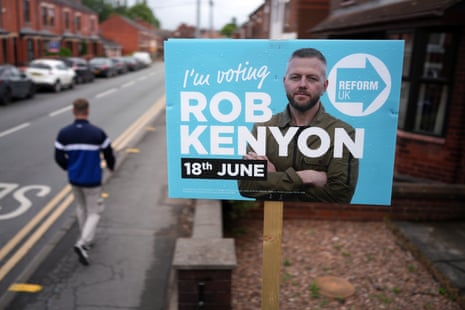
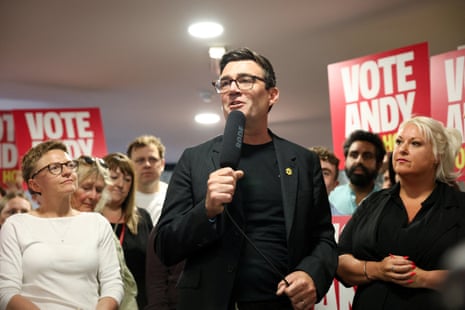
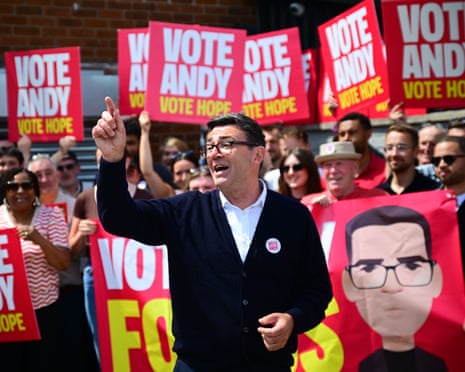
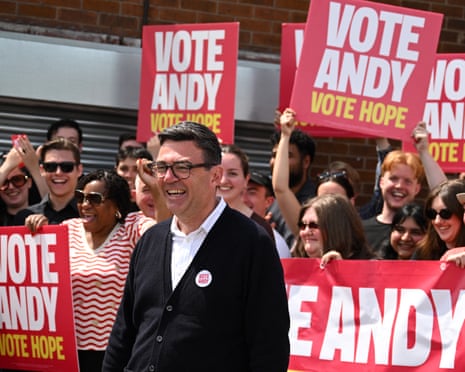
Andy Burnham has become less popular with British voters as a whole following his decision to stand as Labour’s candidate in the Markerfield byelection, according to two separate polls published today.

Burnham is still more popular than other Labour politicians. But the polling suggests some voters have become more negative about him as a result of his decision to put himself forward as a byelection candidate in the clear hope off being able to replace Keir Starmer .

Here are the figures from YouGov .

YouGov says:

In earlier polls in this series, Andy Burnham achieved a positive net favourability rating (+9 at its peak). However, his popularity declined starting from the middle of May – the period that encompassed the Labour party revolt against Keir Starmer that included Wes Streeting’s resignation and Josh Simons stepping down in Makerfield, triggering the by-election that Andy Burnham is likely to win.

As a result, Burnham now takes a net favourability rating of -11 in our latest poll: 30% of Britons like the would-be PM, versus 41% who dislike him.

The YouGov report also says Wes Streeting’s unfavourability ratings have risen since he resigned as health secretary with the intention of challenging Starmer for his job, and Ipsos in its report says it has picked up on the same trend.

According to Ipsos, Burnham’s ratings have fallen in particular with people over the age of 55, people who voted Conservative in 2024, people who think Labour is doing a bad job in government and people from Scotland.

However, the Ipsos report also shows that, of the 17 leading politicians it polled, Burnham has the highest – or least negative – favourability rating.

Starmer should set out timetable for his departure if Burnham wins byelection, Streeting says

Peter Walker is a Guardian senior political correspondent.

Keir Starmer should set a timetable for his departure if Andy Burnham wins the Makerfield byelection on Thursday rather than battle to stay in Downing Street, Wes Streeting has said.

Answering questions after his speech on the economy (see 10.44am and 11.32am ), Streeting reaffirmed that he would fight in any leadership battle, and insisted he has the necessary support among Labour MPs, but refused to say whether he would trigger a contest.

He said:

I would hope that after Thursday’s byelection, when the results are in, and I very much hope Andy Burnham wins … I hope the prime minister will at that stage reflect on his own position and set out a timetable. I think that would be a better way forward for everyone and would enable that better culture that we aspire to.

When he resigned as health secretary last month, Streeting had been expected to trigger a leadership contest himself, and the fact he did not prompted opponents to assume he did not have the backing of the 80 other Labour MPs needed to trigger the process.

Asked if he did now, Streeting replied: “Yes, I have the support I need to be on the ballot.”

However, he refused to say whether he might seek to trigger it next week. He said:

I think I’ve been extremely clear about this. I think there should be a contest. I have every intention of standing in that contest, and I’ve not triggered a contest, because we’ve got a byelection under way where one of the inevitable candidates is on the ballot paper.

To have sought a contest before Burnham was potentially back in parliament would be to “pull a fast one”, Streeting argued.