Keyword – Sport
Trefwoorden – US Open Tennis 2026, Carlos Alcaraz, US Open tennis, Sport, Tennis, US sports
Title – US Open 2026 quarter-final: Ben Shelton stuns Carlos Alcaraz in thriller after latest ever finish – as it happened | US Open Tennis 2026 | The Guardian
Author – https://www.theguardian.com/profile/bryan-armen-graham
Link – US Open 2026 quarter-final: Ben Shelton stuns Carlos Alcaraz in thriller after latest ever finish – as it happened | US Open Tennis 2026 | The Guardian
Publish date – 2026-09-09T08:07:14.000Z
Category – Sport
URL – https://www.theguardian.com/sport/live/2026/sep/08/ben-shelton-v-carlos-alcaraz-us-open-2026-quarter-final-live-updates
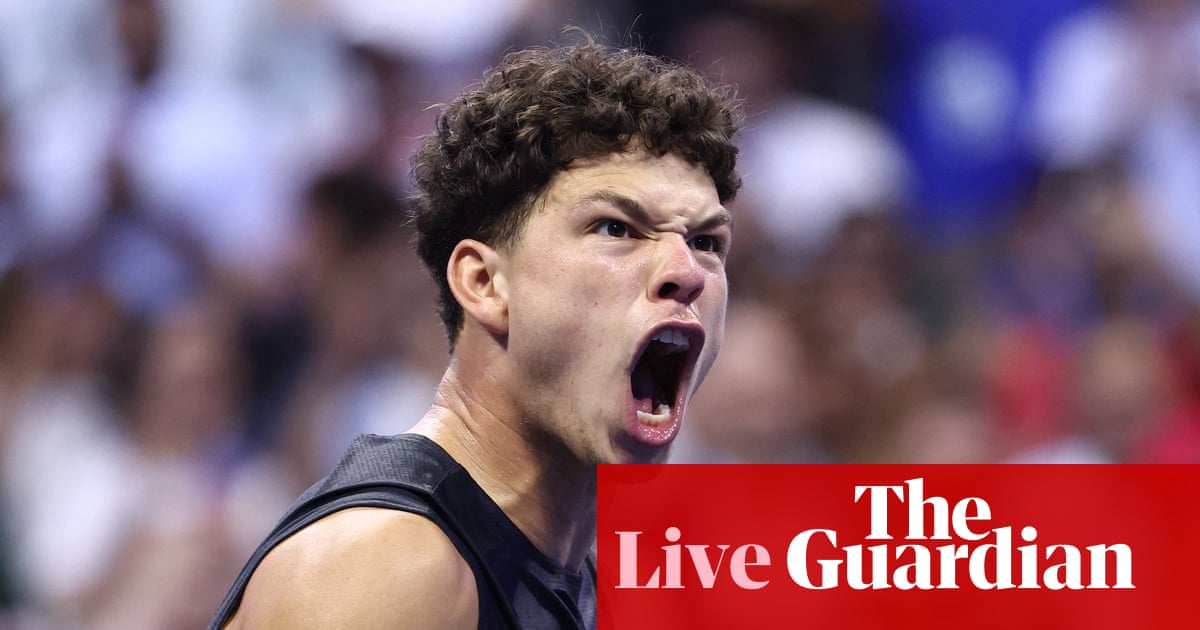
Shelton wins 6-7 (5), 6-1, 6-3, 1-6, 7-6 (7)!
Fifth-set tiebreak: Shelton 10-7 Alcaraz (*denotes next server)
And Shelton has done it, closing it out with a 146mph out wide. Carlos Alcaraz is out of the US Open and Ben Shelton will meet Frances Tiafoe in an all-American semi-final on Friday!
That’s all for tonight. Er, this morning. Thanks for following along with us and be sure to read Tumaini Carayol’s full report off a match for the record books.
Shelton also spoke warmly about the communication with his father and coach, Bryan, during a match that stretched deep into the New York night. “For us, it was just enjoyable to be a part of that match,” he says. “Obviously, the level of tennis, how long the match was going, the fight that it was, how even the match was back and forth throughout. I think that’s something that we can appreciate. Win or lose, have a smile on our face.”
And after nearly four and a half hours on court, is he worried about recovering in time for Friday’s semi-final with Frances Tiafoe ? Shelton’s answer at 3.46am on Wednesday morning was to the point. “Two days? Yeah.”
Shelton admits he was “pissed” after losing that 70-minute opening set , particularly after breaking Alcaraz to force the tiebreak. But that late break also gave him belief. “I knew that my serve was only going to get better, and if I’d already dialed in the return to the point that I could break him, I thought my chances were good to get that second set.”
That proved prescient. Shelton broke Alcaraz three times in a runaway second set, and from there felt able to “play and swing more freely”. The key, he says, was staying patient on return: making Alcaraz play, punishing missed spots and not getting discouraged by the inevitable aces and service winners. “I think for me to be able to hang in there in the rallies, have a game plan from the ground and be able to execute that game plan, and not be losing all the baseline points, also helps with the return.”

Shelton: ‘That was a war’
How does Ben Shelton feel after Tuesday night’s/Wednesday morning’s quarter-final win? “I’m tired,” the American said to a gaggle of reporters in the bowels of Arthur Ashe Stadium, in lieu of a formal press conference given the late hour.
“That was a war, epic match. I mean, so physical. Carlos, one of the greatest champions in our sport already at 23 years old. It’s always fun being on the court against him. It’s ridiculous, the amount of stuff he comes up with sometimes, but the most enjoyable match that I’ve had in my career, for sure.”
What an ending. After 4hr 28min, Shelton finally gets over the line in a fifth-set tiebreak to reach the US Open semi-finals, surviving Alcaraz’s furious fourth-set comeback and a deciding set in which neither man could find the break.
The serve that carried Shelton for so much of the night held firm when it mattered most. He won 70% of his first-serve points and 57% behind his second serve, with 54 of his 156 serves going unreturned. Remarkably, after Alcaraz broke him three times in that fourth-set rout, Shelton did not surrender serve in the decider.
And the contrast in errors tells plenty of the story. Alcaraz finished with 38 winners to Shelton’s 34, but committed 53 unforced errors to the American’s 35. Shelton also dominated the short exchanges, winning 55% of rallies lasting four shots or fewer, while Alcaraz controlled the longer ones. In the end, at nearly four and a half hours and deep into the New York night, the margins could scarcely have been finer.
Shelton wins 6-7 (5), 6-1, 6-3, 1-6, 7-6 (7)!
Fifth-set tiebreak: Shelton 10-7 Alcaraz (*denotes next server)
And Shelton has done it, closing it out with a 146mph out wide. Carlos Alcaraz is out of the US Open and Ben Shelton will meet Frances Tiafoe in an all-American semi-final on Friday!
Fifth-set tiebreak: *Shelton 8-7 Alcaraz (*denotes next server)
Shelton pounds a 146mph serve that Alcaraz can’t handle. Then Alcaraz makes another unforced error off the forehand side to go down a minibreak! He wins the next point coming to net with a drop-shot volley winner. But Shelton is serving for the match at 8-7 with the next two points on his racket.
Fifth-set tiebreak: *Shelton 6-6 Alcaraz (*denotes next server)
Alcaraz makes an unforced error from the baseline and we’re back on serve in the breaker. He then fires in an unreturnable serve. Shelton to serve at 5-6. That beeping you may hear is the sound of the garbage trucks. What an atmosphere. Shelton wins the next point for 6-all and the players will change ends again. The end is near.
Fifth-set tiebreak: Shelton 4-5 Alcaraz* (*denotes next server)
Alcaraz crushes a picture-perfect winner into the corner and now Shelton will serve at 3-4 with the next two points on his racket. An unforced error on Shelton’s forehand gives Alcaraz a minibreak, but the American wins the next point with a body serve that Alcaraz can’t handle. Alcaraz to serve at 5-4.
Fifth-set tiebreak: Shelton 3-3 Alcaraz* (*denotes next server)
Shelton wins the next point but then falters on a backhand, handing the minibreak back to Alcaraz. On serve in the tiebreaker. Another unforced error by Shelton makes it 3-all as the players change ends.
Fifth-set tiebreak: *Shelton 2-1 Alcaraz (*denotes next server)
Shelton serves to begin the tiebreak and rips a forehand winner early in the rally. Alcaraz responsds a quick point but misfires in a 10-shot rally to go down a minibreak. Shelton to serve at 2-1 with the next two points on his racket.
Fifth set: Shelton 6-7, 6-1, 6-3, 1-6, 6-6 Alcaraz
Alcaraz does his part and this historic quarter-final will be decided by a fifth-set tiebreaker. First man to 10 points will face Frances Tiafoe in a US Open semi-final on Friday.
Fifth set: Shelton 6-7, 6-1, 6-3, 1-6, 6-5 Alcaraz* (*denotes next server)
Shelton races to 30-love and “Let’s go, Ben!” chants ring through the lower bowl. Shelton gets it to 40-love, igniting the chants again (and louder), before spraying a backhand past the baseline. But the American is able to hold from there, leaving it to Alcaraz to force a deciding first-to-10-points tiebreaker.
Fifth set: *Shelton 6-7, 6-1, 6-3, 1-6, 5-5 Alcaraz (*denotes next server)
Alcaraz holds at love for 5-all, a game that includes a punishing 19-shot exchange that sees Shelton finally blink first. It’s 3.11am. What is life.
Fifth set: Shelton 6-7, 6-1, 6-3, 1-6, 5-4 Alcaraz* (*denotes next server)
An emphatic servicde game for Shelton, who holds at love in barely a minute as the match spills into its fifth hour. Alcaraz will serve to stay in the tournament after the change of ends.
Fifth set: *Shelton 6-7, 6-1, 6-3, 1-6, 4-4 Alcaraz (*denotes next server)
A couple of unforced errors have surfaced in Alcaraz’s game at the worst time as he goes down 15-30 on his serve. The crowd swells. And now Shelton has just painted the line with a scorching cross-court backhand winner for 15-40 and two break-point chances! This could be the match! He squanders the first after coming to net early in the rally and hitting a backhand long. And Alcaraz saves the second with another brilliant display, coming from nowhere to hit a forehand volley winner than Shelton can’t return into the court. Deuce, and could that be Shelton’s best chance at closing it out wasted?
Not so fast. Alcaraz has just double-faulted and Shelton will have a third break chance. But he can’t convert that one either, sending a running backhand into the net. Now Shelton sends a forehand long and Alcaraz is one point from the crucial hold. (They’re all crucial now.) And he wins it with a 122mph serve out wide that Shelton can’t handle. We’re on serve in the fifth!

Fifth set: Shelton 6-7, 6-1, 6-3, 1-6, 4-3 Alcaraz* (*denotes next server)
Shelton in trouble here. He’s quickly gone down love-30 on his serve and Alcaraz tastes blood. But the American wins two fighting points for 30-all. Shelton then hits an unreturnable serve for game point, but follows with an unforced error off the forehand for deuce. From there Shelton nails down the hold, capping it with a 144mph ace to stay on serve in the decider.
This will be the latest finish in US Open history
Fifth set: *Shelton 6-7, 6-1, 6-3, 1-6, 3-3 Alcaraz (*denotes next server)
Alcaraz closes out a drama-free hold with a 113mph ace down the middle.
And at the stroke of 2.51am it became official: this match will be the latest finish in the history of the US Open. As mentioned earlier, the previous record was 2.50am, set by Alcaraz and Jannik Sinner in their 2022 quarter-final . Alcaraz won 6-3, 6-7 (7), 6-7 (0), 7-5, 6-3 after 5hr 15min.
Fifth set: Shelton 6-7, 6-1, 6-3, 1-6, 3-2 Alcaraz* (*denotes next server)
With Shelton serving at 15-all, chants of “Let’s go Carlos, let’s go!” sound through the crowd. Shelton then hits a forehand volley winner, igniting his side of the crowd, but Alcaraz answeres with a backhand tracers off the ground for 30-all. Another blistering forehand winner by Alcaraz give him a break point at 30-40, but Shelton comes to net early in the rally to erase it for deuce. More “U-S-A! U-S-A!” chants. Two quick points for Alcaraz and he’s escaped with the hold.
Fifth set: *Shelton 6-7, 6-1, 6-3, 1-6, 2-2 Alcaraz (*denotes next server)
Alcaraz holds at love while the clattering sound of a No 7 subway can be heard in the distance.
Fifth set: Shelton 6-7, 6-1, 6-3, 1-6, 2-1 Alcaraz* (*denotes next server)
Shelton falls behind love-30 on his serve, then rattles off four quick points to hold. Alcaraz comes in just too low on a baseline forehand on game point, sending the crowd into roars when the ball caroms back off the net.
Fifth set: *Shelton 6-7, 6-1, 6-3, 1-6, 1-1 Alcaraz (*denotes next server)
Alcaraz holds comfortably, closing it out with a 124mph ace. It’s 2.34am, the lower bowel of Ashe is nearly full, there’s plenty of folks still upstairs and, yes, they’re still selling Honey Deuces (though it seems most stands have run out of the souvenir cups).
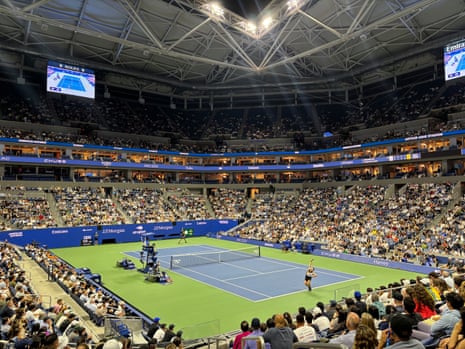
Fifth set: Shelton 6-7, 6-1, 6-3, 1-6, 1-0 Alcaraz* (*denotes next server)
Shelton falls behind love-15 serving to open the fifth set, but gets the better of a 13-shot rally before hitting a unreturnable serve for 30-15. He’s able to hold from there and “U-S-A! U-S-A!” chants break out as the players change ends with Bad Bunny playing from the arena soundsystem.
Alcaraz wins fourth set, 6-2!
Fourth set: Shelton 6-7, 6-1, 6-3, 1-6 Alcaraz
Alcaraz holds at love and we’re headed to a fifth and deciding set!
Shelton finally looked vulnerable behind the enormous serve that had carried him through the middle two sets. Alcaraz is now three for 10 on break points, while Shelton has dropped five service games overall. It’s 2.21am in New York, we’re going five, and the US Open’s all-time latest finish of 2.50am is very much in play.
Alcaraz breaks in sixth game of fourth set!
Fourth set: Shelton 6-7, 6-1, 6-3, 1-5 Alcaraz* (*denotes next server)
Shelton goes down love-30, then 30-40 and break point down, gifting Alcaraz the break of serve with a scratchy backhand. Alcaraz will now serve to force a fifth set.
Fourth set: *Shelton 6-7, 6-1, 6-3, 1-4 Alcaraz (*denotes next server)
Alcaraz finds himself in a love-30 hole after two unforced errors, but wins a couple of medium-length rallies for 30-all. He gets to game point with a forehand winner, but Shelton answers with a forehand winner down the line for deuce. From there Alcaraz reels off two quick points to nail down the hold.
Fourth set: Shelton 6-7, 6-1, 6-3, 1-3 Alcaraz* (*denotes next server)
A stress-free hold for Shelton, who crushes a 123mph ace along the way.
Fourth set: *Shelton 6-7, 6-1, 6-3, 0-3 Alcaraz (*denotes next server)
We’re past 2am here in Ashe and Alcaraz backs up the break with a hold at love. More “Olé, olé, olé” chants.
Alcaraz breaks in second game of fourth set!
Fourth set: Shelton 6-7, 6-1, 6-3, 0-2 Alcaraz* (*denotes next server)
Now it’s Shelton who is pressured on his serve, making back-to-back unforced errors from 15-all to go double break point down. He saves the first with another wild exchange of volleys at the net, but blinks on the second with a backhand error to end an eight-shot rally. “Olé, olé, olé” chants ring down from the loge seats in Ashe as the crowd tries to will Alcaraz on.
For anybody wondering, the latest finish in US Open history is 2.50am, set by Alcaraz and Jannik Sinner in their 2022 quarter-final . Alcaraz won 6-3, 6-7 (7), 6-7 (0), 7-5, 6-3 after 5hr 15min.

Fourth set: *Shelton 6-7, 6-1, 6-3, 0-1 Alcaraz (*denotes next server)
Alcaraz falls behind 15-30 on hi serve, then 30-40 and break point down. But he rattles off three quick points to escape with the hold to open the fourth set.
Here’s a glimpse of the US Open grounds at 1.40am , with Shelton and Alcaraz still going inside Arthur Ashe Stadium. Fountain Plaza, normally one of the busiest thoroughfares at the USTA Billie Jean King National Tennis Center, is almost completely deserted, the concessions shuttered and only a handful of people still milling around.

Shelton wins third set, 6-3!
Third set: Shelton 6-7, 6-1, 6-3 Alcaraz
At 15-all, Shelton pounds a 124mph serve before coming to net and finishing with a muscular forehand winner. He’s two points from the set. Alcaraz answers with a sharply angled backhand winner from the baseline for 30-all. Then, another truly extraordinary point ends after a trade of apparent volley winners, when Alcaraz hits a blistering forehand winner moving into the backcourt for break point at 30-40. A massive point, this. And Shelton gets the better of Alcaraz over a 19-shot rally to save it, bringing the crowd to its feet once again! Deuce. Shelton then outlasts Alcaraz in an 11-shot exchange for set point and the Spaniard looks worse for wear, having been run ragged in these extended rallies. And Shelton forces Alcaraz into another forced error to take the third set in 48 minutes!
Unlike the second-set blowout, this was a much sterner test. The American protected his serve superbly, saving all three break points he faced in the set and losing only seven points on serve altogether. Through three sets he has saved six of seven break points and held in 13 of 14 service games.
The serve remains terrifying – still topping out at 149mph – but Shelton has been winning this match with more than raw velocity. He’s getting 66% of his first serves in and has won 68% of those points, while an extraordinary 39% of his second serves have gone unreturned.
Third set: *Shelton 6-7, 6-1, 5-3 Alcaraz (*denotes next server)
Alcaraz races to 40-love on his serve, then makes it complicated for himself with his 36th and 37th unforced errors, both off the forehand, for 40-30. But he’s able to hold from there and Shelton will serve for the set.
Third set: Shelton 6-7, 6-1, 5-2 Alcaraz* (*denotes next server)
Alcaraz strolls to a stress-free hold and Alcaraz will serve to stay in the third set.
Third set: *Shelton 6-7, 6-1, 4-2 Alcaraz (*denotes next server)
Alcaraz finds himself in trouble on his serve again, but rattles off three quick points to hold from 15-30 down.
Third set: Shelton 6-7, 6-1, 4-1 Alcaraz* (*denotes next server)
Shelton holds comfortably to stay in front. And with new balls coming on court after the change of ends, the American will have the chance to serve out the set with a little extra zip.
Third set: *Shelton 6-7, 6-1, 3-1 Alcaraz (*denotes next server)
Alcaraz holds at love, punctuating it with a barbaric “Va-mos!” after breaking Shelton’s run of nine straight games won.

Third set: Shelton 6-7, 6-1, 3-0 Alcaraz* (*denotes next server)
Shelton goes down love-30 then 15-40 on his serve, giving Alcaraz two chances to break right back. Shelton saves them both for deuce, then uncorks a 142mph ace that draws more audible oohs for game point. But Alcaraz follows by winning the new point of the night – new point of the tournament? – winning a sensational 18-point exhange with a backhand volley winner that brings the reamining crowd of several thousand fans to its feet. Deuce, then two quick points for Shelton to back up the break. That’s nine straight games to the American.
Shelton breaks in second game of third set!
Third set: *Shelton 6-7, 6-1, 2-0 Alcaraz (*denotes next server)
Alcaraz falls behind love-30 on his serve before fighting back to deuce. Shelton then produces a break point by winning a 12-shot exchange and converts it when Alcaraz sends a volley into the net for his 33rd unforced error of the night (against 17 winners).