US-Iran deal may get oil flowing again, but region’s root problems are unsolved | US-Israel war on Iran | The Guardian

Keyword – World news
Trefwoorden – US-Israel war on Iran, Middle East and north Africa, Iran, US news, Israel, World news
Title – US-Iran deal may get oil flowing again, but region’s root problems are unsolved | US-Israel war on Iran | The Guardian
Author – https://www.theguardian.com/profile/jasonburke
Link – US-Iran deal may get oil flowing again, but region’s root problems are unsolved | US-Israel war on Iran | The Guardian
Publish date – 2026-06-16T07:35:56.000Z
Category – News
URL – https://www.theguardian.com/world/2026/jun/15/us-iran-ceasefire-respite-true-peace-distant

In much of the Middle East, news that the US and Iran had come to a fragile agreement was greeted with relief tempered with doubt that any deal would resolve the turbulent region’s deep problems or even prevent a future return to war.

In Kuwait, a frequent target of Iranian drone strikes during the 15-week conflict, Iyad Joumma, a 37-year-old Jordanian engineer, spoke for many.

While the agreement may allow the region to catch its breath, he said, its success “will depend on the ability of the parties involved to address the root causes of the tensions”.

Of a dozen analysts and experts consulted by the Guardian since the news of a potential end to hostilities broke at the weekend, not one suggested the interim deal to be signed on Friday by representatives of Iran and the US would be any more than a temporary solution.

“It’s just a big Band-Aid and future conflict is like to come at some point,” said Neil Quilliam, a Middle East expert at London’s Chatham House.

The memorandum of understanding provides for a 60-day cessation of hostilities during which the two sides will address some of the most contentious issues – Iran’s enriched uranium stockpile and nuclear programme, sanctions and the release of billions of dollars of frozen Iranian assets – in the hope that a final settlement can be reached.

Few analysts believe this is likely within such a short timescale – if at all.

They point to the painstaking 18-month process that led to the 2015 agreement with Iran, which traded economic benefits for restrictions of its nuclear programme, and which Donald Trump tore up during his first term in office.

The interim deal now agreed does little more than commit both sides to further talks, while obliging Washington to lift its naval blockade of Iran and making Tehran allow free passage to all shipping in the strait of Hormuz, which usually carries a fifth of the world’s oil and liquid gas supplies but was blocked by Iran early in the war.

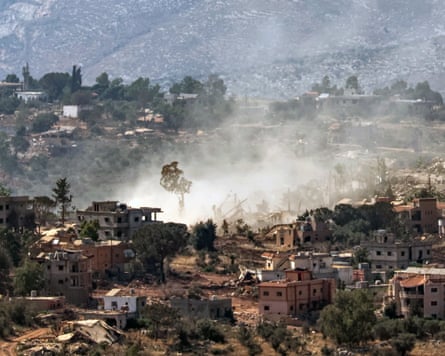
To the great displeasure of Israel , a ceasefire has been imposed once again in Lebanon as part of the interim deal and appears for the moment to be holding.

But such ceasefires count for little these days, said several experts, pointing to Gaza as an example, where almost 1,000 Palestinians have been killed since Donald Trump brokered an end to the war there last year. Israel has occupied more than 60% of the territory , Hamas has not given up its weapons, and there has been almost no progress towards a projected second phase of the deal, let alone the third, which was to have brought a massive reconstruction effort.

“Gaza is a case in point. The deal there didn’t contend with the past: the war crimes that had been committed. Nor the present: how to disarm Hamas. Nor the future: a pathway to a viable Palestinian state and a resolution of the conflict,” said Alia Brahimi at the Atlantic Council in Washington. “It’s almost as if … you can use the cover of a ceasefire to continue to achieve your aims, including military ones.”

But this was not possible in the Gulf, Brahimi said, because the strategic geography was different.

“The strait of Hormuz is of integral importance to the global economy, as the Iranians have demonstrated. They’ve shown us what we always knew in theory: that they can impose cascading stress globally by throwing a few projectiles towards a tanker or two.”

Mkhaimar Abusada, a political science professor at al-Azhar University in Gaza and now in Cairo, agreed.

“The ceasefire in Gaza is holding because Hamas knows that if they fire it will give a pretext for another full-scale Israeli ground invasion but the situation in Gaza is disastrous,” he said.

In Israel there is dismay and disappointment at a deal that does not appear to address Iran’s ballistic missile armoury nor funding of its so-called Axis of Resistance, a loose coalition of militant Islamist movements including Hezbollah in Lebanon, Hamas in Gaza, the Houthis in Yemen and a series of militia in Iraq.

This, too, could threaten instability in the near future, analysts argue.

Danny Orbach, a military history professor at the Hebrew University, Jerusalem, said that that after the bloody surprise October 2023 Hamas raid which triggered the Gaza war, Israel had set out to bring about structural change in the Middle East.

“The structural change [Israel wants] is that the ‘Axis of Resistance’ must no longer be allowed to threaten Israel with destruction. Israel’s destabilising instinct is to tell all regional actors you will not have stability until you solve our problem, and that problem is Iran. This will not change until the memory of [the] 7 October [attack] fades and that will take years and years.”

The sharpest shock, however, is being felt in the Sunni Arab Gulf states, where the stability behind decades of economic growth and growing diplomatic heft has been sharply challenged.

It will take months or even years for damage to civilian infrastructure done by Iran’s strikes on Kuwait, Bahrain, the United Arab Emirates and Qatar to be repaired, and the psychological scars will last much longer . Meanwhile, Washington’s clear unwillingness to accept significant losses, months of potential economic pain or domestic dissatisfaction send a clear message.

“A ‘superpower’ that is not ready to bear 100 casualties is not a superpower,” said Orbach.

H.A. Hellyer, of London’s Royal United Services Institute, said that Gulf states would now seek to contain a newly empowered Iran led by a more confident and possibly more belligerent regime.

“The realisation that they can’t rely on the US is the point of consensus but otherwise [Gulf states] have all got different views of the best strategy going forward,” Hellyer said. “The Arab world has important and legitimate grievances with how Iran projects power and influence and none of these are being addressed.”

Quilliam described a “new era”.

“The [current] agreement will hold and in 60 days we will probably see positive headlines and the oil and gas will flow [again] but there’ll be no major breakthrough,” he said.

“We know that Hormuz can be closed again, the Iranians have carried out strikes on Gulf states, and we have seen that whatever Israel and the US can do, Iran will take it. All the previous thresholds have been passed now.”

‘Our team is the most oppressed’: Iran coach hits out at Fifa and US over treatment | World Cup 2026 | The Guardian

Keyword – Football
Trefwoorden – World Cup 2026, Iran, World Cup, Football, Sport
Title – ‘Our team is the most oppressed’: Iran coach hits out at Fifa and US over treatment | World Cup 2026 | The Guardian
Author – https://www.theguardian.com/profile/alexander-abnos,https://www.theguardian.com/profile/ben-fisher
Link – ‘Our team is the most oppressed’: Iran coach hits out at Fifa and US over treatment | World Cup 2026 | The Guardian
Publish date – 2026-06-16T05:36:17.000Z
Category – Sport
URL – https://www.theguardian.com/football/2026/jun/16/amir-ghalenoei-iran-coach-mehdi-taremi-fifa-us-world-cup

The Iran captain Mehdi Taremi, midfielder Mohammad Mohebi, and head coach Amir Ghalenoei hit out at Fifa and hinted at resentment toward the US government after being told they needed to leave Los Angeles immediately after Monday night’s 2-2 draw against New Zealand in the World Cup.

“Everything is like disaster, actually, for us,” said Taremi, who added that Fifa president, Gianni Infantino, visited the team in the dressing room and they expressed their concerns to him directly.

Ghalenoei said the way they have been treated by Fifa makes them “the most oppressed” team at the tournament.

“After the game today they said to us, ‘You have to leave immediately,’” Ghalenoi said. “Whereas today it’s very important for us to have recovery.

“We’ve been asked to get on a plane and return to our camp in Tijuana and we are really troubled by that. They are forcing us to go back early. They are making the situation more and more difficult, more hurdles, but we’re not going to let that stop us from doing our best.

“We don’t know why they’re returning us, to be honest. I think it’s very strange. It seems like others are doing the planning for us … We were supposed to arrive two nights before the game but they didn’t permit [it]. We were supposed to stay here tonight to recover and return tomorrow lunchtime.

“I think our team is the most oppressed one in the whole World Cup . Our federation isn’t here, our media isn’t here, our management isn’t here.”

Infantino went into the Iran dressing room after the game and a video of his message to the squad was shared online, in which Infantino and Ghalenoei exchanged words, via a member of staff translating.

“You showed to your families, friends, to your people, to the world, that you’re in the World Cup, that you perform and you have two more games to go,” Infantino said. “In these two games, you will make again everyone in the world proud of what you do. Thank you for being here.

“It is also a big, big emotion. I know what you go through, I understand, but you are stronger than everything. You send a strong message to the entire world. Like tonight you united the whole stadium here, you united the whole stadium behind you, behind Team Melli. You are sending such a strong message to the world.

“Let me say one more thing: this is just the beginning of the World Cup. You are writing history, the whole world is watching you. Continue to play with your heart, for your people, your families, for your fans and for everyone in the world that is falling in love with Team Melli. You are stronger than everything.”

Taremi criticised a logistical situation that has seen the team forced to abandon their planned training base in Tucson, Arizona weeks before the tournament, instead training across the border in Tijuana, Mexico and flying in to the US shortly before games.

The team moved its training base to avoid immigration concerns that turned out to be well founded – after arriving in Mexico, 15 of the team’s support staff were denied visas to enter the US, where all of Iran’s group stage games are taking place. That number was later reduced to 11 after some visas were approved.

The team still arrived in Los Angeles minus both of their media officers, some analysts, and federation president, Mehdi Taj. Another analyst for the team served as a stand-in media aide for Taremi and Mohebi’s appearance, which a Fifa official repeatedly attempted to stop as both players continued answering questions.

“I think it’s not good for the football,” Taremi said. “In [the] World Cup, you have to prepare good for the next game, which is a lot of stress for the players and the staff and everyone. But we don’t have that support, and I think Fifa have to help us more than this. Let’s see what’s going to happen in the future.”

Iran faced delays in their travel from Tijuana to Los Angeles, a short trip that Taremi said took five hours. He did not specify what caused the delays, but it was understood that the immigration process was the main cause.

Taremi and Mohebi said being forced to leave immediately afterward would negatively affect the players’ performance at the tournament.

“It’s supposed to be: tomorrow morning recovery, then we fly to Tijuana, then we return to LA again, but right now we have to go back,” Taremi said.

Mohebi added: “Yesterday we came, started the trip in the morning, and we arrive [in the] afternoon, and we directly go to train, and we get tired, you know? I think [it wa] supposed to be, we come here two days before the game. This kind of deal, I think, is not fair … we’re going to get fatigued – hamstring, lower back, glutes …”

By contrast, Ghalenoei praised the warmth of co-hosts Mexico and many Mexicans were in attendance supporting Iran at the Los Angeles Stadium.

“The Mexican people, the Mexican government, especially the people in Tijuana, made us feel at home,” he said.

UK will have to ‘dial back’ military plans without more funding, says chief of defence | Defence policy | The Guardian

Keyword – Politics
Trefwoorden – Defence policy, UK news, Politics, Ministry of Defence
Title – UK will have to ‘dial back’ military plans without more funding, says chief of defence | Defence policy | The Guardian
Author – https://www.theguardian.com/profile/dan-sabbagh
Link – UK will have to ‘dial back’ military plans without more funding, says chief of defence | Defence policy | The Guardian
Publish date – 2026-06-16T12:03:08.000Z
Category – News
URL – https://www.theguardian.com/politics/2026/jun/16/uk-dial-back-military-plans-without-funding-says-defence-chief

Britain will have to “dial back” on military operations and exercises in the next few years if the Ministry of Defence (MoD) does not receive extra funding from Downing Street and the Treasury, the UK’s most senior military officer has said.

Rich Knighton, the chief of the defence staff, told a Lords committee that he was “most concerned” about the budgets for day-to-day activities – in his first public appearance after the resignation of John Healey as defence secretary last week.

The air chief marshal was asked by George Robertson, the chair of the Lords international relations and defence committee, what the “capability implications” were of No 10’s proposal to increase defence budgets by 2.68% of GDP by 2030.

“We’ll have to dial back our activities; our exercise, operational activity, if the level of resource funding that is available to us does not increase,” Knighton said, in effect referring to military activity in Europe, Ukraine and the Middle East.

Though he did not refer to any operations by name, the UK has offered to lead a peacekeeping mission in the strait of Hormuz, if the US-Iran ceasefire is durable, and a possible mission in Ukraine if Russia halts its invasion.

Though capital budgets for defence had increased significantly, Knighton said day-to-day or revenue spending had not. “If you look back at the position 20 years ago, the split between resource spending and capital spending was about 80/20.

“Today it is about 60/40 – 60% on activity and resources, and 40% on capital. On the current projection, by the time we get to 2030 it will be 50/50,” Knighton said, while key costs such as for aviation fuel had soared after the US launched its conflict with Iran.

Healey quit last Thursday because the prime minister, Keir Starmer, would not increase defence spending beyond an already agreed 2.6% of GDP by 2027 to 3% by 2030. Starmer’s offer of 2.68% would have left the UK less safe, Healey said.

The former defence minister is due to give a resignation statement in the Commons at about 1.30pm on Tuesday, while Starmer is in France at the G7 leaders summit. Healey was also unhappy that the UK would end the decade a long way from a Nato spending target of 3.5% of GDP by 2035, agreed by the prime minister a year ago.

Knighton emphasised the importance of the longer term Nato target. “Nato and our allies agree that spending 3.5% of national GDP on defence is what is necessary to deliver the Nato capability targets,” he told peers on Tuesday morning.

Concern about the level of future day-to-day budgets is a notable shift of emphasis from the funding of the 10-year defence investment plan. The plan had been due to be published on Monday, though the MoD was only offered £13.5bn to fund an £18bn budget gap. The plan’s release was halted when Healey resigned.

Ben Jennings on the UK’s social media ban for under-16s – cartoon | Ben Jennings | The Guardian

Keyword – None
Trefwoorden – None
Title – Ben Jennings on the UK’s social media ban for under-16s – cartoon | Ben Jennings | The Guardian
Author – Ben Jennings
Link – Ben Jennings on the UK’s social media ban for under-16s – cartoon | Ben Jennings | The Guardian
Publish date – Mon 15 Jun 2026 19.17 CESTLast modified on Tue 16 Jun 2026 12.02 CEST
Category – Opinion
URL – https://www.theguardian.com/commentisfree/picture/2026/jun/15/ben-jennings-uk-social-media-ban-under-16s-cartoon

The passionate, fun pop culture show you don’t want to stop listening to: best podcasts of the week | Television & radio | The Guardian

Keyword – Television & radio
Trefwoorden – Television & radio, Culture, Podcasts
Title – The passionate, fun pop culture show you don’t want to stop listening to: best podcasts of the week | Television & radio | The Guardian
Author – https://www.theguardian.com/profile/hollie-richardson,https://www.theguardian.com/profile/hannah-j-davies
Link – The passionate, fun pop culture show you don’t want to stop listening to: best podcasts of the week | Television & radio | The Guardian
Publish date – 2026-06-15T06:00:05.000Z
Category – Culture
URL – https://www.theguardian.com/tv-and-radio/2026/jun/15/the-passionate-fun-pop-culture-show-you-dont-want-to-stop-listening-to-best-podcasts-of-the-week

Pick of the week Clara & Munroe Are Into It

If the first episode is anything to go by, Clara Amfo (let loose from BBC broadcasting) and activist Munroe Bergdorf could well be your fun commute companions. The pair are passionate, incisive and just the right amount of gossipy as they unpack the latest pop culture moments – such as what the loud conversation around Olivia Rodrigo’s baby-doll dress says about women in music. Our one complaint? Half an hour isn’t long enough! Hollie Richardson Widely available, episodes weekly

Successpod

Podcast doyen Adam Buxton leans into his more offbeat instincts in this six-parter about what it means to be accomplished in the influencer age. It won’t be for everyone, but Bux stans will surely appreciate songs about him losing his hair – and his edge – and frank chats with Guz Khan, Romesh Ranganathan and more. Hannah J Davies Audible, all episodes out now

OnlyFantasy

It would be easy to tap into moral panic, but Leon Neyfakh (Slow Burn, Fiasco) swerves the obvious in this smart series about online sex work. He’s aided by comedian and OnlyFans creator Gracie Canaan for a nuanced examination of the relationships forged between X-rated creators and ordinary people, featuring candid revelations from Neyfakh himself. HJD Widely available, episodes weekly

Hunting the Suicide Salesman

Six years on, the child abuse investigative series Hunting Warhead remains one of the most accomplished but upsetting podcasts ever released. This follow-up of sorts from Canada’s CBC hears reporter Daemon Fairless turn his attention to a man who sold lethal chemicals online to suicidal people, and is as gripping as it is devastating. HJD Widely available, episodes weekly

This Is TV Now

Podcasting’s pivot to video is in full swing – cue this meta show about the increasingly blurry lines between the mediums. Magazine founder Dane Cardiel hosts alongside producer Stella Young, who reckons – as many will be relieved to hear – that, while change is afoot, video hasn’t killed the radio stars quite yet. HJD Widely available, episodes weekly

‘Wow, it really worked!’: the 70s TV show that’s causing worldwide panic – 50 years later | Television | The Guardian

Keyword – Television & radio
Trefwoorden – Television, Television & radio, Culture, Science fiction TV
Title – ‘Wow, it really worked!’: the 70s TV show that’s causing worldwide panic – 50 years later | Television | The Guardian
Author – Phil Tinline
Link – ‘Wow, it really worked!’: the 70s TV show that’s causing worldwide panic – 50 years later | Television | The Guardian
Publish date – 2026-06-16T12:15:34.000Z
Category – Culture
URL – https://www.theguardian.com/tv-and-radio/2026/jun/16/alternative-3-mockumentary-missing-scientists-conspiracy-50-years-later

O ver the past few months, a strange story has been seeping into the mainstream media from the more excitable corners of Substack and YouTube. Its claim: scientists whose work related to aerospace and nuclear research are either dying or going missing. According to an influential report in the Daily Mail in March , the disappearances form a “chilling pattern”: two, for instance, had worked together at an air force laboratory. The implications, in some accounts, are Hollywood sinister, with scientists working on top-secret breakthroughs running into dark forces who wanted to get hold of what they knew – or ensure their silence. And it all seems to have something to do with what we used to call UFOs.

On examination, these claims collapse. The “scientists” actually worked in disparate fields, from chemical biology to plasma physics. Several were actually administrators. Two had retired. One died of natural causes; another in a shooting spree. In any case, as the debunker Mick West pointed out , the “US top secret-cleared aerospace and nuclear workforce” is around 700,000, so normal mortality rates would predict far more deaths over the 22 months concerned – about 4,000. Nonetheless, Congresspeople have been warning darkly of threats to “national security”. The Trump administration has launched an investigation into a phenomenon that is often said to go hand-in-hand with something called “Alternative 3” – whose origins might end up surprising Trump and co.

O n 20 June 1977, an edition of Anglia Television’s Science Report was broadcast on ITV. It set out to investigate the “brain drain” of British scientists to the US. But it emerged that some of these scientists had vanished completely, while others had died in strange circumstances. The journalists had stumbled on something huge. As the host, former ITV newscaster Tim Brinton, solemnly explained, the greenhouse effect would soon make the Earth uninhabitable, and this had forced the powerful to choose between terrible alternative solutions. The American and Soviet governments had decided to work together in secret to implement “Alternative 3”: building a launch base on the moon, and from there a “human survival colony” for the elite on Mars. The missing scientists had been co-opted to play their part; the dead ones had threatened to leak the plan.

As you probably guessed, the “documentary” was a drama – as signalled by end credits listing the actors who played the horrified reporters and terrified scientists. Science Report did not exist; the whole thing was invented by a screenwriter named David Ambrose. He had been trying to write about people going missing, when he hit on the idea of a mock-documentary about people disappearing to Mars, driven to flee Earth by a novel concern: pollution-induced global warming. From there, he tells me, the script “wrote itself”, drawing on the breathless tropes of onscreen investigative journalism in the age of Watergate: secretly recorded street interviews, hidden truths on poorly-recorded tapes, the terrified witness who knows too much.

The story keyed into serious anxieties about the future, but the idea of playing with these in a pretend documentary raised alarms. “Everybody in Anglia Television was wetting themselves with fear,” Ambrose remembers. But Anglia’s founding executive director was one of the great British movie moguls, Sir John Woolf, who’d produced the likes of Ava Gardner and Humphrey Bogart. And he “just loved it, because he knew exactly what the impact would be, and he just overruled everybody and said: ‘Go ahead!’”

To give the show gravitas, they approached Brinton, who was warned by friends not to get involved, given that he was trying to become a Conservative MP. Brinton ignored them, played the earnest anchorman absolutely straight – and won his election regardless. Brian Eno was commissioned to write an eerie piece of music. The production designer Terry Ackland-Snow, who had worked on Stanley Kubrick’s 2001: A Space Odyssey, ingeniously evoked signs of life under the Martian landscape by dragging a nail under sand. They acquired footage from Nasa and added sensational fake astronaut voiceovers – a mix of fact and fiction that Ambrose wryly concedes was “completely nefarious”.

The show was meant to be broadcast on April Fools’ Day, but fatefully, it had to be moved back, and went out on 20 June. Ambrose says he “intended to cause a flap” – and he did. While those end credits did begin with a dateline saying “April 1st”, many people took the show seriously. ITV was hit by a barrage of calls from viewers – some protesting, others seeking reassurance the programme was fiction. The Scottish Daily Record headlined the row “TV TERROR!” Ackland-Snow had an incensed Jehovah’s Witness knock on his door to tell him he should be ashamed of himself.

Alternative 3 was broadcast simultaneously in Canada, Iceland, New Zealand and Australia – but not in the US. ABC wanted to network it, but was forbidden by broadcasting rules. It was initially visible only to those Americans whose TVs picked up Canadian programming. However, 1978 brought a spin-off book. Ambrose was too busy to write it, but with his blessing, a journalist called Leslie Watkins was brought in. Watkins wove in more 1970s nightmares – drawing on revelations about CIA attempts at brainwashing to suggest that Alternative 3 involved “adjusting” batches of humans to turn them into slaves. It also suggested that the claim the documentary was a hoax was a cover story.

And so Ambrose’s fiction escaped its British origins to take up residence in the strange dreamscape of American conspiracy theory. As the political scientist Michael Barkun traces in A Culture of Conspiracy, the show’s notion that the elite was plotting to abandon Earth keyed into existing visions of imminent apocalypse. Evangelical Christians’ belief in the Rapture, for example – when the chosen few, supposedly, will vanish, leaving everyone else to their fate.

Alternative 3’s afterlife really took off in 1991, when the conspiracist Milton William Cooper included it in his book Behold a Pale Horse. The book’s paranoid tales of secret government evil, “evidenced” by fictions like Alternative 3 , influenced not just paid-up conspiracy theorists such as Alex Jones, but everything from the UFO-obsessed, nothing-is-as-it-seems world of The X-Files to an array of hip-hop stars. On Nas’s 2008 track Testify, for instance, he name-checks “William Cooper, who told you the pale horse is the future”.

Cooper fused Alternative 3 with theories about Aids, depopulation and the Kennedy assassination, while insisting that Science Report was a real series. Another influential theorist, Jim Keith, wrote Casebook on Alternative 3, complete with a chapter on “Missing Scientists”. The book begins by acknowledging the story appears to be a hoax. But what if that claim is just an elite trick? Meanwhile, other conspiracists were worrying about who would get to go to Mars: just how senior a Freemason did you need to be? Ambrose himself was visited out of the blue by a young man.

“He said he’d come all the way from California,” the writer recalls, “and he just really needed it to come to the horse’s mouth. He seemed perfectly sane, perfectly nice. We chatted. I said, ‘No, I’m terribly sorry. I did make the whole thing up.’ And he was very crestfallen.”

How does he feel about the fact his 50-year-old conceit still has some people convinced today? “Frankly: ‘Wow, it really worked!’ A classic of its kind.” The question of what people are willing to believe, he considers, is itself “something worth establishing as a theme”. He cites an old saying: “it’s easier to fool someone than to persuade them they’ve been fooled.”

A lternative 3 shows just how much impact a well-constructed spoof can have, even when its creators protest that it’s not real. It’s far from the only one. Orson Welles’s 1938 radio version of The War of the Worlds famously caused much anxiety with its “news” bulletins about the alien invasion of New Jersey. (Ambrose worked with Welles as a young man, but says War of the Worlds didn’t influence Alternative 3.) The most strikingly similar example, however, is Report from Iron Mountain – a 1960s US government report warning that world peace would destroy the US, which was concocted by anti-war satirists. Like Alternative 3, this has long been taken far too seriously by conspiracy theorists, who’ve used it to back up their fears: that the government is planning to enslave the population, and that environmental calamity is a cover for imposing tyranny.

The basic nightmare here – that the government is infinitely powerful and infinitely evil – also lurks beneath today’s “missing scientists” flap. The real nightmare is that today much of the US government is itself seen as being run by conspiracy theorists.

So – looking back from today’s world of deepfakes and disinformation, doesn’t concocting a hoax documentary “exposing” an evil government plot seem a bit dangerous? Ambrose says the situation in 1977 was “very different” – and concocting a mockumentary seemed radical. “It was a young man’s thing. You’re not scared, you’re just more keen to make an impact.” He was really just following the logic of his idea.

“I was trying to write a play,” he says. “Funnily enough, I never, ever thought of it as a hoax.”

Phil Tinline is the author of Ghosts of Iron Mountain: The Hoax That Duped America and Its Sinister Legacy , out now in paperback.

Elon Musk’s unprecendented accumulation of wealth | Elon Musk | The Guardian

Keyword – Technology
Trefwoorden – Elon Musk, US news, World news, SpaceX, Technology
Title – Elon Musk’s unprecendented accumulation of wealth | Elon Musk | The Guardian
Author – https://www.theguardian.com/profile/nick-robins-early
Link – Elon Musk’s unprecendented accumulation of wealth | Elon Musk | The Guardian
Publish date – 2026-06-16T12:55:35.000Z
Category – News
URL – https://www.theguardian.com/technology/2026/jun/16/elon-musk-techscape

Hi and welcome to TechScape. Nick Robins-Early here, US tech and power reporter at the Guardian. I’m filling in for your usual host Blake Montgomery, who is out this week on vacation.

Today, we’ll be talking about the historic SpaceX IPO and the US government’s surprise order to limit the use of Anthropic’s most advanced AI model over cybersecurity concerns. I’ll also share a dispatch from Web Summit Rio, South America’s largest tech event.

SpaceX IPO mints Musk as a trillionaire

Elon Musk’s SpaceX hit the market on Friday in the biggest IPO of all time, raising $85.7bn and easily shattering the previous record of $29.4bn set by the Saudi oil giant Aramco. The rocket, AI and satellite communications company ended the day at $160.95 per share, up from its IPO price of $135 and satisfying any Wall Street skepticism over the unorthodox rollout of the stock.

SpaceX’s successful market debut turned Musk into the world’s first trillionaire , an unprecedented accumulation of wealth that supporters touted as a testament to his financial genius and critics denounced as a symbol of a broken economic system. Prominent Democrats including Elizabeth Warren and Alexandria Ocasio-Cortez issued posts on X denouncing Musk’s exorbitant fortune and calling for a wealth tax on the ultra-rich.

Musk’s new-found trillionaire status further cemented the immense amounts of wealth being consolidated in the tech boom, with Anthropic and OpenAI also set to hold blockbuster IPOs later this year at sky-high valuations. While putting unfathomable sums of money into the hands of major investors and tech moguls, these companies have also become load-bearing pillars of the US economy itself. Everyday Americans also are having their financial futures increasingly intertwined with companies like SpaceX through 401k retirement funds and index funds, putting everyone at risk should these firms struggle to meet their lofty goals.

Musk claimed on Sunday that SpaceX could bring in $1tn in revenue by 2030. Musk says a lot of things that do not pan out , and some major market analysts are far more skeptical about what kind of returns the company will see in the next five years. Much of it depends on what happens in the broader AI boom and whether the company’s plans for putting datacenters in space, among other moonshot ideas, ever come to pass. Now that SpaceX is public, it will be harder than ever not to have a stake in the outcome.

More on SpaceX’s IPO

SpaceX makes largest ever stock market debut, minting Musk as a trillionaire

After SpaceX’s huge IPO, Americans’ financial future will be bound to AI

How much money did Elon Musk make in SpaceX’s stock market debut?

Another front in the fight between Anthropic and the White House

The US government announced late on Friday that it was ordering Anthropic, the artificial intelligence company best known as the maker of Claude, to halt all foreign nationals from being able to access its most advanced AI models, known as Fable 5 and Mythos 5. The administration cited national security risks and concern that adversaries could bypass the models’ safety guardrails to use the AI tools for cyberattacks.

Anthropic said it would comply with the directive, although it disputed the government’s assertion that there was a general way to bypass, aka “jailbreak”, its models and use them for harm.

“We are complying with the government’s legal directive and are removing access to Fable 5 and Mythos 5 for all users,” Anthropic said in a statement. “However, we disagree that the finding of a narrow potential jailbreak should be cause for recalling a commercial model deployed to hundreds of millions of people”.

The order reignites tensions between the Trump administration and Anthropic after what seemed like a period of detente. Both sides are still locked in a legal battle over Anthropic’s refusal earlier this year to remove some safeguards on its AI models built for government use over concern they could be used for mass surveillance or lethal fully autonomous warfare.

Anthropic’s CEO Dario Amodei has reportedly been on a number of harried calls with administration officials as they try to sort out the latest dispute, but the latest dust up is more evidence of the lack of a comprehensive framework for how to deal with the unexpected threats generated by AI. There is no consensus over exactly who gets to decide when, how and by whom new AI tools get utilized, which is an increasingly pressing question as these rapidly advancing models pose a deepfake and cybersecurity nightmare.

Read more: Anthropic disables its most advanced models after US order limiting foreign access

Who gets to decide what AI will sound like?

While hosting panel talks at the Web Summit Rio tech conference last week, I spoke with Rodrigo Durán, the executive director of Chile’s National Center for Artificial Intelligence. Durán has been working on building Latam-GPT , a regional effort to build an open source, free AI model that will cater specifically to the needs of Latin America.

The project has been a massive undertaking that has involved coordination across 15 countries and dozens of institutions, in addition to using eight terabytes of data for its training. The goal is to create a model that can understand and navigate the intricacies of Latin America’s many languages and dialects, as well as its historical and cultural nuances, in a way that Silicon Valley-based products like ChatGPT or Claude are not capable of doing because of built-in biases and limited data.

I found Latam-GPT a fascinating endeavor, not only because it is part of a growing movement surrounding digital sovereignty from US tech giants, but because of the questions it brings up about how AI models are shaping our cultural and linguistic future.

The growth of new technologies often impacts language, sometimes inventing new ways of speaking and in other cases developing a single standard which boxes out alternative voices. The BBC’s use of a specific “received pronunciation” accent in its early radio broadcasts, something that came to be known as “BBC English,” influenced the way that people learned English and thought about what constituted a “proper” British accent for generations.

Many people can now recognize when text or audio feels like it was AI-generated, as popular AI tools tend to create content with a certain uncanny tone and reliance on a few common sentence structures, words and punctuation choices. The decisions made by AI tools over how to speak, which accents or dialects to prioritize, and what counts as “neutral” language, could similarly shape the way we understand language in future generations.

What Durán is concerned about, and a question for everyone across continents, is who gets to have a say in the way we talk to AI, and AI talks to us.

The wider TechScape

Pokémon Go data trained AI that could assist military drones in war zones

Social media firms hit back as UK announces ban for under-16s

Canadian mother sues OpenAI, alleging ChatGPT led her daughter to kill herself

Is Lewis Hamilton genuinely a contender to win the F1 world title with Ferrari? | Formula One 2026 | The Guardian

Keyword – Sport
Trefwoorden – Formula One 2026, Lewis Hamilton, Ferrari, Formula One, Motor sport, Sport
Title – Is Lewis Hamilton genuinely a contender to win the F1 world title with Ferrari? | Formula One 2026 | The Guardian
Author – https://www.theguardian.com/profile/luke-mclaughlin
Link – Is Lewis Hamilton genuinely a contender to win the F1 world title with Ferrari? | Formula One 2026 | The Guardian
Publish date – 2026-06-15T13:33:30.000Z
Category – Sport
URL – https://www.theguardian.com/sport/2026/jun/15/lewis-hamilton-ferrari-barcelona-gp-f1-analysis

When the soaring emotions began to settle one question remained. After his life‑affirming maiden win for Ferrari in Barcelona, is Lewis Hamilton in contention for the Formula One drivers’ championship?

Typically, in a sport where there are innumerable competing voices, it depends who you ask. But with the 41-year-old’s consummate display at the Circuit de Barcelona‑Catalunya securing his first victory for Ferrari , there is no doubt Hamilton remains among the elite drivers on the grid.

The fact that he finished almost 20 seconds ahead of the second-placed George Russell in the Mercedes demonstrated that Hamilton’s singular talent, given the right circumstances and car, will always make him competitive. Circumstances and car, of course, are the infinite variables: that is where the fascination lies for what British fans hope may become a classic season.

Hamilton trails by 41 points. Another retirement for the drivers’ championship leader Kimi Antonelli – with reliability an increasing concern for Mercedes – plus another strong result for Hamilton, and the Briton is firmly in the fight. On paper, a seven‑time world champion hunting down a talented but inexperienced 19‑year‑old driver would expect to come out on top.

But on tarmac? What the experts call “tyre deg” (degradation) was decisive in Catalunya. Ferrari’s three-stop strategy allowed Hamilton to ease away from his Mercedes rivals on fresher tyres late in the race. Will things fall into place so perfectly again? And – more importantly – can Ferrari’s engineers continue the upward curve in performance they showed here?

Hamilton was ninth-quickest in the second practice on Friday, 1.205sec off the fastest time, and 0.702sec off the leader in the third session. It had been a “very, very tricky weekend”, he said after qualifying, admitting surprise at the pace that enabled him to nearly snatch pole from Russell.

Looking ahead – this being Formula One – there are technological regulations to consider. The new Aduo (additional development and upgrade opportunities) system is a “development mechanism” designed to encourage close competition between manufacturers.

With Red Bull’s ICE (internal combustion engine) ruled the benchmark by the FIA after five rounds, the regulations give Ferrari two upgrade opportunities in 2026 compared to only one for Mercedes, based on their respective performance.

Having completed the first all‑British podium since 1968, Lando Norris of McLaren was emphatic on the Ferrari machine’s potential. “We’re lucky Ferrari doesn’t have a better engine,” Norris told Sky Sports F1. “They’re the class of the field in terms of cornering performance … If they make improvements on the engine side, they’ll embarrass everyone.”

The preferred arithmetic for Hamilton fans is simple, then: serial title winner, plus vastly improved car, equals eighth world championship.

In his customary deadpan style the Ferrari team principal, Fred Vasseur, dampened down talk of a Hamilton charge. Asked if the team would give everything for their driver in a potential title battle he said: “I’m not sure I want to reply … I had some comments [from the media] two weeks ago that everything was a disaster. Now we are speaking about a world championship? The approach is to go to Austria with exactly the same approach as in Barcelona, and not to think about the championship.”

Had he won a sixth consecutive race, meanwhile, the clamour surrounding Antonelli would have skyrocketed. Still, no driver in history has failed to take the title after winning five in a row. Antonelli said of Ferrari: “One very strong point of theirs is reliability. If they keep putting in strong performances like this, they’re going to be a threat.”

Another factor is the growing duel between the Italian and his teammate Russell: the Briton conceded their absorbing mid-race arm-wrestle had cost him precious time in Barcelona. With the Mercedes pair continuing to scrap, as seems certain, Hamilton can be the beneficiary.

“There is a third party now involved in the championship fight,” said Toto Wolff, the Mercedes team principal, referring to Hamilton. “In that respect we will discuss internally with them, the two drivers, how we want to handle the situation where we risk holding each other up.”

With motor sport’s pre-eminent circus heading to Austria in a fortnight, before the British Grand Prix at Silverstone on 5 July, the McLaren team principal, Andrea Stella, offered his assessment of Ferrari v Mercedes. “Ferrari is fastest in the corners,” he said. “Probably Mercedes, over a single lap, is the best car overall when the chassis and the power unit are considered.”

Mercedes will hope to reassert their superiority at the Red Bull Ring in two weeks, but if the weekend proved anything it is that nothing can be taken for granted.

Wolff’s catchy line about Hamilton “smelling blood” smacked of a useful hook for the Drive to Survive production crew. But Wolff, like Antonelli, unquestionably sees Hamilton as a threat. “Absolutely,” Wolff said. “It’s wide open.” Hamilton, surely, will agree with his old boss.

The Guardian view on regulating big tech: the UK’s new, tougher approach to child safety is overdue | Editorial | The Guardian

Keyword – Opinion
Trefwoorden – Social media ban, Social media, Social media bans, Digital media, Media, Young people, Ofcom, Internet safety, Children, Keir Starmer, Mental health
Title – The Guardian view on regulating big tech: the UK’s new, tougher approach to child safety is overdue | Editorial | The Guardian
Author – https://www.theguardian.com/profile/editorial
Link – The Guardian view on regulating big tech: the UK’s new, tougher approach to child safety is overdue | Editorial | The Guardian
Publish date – 2026-06-15T17:33:35.000Z
Category – Opinion
URL – https://www.theguardian.com/commentisfree/2026/jun/15/the-guardian-view-on-regulating-big-tech-the-uks-new-tougher-approach-to-child-safety-is-overdue

T here is a long way to go before children under 16 in the UK are blocked from the main social media platforms – as Sir Keir Starmer announced on Monday that they will be. He proposed a date of next spring, although whether, and when, a ban comes in may be up to an eventual successor.

But whatever happens next, a crunch moment has arrived sooner than expected. Until recently, it seemed highly unlikely that the government would seek to restrict the tech industry’s access to children in the way it is now doing. Eighteen months ago, ministers sided with Ofcom in a row over the implementation of the Online Safety Act. Groups including 5Rights argued that companies should be made accountable for harm reduction, as well as obliged to follow new rules. For a mixture of economic and political reasons, the government seemed determined to stay on the right side of big tech and Donald Trump. Its approach was timid.

That has now changed. A 48-page statement from the Department for Science, Innovation and Technology makes a broad case about children’s wellbeing that goes beyond warnings about inappropriate content. It points to the amount of time many children spend online instead of doing other things such as sleeping, as well as concerns about bullying, child sexual abuse, livestreams, inappropriate use of AI chatbots and messaging functions that enable “stranger communication”.

More detail on proposals, including increased protections for 16- and 17-year-olds, is expected soon. Ofcom has been tasked with working out what “highly effective age assurance” that also protects privacy should look like. Screen-time guidance for children aged five and over is also on the way. Following the introduction of a similar ban in Australia , and a UK-wide consultation in which just 11% of parents said that the benefits outweighed the risks of social media, ministers have been emboldened to announce an ambition to “reset norms”.

How people feel about this depends to some extent on their attitude to big tech. Age verification is controversial because it could carry implications for adults as well, depending on how it is implemented. Last week, Sir Keir committed to compulsory nudity-detection on all devices if Apple and Google do not come up with a software fix to protect children by September. There are legitimate fears that data protection laws may not be sufficient to protect privacy if users are required to upload documents to prove who they are.

Even among online safety campaigners, there are differences. In her new book Users: How Big Tech Took Control and How to Fight Back, Beeban Kidron argues that measures to protect children from behavioural manipulation could lead to a wider reining in of tech’s outsize influence. But there is scepticism too about the government’s latest actions. Ian Russell set up the Molly Rose Foundation, named for his daughter who took her own life after being deluged with self-harm content in 2017. He believes that regulation should target algorithms directly, rather than limiting children’s access.

But if much remains unclear, this week’s gear shift is still welcome. For too long, tech companies have used their market power to dictate terms. Sir Keir’s move represents a belated recognition that while these businesses have changed the world in ways that many people appreciate, their overarching goal of maximising engagement with their products is not aligned with human flourishing – and too frequently undermines it.

Do you have an opinion on the issues raised in this article? If you would like to submit a response of up to 300 words by email to be considered for publication in our letters section, please click here .

‘My hair extensions caught fire in a shootout!’ Dolph Lundgren on playing He-Man in Masters of the Universe | Film | The Guardian

Keyword – Film
Trefwoorden – Film, Culture, Action and adventure films, Family films, Science fiction and fantasy films, Frank Langella
Title – ‘My hair extensions caught fire in a shootout!’ Dolph Lundgren on playing He-Man in Masters of the Universe | Film | The Guardian
Author – Interviews by Simon Bland
Link – ‘My hair extensions caught fire in a shootout!’ Dolph Lundgren on playing He-Man in Masters of the Universe | Film | The Guardian
Publish date – 2026-06-16T12:51:25.000Z
Category – Culture
URL – https://www.theguardian.com/culture/2026/jun/16/dolph-lundgren-masters-of-the-universe-he-man

Dolph Lundgren , played He-Man

Cannon Films had the rights to Masters of the Universe and thought: “Let’s get this new guy. He’s blond, has good pecs … He can wield the sword.” I was convinced to do it but only very reluctantly – I didn’t want to play a toy. There was lots of excitement but also lots of worry. I’d been Soviet bad guy Ivan Drago in Rocky IV and now I was going to be this American hero. I was nervous and afraid people weren’t going to like it.

It was a challenging role. If you play a Soviet fighter, you can watch them on TV but who do you study to play He-Man? The cartoon? I could find some common ground though. I was extremely innocent at that time, vulnerable and kind of boyish. It was daunting trying to access that because I hadn’t done it on camera before. I had conversations with Gary Goddard, the director, but he was also preoccupied with effects and budget. I felt on my own and a bit lost. I was also concerned about my accent – would I sound too Swedish? I did a lot of ADR [Automated Dialogue Replacement], not just because of my accent but also because we had sound issues due to loud generators on set.

I had some say in my costume. The studio wanted me to wear less. I think they thought: “The more we see his muscles, the better.” I wanted the armour to accentuate my body. I’d learned from Sylvester Stallone about what looks good on film. But I basically had nothing on. We shot outdoors in winter and I remember being extremely cold. I had to put Vaseline on to keep my body heat. I did most of my stunts myself. There were lots of incidents on set – during the sporting goods store shootout my hair extensions caught fire!

Frank Langella was very focused as Skeletor. I looked up to him and he gave me pointers. The thick latex on his face took hours to apply. I don’t know how he managed to emote through it. I’m very happy to have been the first guy to play this character in live-action. The compassion of He-Man combined with the brute force of a warrior – I am that. It’s part of me.

Robert Duncan McNeill, played Kevin

Everybody knew these toys and the cartoon. It was huge. When I met Gary Goddard, he said he wanted to make an ET-like story: the Masters of the Universe characters come to Earth and these kids have to save them. I was thrilled.

It felt like it was going to be the biggest movie of all time, but very quickly it became clear they were trying to cut corners. Cannon Films had a very tight budget and shooting schedule. Gary had never directed a movie – his enthusiasm was huge but he didn’t have much experience. We fell behind very quickly. At one point I didn’t even know if we were going to finish it at all.

Billy Barty – who played Gwildor – was hilarious and drunk most of the time. He was an old-school actor and a great storyteller. He’d always have a little cup of something and you could smell the alcohol.

Frank Langella started late in the schedule and had a stop-date in his contract. We were so delayed we’d gone far beyond that date before he even worked. He said he’d still do it as long as he got full approval of his lines – he rewrote lots of Skeletor’s speeches. And he had input on his makeup too. Initial versions were a full headpiece but it kept getting smaller until Frank’s face and expressions came through. He pushed the makeup team to make it as good as it was.

Dolph wasn’t really part of the cast camaraderie. He had exploded as a celebrity after Rocky. He felt he had to be larger than life physically. He had a truck that carried his gym around to sets so he could pump up with dumbbells before filming. It was a make or break film for him and you could see he felt that pressure. Between shots, the rest of us were being silly but he took it very seriously. There was no small talk.

When we see Skeletor’s ship there’s a firefight that blows up a car. The explosion was much bigger than anyone expected and the shockwave blew out windows all down the street. Alarms went off everywhere.

I was very disappointed when it came out. It didn’t do well at the box office or live up to that ET promise. However, maybe because of its imperfections and naive innocence, it has become a beloved, beautiful little mess of a movie. People associate it with being young and, as we get older and life gets more complicated, it’s comforting to revisit something that reminds us of the simplicity of youth.

Masters of the Universe (1987) is on Prime Video . Masters of the Universe (2026) is in cinemas now