Met Office issues rare red weather warning for Wednesday and Thursday | UK weather | The Guardian

Keyword – UK news
Trefwoorden – UK weather, Climate crisis, Extreme heat, Extreme weather, UK news, Environment, England, Wales
Title – Met Office issues rare red weather warning for Wednesday and Thursday | UK weather | The Guardian
Author – https://www.theguardian.com/profile/kevin-rawlinson,https://www.theguardian.com/profile/sallyweale
Link – Met Office issues rare red weather warning for Wednesday and Thursday | UK weather | The Guardian
Publish date – 2026-06-22T12:58:13.000Z
Category – News
URL – https://www.theguardian.com/uk-news/2026/jun/22/uk-met-office-issues-rare-red-weather-warning-for-wednesday-and-thursday
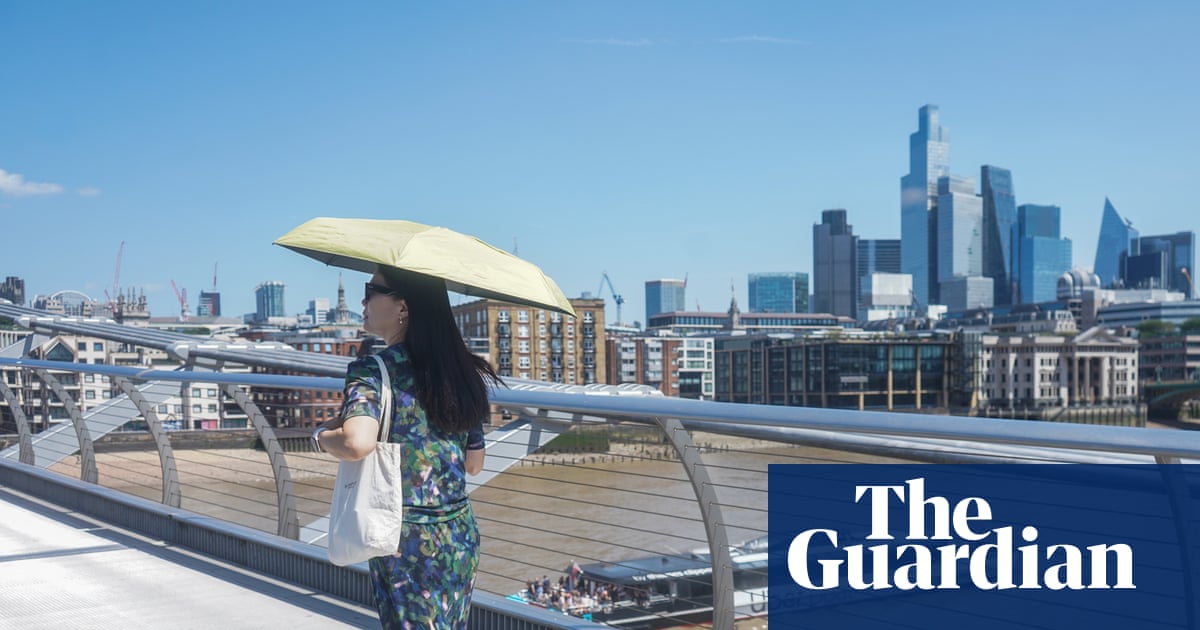
Met Office forecasters have issued a rare red weather warning for Wednesday and Thursday in the face of extreme heat and humidity, while a red heat health alert has been issued in England indicating “a risk to life for even the healthy population”.

The weather warning covers southern Wales as far west as Swansea, and an area of England that includes London and runs from the inland areas of Kent across to Somerset, as far north-west as Birmingham, and as far north-east as southern Cambridgeshire.

People in those areas have been told to take immediate action to keep themselves safe as the UK prepares for dangerously high temperatures.

The UK Health Security Agency (UKHSA) issued a red heat alert for six regions of England.

The West Midlands and East Midlands, the south-east and south-west, London, and the east of England are covered from 1am on Wednesday until 11pm on Thursday. It is only the second red heat health alert to be issued. The first was in July 2022 when temperatures exceeded 40C (104F).

The “area now looks increasingly likely to see a two- to three-day period where maximum temperatures in the shade exceed 37C, perhaps rising to 38 to 40C in some places”, forecasters said. “The heat will be accompanied by high humidity, exacerbating the potential for discomfort and health impacts, with very warm and humid night times also reducing the ability for people to recover overnight.

“Significant disruption to daily life is likely and the public should take every effort to make precautions and adapt their daily routines where possible to cope with these levels of heat, which up to now have been extremely rare for the UK.”
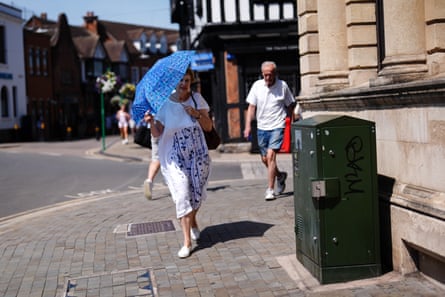
An amber warning – serious in its own right – also incorporates almost all of the rest of Wales, and most of the rest of England across to Cornwall, and up to Yorkshire and Lancashire.

A red weather warning, which indicates high degrees of both likelihood and impact on people’s lives, is rare in the UK. It means “dangerous weather is expected and, if you haven’t already done so, you should take action now to keep yourself and others safe”.

Met Office forecasters say such severe conditions present a genuine risk to life, with “substantial disruption to travel, energy supplies and possibly widespread damage to property and infrastructure”.

Bill McGuire, a professor emeritus of geophysical and climate hazards at University College London, said temperatures of more than 43C were possible in the UK’s current climate, with heatwaves lasting for several days.

But the country’s health services, energy infrastructure and transport are “simply not built for these conditions”, hesaid. “As 40+ temperatures become ever more common, expect many thousands sleeping in the streets as poorly insulated homes become uninhabitable heat traps, widespread power cuts as power cables sag and break, transport chaos as rails, overhead wires and signalling fail, and A&E departments overwhelmed by the old, very young, and vulnerable suffering from overheating.”

Friederike Otto, a professor of climate science at Imperial College London, said: “Our first 40C day was supposed to be a wakeup call, but clearly someone hit snooze. Hitting 40C again, and in June this time, would be incredibly alarming.

“There’s a sad inevitability to all of this, with scientists like me trotting out the same quotes year after year. Yes it’s climate change, yes it’s us, no it’s not El Niño. Simply put, we remain on a one-way trip towards a more dangerous future, and it’s time we hit the brakes.

“Right now, children are struggling to finish their exams in sweltering classrooms and the elderly are enduring dangerously hot homes and care facilities with little relief. This heat is not an inconvenience, it is a growing public health threat. Every heatwave puts lives at risk, and it’s long past time we treated it with the urgency it demands.”

Some schools are closing early this week to avoid the worse of the heat. Among them is Kingdown school in Warminster, Wiltshire, where lessons will finish at 12.25pm from Monday to Thursday for the “safety and wellbeing of our students and staff”.

Other schools are relaxing uniform rules, limiting vigorous PE lessons, relocating classes to cooler spaces and making sure additional water is available. At Kingsholm C of E primary school in Gloucester, where the school day is finishing at 1.30pm, children have been advised to wear PE kits to school.

The general secretary of the school leaders’ union NAHT, Paul Whiteman, said: “While there is no legal ‘upper limit’ for temperature in schools, they will certainly be doing all they can to mitigate the effects of such high temperatures.

“For most, this will mean making straightforward adjustments such as limiting the time spent in the sun during breaks, ensuring additional water is available, making adjustments to uniform expectations where appropriate and ventilating classrooms as best they can.

“If, as it appears, warmer summers are going to become the norm, then government really does need to act more urgently to improve and modernise school buildings, including a focus on ventilation and potentially air conditioning.”

The Department for Education does not normally advise schools to close in hot weather, insisting it can usually be managed safely. It advises sunscreen, relaxing uniform rules, adapting PE lessons and ventilation.
Bare bums brave the cold for Hobart’s Dark Mofo annual nude solstice swim – in pictures | Dark Mofo | The Guardian

Keyword – Culture
Trefwoorden – Dark Mofo, Swimming, Tasmania, Hobart, Festivals
Title – Bare bums brave the cold for Hobart’s Dark Mofo annual nude solstice swim – in pictures | Dark Mofo | The Guardian
Author –
Link – Bare bums brave the cold for Hobart’s Dark Mofo annual nude solstice swim – in pictures | Dark Mofo | The Guardian
Publish date – 2026-06-22T02:38:44.000Z
Category – Culture
URL – https://www.theguardian.com/culture/gallery/2026/jun/22/dark-mofo-nude-solstice-swim-hobart-tasmania-in-pictures

Clive Davis: a life in pictures from Diana Ross to Aretha Franklin | Music | The Guardian

Keyword – Music
Trefwoorden – Music, Culture, Music industry, Whitney Houston, Aretha Franklin, Diana Ross, Pop and rock
Title – Clive Davis: a life in pictures from Diana Ross to Aretha Franklin | Music | The Guardian
Author – https://www.theguardian.com/profile/guardianmusic
Link – Clive Davis: a life in pictures from Diana Ross to Aretha Franklin | Music | The Guardian
Publish date – 2026-06-22T17:21:30.000Z
Category – Culture
URL – https://www.theguardian.com/music/gallery/2026/jun/22/clive-davis-photos

‘They didn’t know or care, or wouldn’t say’: how we investigated the casualties of a covert US war | Press freedom | The Guardian

Keyword – Membership
Trefwoorden – Press freedom, Media, Newspapers & magazines, Somalia, Al-Shabaab, Drones (military), Middle East and north Africa, US foreign policy
Title – ‘They didn’t know or care, or wouldn’t say’: how we investigated the casualties of a covert US war | Press freedom | The Guardian
Author – https://www.theguardian.com/profile/gautam-malkani
Link – ‘They didn’t know or care, or wouldn’t say’: how we investigated the casualties of a covert US war | Press freedom | The Guardian
Publish date – 2026-06-21T09:00:26.000Z
Category – News
URL – https://www.theguardian.com/membership/2026/jun/21/they-didnt-know-or-care-or-wouldnt-say-how-we-investigated-the-casualties-of-a-covert-us-war

T here are many reasons why some military conflicts go unreported or underreported. Local restrictions on press freedom. Prohibitively high risks to journalists’ safety. A lack of resources. The tendency for geopolitical conflicts to attract more attention than civil conflicts. And the sheer number of armed conflicts around the world right now. All these factors can also impede reporting on the humanitarian toll, civilian casualties and attempts to hold armed forces accountable.

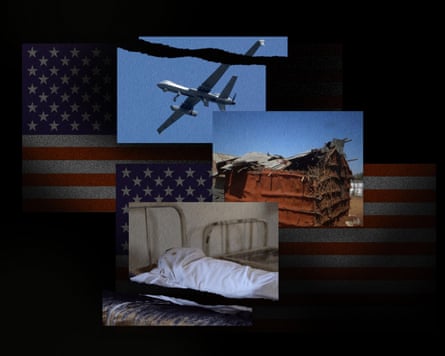
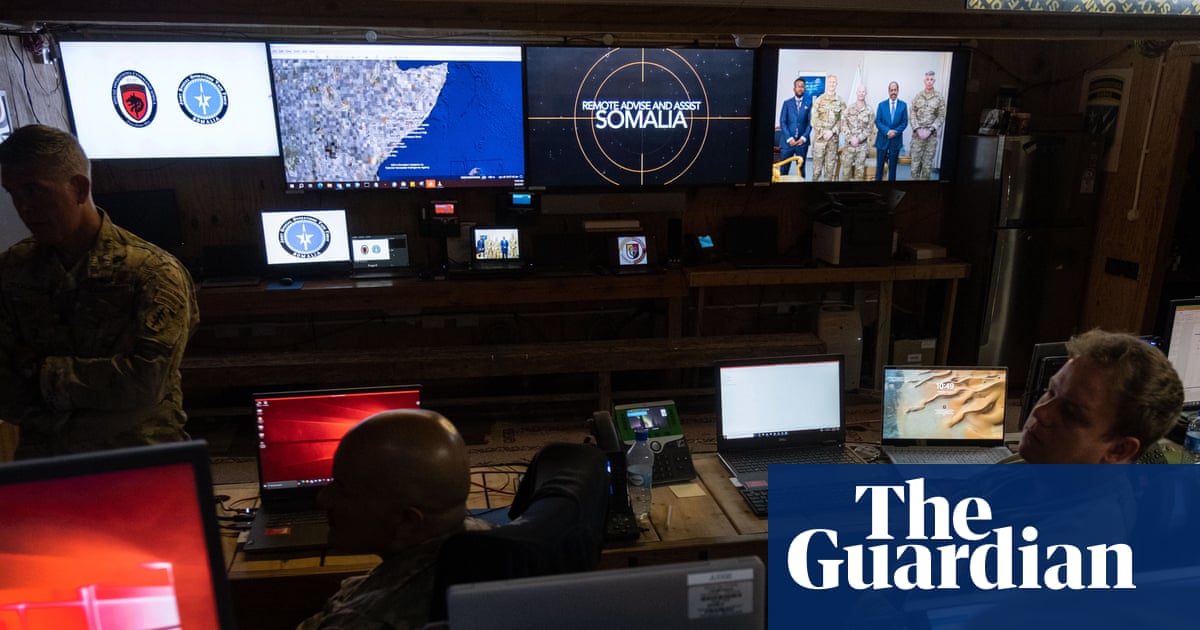
Earlier this week, the Guardian published an investigation into the deaths of at least 12 civilians, including eight children, who were killed in a US airstrike in Somalia last year amid Washington’s covert military campaign against the Islamist militant group al-Shabaab. The articles, which are part of our Rights and Freedom series, are an example of the Guardian’s efforts to highlight conflicts that might otherwise receive little public attention.

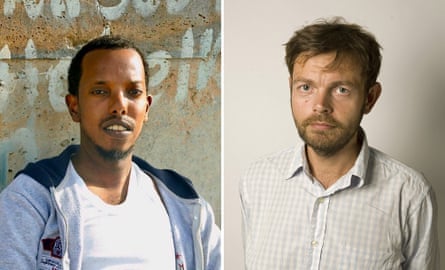
“We’re reporting on this in the hope that the information and the Guardian’s reach will cut through,” says Mark Townsend, a senior global development reporter who worked on the investigation with Mohamed Gabobe, a freelance journalist and producer based in Mogadishu. “But it’s a very hard conflict to actually report on. Even excellent reporters like Mohamed can’t travel to areas controlled by al-Shabaab where this war is being conducted. And civilians in those areas aren’t allowed internet access or smartphones, so getting footage of strikes or images of the aftermath and victims and all the things you’d want to corroborate testimony is very difficult. On top of that, the US doesn’t release anything about what’s going on – it’s a very opaque campaign.”

The airstrike in question happened in November in the town of Jamaame. It was the deadliest US operation for civilians in Somalia during either Trump administration, and the bombing has become increasingly aggressive .

Mohamed says the impact on civilians caught up in the US drone war is all-too often overlooked by western news organisations. “I sometimes get the sense that many western media outlets view civilian casualties from US airstrikes in Somalia as a norm and part of everyday life,” he says. “But death shouldn’t be normalised, especially when the most powerful nation in the world is doing it on communities that have nothing to do with the armed parties involved in the Somalia conflict.”

Mohamed and Mark’s collaborative reporting illustrates how these kinds of hidden military operations can still be properly probed instead of neglected or normalised. As well as close cooperation between the Guardian and a well-connected journalist with local expertise, the investigation involved piecing together disparate sources of information in the absence of official records and documentation, and putting the findings to the relevant authorities.

“When it comes to this model of working, I think it varies depending on the particular news organisation,” says Mohamed, who has been a journalist for 10 years and first reported for the Guardian in 2022. “For instance, some western media outlets allow the local journalist in the field to take the lead, and once the work is done they’ll continue to coordinate with that local journalist to make sure the story is told in an accurate and authentic way. Meanwhile with others, once you do the work, they will overlook the knowledge and context of the local journalist and will release the story in a manner that fits their narrative – which isn’t always accurate and, in some cases, is biased, sometimes without them even knowing.”

Mark, who has reported for the Guardian and its former sister newspaper, the Observer, for 24 years, has worked on several similar collaborations with local journalists in other countries. “Obviously, it requires trust on both sides,” he explains. “It’s a collaboration in the most complete sense. But Mohamed did the hard yards here in terms of the on-the-ground reporting, so whatever feedback he had – for instance if something needed to be changed or slightly nuanced – then he got the final say, as far as I was concerned because it’s his lived experience, he’s the expert.”

Mark first contacted Mohamed after Tess McClure, an editor for the Guardian’s Rights and Freedom series, first spotted reports of a high number of children killed in last November’s airstrike.

Given the physical restrictions and risks of prosecution for reporting from al-Shabaab-controlled areas, Mohamed had to improvise. “I reached out to clan elders in Mogadishu,” he explains. “Clan elders are the leaders and decision-makers when it comes to the affairs of each respective clan and sub-clan in Somalia. By negotiating with them and explaining my intentions and the importance of survivors speaking out, they helped put me in touch with some of the victims.”

The survivors’ accounts of that day bring home the devastating reality of the drone strikes for civilians caught up in the conflict. “One of the biggest challenges was asking the victims who’d lost loved ones in the attack certain questions that went into details about the bodies of their loved ones, or the screams they heard once the aerial bombardment ceased,” says Mohamed. “I don’t like asking people those kinds of questions – it feels like you’re making them relive horrors that no human being should endure. When asking these questions, if the victim pauses, I get the sense that they’re having a flashback. And if they weep or whisper a prayer, or even make a reference to a verse of the Qur’an, then I know they’re hurting a lot. But these details are crucial for putting together what actually happened.”

Alongside the witness testimony, Mohamed and Mark also pieced the story together using photographs, video footage, X-rays of children’s shrapnel injuries, interviews with drone specialists and military analysts. Mark put about 30 detailed questions to the recently renamed US Department of War. They did not respond. The White House was also approached for comment and their eventual response, which is quoted in one of the articles published this week, is a stark reminder that the current US administration presents its own kind of hostile environment for journalists.

“It’s very important that their response was included in the article because it shows how they’re doing these things without any kind of transparency or proper legal course,” says Mark. “They didn’t know, didn’t care, or wouldn’t say. Either way, it’s pretty dire if you’ve killed innocent people – you’d think you’d feel a responsibility to work out why.”

The articles contain a series of urgent and unanswered questions, such as who signed off the attack on a densely populated family neighbourhood? Why and who, if anyone, was the intended target? The questions provide a powerful accompaniment to the witness testimonies. “Their refusal to share anything about what happened is in itself a galvanising factor,” says Mark.

Mark’s extensive and acclaimed reporting on the wars in Sudan and the Democratic Republic of the Congo has demonstrated that readers are willing to pay attention to underreported conflicts: “Readers have responded brilliantly to our reporting about Sudan and the DRC, which are knotty conflicts that are quite complex. Readers do really care, which is very reassuring. Whether or not the wider world does, I’m not sure, but our readers do.”

This article is taken from the Guardian’s weekly email for supporters, sent on Tuesdays. To support the Guardian’s work, please click here . To find out more about theguardian.org, please click here

Interstellar comet may be oldest object seen in our solar system, scientists say | Comets | The Guardian

Keyword – Science
Trefwoorden – Comets, Space, Science, The sun, Nasa, Astronomy, James Webb space telescope, Seti (Search for Extraterrestrial Intelligence)
Title – Interstellar comet may be oldest object seen in our solar system, scientists say | Comets | The Guardian
Author – Daniel Lawler
Link – Interstellar comet may be oldest object seen in our solar system, scientists say | Comets | The Guardian
Publish date – 2026-06-22T16:37:49.000Z
Category – News
URL – https://www.theguardian.com/science/2026/jun/22/interstellar-comet-may-be-oldest-object-seen-in-our-solar-system-research-finds

An interstellar comet that blazed past the sun last year could be nearly three times older than our solar system and is unlike anything ever before seen in our cosmic back yard, astronomers said on Monday.

The comet 3I/Atlas is just the third visitor from beyond our solar system that humanity has ever observed, its unusual brightness offering scientists an unprecedented opportunity to study something that came from elsewhere in the galaxy.

After being spotted in July last year, the space rock prompted excitement online, with one prominent Harvard researcher speculating it could be an alien spacecraft: a theory that Nasa shot down . Now, observations made by the world’s most powerful telescopes are revealing more about the unique comet.

According to a study published in the journal Nature, 3I/Atlas could be up to 12bn years old. Our solar system is believed to have formed about 4.5bn years ago.

The lead study author, Martin Cordiner of Nasa’s Goddard Space Flight Center, told Agence France-Presse that “maybe it’s the oldest object to have been observed in our solar system”. However, there could be “edge-case scenarios” that offer other explanations for the comet’s unusual chemical composition, he added.

The new research is based on the comet’s ratio of chemical elements called isotopes detected by the James Webb space telescope and the Alma observatory in Chile. These measurements “reveal an elemental composition unlike any solar system body”, the study said.

Compared with comets in our solar system, 3I/Atlas has 10 times more deuterium, a type of hydrogen commonly seen in heavy water, according to the study. “That high abundance of heavy water can only really happen, according to our understanding of astrochemistry, in a very cold environment,” Cordiner explained.

This means the comet is also probably among the coldest objects ever seen in our solar system, the isotopic evidence suggesting it formed in an environment that was -243C (-405.4F).

Exactly where this comet came from within the Milky Way remains a mystery, but these interstellar objects are thought to form in a similar way to the comets in our solar system – being flung out during the violent formation of a new planet. Untethered to any star, 3I/Atlas likely spent billions of years on “vast unimaginable trajectories around our galaxy”, Cordiner said.

The scientists also detected a strange lack of chemical enrichment on the comet, which suggests it formed relatively close to stars being born. It could even be a “relic” from an era called “cosmic noon” when many stars were forming approximately 10bn years ago, Cordiner said.

The previous interstellar objects – 1I/’Oumuamua, which was spotted in 2017, followed by 2I/Borisov in 2019 – were not bright enough to gather isotopic evidence. The Harvard professor Avi Loeb, who had previously sparked controversy by suggesting ’Oumuamua could be an alien spacecraft, made similar suggestions about 3I/Atlas.

However, Nasa dismissed this possibility. The Search for Extraterrestrial Intelligence Institute (Seti) said last month it had found “no evidence of extraterrestrial technology” on the comet.

The astronomer Peter Vereš, who was involved in identifying the comet at the International Astronomical Union’s Minor Planet Center, called the research “exciting”. “The comet is now leaving the solar system and will never return, so future observations will become increasingly difficult,” he told AFP.

However, astronomers expect to spot many more interstellar objects in the coming years, particularly thanks to the new Vera C Rubin observatory in Chile. “This is just the beginning of an exciting new field, we’ve got a lot more to learn about these things – and what they can tell us about our galaxy,” said Cordiner.

L’Équipe apologises to Belgian footballer Jérémy Doku for presenter’s comments | World Cup 2026 | The Guardian

Keyword – Football
Trefwoorden – World Cup 2026, Belgium, Football, France, Media, Europe, Parents and parenting, Pregnancy, Sport, World Cup
Title – L’Equipe apologises to Belgian footballer Jérémy Doku for presenter’s comments | World Cup 2026 | The Guardian
Author – https://www.theguardian.com/profile/ashifa-kassam
Link – L’Equipe apologises to Belgian footballer Jérémy Doku for presenter’s comments | World Cup 2026 | The Guardian
Publish date – 2026-06-22T19:40:42.000Z
Category – Sport
URL – https://www.theguardian.com/football/2026/jun/22/lequipe-apologises-belgium-footballer-jeremy-doku-birth-child-presenter-comments

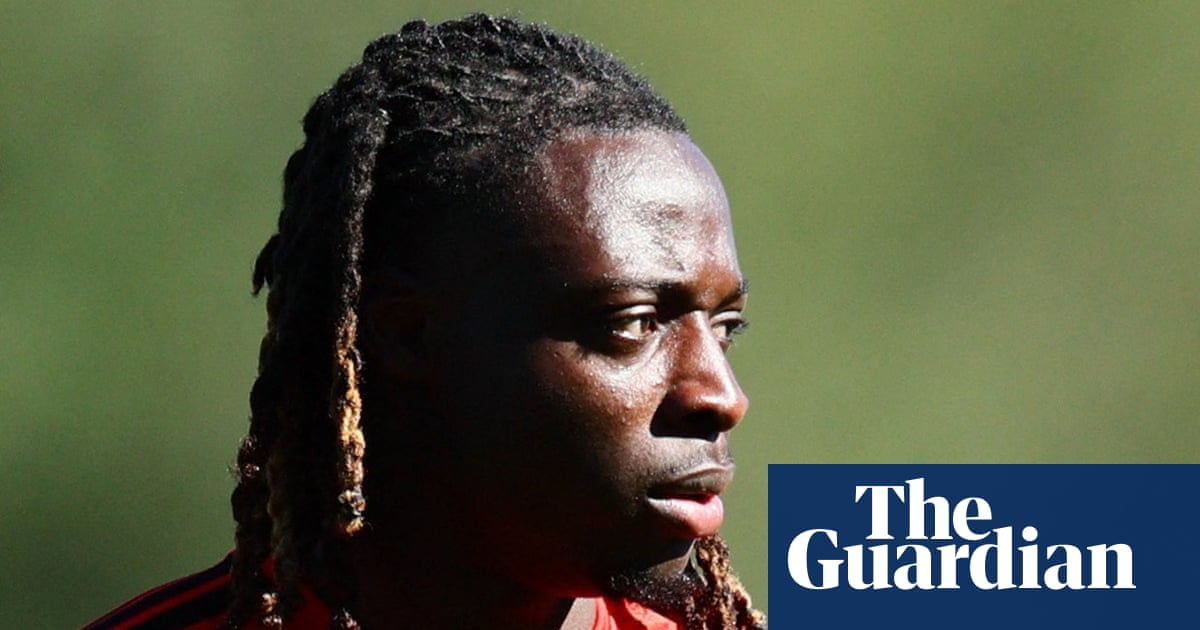
The French media outlet L’Équipe has apologised to the Belgian footballer Jérémy Doku after he was criticised by one of its pundits for saying he would duck out of the World Cup to be present at the birth of his first child.

News of the apology came as the Belgian football federation said Doku had made it back to London in time to be with his wife Shireen, who gave birth to a boy called Praise ⁠on Monday.

“Jeremy received news before yesterday’s match that the birth was imminent,” the team ⁠doctor, Brahim Hacene, said in a statement. “Everything went perfectly, and the mother, father, and baby are all doing wonderfully. Jérémy will rejoin the squad [on Tuesday] evening in Seattle.”

Last week Doku had told reporters that Shireen was due to give birth in the second week of July and, should Belgium still be in the tournament by then, he was hoping to go home for the birth . “It depends on when it happens, but it’s my first child, so I ‌would ⁠definitely want to be there,” said Doku, Belgium’s 24-year-old winger, who plays for Manchester City. “If you ask me what I want, my answer is that nobody wants to miss the birth of their first child … I know the federation supports its players and understands their situations. We’ll see what we can do.”

His comments drew short shrift from France Pierron, a presenter with L’Équipe, who on Friday cited the “hundreds of footballers who would kill” to be playing in Doku’s place at the World Cup. “You’re living out a childhood dream, yet you’re going to walk away ‌from it all to attend the birth of your child – a disgusting moment, if you’ll pardon the expression, where the dad is completely useless,” she said. “He just holds your hand and takes a photo.”

Her view echoed the criticisms already made last week, when one of Doku’s former youth coaches told Belgian media that the player had already made his choice by turning up at the World Cup. “It may sound harsh, but if you’ve chosen to be there, you’ve chosen to play,” Peter Janssens told the news site VRT. ”The baby will still be there afterwards.”

The former Belgium international Gert Verheyen made light of the decision, asking what Doku would do while his wife was giving birth. “The only thing you can say is: ‘You’re doing great, keep going,’” he said. It wasn’t long, however, before it was Pierron being criticised, amid a global conversation on the intersection of sport and modern-day fatherhood. As her remarks went viral, voices from across the world of football and beyond lined up behind Doku.

“Shame on you,” the content creator Caroline Salame, who played for Canada at the Under-17 World Cup in New Zealand, told the TV presenter on social media. “As someone who has played in a World Cup and who has also given birth, let me tell you this: the hardest thing I have ever done in this lifetime – and the thing that I am most proud of – is bringing my baby earthside,” she said. “And I do not know how I would have done that without my husband beside me. Birth can be extremely complicated; anything can happen.”

Pierron’s comments were also challenged by a fellow commentator on L’Équipe. The retired boxer Brahim Asloum, who won light-flyweight gold for France at the 2000 Olympics in Sydney, immediately took umbrage with Pierron’s claims, describing the birth of a child as a singular, once in a lifetime moment. “A baby is your entire life. A World Cup is over when it is over,” he said.

As a furore mounted online, Pierron appeared on social media to apologise. “These remarks are solely my own and in no way reflect a collective position. I understand that they may have shocked, offended or hurt some of you, and I am sorry for that. My intention was never to minimise the place or role of fathers with their partners and children,” she wrote.

In a statement published late on Sunday, L’Équipe distanced itself from the comments made by Pierron, saying they had “shocked” many of its viewers. “L’Équipe distances itself with these remarks, which are far removed from [its] values and apologises to the footballer concerned and more broadly to its audience,” it said. The TV channel of the French sports newspaper was reported by AFP to have said on Monday that Pierron would remain off-air until the end of the current season of her show on 3 July.

Critics remained unimpressed. “It seems ridiculous to me that we still have these big outrages, when men talk about wanting to do the most basic human thing imaginable, which is to be present when their baby is born,” said Jeremy Davies of the Fatherhood Institute in the UK.

He described Doku as setting a “refreshing” example by demonstrating that one can be more than just a top-ranked footballer. “To me, it’s like we haven’t moved on from the sort of gladiators in the Colosseum. You know, these kinds of masculine heroes who are supposed to have no softness to them, no family commitments or anything like that,” he said. “You can be a soft and loving man and hard as nails on the pitch, if you like.”

He applauded the footballer for having the “perspective” to see the broader picture. “In the end, fine – football is important, everybody loves football, everybody gets terribly excited. It’s just a job, on some level, too,” he said. “This footballer gets it, and it seems to me that’s a healthy attitude in life. And if more of us had it, maybe the world would be a better place, you know?”

Julián Quiñones, Blackness in Mexico and the complexities of national identity | World Cup 2026 | The Guardian

Keyword – Football
Trefwoorden – World Cup 2026, World Cup, Mexico, Football, Sport
Title – Julián Quiñones, Blackness in Mexico and the complexities of national identity | World Cup 2026 | The Guardian
Author – https://www.theguardian.com/profile/raul-vilchis
Link – Julián Quiñones, Blackness in Mexico and the complexities of national identity | World Cup 2026 | The Guardian
Publish date – 2026-06-22T12:22:53.000Z
Category – Sport
URL – https://www.theguardian.com/football/2026/jun/22/julian-quinones-mexico-world-cup-blackness-race-identity

O n a March night in Guadalajara in 2024, Club América were winning El Clásico Nacional. Julián Quiñones, their star player, had scored and headed toward the sideline. Then a shout at Quiñones, who is Black, rang out from the stands. ¡Puto negro! A racial slur.

Moments later, monkey noises were heard in the stands. The scene was familiar to anyone who follows Mexican soccer. Cell phone videos captured it. Commentators analyzed it the next day. Officials condemned it. Investigations were announced. For a few days, the Mexican game went through its ritual of shock.

Then the season continued. Another match, another transfer rumor, another refereeing controversy. That June, Quiñones moved to Al-Qadsiah in Saudi Arabia, where he would become the league’s top scorer. The incident was lost in the vast archive of soccer’s weekly dramas. Or so it seemed.

Less than two years later, another Mexican stadium produced another uproar. This time it was a celebration.

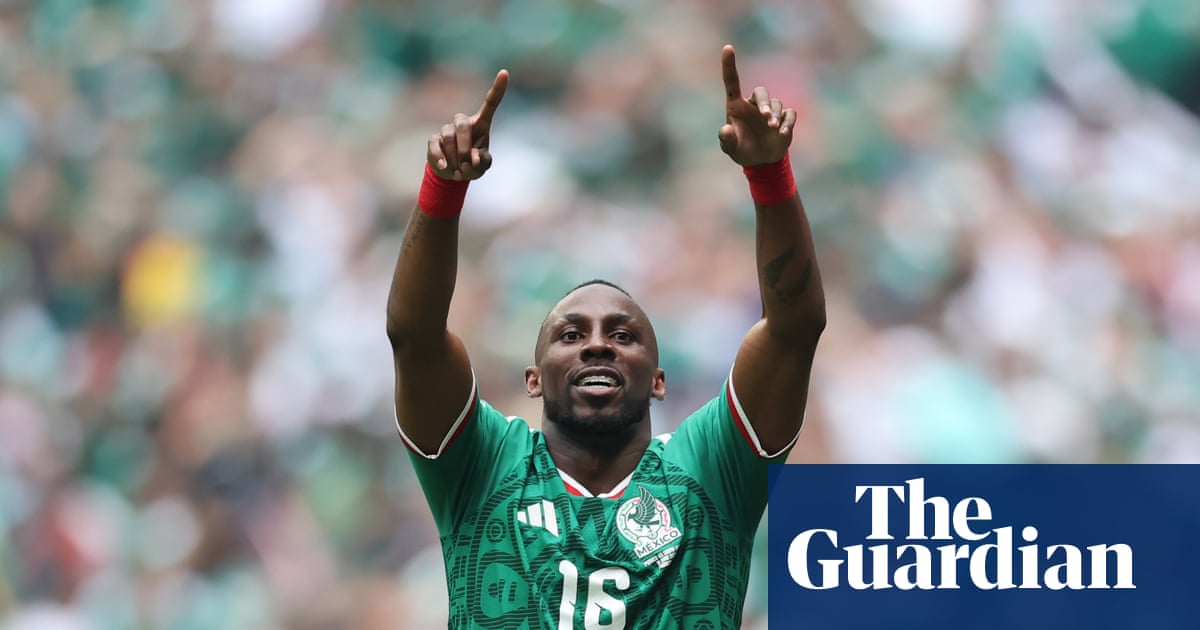
On 11 June, Quiñones scored Mexico’s first goal in the 2026 World Cup, the opening triumph in a tournament played on home soil for the first time in four decades. Tens of thousands rose to their feet. Television commentators chanted his name. Images of the striker draped in the Mexican flag flooded social media. The same culture that had publicly denigrated him hailed him as a national hero.

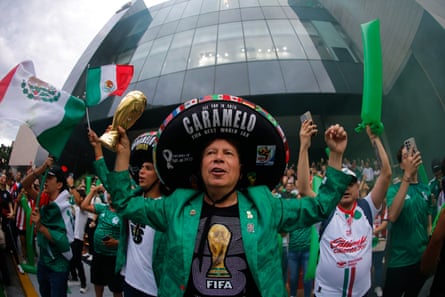
This week, Quiñones returned to the same stadium in Guadalajara where the racist chant had been heard in 2024. Before Mexico’s second group-stage game against South Korea on Thursday, crowds wearing Mexico jerseys and oversized sombreros gathered outside the hotel housing the national team. When Quiñones appeared they shouted in unison: ¡Quiñones, hermano, ya eres Mexicano! “Quiñones, brother, now you are Mexican.”

It was an embrace for the Mexican national, but still a tentative one. The chant is usually reserved for foreigners who have shown an affinity with Mexico, not for Mexican passport holders like Quiñones.

These moments, so close in time yet distant in spirit, capture all the contradictions of how modern Mexico is grappling with its own national identity.

Karma Frierson, who teaches Black studies at the University of Rochester and has written about Black culture in Mexico, said the discourse around Quiñones’s goal, and the fact that he is Black, was one of surprise. “This surprise speaks to the expectations people still have about what a Mexican person looks like. So, you have this dissonance,” she said. “You know that the player, by virtue of wearing the jersey is of that nationality, but you never imagined that person would look a certain way.”

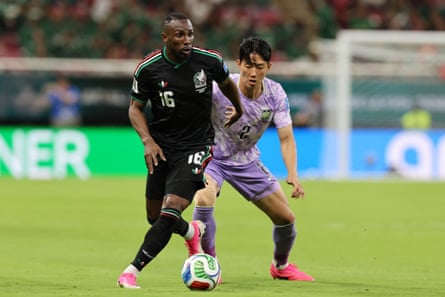
Q uiñones, 29, was born in Colombia, arrived in Mexico in 2015 and forged his career in Liga MX. He became a naturalized Mexican citizen in 2023 and was first called up to the national team that same year. His inclusion on the World Cup squad raises a question about race that Mexico has tried to avoid for much of its modern history: who has the right to be Mexican?

The answer is wrapped up in the national soccer program’s future, which increasingly lies beyond Mexico’s borders.

For much of the 20th century, the national team was primarily comprised of players developed within its own territory. Today, however, the pool of Mexican talent extends across a transnational landscape shaped by migration and family networks.

It is possible that the most important soccer recruiting ground for the Mexican federation is no longer a state within Mexico, but rather in California or Texas. A new generation of Mexican-American players is emerging north of the border, including more Black players. Two of the most promising young prospects for Mexico’s program were born in the United States to Mexican mothers and African American fathers. Antonio Leone and Da’vian Kimbrough, both born in California, have represented Mexico’s youth teams.

Other recent stars have come from farther south. In recent years, Giovani and Jonathan dos Santos played on the national team. Their father was the Afro-Brazilian footballer Zizinho; their mother is Mexican. Melvin Brown, who was of Jamaican descent through his paternal grandfather, represented Mexico at the 2002 World Cup.

None of these players fit neatly into the visual stereotype often associated with Mexican nationality.

“Historically, Mexican society doesn’t talk about race,” Frierson said. “The promise of mestizaje was that there is no race because we are all one race.”

The concept of mestizaje – the idea that Mexico emerged from the fusion of Indigenous and European peoples – became one of the founding myths of the modern Mexican state. After the Mexican revolution, it offered an appealing narrative for a fragmented nation. Instead of emphasizing difference, it emphasized mixing. Instead of multiple peoples, it envisioned a single people.

Versions of this ideology emerged throughout Latin America, and served as a powerful contrast to the racial order of the United States. While the US openly grappled with segregation and racial classification, many Latin American countries embraced the notion that mixing itself had dissolved such distinctions.

The promise was seductive. The reality proved to be more complex.

Discrimination and racism against Black people in Mexico are still prevalent but often dismissed. When South Africa hosted the World Cup in 2010, Mexico’s largest broadcaster Televisa featured characters in blackface and afro wigs wearing animal skins and wielding spears. In 2018, on major broadcaster TV Azteca, reporter Carlos Guerrero appeared in blackface during a broadcast of a Liga MX game . The networks received criticism but many people brushed the incidents off as jokes.

Black players in Liga MX – Colombian striker Darwin Quintero, who played for América, and Panamanian defender Felipe Baloy, who played for Santos Laguna – have accused rival teams of racist insults. In 2021, Ecuadorian Félix Torres, a defender for Santos Laguna, left the field in tears after reporting alleged racist insults from Germán Berterame, then a player for Atlético de San Luis. While the Mexican Football Federation investigated those incidents, officials said they could not be corroborated and no disciplinary action was taken.

Quiñones himself mostly shrugged off the 2024 racist incident in Guadalajara. In an Instagram statement at the time, he spoke out against online harassment of his daughters – “you can say whatever you want to me, but don’t mess with my daughters” – and said he was “mentally strong enough to handle any kind of insult, especially when it’s about my skin color, which is the most frequent type of message I receive”.

Having a Black player excel at a home World Cup may help bring race to the forefront of Mexican culture in a way that it hasn’t before, Frierson said.

At the same time, Mexican players who travel to the US to play in Major League Soccer are also bringing new perspectives back home. Jonathan dos Santos, in a 2020 interview when he was playing for LA Galaxy, said he felt comfortable in the US because he didn’t receive racist taunts.

“It’s truly sad to hear the insults, the racism. I’ll never understand it,” he said at the time. (He said he also experienced racism in Spain, where he played for Barcelona and Villarreal.) “I think many countries have to learn from the United States regarding the respect shown to athletes.”

Opening up a discussion about race in the country’s national sport, could lead to a broader exploration of Mexico’s own history, which includes roots in Africa. During the colonial period, hundreds of thousands of enslaved Africans were brought to New Spain. Their descendants built communities throughout the territory, especially in Veracruz and along the Costa Chica of Guerrero and Oaxaca. They participated in the formation of Mexican society from its very beginnings. Vicente Guerrero and José María Morelos were both heroes of Mexican independence with Afro-Mexican roots, though that heritage is not often mentioned.

“Blackness is incorporated into the very fabric of the nation,” Frierson said.

Seen from this perspective, it’s not just that Mexican soccer today is becoming more diverse. It’s that race in Mexico is becoming more visible.

Soccer, at times, can be a national mirror. A national team represents not just a country, but an idea of the country. The World Cup is one of the few remaining spaces where nations are publicly showcased. Every starting lineup announcement, every anthem, every goal becomes a debate – sometimes conscious, often unconscious – about who belongs.

Mexico is changing. Digital nomads from Europe and the US are setting up shop in Mexico City, opening trendy coffee shops and stores that resemble those in other international capitals. People from Haiti, Cuba and South America have settled in the country at unprecedented levels, some discouraged from migrating to the US. And some Mexicans who had been living in the US for decades are now returning home with their American families, either voluntarily or after deportations. The Mexican national team is beginning to show a bit of that diversity: the World Cup squad includes a player born in Spain, Álvaro Fidalgo; another born in Alaska, Obed Vargas; one born in Argentina, Santiago Giménez; and Quiñones, who was born in Colombia.

Quiñones is challenging the expectations many still hold about what a Mexican is supposed to look like. Mexican diversity has always existed, but soccer possesses a unique ability to bring that reality to light.

A player scores a goal. The crowd rises. Cameras search for a face. And, for an instant, a nation contemplates itself. Not necessarily as it imagined itself to be, but as it has been all along.

How paragliding soldiers carrying bombs rain destruction on Myanmar’s villages | Myanmar | The Guardian

Keyword – Global development
Trefwoorden – Myanmar, South and central Asia, Human rights, World news, Conflict and arms, War crimes
Title – How paragliding soldiers carrying bombs rain destruction on Myanmar’s villages | Myanmar | The Guardian
Author – https://www.theguardian.com/profile/harriet-barber
Link – How paragliding soldiers carrying bombs rain destruction on Myanmar’s villages | Myanmar | The Guardian
Publish date – 2026-06-22T10:00:22.000Z
Category – News
URL – https://www.theguardian.com/global-development/2026/jun/22/myanmar-paragliders-junta-bombs-light-aircraft-civilians

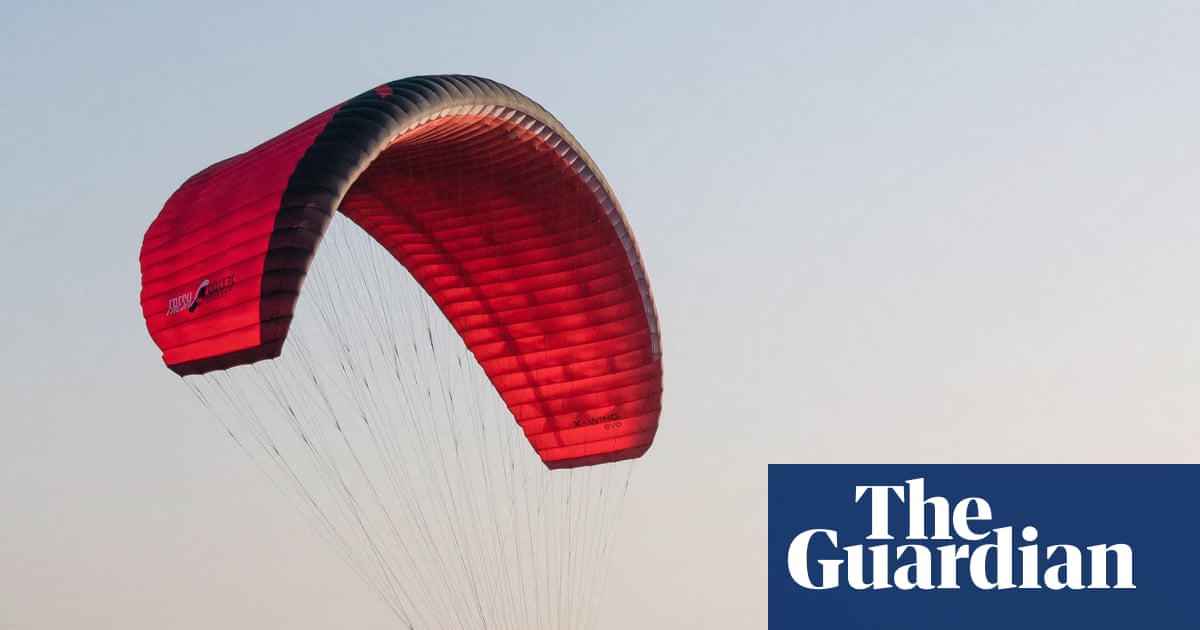
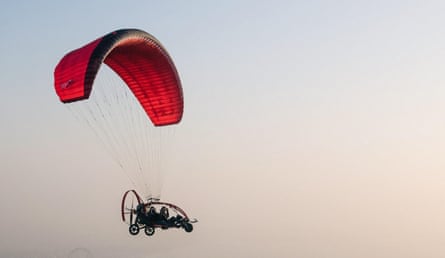
T hey appear after midnight, slowly crossing Myanmar’s skies. The motorised paragliders are improvised aircraft, suspending small metal frames from brightly coloured sails. They drift over a patchwork of villages, farmland, forests and winding rivers.

Each “paramotor” has two or three soldiers strapped in – one piloting, the others holding the bombs. Their craft are powered through the sky by small, rattling engine propellers, heading towards the lowland villages. Finally, switching their engines off to glide low and near silently through the dark, the men throw their explosives.

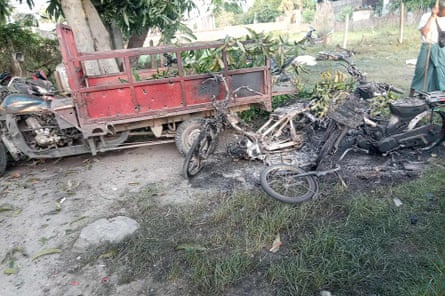
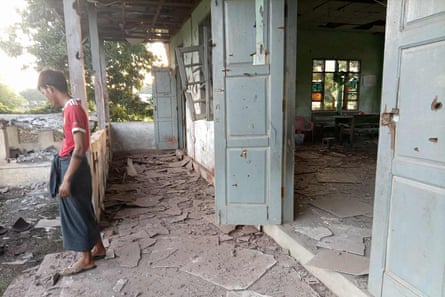
The destruction is immediate and devastating. Attacks can last several minutes, with bombs weighing up to 16kg (35lb) each dropped in quick succession. Homes are torn apart, schools and religious buildings destroyed – and civilians killed or injured as they sleep. The villages descend into panic and confusion, with families fleeing into the darkness and emergency workers digging through debris for the wounded.

“People try to run to the bomb shelters. But there is usually not enough time,” says Lwan Thu, an activist in the Sagaing region, which has been heavily bombed by the paramotors. “There are scores of dead and injured after the strikes.”

Often, as rescue teams are still digging through the rubble, the telltale chainsaw-like sound of engines heralds the gliders’ return. In these “double-tap” attacks, more bombs are dropped, striking people who have rushed to help victims of the first blasts.

What began as a handful of attacks in late 2024 has rapidly evolved into a nationwide tactic as Myanmar’s civil war grinds into its sixth year. Data collected by the conflict monitor Acled recorded just two incidents involving paramotors in 2024. By 2025, that figure had surged to 353. More than 100 attacks were recorded in the first five months of this year alone.

In 2025, the Myanmar military added another aerial asset: the gyrocopter, a small rotor-propelled aircraft capable of flying faster, higher and over longer distances than paramotors. Acled recorded 69 incidents involving gyrocopters in 2025 and a further 74 in the first four months of 2026.

The data suggests the attacks have resulted in hundreds of casualties and deaths, though analysts say the true toll is probably higher.

“We’re facing constant strikes by these new aircraft,” says Lwan Thu. “They are using them to attack everything – civilians, hospitals, religious ceremonies, residential homes.”

Myanmar’s military junta seized power five years ago, crushing a decade of democratic reforms and imprisoning much of the elected government. Peaceful protests against the coup met lethal force, igniting a nationwide conflict between the junta, pro-democracy resistance groups and long-established ethnic armed groups. Thousands of people have since been killed and more than 3.6 million displaced, according to UN figures.

In recent years, resistance forces have seized territory from the military, prompting the junta to expand its air power with improvised aircraft – typically used by explorers and hobbyists – to strike opposition-held areas beyond the reach of its ground troops. “It’s a significant development in this conflict,” says Su Mon, a senior Asia-Pacific analyst at Acled. “The impact is devastating.”

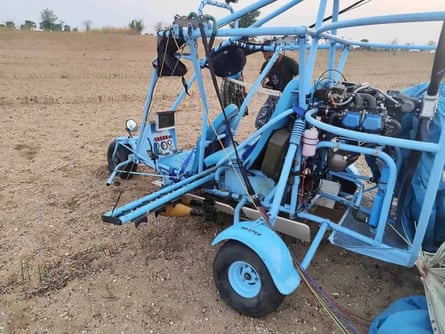
Unlike military jets, these lightweight aircraft require little infrastructure, use small amounts of fuel, are cheap to buy and are hard to track, evading detection from early-warning systems. Soldiers can be trained to operate them in a matter of days, rather than the years needed to fly conventional aircraft.

Buying paragliders, which are widely available commercially, also allows the junta to evade international sanctions targeting the military’s access to arms.

“The junta essentially buys and assembles commercial motorised paragliders. Then they send up soldiers to drop mortar shells,” says Shayna Bauchner, a Human Rights Watch researcher.

The geographic spread of the attacks appears to be increasing. Acled data shows paramotor attacks were recorded in 42 townships during 2025. In the first four months of 2026, they were used in an additional six townships.

For every two attacks there is at least one death recorded, says Acled, with some leading to dozens of fatalities. The group has recorded at least 321 deaths from paramotor and gyrocopter attacks since 2025.

One attack on a Buddhist festival at a primary school in October killed at least 24 people, including three children, and wounded 61. A witness told Fortify Rights, a human rights organisation : “[The paramotors] had no lights … I didn’t hear any engine sounds at all.

“We later found out that the paramotors turned off their engines when they approached the school compound and glided over with their parachutes.”

One woman told Agence France-Presse in the aftermath: “Children were completely torn apart.” The next day, she said, they were still “collecting body parts”.

In January , a gyrocopter attacked a hospital in the Salingyi township, killing the hospital’s chief doctor and two other hospital staff. The next day, another gyrocopter bombed the cemetery where the doctor was due to be buried.

Lwan Thu says the last attack he witnessed was in March. At midnight, the air force bombed the area with a jet fighter, then attacked with paramotors. “Three people were killed and five buildings were destroyed. The bodies were only recovered in the morning,” he says.

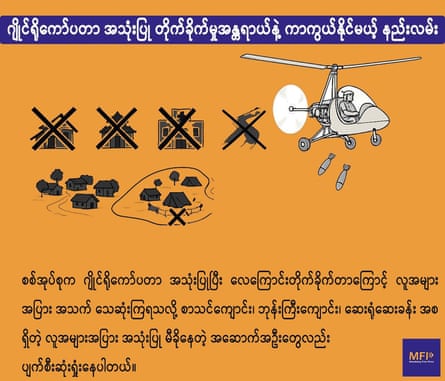
On 1 June, the Mandalay Free Press, a Myanmar-based news agency, released a poster campaign advising civilians on how to protect themselves from a gyrocopter attack. “Immediately take cover in a well-built bomb shelter,” read one poster. “Avoid villages, densely populated schools, monasteries, hospitals and military bases as they may be targeted.”

Human rights groups say the consequences of the attacks are worsened by severe restrictions on aid access. “The ability for people who are injured, but not immediately killed, in these attacks to get the necessary medical care is extremely limited,” says Bauchner.

“Often we hear that a smaller number of people were killed directly, but then larger numbers die because of the lack of access to medical care and aid.”

The junta has systematically dismantled Myanmar’s healthcare system during its campaign of terror. It has arrested more than 870 healthcare workers affiliated with the anti-coup movement, closed private hospitals and attacked at least 263 healthcare facilities, according to Human Rights Watch .

Analysts and rights researchers say these aircraft are part of a wider pattern of escalating air attacks that have repeatedly been accused of violating international humanitarian law.

“The military is continuing to carry out war crimes, both deliberate and indiscriminate attacks on civilians, like how it is carrying out these paramotor and gyrocopter attacks,” says Bauchner.

She says the junta is continuing such operations, despite recent attempts to rehabilitate its image on the global stage.

Su Mon anticipates paramotor and gyrocopter attacks will expand across the country in the coming months, particularly given the limited ability of resistance groups to defend against low-flying aircraft.

“The result is not only physical danger but a profound psychological impact,” she says. “They are left feeling constantly insecure and constantly in fear.”

Sweat, tears and camaraderie as 20,000 runners take on world’s largest ultramarathon | South Africa | The Guardian

Keyword – World news
Trefwoorden – South Africa, Ultrarunning, World news, Africa, Sport
Title – Sweat, tears and camaraderie as 20,000 runners take on world’s largest ultramarathon | South Africa | The Guardian
Author – https://www.theguardian.com/profile/rachel-savage
Link – Sweat, tears and camaraderie as 20,000 runners take on world’s largest ultramarathon | South Africa | The Guardian
Publish date – 2026-06-21T08:00:24.000Z
Category – News
URL – https://www.theguardian.com/world/2026/jun/21/comrades-ultramarathon-south-africa

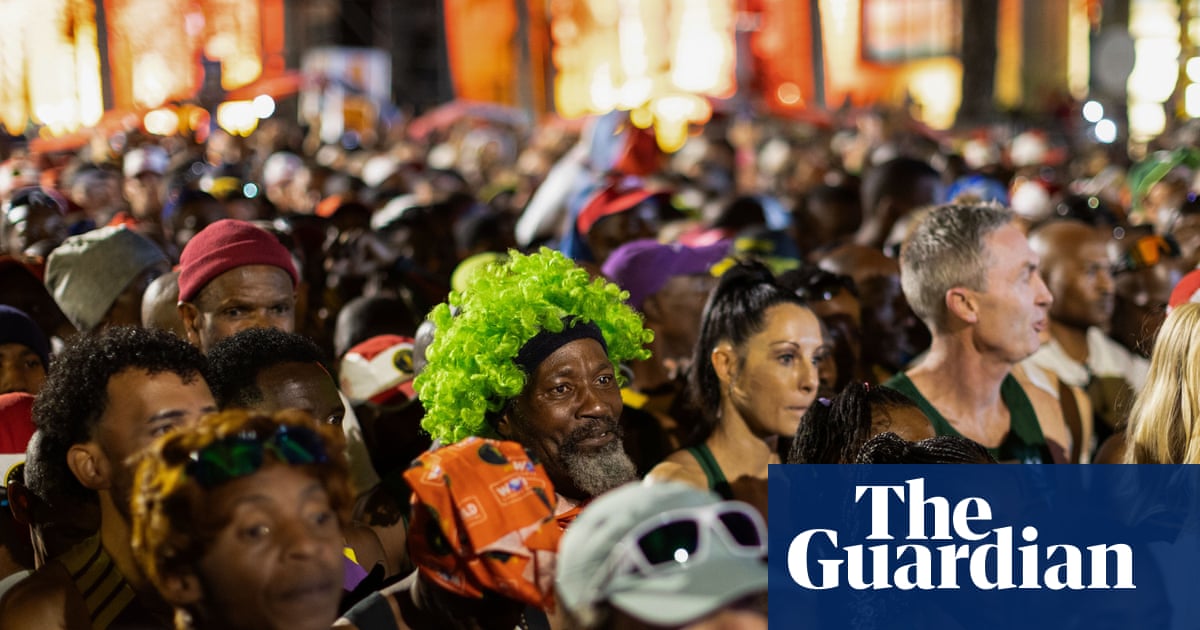
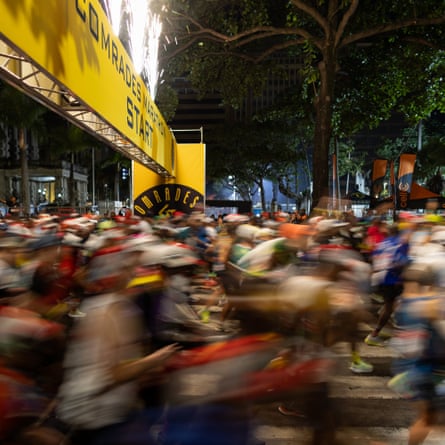
I n the early morning dark, thousands of runners waited, jostling with anticipation. South Africa’s national anthem rang out. Then the haunting swell of Shosholoza , first sung by Zimbabwean migrant workers in South Africa’s goldmines. Finally, that unmistakable, spine-tingling piano: Chariots of Fire.

Runners gather before the start of the marathon

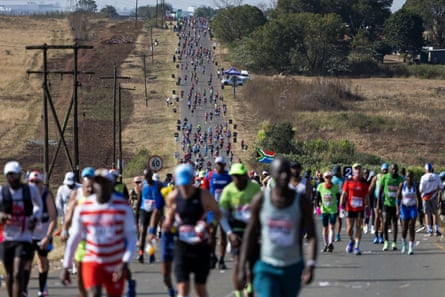
5am. A cock crowed. A gun fired. The runners streamed across the start line of the Comrades marathon.

The Comrades is the world’s oldest and largest ultramarathon. The first race in 1921 took the runners 54.6 miles (88km) from Pietermaritzburg downhill to Durban on the coast. The following year the race was run in reverse, uphill back to Pietermaritzburg, and it has changed direction every year since, pausing only for the second world war and the Covid-19 pandemic. Over its 99 iterations, the route distance has averaged just under 55 miles.

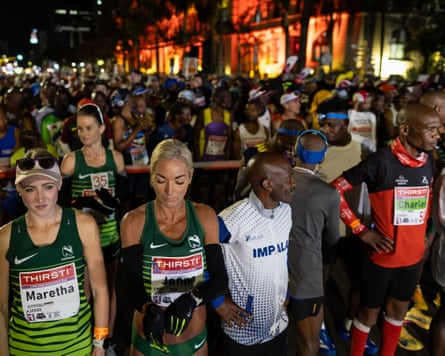
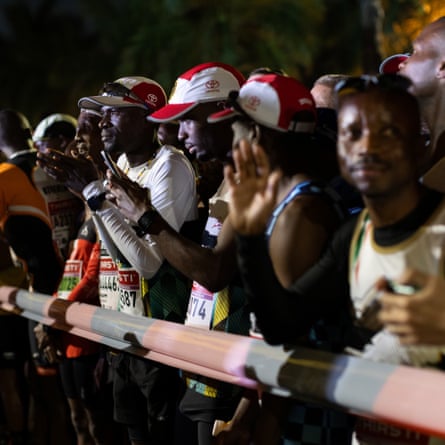
L-R clockwise: Athletes gather before the start of the Comrades Marathon in Durban; supporters gathered to watch the start of the 2026 Comrades; the race begins

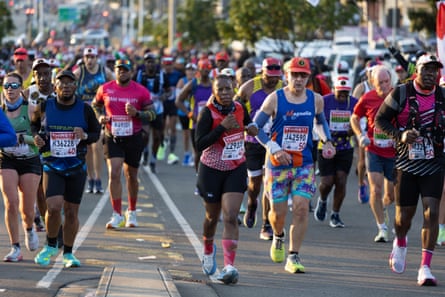
That first year, 34 runners, all white men, lined up for the race, conceived by the first world war veteran Vic Clapham as a way of honouring his fallen comrades. Sixteen of them finished. More than a century later, on 14 June, more than 20,000 people stood outside Durban city hall, hoping to make it to Pietermaritzburg before the 12-hour cutoff.

What started as an all-white, all-male test of physical endurance has become part of the fabric of South African life, something so ordinary that you would be hard-pressed to find someone here who does not know a Comrades finisher.

Running clubs bus in from all over the country. Security guards and shop workers line up alongside bankers and celebrities. And, for one day, every June, South Africa’s searing racial inequality seems to melt away.

Nomusa Shelembe, from the Run Alex team, passes through Pinetown

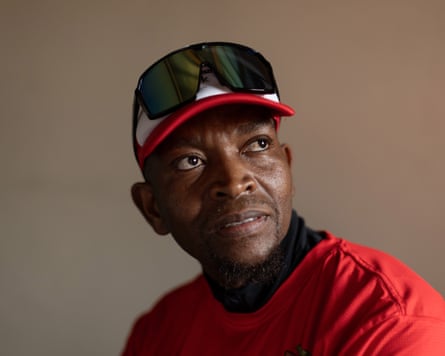
You hear it all around the race: every runner has their reason. William Seleka started running in March 2025, amid a deep depression after the break-up of his marriage. “I thought for me to stay alive, I had to keep myself busy,” he said, as he stretched before a run, outside the single room he rents in the Johannesburg township of Alexandra, two weeks before Comrades.

Seleka was persuaded to join Run Alex , a local club. Six months later, having never run further than 10km, he finished a 50km ultramarathon, from Johannesburg to Pretoria.

“I used to hear people saying, ‘This is Comrades, you are running from Durban to Pietermaritzburg.’ I said, ‘It’s insane, you can’t do that.’ But now we are facing reality – I’m doing that as well,” he said.

To train, Seleka ran at least 10km every weekday evening, after a day spent repairing appliances for fridge-maker Smeg. On Saturdays, the 38-year-old would run up to 50km with Run Alex. “Recovery,” he said, was a half marathon.

Seleka said he wanted to create a legacy for his 15-year-old son and three-year-old daughter. “I can’t wait to have my red cap and the medal to show my kids.”

William Seleka

On a Comrades “up run”, runners must climb about 1,800 metres (5,900ft) on their journey to Pietermaritzburg, 650 metres higher than Durban . This year, runners started in three batches, at 5am, 5.15am and 5.30am.

About 12 miles into the race, the sun began peeking above the horizon in Pinetown, a suburb above Durban. “Let’s go! Let’s go!” spectators shouted. Seleka appeared up the hill. “Good to see you,” he beamed, sweeping in for a glancing hug.

In 1923, Frances Hayward became the first woman to start and finish the Comrades. In 1935, Robert Mtshali was the first black man to complete the race. Nonetheless, with only white men officially allowed to compete, the Comrades seemed fated to stay what most ultramarathons remain today – a niche, elite pursuit.

L-R: A runner receives a leg-rub from a volunteer along the route in Camperdown; spectators cheer on the runners in Pinetown

That changed in 1975 when the privately run race was desegregated and also opened to women. South Africa at the time had been shut out of all major global sporting events in response to apartheid, driving the sport-obsessed country mad.

“Some people in the sporting world in South Africa had the idea that if they start desegregating some minor sports … it’ll show that South Africa is not as backward and racist a place as it’s made out to be,” said Ryan Lenora Brown, a journalist who has been covering the Comrades since 2017.

Then there was the introduction of TV in 1976. The single, heavily censored state channel started showing Comrades highlights. In 1986, it broadcast the entire, all-day race in full.

South Africans were mesmerised by the sight of delivery driver Hoseah Tjale going toe to toe with Bruce Fordyce, a professional athlete who won eight Comrades in a row from 1981.

Runners fill the road from Durban to Pietermaritzburg

“You would have these scenes in the 1980s of a white runner sharing a bottle of water with a black runner, which was such a small gesture, but such a huge thing in that society that was so divided,” said Brown.

Apartheid had forced black South Africans on to the lowest rungs of society. But Tjale and Sam Tshabalala, the first black man to win Comrades in 1989, were proof that they could do anything.

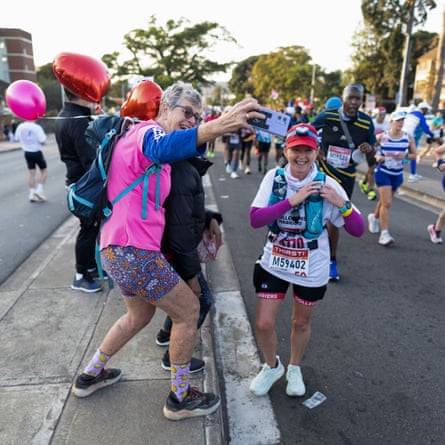
L-R: Supporters take photos with a runner in Pinetown; spectators line the route out of Camperdown

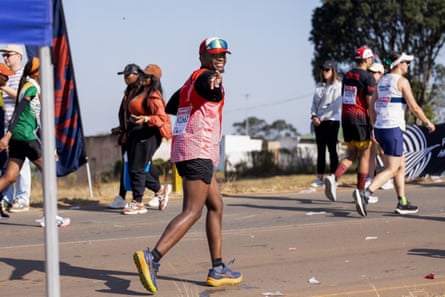
As the runners left Durban, they wound their way upwards through lush trees, open fields and small towns. Families braaied by the roadside. Running clubs handed out supplies from gazebos pumping out music. Everybody was cheering the runners, willing them on.

By the halfway point, most were walking up each hill. At the Run Alex aid station, Seleka changed into a spare pair of shoes. It was the wrong choice: by 34 miles he was in agony. The only way he could distract himself from the pain was by counting or singing.

William Seleka near Camperdown

“I’m not a person who goes to church,” he said. “But on that day I started to sing. I don’t know where those songs came from.”

Around 46 miles, Seleka found another Run Alex aid station and put on a clubmate’s shoes. He pushed on.

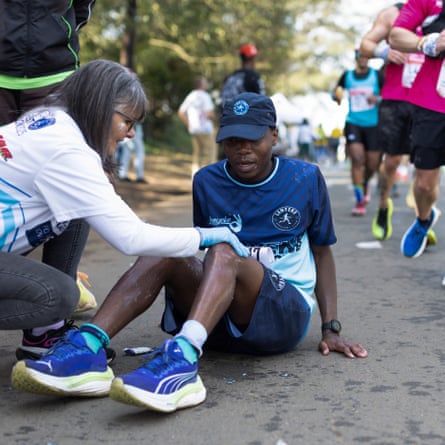
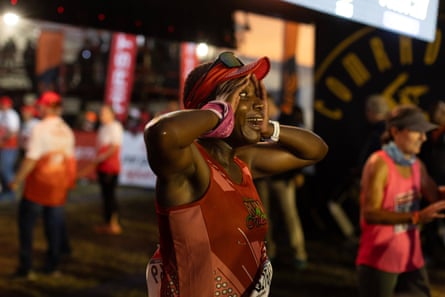
The light turned golden. Some runners danced across the finish line, arms outstretched. Some were arm in arm, complete strangers who had become friends on the road. Many stumbled over the line, or collapsed and were carried away on waiting stretchers.

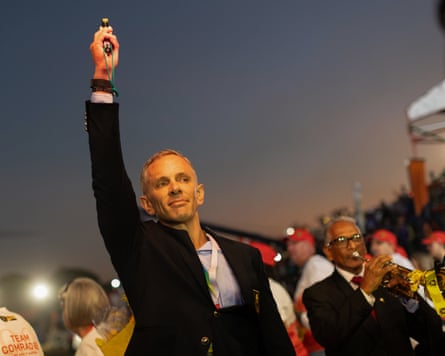
Darkness began to fall. Guns were fired for the first 12-hour cutoff, and then the second. Around a third of Comrades runners finish in the final hour .

An official prepares to fire the shot to mark the final 12-hour cutoff

South Africa’s pacing “buses” are unique in long-distance running for their size and camaraderie, racers singing and chanting, led by a metronomic pacer, known as a bus driver. Perhaps the biggest cheer of the day came when the final 12-hour bus driver, Shahieda Thungo , crossed the line at 11:56:34, carrying dozens of runners home with her. About 91% of runners finished this year, according to The Running Mann blog.

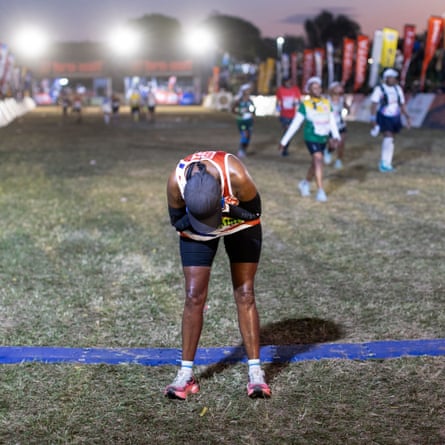
L-R: Jenny Da Silva misses the 12-hour cutoff time by seconds; an exhausted runner rests shortly after crossing the finish line in Pietermaritzburg

Then there were those who just missed the cutoff. At exactly 5.30pm, a wall of people stepped across the finish line. Two women ran into them, seconds short. One, wearing the green bib of a 10-time finisher, doubled over in anguish, her face in her hands.

Seleka cried as he crossed the line at 10:30:49. He was thinking of his sister, whose kidneys failed in 2018. “At the start, everything changed,” he said. “I said this pain today is for my younger sister.”

A runner crosses the finish line of the 2026 Comrades Marathon in Pietermaritzburg

Everyone needs a reason if they are to finish the Comrades, said Seleka, who was already planning his race next year. “If you’re going through a lot, once you say why, then it’s a mission,” he said. “After Comrades is accomplished, it’s a new chapter again.”

Ibeyi: Offering review – French twin sisters master the balance between mysticism and edge | Pop and rock | The Guardian

Keyword – Music
Trefwoorden – Pop and rock, Music, Culture, R&B
Title – Ibeyi: Offering review – French twin sisters master the balance between mysticism and edge | Pop and rock | The Guardian
Author – https://www.theguardian.com/profile/rachel-aroesti
Link – Ibeyi: Offering review – French twin sisters master the balance between mysticism and edge | Pop and rock | The Guardian
Publish date – 2026-06-19T08:00:26.000Z
Category – Culture
URL – https://www.theguardian.com/music/2026/jun/19/ibeyi-offering-review

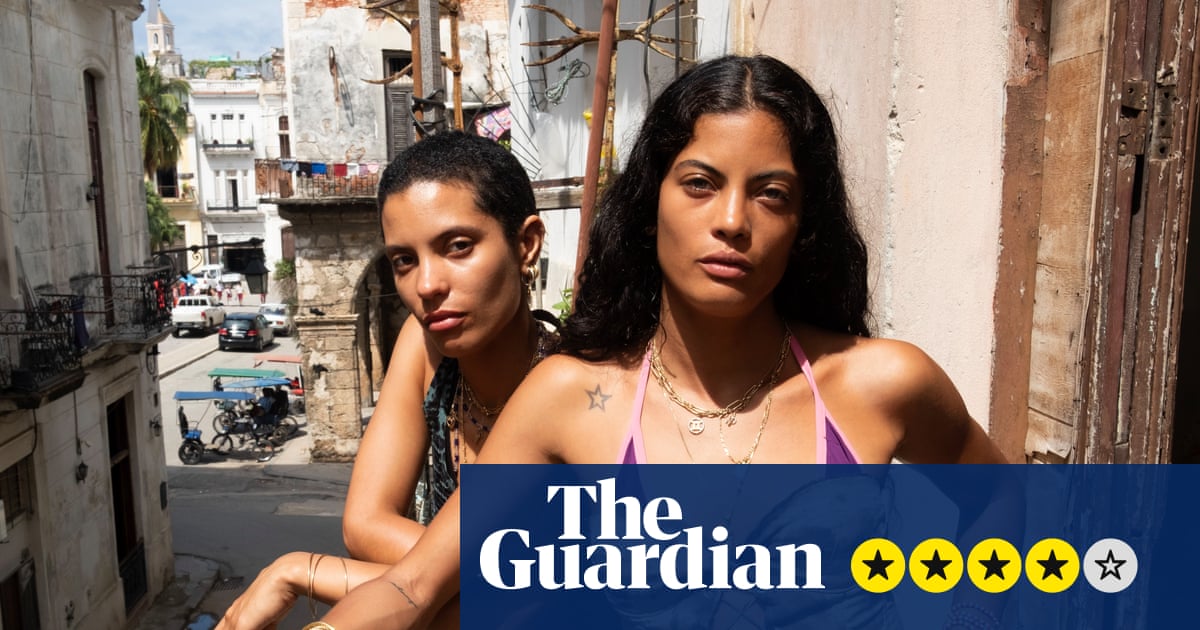
H aving ceded creative control to numerous collaborators on 2022’s Spell 31 (veteran pop songwriter Eg White; rappers Pa Salieu and Berwyn), Naomi and Lisa-Kaindé Diaz return to first principles for their fourth album. Written mainly by the sisters themselves, Offering recentres Ibeyi in their own sonic universe: fusing the influences of their Cuban percussionist father and Parisian upbringing, the twins sing in multiple languages, summoning ancient lore over intricate beats, transcendent harmonies and brooding distortion.

Self-sufficiency crops up as a lyrical theme, too: “One thing is for sure, I’m who I was looking for,” goes the refrain of Baba, which matches incantatory vocals with an irresistibly grimy bassline. (Perhaps the fact this is being released on their own label rather than XL, the taste-making British indie they were previously signed to, is also relevant here.)

That said, it would be a contradiction to suggest Ibeyi are going back to basics: there has never been anything straightforward about their sound. It’s a heady brew that can overwhelm in large quantities, but this finely tuned, melodically strong collection provides the perfect dosage. The duo have mastered their Rosalía-like balance between otherworldly mysticism and grinding edge: on opener Olokun, urgent chanting about an ocean deity walks the line between euphoria and doom, while celestial R&B gets a gratifyingly industrial tinge on Moshpit. Yet it’s the truly heavenly vocal interplay on the spine-tingling Good Life that feels like the Diazes’ most impressive accomplishment: an offering you’d be a fool to refuse.