Keyword – Sport
Trefwoorden – US Open, Golf, Sport, US sports, European Tour, PGA Tour
Title – US Open golf 2026: final round – as it happened | US Open | The Guardian
Author – https://www.theguardian.com/profile/scottmurray
Link – US Open golf 2026: final round – as it happened | US Open | The Guardian
Publish date – 2026-06-21T23:22:56.000Z
Category – Sport
URL – https://www.theguardian.com/sport/live/2026/jun/21/us-open-golf-2026-final-round-updates-wyndham-clark-live
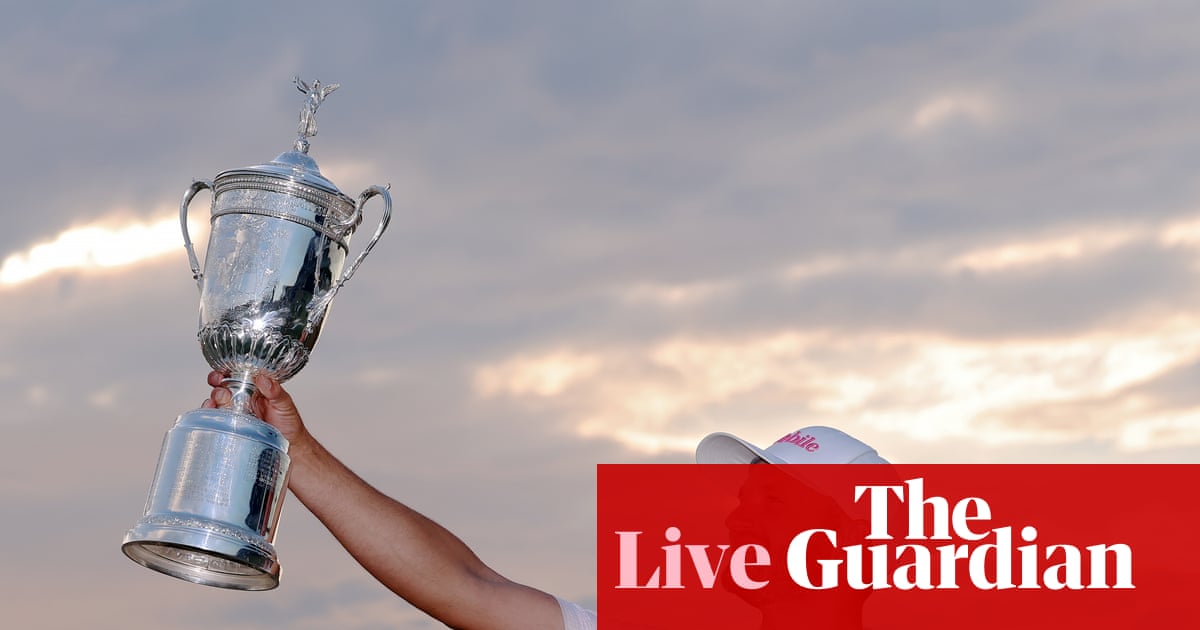
Bryan Armen Graham was at Shinnecock Hills: his report has landed, below, and is a mere click away. At which point, this blog signs off. Congratulations to Wyndham Clark, the 2026 US Open champion! Commiserations to Sam Burns, who is getting closer and closer to US Open glory by the year – his last three finishes are now T9-T7-2 – and Tom Kim, who is back in the big time after a couple of quiet years. And thanks to you for sticking with myself, Dave Tindall and Matt Cooper over the four days. It’s been a blast. See you here for Birkdale next month? OK, it’s a date!
-4: Wyndham Clark -3: Sam Burns -1: Tom Kim E: JT Poston, Keith Mitchell, Scottie Scheffler +1: Joaquin Niemann, Tyrrell Hatton, Gary Woodland, Sam Stevens +2: Justin Rose, Aaron Rai, John Parry, Tommy Fleetwood, Xander Schauffele, Sahith Theegala
Then another nod to his locker-bothering antics at Oakmont last year, something he’s taken ownership of and for which he’s clearly sorry. “The first [US Open] was the breakthrough of knowing I can do it … this one was a lot of redemption … last year was so tough … a terrible year … I left this place in shambles … it’s amazing what a year can do … I’m leaving this Sunday as a champion and I am just so blessed … thank you, guys … happy Father’s Day, I love you so much!”
Then the inevitable question about the attitude of the gallery: “Yeah, New York really didn’t like me … I love you guys … but I get it … [some cheering and applause] … some of it is self-deserved … I did some unfortunate things last year that I really regret … I’ve been sorry multiple times and I’m still sorry … hopefully I can win you guys over eventually … but I get it, they’re rooting for Scottie! … grand slams only happen a few times … he’s gonna get it … he’s the best player in the world … but today is my day!”
A broad smile. More applause. That was a classy response given the borderline contempt he’s been subjected to by some sections of the gallery. And to be fair it was reciprocated by the punters who have stayed to watch the trophy hoist and speeches.
Clark is asked by NBC how it feels to lift the trophy again. “Pretty amazing … it seems just like yesterday … pretty similar, two putts to win … surreal, to be honest … I played some ugly golf the last two days but my putter and short game kept me in it … to make all the putts I did with my Ping putter that I love so much has been amazing … it comes down to believing that good things are going to happen and you’re going to make the putt … it’s been a grind … I haven’t played the prettiest golf … to make birdie [on 16] was the pivotal moment.”
The closing ceremony. First up, a silver salver for Wyndham Clark’s caddie, David Pelekoudas. Then the Jack Nicklaus Medals for Ryder Cowan and Jackson Koivun, this year’s co-low amateurs. Then the champion of the 126th US Open , who receives the Jack Nicklaus Gold Medal. Some warm applause at last! Finally the trophy is handed over, and lifted. More of that sweet-sounding applause. Where was that all afternoon? Better late than never!
Wyndham Clark started the day six clear; he was reeled in to a single shot. But he never so much as shared his lead. When he looked like buckling, he pulled some magic out of the hat. Nothing on a par with his 3-wood into 16 last night, that set up eagle, but some stuff that came close: his approach to 10 that set up a momentum-shifting first birdie of the day; his staunch birdie at 16, teasing in a 30-footer from the back of the green, just as Sam Burns and Tom Kim were threatening to finally catch him. A final round of 73 was enough, his work done long before: that 64 on the first day, all of those scrambles yesterday afternoon. It might not have been the prettiest US Open victory; it was certainly one of the grittiest. And all of that while fending off both the world number one and an antagonistic gallery. The toughest round Clark ever played, according to his pops, and he came through with flying colours. He’s now a two-time US Open champion. He’s earned that status.
Clark is congratulated by his caddie, Scottie Scheffler, his partner, several friends and family … and finally, a surprise, his father! Well it is Father’s Day after all. A huge hug. “So glad you could be here,” Clark mutters in his pop’s ear. “I’m so proud of you!” his dad returns. “That was the toughest round you ever played, and you were such a worker!” Tears and smiles. Clark deserves this sweet moment. He’s been through the wringer today, and come out smiling.
Wyndham Clark: 2026 US Open champion!
Clark taps in, spins around, celebrates with his caddie, and soaks up the … well, the reserved applause from the gallery who were never on his side. But he deserves a hell of an ovation: he’s just won the US Open , leading wire to wire after opening with a 64 on Thursday, and never relinquishing his lead, despite the field threatening to catch him. But every time they got close … Clark got clutch. What a performance!
-4: Clark (F) -3: Burns (F)
Scheffler tidies up for his par. A final round of 71, and that’s a tie for fourth at level par. And then …
Scheffler very nearly does chip in, as well. A delightfully judged clip bounced into the bank and rolled out to four feet. And then over to Clark, who has two putts to win the US Open … and he strokes it up to tap-in distance! A clenched fist as he celebrates his certain win, though he’ll not tap in before Scheffler tidies up! Muted applause, bordering on respectability, but that’s all he’s getting for now. Sam Burns meanwhile trudges off the practice green. So close. Again.
Scottie Scheffler won’t be completing the career slam this week. But he receives a warm ovation from the gallery anyway as he walks up to assess his final chip of the week, having bundled his ball through the back of the green. He’ll be desperate to get up and down for a share of fourth place. Chip in, and he’s sharing third with Tom Kim.
Wyndham Clark catches a good lie in the semi-rough to the right of the 18th fairway. Upon hitting his nine-iron, he reacts like he’s made a grievous error, moaning in despair. But his ball reaches the green. A good 50 feet from the pin, but it’s uphill, and two putts will secure the 32-year-old from Denver his second US Open in four years!
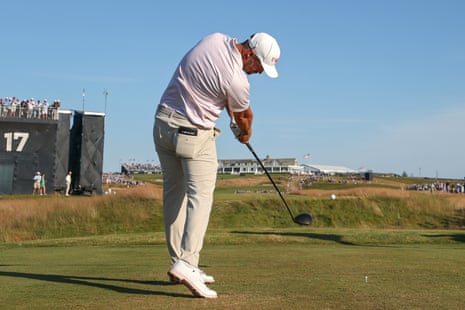
Tom Kim dribbles his birdie putt towards the hole at 18. No birdie, but that’s a kick-in par for a 70. Third place at the US Open: happy 23rd birthday, Tom!
-4: Clark (17) -3: Burns (F) -1: Kim (F) E: Poston (F), Mitchell (F), Scheffler (17)
Wyndham Clark bogeyed 18 last night. He can’t afford the same outcome now. And he doesn’t start well, carving his tee shot towards the fescue on the right. But the ball, which initially looks like scampering from the fairway, through the first cut, and into the tall stuff, stops a couple of feet short of the proper nonsense. Not perfect, but not a killer either. Up in the clubhouse, Sam Burns can’t sit still. If he doesn’t win this, he’ll see those putts at 17 and 18 again and again when he closes his eyes tonight. So close.
Clark steps up to take his putt … but he doesn’t like it, and withdraws. When he gets back into his routine, he still looks a little twitchy … and sends a nervy putt slipping by on the left. He tidies up for bogey, but it’s now just a one-shot lead going up the 72nd. Just! He’d have taken that at the start of the week, but perhaps not at the start of this round, given that six-shot advantage. But here we all are. The crowd cooed their approval at the miss, by the way. Of course they did.
-4: Clark (17) -3: Burns (F)
Clark is left with a putt of 70 feet. He lags it up to six. Another test upcoming. The business end of the US Open . Meanwhile up on 18, Tom Kim, having split the fairway with his tee shot, sends his second to six feet. Too late for glory, but he allows himself a warm smile anyway. It’s been a good week, and it is his birthday after all. Third place at the US Open won’t be too bad a present!
Clark’s tee shot at the par-three 17th finds the dancefloor. Not anywhere near the flag, but then it doesn’t have to be. That birdie on 16 should seal the deal, though nothing on major-championship Sunday is certain until the past putt drops.
Wyndham Clark’s putt from the back of the green rolls up a ridge, then down a fast slope. It looks like stopping short for a second, but somehow keeps on going, and drops for birdie! What an outcome, given the wild tee shot … and how close his approach came to dropping off the back of the green. But fortune favours the brave, and he was certainly that with both approach and putt. It’s a huge birdie, one that’s almost certainly won him this US Open … and shoved a few hollers back down the throats of the gallery that’s been baiting him all day. Tom Kim meanwhile can’t get up and down from sand at 17, and a brave charge from a previously out-of-sorts player comes to a quiet end.
-5: Clark (16) -3: Burns (F) -1: Kim (17)
Scottie Scheffler’s uphill 29-footer needs to go in. But like so many of his putts this week, it stops one turn short. The world number one’s been a little too tentative with the flat stick all week. He remains level par, and he’s all but cooked.
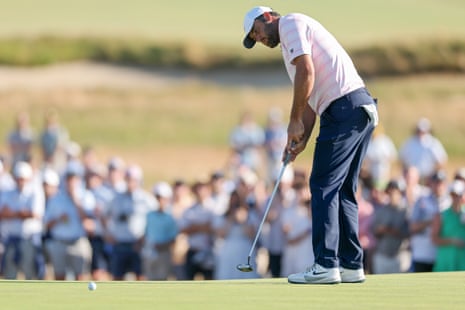
Clark from the centre of 16, 144 yards out. He sends his approach a little bit long and left, and the ball threatens to topple off the back. But it stays put on the back edge. Just. So close to potential disaster. Scheffler meanwhile sends his third from thick rough down the right into the heart of the green. He’ll need to make a 30-footer for birdie if he’s to have any realistic chance of making a play-off, his best remaining hope.
Scheffler splits the fairway at 16, then opts to go for the green. Driver off the deck! He carves it off into trouble down the right. Clark then powers out of the thick fescue, back onto the fairway. That’s a great shot, a great result considering the circumstances. And up on 17, Kim’s tee shot dribbles into the bunker to the right of the green. This is all still very much in the balance … but Clark remains in the box seat. No huge mistakes, and this is most likely his title. That’s what he has to tell himself, anyway.
Tom Kim isn’t out of this either! He lays up at the par-five 15th, backing his wedge game. The birthday boy – 23 today – wedges from 127 yards to nine feet, prowls around the putt awhile, then rolls it into the centre of the cup confidently! He yells in delight as the birdie putt drops. He’s just two off the lead, one off the clubhouse lead. The biggest two holes in his life coming up!
-4: Clark (15) -3: Burns (F) -2: Kim (16) E: Poston (F), Mitchell (F), Scheffler (15)
Poor Sam Burns, who enters the scorer’s room a study in dejection. A hige sigh. He sits in the chair, leans back, closes his eyes, and puts his hands to his head. Off comes the cap as he stares at the wall awhile, before finally getting down to the business of signing his card. It could still be the winning card, to be fair. Meanwhile Scottie Scheffler can’t make his birdie effort on 15, and his race is more likely than not run. But he’s not quite out of it yet either. Not least because Wyndham Clark has just yanked his tee shot at 16 into thick rubbish down the left of the par-five. Not a good lie at all.
Burns shoots 67; sets -3
Sam Burns, having gone to school on that putt, rolls his effort on a similar line … but it slides by the right lip. He falls to his knees while tossing his putter away – gently – with sadness. Two missed birdie chances on 17 and 18 could prove the difference. He signs for a 67 and sets a clubhouse target of -3, but wears the look of a man who thinks he might have come up just short yet again on US Open Sunday.
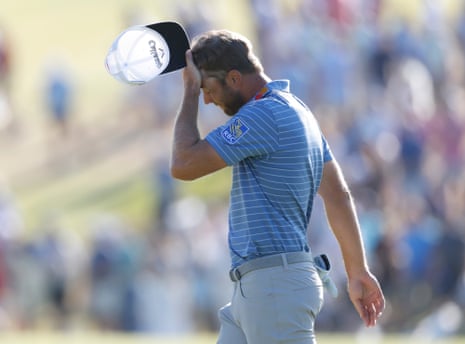
Wyndham Clark and Scottie Scheffler take turns to land their approaches at 15 pin high, spinning them back to 20 feet. Both left with uphill putts. Clark’s effort is never going in, always stopping a little short, but it’s close enough to tap in for par. Meanwhile up on 18, Keith Mitchell reads the line of his right-to-left slider perfectly … but doesn’t give it enough oomph. It stops one turn short and he tidies up for par. His fourth level-par 70 of the week, and he becomes the first-ever player in US Open history to make par in each of his four rounds!
Sam Burns sends his tee shot at 18 into the semi-rough down the right. Anticipating a flyer, he clubs down, and sends a nine-iron into the front of the green, the ball rolling up to 15 feet. A chance of birdie – and he’ll get a read from Keith Mitchell, whose second stops a couple of feet behind. Should it go in, he’ll post a clubhouse score that will challenge Wyndham Clark to close it out.
Xander Schauffele ends the week at +2. He’ll end the week in the top 15, and that’s the tenth time he’s done that in his ten appearances. What a record, without actually once winning it! It’s a sequence only matched in history by Willie Anderson and Bobby Jones, two bona-fide US Open legends. Tommy Fleetwood flings an arm around him; he finishes at +2 as well. At least Schauffele has a couple of majors to his name; poor Tommy is still looking for his first.
On 17, Burns hangs his head as his pusillanimous prod at his short downhill birdie putt dribbles apologetically towards the hole, then stops short. Par. And it’s a three-putt bogey for his playing partner Keith Mitchell, whose race is now almost certainly run. Par for Tom Kim at 15, but otherwise, the last few minutes have generated some much-needed positivity for the beleaguered leader.
-4: Clark (14) -3: Burns (17) -1: Kim (15) E: Poston (F), Mitchell (17), Scheffler (14)
From 33 feet on 14, Clark nearly makes one of the birdie putts of the week, a big right to left swinger that grazes the right-hand lip. But it somehow stays out. Not even the width of a dimple away. Then Scheffler clips that right-hand lip from similar distance, albeit along a straighter line. He’s got a bit excited with that, though, and it slingshots three feet to the left. And he doesn’t make the one coming back. Almost complete silence as the crowd process their hero’s error. The career slam might have to wait for another year. Clark remains at -4, Scheffler slips back to level par.
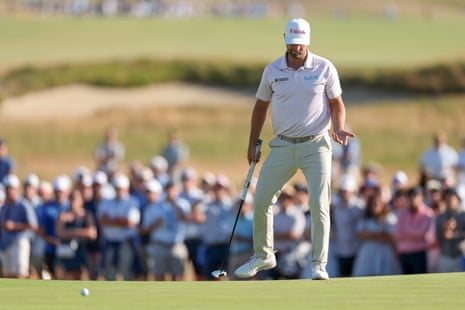
Scheffler and Clark both reach the 14th green in regulation. Neither particularly close to the pin. Scheffler was coming in from 200 yards; Clark, who had gone for broke with the big stick, will be a little bit disappointed to end up further away than his playing partner from 150 yards. Putting contest coming up, though with three shots still between the players, time is running out for Scheffler to make his move. Level par for his round so far, he’s not made a move towards Clark today; it’s Clark, at three over today, who has come back towards him.
Sam Burns has clearly decided to go for broke. Win or bust. He whistles a forensic arrow at the par-three 17th straight at the flag, to six feet. A huge chance for birdie that would give him a share of the lead. He was seven behind at the start of play.
Sam Burns with a bounceback birdie on the par-five 16th! He walks in a left-to-right slider from 20 feet and the crowd do their (much more reasonable) thing! We’ve got ourselves a US Open here all right.
-4: Clark (13) -3: Burns (16) -1: Mitchell (16), Kim (14), Scheffler (13) E: Poston (F)
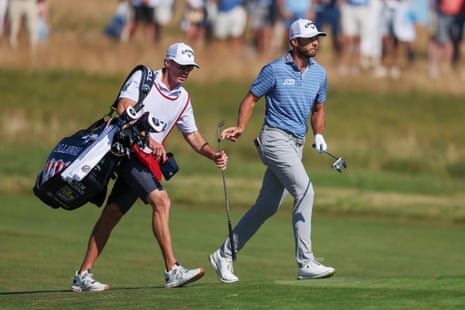
Amid the hubbub, Clark does exceptionally well to bump his chip up from the bottom of the swale to eight feet. He’ll have a chance to salvage his par. Before he can have a go, Scheffler’s left-to-right birdie slider dies a death one dimple shy of the cup. A few joules more, and that was birdie. Scheffler turns with an agonised look on his face; he knows holes are running out. But Clark does him a favour by letting his par putt slide by on the low side. Off go the crowd again, delighting in his misery. This is getting both old, and increasingly embarrassing.
-4: Clark (13) -2: Burns (15) -1: Mitchell (15), Kim (13), Scheffler (13) E: Poston (F)
Pantomime nonsense at sporting events is all good and well. But this is getting really uncomfortable to listen to now. Scottie Scheffler’s second into 13, sent pin high to 20 feet, is met with love. Wyndham Clark’s approach topples off the back, ever so slowly, and the groans when the ball threatens to stop on the green, followed by the delighted cheers when it speeds away down the slope, are a bit much. The gallery need to raise their game.
Cowan and Koivun share low amateur
Ryder Cowan makes a birdie on 17 thanks to a shot that he could sell to the leaders for cash money. Were he not an amateur, that is. And were it actually possible. Anyway, one shot behind Jackson Koivun, in the house at +5, and needing a birdie, Cowan fires a go-for-it arrow over the bunker guarding the pin, front left, to seven feet. In goes the putt, and then he pars the last. And so that’s a share of Low Amateur status with Koivun, the pair winning the Jack Nicklaus Medal! Some players to have previously won this award (latest first): Viktor Hovland, Scottie Scheffler, Patrick Cantlay, Justin Leonard, Phil Mickelson, Fred Couples, Ben Crenshaw, Jack Nicklaus, Bobby Jones. Not bad company, huh?
Out of nowhere, a careless three-putt bogey for Sam Burns on 14. That could be extremely costly with holes running out. Back on 12, Scottie Scheffler nearly holes his birdie putt. [FX: BEDLAM] Then Wyndham Clark narrowly misses his effort. [FX: TUMBLEWEED] It’s getting a bit too much on the nose, this.
-5: Clark (12) -2: Burns (15) -1: Mitchell (15), Kim (12), Scheffler (12) E: Poston (F)
There are reports of some fans getting hoicked off the property for sledging Wyndham Clark. He’s getting the full treatment from a few members of the gallery. One punter screams “GO WYNDHAM!!!”, though it’s not 100 percent clear whether that’s sarcasm as his tee shot at 12 disappears into semi-rough. Either way, that particular doofus is quiet when Clark whips out a chip to 12 feet. His ball is right by Scottie Scheffler’s, and the world number one will give him a read.
Some missed birdie putts. Sam Burns on 14, Tom Kim on 12, Scottie Scheffler and Wyndham Clark on 11. The pressure cranking up and up and up. The crowd becoming even more obvious in their preferences, too: a few cheers as Clark missed his birdie chance, whoops as Scheffler tidies up for par, next to nothing as his playing partner does the same. Some residual ill-feeling for Clark beating up on his locker at Oakmont last year, perhaps.
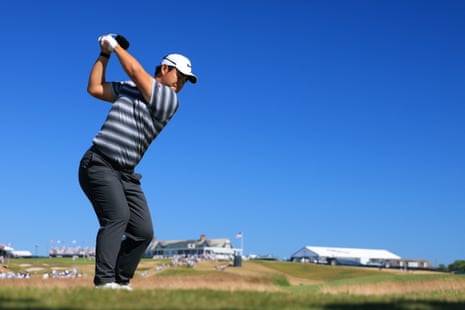
Par for JT Poston at the last. He signs for a superb 67, and becomes the new clubhouse leader at level par. His playing partner John Parry bogeys and that’s a 69 for a +2 finish. Parry is part of an impressive English contingent at the top end of the leaderboard, alongside Tyrrell Hatton (+1), Justin Rose (+2) and Aaron Rai (+2). Tommy Fleetwood (+2) and Matt Fitzpatrick (+3) are still out there too.
Scottie Scheffler is in the zone. After rolling in that birdie putt on 10, he sends his tee shot at the par-three 11th to the left of the flag, the camber taking the ball back to the right, ten feet past. Good birdie op. But not as good as the one Wyndham Clark sets up for himself: he fires over the flag, the spin taking his ball back to six feet. The gallery don’t boo exactly, but there are groans as Advantage Wyndham is established. Scottie clearly the crowd favourite, and though that’s been obvious from the very first shots of their round, it’s beginning to get a little bit more pronounced. Again, this could either work for or against both players. How much Brooks Energy does Clark have within?
The golfing gods smile kindly on Scheffler’s moment of sporting largesse. He rattles in his 15-footer for birdie, and suddenly the pressure is on Clark, whose four-footer looks twice the distance. But he pours it in. Once again, it’s notable that the gallery whoops and hollers when Scheffler sinks his birdie putt, but not when Clark makes his. Tough crowd, but that’s the entertainment industry for you.
-5: Clark (10) -3: Burns (13) -1: Mitchell (13), Kim (11), Scheffler (10) E: Poston (17)
Tom Kim responds to dropping a stroke on 10 by hitting one of the shots of the day at the par-three 11th. A gentle fade from 154 yards to a couple of feet. He’ll tap in for birdie to bounce back to -1. Meanwhile back on 10, Scottie Scheffler sends his second to 15 feet, a fine result given the carnage that’s occurred on and around this green this week. But Wyndham Clark trumps him with a glorious wedge in, the ball gripping 15 feet past the hole and spinning back to four feet. Scheffler, already up on the green, and to his great credit, offers a thumbs-up back down the fairway to Clark. A lovely sporting moment! And what a shot from Clark.
The new PGA champion Aaron Rai finishes well. A long birdie rake across 17, followed by par at the last, and that’s a final round of 69. He ends the week at +2 and that’s a very respectable return for a man playing in his first major championship as a major champion. The gallery give him the flowers he’s due. A class act, as ever.
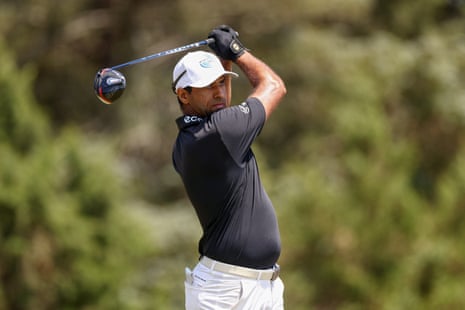
JT Poston, who missed a tiddler on 15 to move to -2, can’t get up and down from the back of 17 and drops back to level par. The small margins between glory and ending up in the pack. Bogey meanwhile for Tom Kim at 10; he slips back to level par as well. There are now just three players under par, which is just how the USGA like it.
-4: Clark (9) -3: Burns (13) -1: Mitchell (13) E: Poston (17), Stevens (11), Kim (10), Scheffler (9)
If Wyndham Clark’s nerves are jangling, his short game isn’t betraying them. From the thick rough at the front of the 9th green, he lobs high and confidently into the air, the ball landing softly a couple of feet shy of the cup and nearly rolling in. That would have been a proper US Open moment. Not quite up there with Tom Watson on 17 at Pebble in 1982, but something nonetheless. He’d have grabbed par with both hands before taking the shot, though. Scottie Scheffler doesn’t hit his birdie putt from 15 feet and what looked most likely to be a two-shot swing ends up in a half. Clark remains -4, Scheffler level par.
Clark can’t reach the green with his second from the rough at 9. His ball lands in the thick strip of rough guarding the front of the green. Scheffler turns up the heat by clipping his iron from the middle of the fairway pin high. It’s a half-chance for birdie; a two-shot swing between these players is eminently possible here.
Sam Burns finds the thick stuff down the right of 12. He sends his second scampering to the edge of the green, then nearly drains his Texas Wedge. He’ll take that par to remain at -3. Meanwhile back on 9, Scottie Scheffler batters a drive down the middle, but Wyndham Clark’s tee shot ends up in the first cut to the right of the fairway, and mostly disappears. The leader is three over for his round today and continues to look ragged. He got away with a wild long game yesterday, but it’s not entirely clear whether this is sustainable. When it all comes down, it may prove that he started the day with enough shots in his back pocket. But right now, he’s treading a thin line.
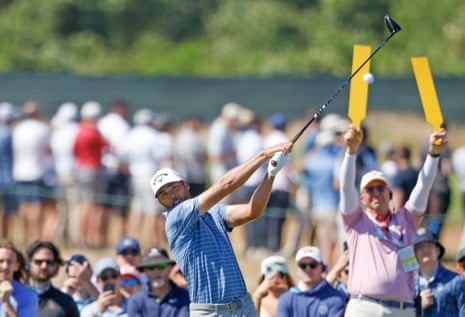
Wyndham Clark lags his long putt at 8 to a couple of feet, and wastes not too much time over the par putt. In it goes. Scottie Scheffler reads his 15-foot right-to-left birdie curler perfectly … but doesn’t hit it! He taps in. Both players move on, four shots between them.
Gary Woodland signs for a 68. That’s the 13th round under par already today; there were only two players to break 70 yesterday. That puts the 2019 champion in a tie for the clubhouse lead at +1. Meanwhile Rory McIlroy, who fought his way into contention on Thursday, and Friday, and Saturday, carelessly letting things go south each time, finishes his week with an underwheming 73. He’s +6 and he’ll always have Congressional.
Bogeys on 7, then, for both players in the final group. But Scheffler will be much more content with the way it all unfolded, making his missable putt after taking two to escape from sand, Clark missing a short one for his par. And now on 8, Scheffler is on in regulation, while Clark, having found a fairway bunker … well, he gets on as well, but he wasn’t in any position to go for the flag, and aiming for the meat of the green, is a long way away. Concern etched across his face. He’s not got his best stuff here at all.
It’s Scheffler’s turn to make a damage-limiting putt. He guides in his right-to-left bogey curler on 7 … then Clark shoves his downhill four-footer right of the cup and a couple of feet past! He makes the one coming back, but that was an extremely nervous stroke. And on that subject, JT Poston misses a putt from similar distance on 15 for birdie. He remains very much in this at -1, but what an opportunity to put some scoreboard pressure on the leaders. However Keith Mitchell, who dropped a stroke at 10 having failed to get up and down from the swale, birdies 11, and this US Open continues to bubble away. No procession here!
-4: Clark (7) -3: Burns (11) -1: Poston (15), Mitchell (11), Kim (8) E: Scheffler (7)
Scottie Scheffler splashes out delicately from the bunker at 7. Too delicately. His ball topples back into the trap, and though he gets out with his second attempt, he’ll need to make a 15-footer for bogey. Wyndham Clark by contrast whips up decisively to four feet, and this could be a matchplay double-whammy for the world number one.
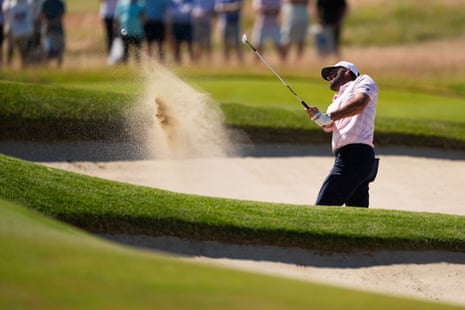
Scheffler and Clark both find the bunker guarding the front-left of the par-three 7th green. But while the former’s only just squeaks in, looking for a while like it was dead on line for the pin, the latter slam-dunks into the trap. The leader continues to make some big tee-to-green errors … though it’s not cost him dearly. Yet. He remains ahead thanks to that street-fighting short game, which by the looks of things will continue to be stress-tested over the closing two-thirds of his round.
Forget that bit about putting. Both players opt to chip up. Clark leaves his effort ten feet short, giving Scheffler the green flag to get more aggressive. Which he does, and he should be tidying up from a couple of feet. Another big pressure putt for Clark … and he makes them more often than not. And so he does here, the confident roll ensuring a bobble halfway along the route to the cup doesn’t divert the ball offline. Scheffler makes his par, and it’ll be Clark who’ll be the happier right now. But his game is getting a little tatty under these extreme tournament conditions. If at any point his putter goes cold, he’ll be in a spot of bother.
Having got to within one shot, Sam Burns immediately cedes ground. His chip at 9 races eight feet past the hole, and he’s left with a treacherous downhill par putt. He dribbles it down, but it slides off to the right. Bogey, and Clark’s lead is two again. The iron in at fault there. Burns still out in an impressive 32 strokes, mind. Meanwhile back on 6, Clark and Scheffler both send fine approaches into the heart of the green … only for the camber to slowly take both balls away from the flag and off the putting surface to the right. No bunker, and both will most likely putt from where they are, with Clark going first to offer his opponent a read.
-5: Clark (5) -3: Burns (9) -1: Poston (14), Mitchell (9), Scheffler (5) E: Fleetwood (9), Grillo (7), Kim (6) +1: Niemann (F), Hatton (F), Woodland (17), Parry (14), Morikawa (11), Schauffele (9), Stevens (7)
… so having said that, Sam Burns makes his first big mistake of the final round. From the centre of the fairway at 9, he underhits his approach, and his ball topples back off the front. It stops in a thick collar of rough. Meanwhile a final-hole bogey for Tyrrell Hatton, the result of finding the long stuff with his tee shot. That’s still an impressive closing round of 67, and at +1 he’s got a fair chance of another top-ten finish at the US Open . He’s got two of them on his resumé already. Hatton joins Joaquin Niemann in the clubhouse lead.