Uefa has opted against following Fifa’s lead and introducing automatic red cards for players who cover their mouths when confronting an opponent or leave the pitch in protest at a refereeing decision.
Football’s lawmaking body, the International Football Association Board (Ifab), approved those regulations last month after prompting from Fifa and they will take effect on 1 June, with match officials instructed to apply them at the World Cup. But Uefa’s decision means they will not apply in the men’s and women’s Champions Leagues or its other club competitions.
Fifa was responding to two major controversies this year that it is determined to avoid recurring at the World Cup, one of which took place during a Champions League game.
Real Madrid’s Vinícius Júnior accused Benfica’s Gianluca Prestianni of racially abusing him while covering his mouth with his shirt during a Champions League game in February. The Argentinian was given a six-game ban by Uefa, with three of those matches suspended for a two-year period, after being found guilty of homophobic conduct.
In January the final of the Africa Cup of Nations was marred by Senegal players leaving the pitch for 15 minutes in protest at Morocco being awarded a late penalty.
Morocco’s Brahim Díaz missed from the spot and Senegal won in extra time, but the Confederation of African Football’s appeals committee declared Morocco 3-0 winners in March, a decision Senegal have appealed against at the court of arbitration for sport.
Ifab has not mandated that the rule changes be enforced in all competitions. Uefa’s executive committee will meet for the final time this season in Istanbul on Wednesday and it is understood no regulation changes are on the agenda.
After the ExCo meeting Uefa’s club competitions committee will sign off next season’s regulations for its men’s and women’s tournaments in Leipzig next week, with no significant changes expected.
Uefa sources said that its referees committee would monitor the impact of the new regulations during the World Cup with a view to discussing potential changes during next season.
Domestic leagues have discretion over whether to introduce the regulations. The Premier League will confirm its plans for next season after the clubs’ AGM next month. Given only Fifa has committed to introducing the rules at this stage, it is unlikely they will be adopted.
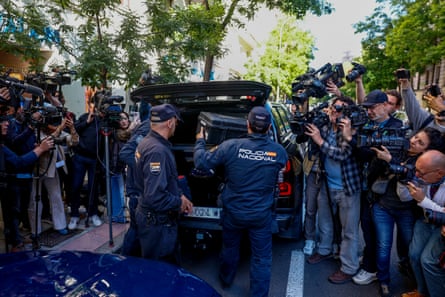
The former Spanish prime minister José Luis Rodríguez Zapatero has been placed under investigation for alleged influence-peddling and other offences by a judge examining the state bailout of a Venezuela-linked airline during the Covid pandemic.
Zapatero, a socialist who served as prime minister from 2004 to 2011, has been ordered to appear before Spain’s highest criminal court, the Audiencia Nacional, on 2 June.
Although other former and serving Spanish prime ministers have been called to testify in corruption cases, this is the first time a former prime minister has been placed under criminal investigation.
The latest investigation is part of an inquiry into the €53m (£46m) state rescue of the Spanish airline Plus Ultra in March 2021. Prosecutors are examining whether the company made “inadequate use” of the public funds the government approved for the bailout, while anti-corruption police are investigating whether the airline used the rescue money to launder funds from Venezuela through France, Switzerland and Spain.
According to the investigating judge, Zapatero is alleged to have overseen “a hierarchical structure of influence peddling”, whose purpose was “to obtain economic benefits through intermediation and the exercise of influence before public bodies in favour of third parties, mainly Plus Ultra”.
In a statement released on Tuesday, the court said the judge had authorised police to search Zapatero’s office as well as those of three other companies.
Zapatero released a video in which he insisted on his innocence and stated his willingness to cooperate with the investigation.
“I’d like to reaffirm that all my public and private activity has always been conducted with absolute respect for the law,” he said, adding he had never carried out “any action” relating to the airline’s bailout.
Zapatero’s denials echoed his appearance before a senate committee in March , where he said he “had never taken any commissions from Plus Ultra”. But he did tell the committee he had done some consultancy work for his friend Julio Martínez Martínez, a businessman who worked with Plus Ultra and who was arrested by anti-corruption officers in December last year.
Appearing before the senate committee in February, Plus Ultra’s president, Julio Martínez Sola, insisted that bailout had been conducted in complete compliance with the relevant laws. “There was no exceptional procedure outside the norm; there was no preferential treatment or undue interference; there was no illicit aid,” he said. “There was a regulated process, with controls, reports, and very strict conditions that have been met. Nobody has given us anything for free.”
Zapatero’s socialist successor as prime minister, Pedro Sánchez, is facing a series of corruption allegations involving his family, his party and his administration.
Last month, Sánchez’s wife, Begoña Gómez, was charged with embezzlement, influence-peddling, corruption in business dealings and misappropriation of funds at the end of a two-year investigation by a judge in Madrid. The prime minister’s younger brother, David Sánchez, is also facing trial this month on charges of influence-peddling.
Both Gómez and David Sánchez deny any wrongdoing, and the prime minister has accused his political and media opponents of smearing and pursuing his family.
Two senior former figures in Sánchez’s government are on trial for alleged corruption . The prime minister’s former right-hand man, the former transport minister José Luis Ábalos, is accused – along with his former aide Koldo García and the businessman Víctor de Aldama – of taking kickbacks on public contracts for sanitary equipment during the Covid pandemic. Ábalos and García, who deny all charges, are facing sentences of 24 years and 19 years respectively while Aldama, who has already admitted to his part in the alleged scheme, faces a seven-year sentence.
The socialist party issued a statement in support of Zapatero on Tuesday, calling him a pioneering prime minister whose “two terms were defined by an ambitious programme to expand rights, equality, and social protection”. It added: “The right and the far right have never forgiven him for these advances.”
The opposition conservative People’s party described Zapatero’s as “Sánchez’s muse” and said, “the principle that links Spain’s two most recent socialist prime ministers is corruption … this indecency must end”.
Two cabinet ministers have warned Labour colleagues against damaging anonymous briefings as the party prepares for a probable leadership contest, arguing it is disrespectful to voters to wage a factional war in public.
The comments by Yvette Cooper, the foreign secretary, and Jonathan Reynolds , the chief whip, came as Labour MPs gathered late on Monday for the weekly meeting of the parliamentary Labour party.
There has been a volley of briefings since Labour’s terrible results in elections for the Scottish and Welsh parliaments and English councils, often attributed to “allies” or “supporters” of Keir Starmer or those with hopes of replacing him, such as Wes Streeting and Andy Burnham.
Cooper began by saying she had spent the weekend meeting former Labour councillors in her West Yorkshire constituency who had lost their seats on 7 May “to say sorry to them that they had to deal with national issues and problems in what should have been a local campaign”.
She said: “We need to deal with the aftermath of that, and there will be serious debates within our party about how we respond and how lessons are learned. But I would also say, based on nearly 30 years in parliament, that the way in which we debate matters.
“When it is being reported that ‘the things Labour people are saying about each other are unprintable’, I would just say, frankly, I don’t care who you are in our party, and what you think the answer is for the future, we treat each other with respect. And above all we show respect to people across the country who rely on us to keep focusing on the things that matter most to them.”
Speaking at the same event, Reynolds said he wanted to remind fellow Labour MPs that they should support each other, rather than brief damagingly.
“I just want to say, whatever else is going on, we are the government,” he said. “Our first duty, our first responsibility, is to do the work, to be responsible, to understand why we do everything we do, and that is our duty to our constituents, but it is also our duty each other.
“I just wanted to highlight that in terms of some of the comments and exchanges I’ve seen between colleagues in the past few days. Let us never forget, please, why we are here and who we are here to serve.”
Examples of anonymous briefings in recent days include supporters of Starmer saying Streeting had “bottled” a leadership bid; one that referred to 2024-intake MPs as “erratic” and inexperienced; and another calling Streeting “a recently crashed-out backbencher”.
By no means all the anonymous quotes come from MPs, with many originating from officials, advisers or others.
R omanian director and Palme laureate Cristian Mungiu – the winner here in 2007 with his stunning 4 Months, 3 Weeks and 2 Days – comes to Cannes with an anticlimactic, underpowered movie which it seems to me could be part of an odd phenomenon at this year’s festival, detectable also in films here by Kantemir Balagov and Ryusuke Hamaguchi: auteurs making coproduction movies outside their home turf and mother tongue with big foreign stars, perhaps as a result of creative conversations at international film festivals with admirers from all over the world – and losing focus. Fjord is an odd film, bearing Mungiu’s signature, certainly, with enigmatic long shots and avoidance of closeups, and one very distinctive crowding of faces in a dinner-scene tableau. But the ostensible pain and trauma of its story is conveyed without the rewarding complexity that we have come to associate with him, and without revelation or mystery. Ultimately, the film does not compellingly deliver a blazing truth about its various relationships – but neither does it intriguingly withhold any such truth from us. Sebastian Stan plays a Romanian guy called Mihai, married to a Norwegian woman called Lisbet (Renate Reinsve); they have to come to live in the beautiful, remote village of Lisbet’s birth because Mihai, a qualified software engineer, can get an IT job and there is a strong church community thereabouts which is a great attraction as Mihai and Lisbet are fundamentalist conservative Christians who are very strict. They are given a warm welcome by their (non-Christian) neighbours, who are the school’s headteacher and his wife. The film begins on a disquieting, ambiguous moment: Mihai has clearly just delivered a punishment of some sort to their teenage daughter who is now required to give him a penitent hug. The school’s staff notice that the children have marks and bruises. They are gently but pointedly questioned and (perhaps) incriminate their parents because they are not sufficiently proficient in any language other than Romanian. Perhaps the language issue also contributes to the calamitous statement Mihai then gives to the police with no lawyer present. With lightning speed, the children are taken into provisional care pending a hearing and criminal trial. Things are complicated by a growing concern about their neighbours’ elderly disabled father and about Mihai and Lisbet’s daughter forming a close relationship with their neighbours’ rebellious teen daughter. There is something undoubtedly ingenious in the way Mungiu invites the audience to sympathise with the children, and side against this ice-cold patriarch – and then almost side with the patriarch against the blandly smug, supercilious officers of a system weighted against them. Liberal prejudice against them as Christians or as Romanians arguably plays its part. But the facts of the matter do not seem to be in doubt: Mihai concedes he smacks or slaps the children occasionally – quite normal in the robust world of Romania. But don’t those bruises and marks show something worse than that? The matter is not resolved in court or in the film and then we have a strangely inert and suspense-free finale at the ferry terminal which reveals that the relationship between the teen girls Elia (Vanessa Ceban) and Noora (Henrikke Lund-Olsen) is something else the film has not sufficiently told or not told us about. Mungiu’s technique will always be interesting but this is a disappointment.
Neymar is Brazil’s record goalscorer but hasn’t played for the national team for three years. He was part of the greatest attack of all time – MSN – but never won a Ballon d’Or. A generational talent who arguably butchered his career with money-fuelled moves to PSG and Saudi Arabia. After too many off-pitch controversies to count – only this month, he slapped a Santos teammate , Robinho Jr, in training – Neymar will be remembered as much for knack (including the injury that kept him out of that 7-1 defeat by Germany – as he will for the nutmegs, the rainbow flicks, the Remontada heroics, his Pausa , Bigger Cup triumphs, and Puskas Award goal . The overarching feeling for many is “yes, what a player”, but also, “what a waste”.
That is, at least, the view from Europe, and when it comes to the Geopolitics World Cup that view matters not one jot. Simply put, the European mind (save for Carlo Ancelotti, of course) cannot comprehend how different the standpoint is in Brazil , where Neymar remains a sort of demi-deity – seemingly the last bastion of jogo bonito and the essence of the Selecao ; both a symbol of its glorious past and its recent struggle. No Brazil team has ever gone longer than the current 24-year World Cup drought. After decades of collective suffering – Neymar and Brazil are in desperate need of redemption and glory. In a deeply Catholic country, those themes are overwhelmingly seductive.
One only needs to watch the videos of people reacting to Neymar’s inclusion in Ancelotti’s Brazil squad to get a sense of it. Grown men were reduced to hot salty tears of joy (and fits of destruction ), there were parties in the streets and schoolchildren – so young that they were not even born when Neymar was in his Barcelona pomp – chanted wildly in celebration , apparently hard-wired in their devotion. “Neymar will be an important player for us at the World Cup,” soothed Ancelotti. “We realised that in this last period he had continuity and was in good physical condition.” Not to mention 11 goals and four assists in his last 18 matches for a relegation-threatened Santos.
Neymar’s domestic form and a complete lack of it for João Pedro in a Brazil shirt – no goals or assists in eight appearances to date – is probably lost on many commentators and Social Media Disgrace influencers complaining on Tuesday at Ancelotti’s omission of the Chelsea forward. And while that was a surprise, it’s probably best not to question Ancelotti, one of the greatest managers of all time with five Bigger Cups to his name. You’re better off with Ancelotti than without him and if you don’t believe that, just have a look at how Real Madrid are doing at the moment.
LIVE ON BIG WEBSITE
Join Rob Smyth at 8pm (BST) for red-hot updates on Bournemouth 1-3 Manchester City, while Simon Burnton will be on hand at the same time for Chelsea 2-0 Tottenham.
QUOTE OF THE DAY
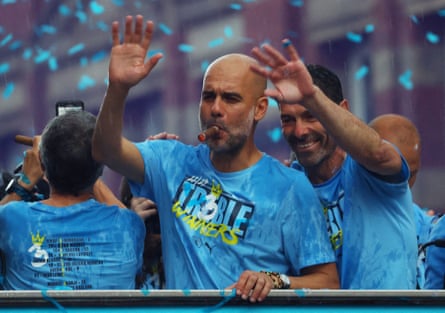
“I have no idea [about] that. They don’t have to do anything, honestly. The important thing in our lives is when you look back and say, ‘wow, you can look with a big smile and that is good’. And Bernardo [Silva] can feel that and John [Stones] can feel that. We spoke about that in last days and about [what] we lived. So when you are an old grandfather and you look back and you can laugh for the memories” – Pep Guardiola reckons he doesn’t need the new North Stand naming after him when he leaves Manchester City at the end of the season because memories of the good times – and he’s had a few – are more than enough.
FOOTBALL DAILY LETTERS
If Tottenham Hotspur get relegated (which is every Arsenal fan’s fantasy), when do we achieve next season’s St Totteringham’s Day? Do we mark it on the final day of this season or do we carry over the occasion to the opening day of the next one?” – Ronald Kondowe.
Given that Burnley have bounced between the bottom of the Premier League and the top of the Championship a couple of times in recent memory, is it time to replace their parachute payment with a yo-yo payment?” – Peter Oh.
Surely we have to doff our collective caps to the once ‘Special One’, then ‘Happy One’, then ‘Desperate for a Job One’ and, somewhat inevitably, the ‘ Lucky that Real Madrid are Even More Desperate Than He is One ’. His Benfica have just gone through the whole league season unbeaten. That surely puts them up there with Arsenal’s so-called ‘Invincibles’, who also went through the season unbeaten (if you ignore them losing once in the FA Cup, twice to Middlesbrough in the Milk Cup and three times in the Big Cup that is). That’s the way this works, right? Hold on a minute. Benfica finished where ?” – Noble Francis.
If you have any, please send letters to the.boss@theguardian.com . Today’s prizeless letter o’ the day winner is … Noble Francis. Terms and conditions for our competitions, when we run them, are here .
RECOMMENDED LISTENING
Women’s Football Weekly is heading for your ears, right here , with a look back at the WSL season that was.
RECOMMENDED LOOKING
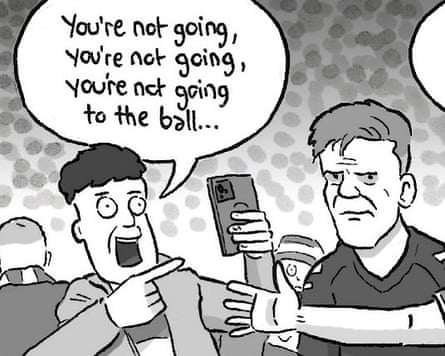
It’s our man David Squires on … Celtic crushing Hearts’ hopes of a Scottish fairytale.
This is an extract from our daily football email … Football Daily. To get the full version, just visit this page and follow the instructions .
T he unnamed 28-year-old narrator of Avigayl Sharp’s debut novel teaches literature at a girls’ boarding school in the US, and is not OK. She has lost touch with her friends, is hooked on prescription stimulants and cries too easily. She is also sexually uptight, which she attributes to childhood trauma, and weirdly obsessed with Joseph Stalin (“his brutality, and his paranoia, reminded me very much of my mother”).
The pupils at the school are brittle and entitled. One of them opines: “This guy Kafka kept acting like everything was out of his control … I thought, why don’t you take a little initiative, buddy?” Another “let her head drop back against the window, exhausted from the effort of speech” after uttering three sentences in a class discussion. They’re not terribly keen on reading – “due to the devastating psychic effects of daily technological overstimulation” – so she assigns them Charles Dickens’s 900-page novel, Bleak House.
Offseason is a wryly funny portrait of an enervated psyche. The narrative voice is deadpan to the point of absurdity. (“I am having a series of lucid and penetrating thoughts, I thought.”) Intense, improbably one-sided conversations play out in banal contexts, like a sendup of Rachel Cusk’s Outline. On learning that the school’s handyman is Bulgarian, the narrator – who is of eastern European Jewish heritage – offloads at length on intergenerational trauma. She thinks it might explain her mother’s “mania for purchasing obscene quantities of designer purses on clearance … then forcing me to observe and praise each one in exaggerated terms, after which she would narrow her eyes and accuse me of wanting her to die so I could have all of the purses”.
This mother-daughter dynamic is highlighted when she goes to stay with her parents during the end-of-term break that gives the novel its title. Some deliciously awkward exchanges attest to her mother’s problematic nature, but the narrator also reveals that she herself had been a compulsive liar as a child, which suggests her memories might not be reliable. Meanwhile her father helpfully intones: “Jewish people like your mother have intolerable histories, due to the Holocaust, fleeing the Soviet Union for the nation of Israel, cruel parents, estranged sisters, and other miscellaneous factors.”
The glib, on-the-nose quality of this pronouncement gently lampoons the rich tradition – in which this novel also resides – of fiction that explores the nexus of personal neuroticism and collective experience. Philip Roth’s Portnoy’s Complaint springs to mind, as well as more recent titles such as Katharina Volckmer’s The Appointment and Will Self’s Quantity Theory of Morality. Sharp’s protagonist is certainly neurotic, and neurotically fixated on delineating the hierarchies of causality that made her so. She brings these preoccupations into the classroom, much to the bewilderment of her young charges. “I wrote ‘Trauma Olympics – what if good?’ on the whiteboard.” Tellingly, however, she never seems fully on board with the intellectual ideas and discursive frameworks she invokes, and is more vigorously incisive when saying it straight: “My parents did not have intimate friendships, due to their limited attention spans and terrible personalities”.
Sometimes people are maladjusted for reasons that are destined to remain obscure, and the myriad strange and delightful ways in which that manifests might actually be more compelling than the originating causes. Offseason skewers, simultaneously and with plenty of droll wit, several commonplace tropes in recent literary fiction: the pat complacency of the trauma plot; the gooey sentimentalism of the immigrant experience novel; the narcissism of autofiction; the heavy foregrounding of theme at the expense of texture.
Sharp’s frazzled narrator is a 21st-century downgrade on Muriel Spark’s Miss Jean Brodie. Unlike her, she’s on a temporary contract, and lacks the courage of her convictions, preferring to wallow in the comforts of comic bathos. Her predicament makes her an avatar for our increasingly beleaguered humanities, embattled by funding cuts, culture wars and smartphone-induced brain rot. In such a climate, teaching American teenagers about Dickens’s London may indeed feel like a sisyphean task. (One of her pupils asks: “Is fog going to be on the exam?”) Offseason’s narrative arc echoes that sense of futility – the novel builds to an elliptical anticlimax – but when the journey is this fun, the destination hardly matters.
Offseason by Avigayl Sharp is published by W&N (£18.99). To support the Guardian, order your copy at guardianbookshop.com . Delivery charges may apply.
Uefa has handed a lifetime ban from all football-related activity to Petr Vlachovsky, the Czech coach who used a hidden camera to secretly film his female players in their changing rooms.
Vlachovsky was convicted in May 2025, having been found to have filmed 14 players at FC Slovacko over a four-year period. He was convicted without a public hearing and handed a suspended one-year prison sentence and a five-year domestic coaching ban, which prompted calls from the Czech players’ union for his punishment to be broadened.
On Tuesday, European football’s governing body announced that after an investigation its control, ethics and disciplinary body had imposed a lifetime ban and written to Fifa to ask the world governing body to extend that globally.
Vlachovsky, who was also caught in possession of child sexual abuse material, had previously coached the Czech under-19 women’s national side. His youngest victim at Slovacko was 17 years old.
Alex Phillips, the secretary general of the global players’ union Fifpro, told the Guardian in April that this case was “the tip of the iceberg” but that players were frequently unsure how to report concerns.
Fifpro welcomed Uefa’s ban, saying: “This outcome sends a strong and necessary message that abusive and inappropriate behaviour has no place in football and that safeguarding the wellbeing of players must remain a priority at every level.”
B rexit, it seems, is back. Or at least back within the Labour party. Wes wants to be back in (at some point). Andy once said there’s a case, but seems to have changed his mind . Nigel, meanwhile, warns of betrayal .
On one hand, this is all terribly predictable. Winning any Labour leadership race was never going to be possible without staking out a clear and ambitious position on the EU. Most Labour members are remain backers who regret leaving Europe. Even before the beginning of a formal contest, we were always going to see those vying for the top job try to outbid each other.
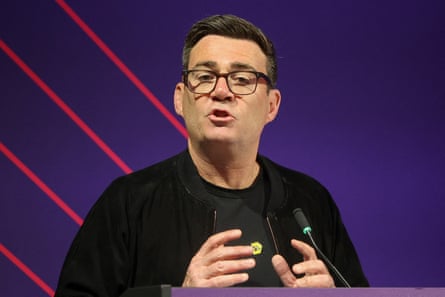
Andy Burnham’s decision to run for parliament is an additional wrinkle. Makerfield is a leave-backing constituency, and Reform UK are Labour’s main opponents, so revealing ambitious plans to move closer to the EU would be incredibly high risk. Hence yesterday’s switch to a more sceptical stance.
All of which gives Wes Streeting an additional reason to go big on Europe. The hope, presumably, is that Burnham is either driven to say something that makes the people of Makerfield less likely to vote for him (which Burnham seems to be avoiding), or that he is forced to adopt a position that makes members of the Labour party less likely to vote for him (which seems to be the chosen direction).
While Burnham navigates that bind, Streeting says as little that commits him to actually doing anything as possible. In his speech to a conference held over the weekend by the thinktank Progress, the former health secretary spoke in splendidly vague terms about a new “special relationship” with the EU while mentioning he’d like to see the UK rejoin one day. That’s it. That it was enough to set so many hares running is a tribute to his political nous – but not a signal of intent when it comes to EU policy.
Which is a shame, because a rethink of EU policy is increasingly necessary. The current negotiations – covering areas ranging from agriculture to UK participation in the EU’s electricity market – have stalled over the EU’s insistence that the youth experience deal it sees as key to the whole package allows EU students to pay domestic fees to attend UK universities.
And even if the two sides find a way to unlock the current impasse, there is the question as to what comes next. The UK government has made it clear that it wants even closer relations.
But the EU, for its part, has balked at the idea that London gets to pick further bits of the single market with which it wants to align. The view in Brussels is increasingly that the UK either stays where it is or opts for something much bolder.
The UK’s choices are therefore not only increasingly constrained, but seemingly at odds with the stipulations of the 2024 manifesto that the UK will not rejoin the single market or customs union or accept freedom of movement.
So a real debate is necessary. About how far Labour want to go. About whether the red lines as they are should stand. About whether any of the potential landing zones are actually in our interest.
This last point is particularly important. Many Labour MPs have spent the last couple of years propounding the idea of a customs union or of the UK joining the single market. There is evidence now that they are actually starting to ponder what these alternatives might mean.
A customs union will do precious little to compensate for the economic impact of Brexit , while conceivably tying the UK to EU trade deals over which it has no say. Equally, the single market means allowing the EU to set the rules for the UK economy with London perhaps being consulted but certainly having no vote. What works for Norway will not necessarily do so for us, not least because the Norwegian model rests on depoliticisation of the EU issue.
As for membership, what has become clear in the negotiations to date is that the EU will play hardball in any talks and extract whatever it can from us. Membership will come at a price in terms of budgetary contributions, and doubtless a commitment to join the euro . The talks will be brutal, and they will not be completed at any time soon. Signing up for this is signing up for many years of difficult negotiations carried out under the glare of Brexiter scrutiny.
So there is much to discuss. The problem is that an open and honest debate is not what we are likely to get. Ten years on from the referendum, Brexit as domestic football is still the order of the day. Whether speaking to the good people of Makerfield or to party members, Labour politicians have a strong incentive simply to say what their audience wants to hear.
All of which will serve merely to irritate the EU. Having watched consecutive Conservative administrations argue with themselves over Brexit, they’re now getting to see Labour do the same thing. And, like the Conservatives, Labour are doing so with precious little attention paid to what the EU might or might not be willing to give us.
Little surprise, then, that the reaction from Brussels is simply a shrug. Let the British play their games. We can talk to them when they’ve actually decided what they want. Albeit what they want might not be on offer, and what is on offer might not be what they want.
Anand Menon is director of UK in a Changing Europe and a director at Public First
‘No place for threats’ against UN security council member, US says in response to Russian comments
US ambassador Tammy Bruce, deputy representative of the US to the UN, is the next speaker as she strongly condemns the Russian threats against Latvia.
“ There is no place for threats against a council member. The United States keeps all of its Nato commitments,” she says.
Closing summary
… and on that note, it’s a wrap for today!
Senior EU and US diplomats condemned Russia’s threats against Latvia and the Baltic countries after Russia’s representative told the UN security council that “Nato membership will not protect” them from retaliation if Ukraine launches drones against Russia from their territory ( 17:58 , 18:24 ).
Russia’s Vasily Nebenzya aggressively floated Moscow’s allegations that Ukraine is looking into using the Baltic countries as a launch pad for attacks on Russia ( 17:55 ) , despite repeated denials from all parties ( 12:38 , 17:57 , 18:10 ).
Latvia’s UN representative dismissed the allegations as “pure fiction and pure lies,” with Ukraine’s representative calling them “fairytales” ( 17:57 ).
The tense exchanges come hours after a Nato fighter jet shot down a stray Ukrainian drone over Estonia ( 12:10 , 12:47 ), which Kyiv said had been jammed and detoured by Russia ( 14:10 ).
At least two air alerts were also separately issued in Latvia .
The incidents come just days before a key meeting of Nato’s foreign ministers in Sweden on Friday.
In other news,
Top Nato commanders confirmed that 5,000 US troops will be withdrawn from Europe but insisted these “adjustments” do not impact their ability to deter attacks , even as they warned the continent could see more “redeployment” of US forces in the future, and urged European leaders to ramp up their defence spending ( 16:18 , 16:25 , 16:30 , 16:41 ).
Troels Lund Poulsen, the leader of the centre-right Danish Liberal Party has announced plans to form a right-leaning minority government ( 10:55 , 11:47 ), despite no clear political backing for his proposal ( 12:26 ).
The former Spanish prime minister José Luis Rodríguez Zapatero has been placed under investigation for alleged influence-peddling and other offences by a judge examining the state bailout of a Venezuela-linked airline during the Covid pandemic ( 10:26 ).
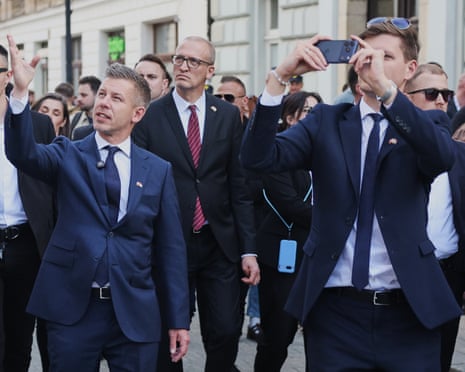
Hungarian prime minister Péter Magyar has landed in Poland as his first foreign trip since taking office earlier this month, where he is due to meet with Poland’s political leaders on Wednesday as he wants to restore bilateral relations after years of tensions with the previous prime minister, Viktor Orbán ( 15:19 , 17:28 ).
If you have any tips, comments or suggestions, email me at jakub.krupa@theguardian.com.
I am also on Bluesky at @jakubkrupa.bsky.social and on X at @jakubkrupa .
The EU permanent representative ends on a stronger note as he says that Russia’s aggression is “unacceptable under international law,” and the aggressor “will face accountability and will never be allowed to change borders by force.”
He says that “the future of Ukraine and its citizens lies within the European Union .
“ The Ukrainian people have a right to choose their own destiny, including a path towards EU membership. No former imperial power, however irredentist or aggressive, should be allowed to change that or can change that.”
That ends the meeting.
Russia’s engages in ‘head-spinning distortion of reality,’ EU’s UN ambassador says
The EU’s UN representative, Stavros Lambrinidis, also offered strong backing for Ukraine as he says “Russia must take full responsibility for the full effect and the consequences of its actions.”
“There should be no doubt in distinguishing between an aggressor and a victim.”
He particularly condemns Russia’s move to “threaten a member of the Security Council and an EU member state” in Latvia ( 17:55 ), saying Moscow lost “all pretence of reason, measure, modesty and dignity.”
He adds:
“Accusations, which we often hear in this chamber from the aggressor, that the European Union is prolonging the conflict are a head spinning distortion of the reality on the ground.”
Ukraine’s UN representative Andriy Melnyk is speaking next, outlining the persistent Russian attacks on Ukrainian cities, saying “the first half of May has been one of the deadliest periods for Ukrainian civilians” since the start of the war.
He says Russia should “stop complaining about the suffering of poor Russians,” as what it is witnessing is just the reaction to it’s continued aggression on Ukraine.
“ Unlike Russia, Ukraine forces never target civilians, ” he stresses.
Listing the numerous Russian attacks in recent weeks, he references that which killed two sisters in Kyiv ( 15:56 ).
But he says that “regrettably, all these barbaric crimes committed by Russia against Ukrainian civilians … have still not met with an adequate response from the international community.”
He urges all UN members to “enhance their sanctions regime” and prevent the delivery of components to Russia’s “war machine.”
He says:
“ Despite Putin’s boasts about alleged successes, … even Russian pro-war military bloggers are criticising disasters on the battlefield, and many of them openly acknowledge that the current momentum favours Ukraine.
Moreover, some Russian military experts warn that Putin is losing this war, with the frontline stalled, an estimated almost 1.4 million Russian troops dead or wounded, and ordinary Russians under increasing economic pressure.
The war that Putin believed would produce his crowning life achievement will prove to be his final downfall.”
Mocking Moscow’s recent scaled-down Victory Day parade , he says “the illusion of Russia’s invincibility was ultimagtely cracked,” marking “the beginning of the end for Moscow’s imperial ambitions, the imminent collapse of Putin’s rule.”
He rejects Russia’s allegations on Ukraine’s use of drones from the Baltics as “fairytales.”
He also warns about the planned nuclear exercises involving Belarus , saying it “represents an unprecedented challenge to the global security architecture.”
‘No place for threats’ against UN security council member, US says in response to Russian comments
US ambassador Tammy Bruce, deputy representative of the US to the UN, is the next speaker as she strongly condemns the Russian threats against Latvia.
“ There is no place for threats against a council member. The United States keeps all of its Nato commitments,” she says.
Latvia rejects Russian ‘lies and aggressive disinformation’ after threats over drones
Latvia’s UN representative Sanita Pavļuta-Deslandes says she has little time for Russia’s “pure fiction and pure lies.”
“I will just repeat that lies and aggressive disinformation and threats are a sign of despair and weakness, and we have seen similar lies addressed against other members of this council in the previous meetings, so I’m very honoured to have the attention drawn to my country today.”
Peace talks with Ukraine ‘at dead end,’ Russian UN diplomat says as he brushes off responsibility for war in Ukraine and threatens Latvia
The latest air alert over Latvia comes just as the UN security council meets to discuss the latest on Ukraine , with countries expressing their concerns about the state of the conflict.
But Russian permanent representative Vasily Nebenzya is having none of it though as he blames absolutely everyone but Russia for what’s going on in Ukraine.
He says the negotiation process to reach a peace settlement is “at a dead end,” and blames Ukraine’s president Volodymyr Zelenskyy for not ordering his troops to cease fire and withdraw from the regions Russia wants to control.
He says “until [Zelenskyy] realises this, achieving the goals of the special military operation will be done by the armed forces of the Russian Federation.”
He says Zelenskyy’s “stubborness” is “actively supported by European countries,” with honorary mentions to London and Brussels, alleging Europe wants to “drag it out for as long as possible to infict as much damage as possible on Russia.”
He then launches into an extended ridicule of the EU’s foreign policy chief Kaja Kallas, saying suggestions she could be the EU’s negotiator with Russia “can only be called a mockery,” as she has “no understanding whatsoever of what diplomacy is.”
Nebenzya then seeks to advance the same (completely false) theories that Ukraine and Latvia pushed against earlier ( 12:38 ) as he alleges that Kyiv will “be launching [drones] from the territory” of the Baltic countries, and particularly from Latvia.
He specifically threatens Latvia by saying “the membership of Nato will not protect your from retaliation.”
Obivously, expect Latvia to strongly deny and protest against all of that.
Latvia issues another possible air threat alert
Back to Latvia, the country has once again reported possible air threat to Latvian airspace in two counties bordering Russia.
“Seek shelter indoors, close windows and doors,” the authorities said in an alert.
However, no drones have been detected in Latvian airspace so far, the army’s spokesperson Māris Tūtins told Latvija Televīzija.
Magyar wants to restore relations with Poland after years of tensions under Orbán
Meanwhile, beginning his first meeting in Poland , Magyar stressed he was looking to restore bilateral relations with Poland so they can “regain the place they deserve” after years of conflict under Viktor Orbán.
He also said he wanted to reinvigorate the Visegrad Four format – with Czech Republic and Slovakia – and even expand it to include Austria and other regional partners.
As expected, he also had to face awkward questions about the fugitive Polish minister ( 15:19 ) , revealing he too had learned about his escape from the media.
He said Ziobro most likely left Europe not from Hungary , but from another EU member state, but this is still being looked into.
Earlier, Magyar laid wreaths at the monuments to Polish pope John Paul II and the former, 16th-century king of Poland, the Hungarian Stephen Báthory.
He is currently getting a guided tour of Kraków, which you can follow live (if you speak Hungarian, with some occassional Polish and English) on his YouTube.
In the process, he shows off some of his Polish in the process, greeting locals with cheery (“dzień dobry”) “hello” in Polish and somewhat accidentally telling someone he likes the colours of their football scarf – of Lechia Gdańsk football club – purely on the basis of their colours coinciding with those of his favourite team, Ferencvárosi TC.
Conveniently, both Poland’s PM Tusk and president Nawrocki support Lechia, so guess that’s one more thing to talk about tomorrow.
Grynkewich’s words are intended to reassure and project urgency at the same time – snap analysis
Grynkewich’s words there are not exactly surprising – we have long known that the US was looking to pivot away from Europe and wanted to see more from its European allies – but his clear language on future redeployments of US troops from Europe will only add further urgency to Europe’s attempts to build up its military capabilities .
Behind his reassuring words that the decision to pull out some US troops does not impact “the executability” of Nato’s plans ( 16:18 ) and that he remains “very comfortable” with where we are ( 16:25 ), there is a clear signal to European allies to get on with the task of expanding its military, quickly.
Global health leaders are considering whether vaccines or medicines still in development could be used to fight Ebola in the Democratic Republic of the Congo , as the World Health Organization’s chief said he was deeply concerned by the outbreak’s speed and scale.
Dr Tedros Adhanom Ghebreyesus said there had been at least 500 suspected cases of Ebola and 130 suspected deaths in DRC since the new outbreak began – up from about 200 cases and 65 deaths when it was announced on Friday .
Dr Mesfin Teklu Tessema, senior director of health at the International Rescue Committee, which works in the DRC’s Ituri Province, where most cases have been reported, told the Guardian he expected current known cases were “the tip of the iceberg”.
Spread across the porous border to South Sudan, he said, was probably “a matter of when”. He warned that a weak public health infrastructure there meant “we are actually flying blind”.
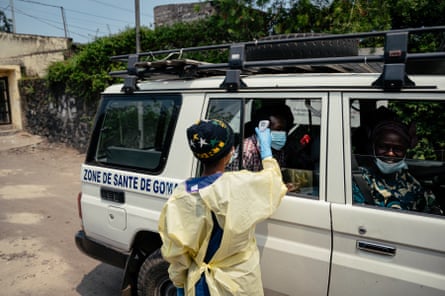
The IRC provides humanitarian relief in the region, including support to health clinics. Tessema said there was a severe lack of basic protective equipment, such as gloves, masks and goggles, for healthcare workers seeing patients in the area.
He added: “Ebola is a very deadly disease – this strain has a mortality rate between 30% and 50%. That is with availability of care. When care is not available, when people are arriving late, that risk of mortality could be higher than that.”
There are a number of strains of the virus that can cause Ebola. The Bundibugyo strain, which has been identified as responsible for the current outbreak, has no approved vaccine or treatment.
Scientists from the DRC and Uganda published the genome of the virus online on Monday night. Experts who examined the genetic data said it suggests the outbreak was recently sparked by a “spillover event”, meaning a human became infected through contact with an infected animal, and has since spread from human to human.
“That is useful because it suggests this outbreak can potentially be traced and interrupted as it has been in the past. Repeated independent spillovers from an animal source would complicate the efforts to stop the outbreak,” said David Matthews, Professor of Virology, University of Bristol.
A WHO official in Ituri province, said the outbreak could take a long time to bring under control.
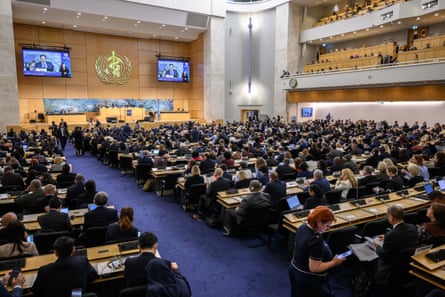
“I don’t think that in two months we will be done with this outbreak,” Anne Ancia, the WHO’s representative for the DRC, told reporters in Geneva at the World Health Assembly, pointing to a recent Ebola outbreak that took two years to end. Nearly 2,300 people died between 2018 and 2020 in the deadliest outbreak in the DRC to date.
“At the international level, [we are] looking at what candidate vaccines or treatment are available and if any could be of use in this outbreak,” Ancia added.
In Uganda, people have been told to avoid hugging and holding hands, and the country’s annual Uganda Martyrs’ Day celebrations on 3 June, which usually involve millions of people gathering, has been cancelled.
While the WHO recommends screening at border crossings with the DRC and Uganda, it urged other states not to place restrictions on travel and trade. Some countries, including the US, have placed bans on travellers from the area. Rwanda has closed its borders with the DRC.
A senior official at Médecins Sans Frontières (MSF) said the response was likely to be complicated by a lack of access to healthcare in the affected area, where there is a lengthy armed conflict.
Tedros said the number of cases and deaths would change “as field operations are scaling up, including strengthening surveillance, contact tracing and laboratory testing”.
Thirty cases in Ituri have been confirmed by laboratory testing, and one death and case in Kampala, Uganda. A US citizen has also tested positive and has been transferred to Germany.
The WHO is convening a technical group for advice on what tests, vaccines and treatments could be useful. Vaccines are only available for the Zaire strain, which was identified in 1976. A 2023 campaign in the DRC vaccinated about 55,000 frontline workers in the Ituri and neighbouring North Kivu provinces against that strain.
Ancia said the expert view was those vaccines “cannot be used in the current response” although “a lot more studies need to be done”.
The outbreak, made public on Friday, was declared a public health emergency of international concern (PHEIC) by Tedros in the early hours of Sunday morning.
On Tuesday, he said: “This is the first time a director general has declared a PHEIC before convening an emergency committee. I did not do this lightly … I’m deeply concerned about the scale and speed of the epidemic.”
Tedros said reports of Ebola cases in urban areas, where the virus typically spreads more easily, were cause for concern. Cases among health workers indicated potential spread in clinics and hospitals, he said, and there was “significant population movement in the area” for work and also due to conflict.
The province of Ituri was “highly insecure”, he added. “Conflict has intensified since late 2025, and the fighting has escalated significantly over the past two months resulting in civilian deaths. Over 100,000 people have been newly displaced. And in Ebola outbreaks, you know what displacement means.”
Dr Maria Guevara, the international medical secretary at MSF, who has worked in the DRC, said: “The fact is the system is broken and the community is not able to access any type of health care.”
She said conflict had made routine immunisation extremely difficult, and that most of the DRC had experienced severe outbreaks of cholera only last year.
Speaking at an event in Geneva organised by the Independent Panel on Pandemic Preparedness and Response, she added: “You put Ebola on top and then you want to be able to do the proper protocol and case management, proper case treatment, but they’re inundated with all the other outbreaks, also dying of maternal mortality, from malaria, from everything else. And you’re expecting the community to be able to understand why you’re coming in with a zoot suit [slang for the personal protective gear worn by health workers].”
Ancia said the WHO was rushing to address the current crisis and had deployed more than 40 experts to the field, alongside national responders.
The UN health agency had also sent 12 tonnes of supplies, she said, including personal protective equipment for frontline health workers, from the DRC’s capital, Kinshasa, and Nairobi in Kenya.
Ebola spreads through direct contact with body fluids from infected people or animals and causes symptoms that can include high fever, vomiting and internal and external bleeding. According to the WHO, the average fatality rate from Ebola is about 50%, varying from 25% to 90% in past outbreaks. This is the 17th Ebola outbreak in the DRC since the discovery of the virus.