Splore no more: New Zealand’s shrinking festival scene hurts local artists as big acts roll in | New Zealand | The Guardian

Keyword – World news
Trefwoorden – New Zealand, Music festivals, Music
Title – Splore no more: New Zealand’s shrinking festival scene hurts local artists as big acts roll in | New Zealand | The Guardian
Author – Henry Oliver in Auckland
Link – Splore no more: New Zealand’s shrinking festival scene hurts local artists as big acts roll in | New Zealand | The Guardian
Publish date – 2026-06-13T21:00:24.000Z
Category – News
URL – https://www.theguardian.com/world/2026/jun/14/new-zealand-music-festivals-struggle-shut-down-splore

O n New Year’s Eve 1998, a few hundred people gathered for a dance party on a clifftop above the black sands of Karioitahi beach, south of Auckland. It was wild and lo-fi. Inspired by outdoor raves in Goa, India, and New Year’s Eve parties in the hills of the South Island, there were stilt walkers and fire performers and all kinds of dance music. It was called Splore, a Scottish word meaning merrymaking and frolicking.

Fat Freddy’s Drop played their first ever festival show at Splore, and have gone on to become a festival favourite in Europe. Other acts followed that path. For nearly three decades, Splore was an unofficial launchpad – where a band or DJ used to playing to a hundred people could suddenly be on a main stage in front of thousands. People came back year after year, they brought their children. Their children brought their own friends.

But Splore is no more. Its’ final event was held in February. In a sad sign of the times for music festivals in New Zealand , dozens of festivals have ended in the past two years, including The Others Way, JuicyFest, One Love, the Timeless Summer Tour and more. Womad and Bay Dreams are on hiatus and Twisted Frequency has warned its next edition may be its last. Local music magazine Newzician has estimated up to half of the 70 music festivals held in the summer of 2023-2024 had been cancelled, shut down or postponed.

Music festivals have been a mainstay of New Zealand’s summers for decades and, for many, a cultural rite of passage. Up-and-coming local artists cut their teeth on the festival circuit and larger events draw international acts to the isolated country.

But the music community is becoming increasingly alarmed as it watches the country’s local independent festivals buckle under the weight of tough economic conditions, dwindling funding and the rise of international promoters, whose big budget events are difficult to match.

Ben Howe, a festival founder and co-owner of local record label Flying Nun, is shocked by how rapidly festivals are shutting down.

“Culturally [music festivals] are really important” he says, adding the success of artists such as Lorde and Aldous Harding was buoyed by their early-career appearances at local festivals.

“The changes just mean less diversity and less opportunities for local artists, and less interesting stuff going on.”

No one understands that narrowing better than John Minty, 74, who ran Splore from 2006 before he made the painful decision to shut it down. In 2024, for the first time under his watch, Splore lost money, approximately $320,000 ($188,000). The festival took a year off in 2025, with Minty hoping conditions would improve. But when the 2026 event went on sale, for $385 ($225) with camping, “it was crickets,” he says. “Tickets just didn’t move at all.”

At the same time, international acts and promoters are finding fans in New Zealand, as concert giants such as Ticketek, Live Nation and its Ticketmaster subsidiary gain a strong foothold.

The annual Laneway festival, which has been in a partnership with Ticketek since 2021, keeps growing. In 2026, more than 35,000 people attended the Auckland event – a record number – said David Benge, who worked on the festival’s first edition in Melbourne in 2005 and has recently returned to focus on its Auckland leg.

“We’re not trying to hit a number,” he says of the booking philosophy, “we’re trying to hit an identity.”

It helps, Benge acknowledges, that Laneway has buying power nobody else in the market can match: six dates across Australia and New Zealand mean agents take the calls.

Even then, the festival would be “more profitable” if New Zealand was cut out of the schedule, Benge says. That said, music festivals in Australia have also struggled with poor ticket sales and cancellations in recent years.

Overseas, international promoter Live Nation has faced a verdict in the US and accusations in Australia of anti-competitive behaviour. In New Zealand, there is growing concern multinationals are pushing smaller promoters out of the market.

“Those big multinational companies are not really interested in furthering local music,” Howe says.

“They can afford to pump through lots of artists, which sort of floods the market to some degree and makes it difficult for local events to compete,” he says. “It’s not really helping the local music community, and in fact, its kind of killing it.”

Benge identifies a “no man’s land” – festivals too large to survive on passion alone, too small to attract sufficient sponsorship or government support. That’s where many festivals get caught, he says.

Minty is more pointed about the government’s role. The NZ$10m Event Boost Fund, announced in 2024, was presented as a lifeline for the sector. In his view, the money went to the wrong place.

“It went to big multinationals, big international artists,” he says. “The bulk of that money went directly overseas.”

Contrary to Minty’s assertion, a list of funded events to date shows a mix of local and international acts, across multiple genres and venue sizes. His own application – $240,000, less than 10% of Splore’s annual budget – was rejected.

The final Splore sold out its roughly 8,000 tickets. Hundreds attended for the first time, drawn by the knowledge it was ending. They told Minty it had blown their minds, that they couldn’t believe he was stopping something so good.

“And I’m thinking,” he says, “you should have come 10 years ago.”

Additional reporting by Eva Corlett

World Cup 2026: England camp hit by tornado warning as Scotland reacts to first victory in 36 years – live | World Cup 2026 | The Guardian

Keyword – Football
Trefwoorden – World Cup 2026, World Cup, Football, Sport
Title – World Cup 2026: England camp hit by tornado warning as Scotland reacts to first victory in 36 years – live | World Cup 2026 | The Guardian
Author – https://www.theguardian.com/profile/emillia-hawkins,https://www.theguardian.com/profile/billy-munday,https://www.theguardian.com/profile/yara-el-shaboury,https://www.theguardian.com/profile/danielharris,https://www.theguardian.com/profile/jacob-steinberg,https://www.theguardian.com/profile/jonathanwilson
Link – World Cup 2026: England camp hit by tornado warning as Scotland reacts to first victory in 36 years – live | World Cup 2026 | The Guardian
Publish date – 2026-06-14T13:15:31.000Z
Category – Sport
URL – https://www.theguardian.com/football/live/2026/jun/14/world-cup-2026-news-scotland-react-to-first-world-cup-victory-in-36-years-as-australia-beat-turkey

Australia: Someone inform Nestory Irankunda that he has had a lifetime offer. Rafqa Touma was in Melbourne to soak up all the joy and heartbreak from Australia and Turkey fans.

Plus Jack Snape, Martin Pegan and Sam Lewis analyse the win and predict what may be next for the Soceroos.

Thanks Daniel and hello all. It is just past 11pm in Sydney, which in my view means the party should just be getting started. Especially since, with their win over Turkey, Australia are now the unofficial football world champions – the informal way of calculating the world’s best team, using a knockout format.

How have Australia won it? Let me break it down.

Argentina won the 2022 World Cup in Qatar. They held the title for just under a year before losing to Uruguay during World Cup qualifications. From there it went – Cot D’Ivoire, Sierra Leone (Fifa raking of 125, lowest UFWC ever at the time), Liberia (Fifa ranking of 149th, new record for lowest UFWC), Algeria, Sweden, Kosovo, Turkey.

Australia’s title defence comes in their next group game against the United States on 19 June.

Righto, my watch is over; Yara El-Shaboury is here to hang for the next bit. So I’ll leave you in her capable hands and see you shortly for Germany v Curaçao.

Back to our next game, I’m sad to say that we’ll not be seeing Curaçao’s delightful away kit in the group stages, as none of Germany, Ecuador and Côte d’Ivoire play in blue. But a delight it remains.

“Aussies really did park the bus,” says my Scottish, naturalised Aussie mate. “Was like a training exercise but they were decent on the break. Scotland were dismal.”

Are these two sporting cultures diametric opposites?

What a result this is for Australia. Like Scotland, they lost on every metric bar the one that counts, and will now fully expect to qualify for the last 32 – also in Group D are Paraguay and USA.

We’re bringing you a banger from Edgbaston this afternoon:

Talking of Scotland, the headline on Sky earlier was “Magical McGinn”. Er, did you see the goal, lads?

One for Scotland fans: if they were to lose their second and third games, what are the chances they still qualify for the last 32? With a goal difference of:

-1: 87.5%

-2: 69.4%

-3: 47.3%

-4: 29.2%

-5: 20.5%

I do wonder if they’ll come to regret not beating Haiti more convincingly, but ultimately they lost the shots, possession and xG, so any kind of win is acceptable. If they do lose to Morocco and Brazil, though, they’ll probably need at least of the games to be close.

Hello from Kansas City, where those of us following England are dealing with the wild mid-west weather. We went to England training yesterday afternoon and had our World Cup fever replaced by heatstroke. It was incredibly hot and humid at Swope Soccer Village – and in the evening the sun was replaced by an astonishing storm.

The sirens warning residents to stay inside were going off for over an hour. I was in a local bar watching the Scotland game and the NBA but both feeds were taken over by non-stop weather updates. Turns out the weather guy is a big celebrity here. We had to hunker down as the wind and rain raged outside. A tornado eventually touched ground 20 miles from where we were. Apparently they don’t actually get into Kansas City, which explains why it’s still standing after all these years.

I can’t lie, I’m a little envious of this – I’d love to experience some outrageous weather. I’ll have to find some for our next date night…

Our first game today – depending on where in the world you are – is Germany v Curaćao. I’m really looking forward to seeing how Julian Nagelsmann’s team do – he’s got some lovely players, especially in midfield, but I wonder if his method of management, quite heavy on instructions, is what international football requires given how relatively little time there is to inculcate them. I also fear there’s a lack of goals up front – I don’t see them as potential winners – but they’re good enough to beat anyone on a good day.

As luck would have it, Black Sherif has a song called YAYA, “yaya” meaning to chill in Twi.

My wife and I were lucky enough to interview Blacko for the Guardian not that long ago. I fear that with the date night I set a standard I can’t maintain, but what can you do.

Not strictly World Cup-related, but Yaya Touré is the new head coach of … Slovan Bratislava , not words I expected to type when I woke up this morning. Top of the Morning matter!

Now on to my favourite player footage so far: Black Sherif, my the my the greatest recording artist in the world, has been to visit the Ghana team. It’s fair to say they’re fans, and even more excited than he is.

The track they’re singing is called Top of the Morning:

And it’s from Iron Boy, Blacko’s sophomore album – for my money, the best 2025 has to offer, and by far.

First of all, check out what else we’ve got going on:

Thanks Emilia and safe everyone. I trust there’s a spring in all our steps? I’m here to hang for the next hour so let’s see what’s what we start considering our next set of games.

Right, time to hand this blog over to Daniel Harris now as he continues the countdown to kick-off.

Amazing reference. Love it!

“Harry I’ve a feeling we’re not in Kansas anymore!”.

I’m keen to know, what is something that has stood out to you at the World Cup so far?

I stumbled across the profile of a Boston resident on social media yesterday. His name is Mike and he has fully embraced Scottish football and the fans staying in his neighbourhood. He even made them sausage sandwiches before the game yesterday! Fans have grown to love him and one even offered him a ticket to a game. That is what the World Cup is all about!

The match between Netherlands and Japan later today has potential to be the game of the tournament so far. I’ll definitely be watching that one.

I’m also really looking forward to Germany v Curaçao – and not just because it’s a nice early evening match for us here in the UK. Curaçao fans will create an incredible atmosphere in Houston. What a moment it will be for them against the four-time champions.

I can only imagine what the atmosphere was like in New York last night. Not only is football fever sweeping the nation, but thousands were out on the streets after the Knicks won the NBA Finals. What a time to be in the city!

Thanks Billy!

On that Qatar v Switzerland game, I thought Qatar absolutely deserved the point. Switzerland wasted far too many chances and paid the price for it in the end. I’ll admit, when watching the match I thought Remo Freuler was marginally offside. Obviously, the officials thought otherwise.

Who knows what could’ve happened if Switzerland did not convert that penalty…

Emillia Hawkins is back on deck, so I’ll hand over to her. Keep your comments coming.

Another of yesterday’s talking points was (apologies in advance) the use of VAR in the Switzerland v Qatar game. Fifa said a “technical outage” prevented VAR graphics from being shown during the 1-1 draw.

There was confusion for supporters inside the stadium in California and watching on TV after no images or animations were made available to show that Switzerland’s Remo Freuler was onside moments before winning a penalty in the first half.

ITV pundit Gary Neville described the governing body as a “dictatorship” and suggested that failing to demonstrate to viewers why play had been allowed to continue undermined trust in the process.

Fifa said: “During the Qatar vs Switzerland match in the San Francisco Bay Area, a brief technical outage prevented the onside animation graphic from being generated ahead of the penalty awarded to Switzerland in the 14th minute. The issue was quickly resolved.

“The workflow of the VAR was not affected by this issue and followed the normal procedure in checking the on-field decision. The lines used by the VAR to check the position of the relevant players did not show the attacking player to be in an offside position in either of the two situations immediately before the penalty decision.” PA Media

It’s Curaçao’s big day today. A first World Cup game for the tournament’s smallest ever nation by land and population – against Germany, no less.

Arthur Renard has been speaking to members of the playing squad and backroom staff in this rather fun and often moving piece.

Curaçao’s openness became clear when Fifa asked them what requirements they had for their World Cup stay. “We don’t have any,” replied team coordinator Wouter Jansen. He was told a separate entrance could be arranged at the hotel and room keys prepared in advance. “I said: ‘All of that isn’t necessary,’” Jansen says. “We’re just used to walking in through the reception in the lobby and if we have to wait a bit, that’s no problem. We’re used to hotels where the rooms still need to be prepared. And nobody complains. That took them a bit by surprise.”

But what about security, Fifa then asked. “Security?” Jansen responded. “We really don’t need security; we’re more than happy to give out an autograph.”

Curaçao sprung another surprise when Fifa inquired about when open training sessions for media and fans should be planned. “Honestly, everyone is welcome with us,” Jansen replied. “And the public can even come on to the pitch after training.”

Kick-off in Houston, Texas is midday local time, 6pm BST and 3am on Australia’s east coast.

Brazil got off to a slow start , shall we say, against Morocco.

How ponderous were Brazil. That midfield has all the dynamism of treacle.

The starting midfield pairing of Casemiro and Bruno Guimarães was not great … but swapping Casemiro and Fabinho at half-time didn’t seem to make much difference. Carlo Ancelotti looks very short of options in that area – Atalanta’s Ederson was left on the bench.

Morocco meanwhile are pretty blessed in midfield – I thought Ayyoub Bouaddi was excellent alongside Neil El Aynaoui. The 18-year-old is currently studying for a maths and physics degree.

Quite delighted at the success of the Australian youngsters. Full credit to Tony Popovic for backing youth, especially replacing his captain and goalkeeper with young Patrick Beach (8 saves) and picking 20 year old Nestory Irankunda to score the first goal.

The win will have given them some confidence, which they’ll need playing the US next week in Seattle.

Australia has many beautiful beaches and one was on the pitch today! Well played Australia!

Tony Popovic’s gambles on youth paid off for the Socceroos against Turkey but he wasn’t surprised:

They may be shocks for a lot of people, but not shocks within our playing group or staff because we’re all working together every day and we can see the quality of these young boys.

Their ceiling, they’re nowhere near it because they’re a young group with no experience at a World Cup, very limited experience playing for their national team.

Their ceiling should come in four or eight years really, most of these boys.

Australia fans – have your expectations for the tournament changed after game one?

Thanks Emillia. A word on Haiti , I think. They impressed me, like the rest of the North American nations so far, with plenty of attacking dynamism. Never mind Scotland’s 28-year absence, that was their first World Cup match for 52 years. Their fans had a real presence too.

Here’s what their manager, Sebastian Migne, had to say:

We are definitely disappointed, we were trying to win. I am very proud, we played good football and put up a good showing.

In the last 30 yards we lacked spontaneity and there were also some poor decision-making at times.

We rose to the challenge, which is why we are frustrated that we came up slightly short. We hope we can use that to continue to play well.

They almost certainly won’t make it out of the group now but it’s going to be a fun ride – it’s Brazil next in Philadelphia.

And with that, I’m going to grab a quick break now. Billy Munday is here to take over.

Given that three teams in most groups will qualify for the knockouts, Scotland are in a great position already. They will take plenty of confidence from that win and, as Steve Clarke has already suggested, it should take some pressure off going into the next two group stage games. Anything can happen!

Scotland are bagpiping their way into the knockout stages. When you get to that stage, as my brother likes to say, anything can happen. Brazil are not looking so hot. Scotland could win this group, which would mean a kind draw in the knockouts. There can be only one.

“In the past two decades Japanese and South Korean players have become increasingly familiar in European leagues, but Japan are still to make it beyond the last 16 of a World Cup , something their manager, Hajime Moriyasu, has admitted has become a mental block. In 2010, after outplaying Cameroon and Denmark in the group, they allowed themselves to be dragged into a stalemate of ferocious tedium by Paraguay, losing on penalties. They tossed away a two-goal lead against Belgium at that stage in 2018 and then, in 2022, having beaten Spain and Germany in the group, ran into Croatia with predictable consequences.

“But this year, perhaps, is different. As Japan start their World Cup campaign against the Netherlands in Arlington on Sunday, it feels genuinely possible that they are not merely the best Japan side in history, but the best Asian side to play at a World Cup. Moriyasu has been in the job since 2018 and, as such, is the longest-serving Japan national manager ever. He has been bullish about Japan’s chances, talking openly of winning the competition…”

So, what’s happening today? We have four games to look forward to on matchday four, with Germany and the Netherlands among the teams involved.

Germany v Curaçao (6pm BST)

Netherlands v Japan (9pm BST)

Ivory Coast v Ecuador (12am BST)

Sweden v Tunisia (3am BST)

Thousands of Scotland fans gathered at the Ovo Hydro arena in Glasgow in the middle of the night to watch the match live. Incredible scenes!

I imagine there will be thousands of very tired Scotland fans today… At least there is an extra bank holiday to look forward to!

That was a lot, lot tougher than we thought it would be. But we have won a match at a world cup for the first time since I was 6, so who cares!

We do need to play a hell of a lot better in the next two games though. Oddly enough the counter-attack might suit us; we will likely go back to 4-5-1, we never seem to do well when expected to be on the front foot. We are at the world cup, we have won a game, this is the time for unbridled optimism and complicated calculations.

Enjoy a very tired sunday!

Saw the australia highlights. Very, very well done to them.

It may have only been a 1-0 win, but it was still huge for the nation. That 2am wake-up for Scotland fans was surely worth it!

We won. It was 1-0. Wouldn’t it have been nice had it been 2-0? Or 3-0? Of course. But 1-0 is there to be enjoyed, a hex put to sleep & the next game to look forward to.

England stars arrived in Kansas City yesterday to begin final preparations for their World Cup opener against Croatia on Wednesday. They were welcomed with a huge reception from hundreds of fans.

England camp hit by tornado warning

Meanwhile, the England camp was hit with a tornado warning on Saturday evening. Players and staff were instructed to take shelter with fears of 80mph winds. The England hotel and training ground were unaffected by the strong winds and heavy rain.

It has been reported that Thomas Tuchel and his squad will train as normal today.

The latest episode of World Cup Daily has just dropped. Be sure to give it a listen as Max Rushden, Barry Glendenning, Alex Abnos, Jeff Rueter, Jack Snape and Ewan Murray discuss the latest action from the United States, Canada and Mexico.

How Group D stands after the opening games…

Group D also continued today, with Australia earning a 2-0 win over Turkey in Vancouver. You can recap the action below.

How things stand in Group C…

Also in Group C, Morocco held Brazil to a 1-1 draw at New York New Jersey Stadium.

As always, feel free to leave a comment below the line with any reaction from the latest games. You can also throw in some predictions for today’s fixtures.

Or, you can email in at matchday.live@theguardian.com

Scotland fans, you might want to take a look at this…

Steve Clarke suggested the pressure on Scotland has eased following their win over Haiti. The manager said: “I am absolutely delighted with my players. Resilience, character had to be on the pitch tonight. There is no relief. Everyone told us it was a must-win game and we won. When you win a must-win game, you have to be happy with yourselves.”

On the upcoming group stage fixtures against Morocco and Brazil, he added: “We go into them with less pressure than everybody put on to us going into this game. If we defend as well as we did here, hopefully play a little bit better with the ball and create more, we will be OK. It’s not about raising the performance, it is about a different approach against a different opponent.

“Towards the end, you know you are 1-0 up and have something to hang on to so that is what you do. The players deserve a lot of credit. I thought Haiti were terrific at denying us time and space, which made it difficult. So the other characteristics that get you three points come out. That is why we are sitting here with three points and Haiti are empty handed.”

Scotland kicked off their World Cup campaign with a crucial 1-0 win over Haiti thanks to a first-half goal from John McGinn. Ewan Murray was at Boston Stadium to watch the action unfold…

Latest results

Brazil 1-1 Morocco

Haiti 0-1 Scotland

Australia 2-0 Turkey

Preamble

Hello and welcome to World Cup matchday four! There has been plenty of action over the last 24 hours or so as Morocco held Brazil to a 1-1 draw, Scotland won their first World Cup game in 36 years and Australia cruised to a 2-0 win over Turkey.

Meanwhile, England had some of their training equipment stolen while travelling to their base in Kansas City.

As always, we’ll be bringing you the latest reaction and updates throughout the day and look ahead to every matchday four fixture. Join us!

Scientists are working on headphones that block annoying noises and allow the ones you love? I can’t wait! | Emma Beddington | The Guardian

Keyword – Opinion
Trefwoorden – AI (artificial intelligence), Life and style, Technology, Health & wellbeing, Health
Title – Scientists are working on headphones that block annoying noises and allow the ones you love? I can’t wait! | Emma Beddington | The Guardian
Author – https://www.theguardian.com/profile/emma-beddington
Link – Scientists are working on headphones that block annoying noises and allow the ones you love? I can’t wait! | Emma Beddington | The Guardian
Publish date – 2026-06-14T13:04:37.000Z
Category – Opinion
URL – https://www.theguardian.com/commentisfree/2026/jun/12/scientists-headphones-block-annoying-noises

U npopular opinion incoming: there’s cool stuff brewing in the world. Microbots might one day mend spinal cords , a petri dish of brain cells can already play video games , and now the prospect of a new wonder: according to a New Yorker article on misophonia ( the condition where unwanted noise triggers disproportionate, unpleasant cognitive and physiological reactions), a team of miracle workers are “using machine learning to develop headphones that … can quickly target and eliminate irksome audio”.

Now we’re talking! This project, led by Shyam Gollakota of the University of Washington’s Mobile Intelligence Lab, aims to develop headphones that selectively filter out triggering noises, leaving or enhancing the good sounds. Gollakota offers the example of sitting on a park bench, oblivious to loud talkers next to you but able to hear birdsong.

Imagine the potential – I’m thinking Nobel peace prize. Ridiculous? Maybe, but one study showed a correlation between noise exposure levels and aggression; another of the area around Frankfurt airport found “a 1 decibel increase in average noise levels raises the violent crime rate by 1.6%”. I’m a subclinical misophonia sufferer (or possibly just a misanthrope) and inconsiderate noise makes me fantasise I’m one of those murdering aliens from A Quiet Place .

Aren’t there sounds we’d all love to eliminate? Imagine listening to an interview in which an intensively media-trained politician is sticking doggedly to their script (my body flooded with cortisol just typing that). Now imagine having headphones that filter out every nonsensically on-message utterance, leaving you with just the unvarnished truth: “I … don’t … know”, say. Or: “They told me … to … come here …. and … say nothing … real.” Sweet relief. (Nigel Farage needs a specific frequency blocker. It would create absolute silence the second he draws breath, allowing me the peace to imagine an alternative universe where his influence is limited to annoying some Kent darts club committee members, or something.)

Or here’s a seasonal scenario: the sun comes out between two June hailstorms and you’d love to sit quietly soaking up the warmth, but you can’t, because everyone in a five-mile radius is collaborating on an experimental found-sound symphony of strimming, mowing, leaf-blowing and pressure-washing their driveways. Magic headphones could mute them, dialling up the sound of grass defiantly growing, leaves unfurling and the fecund miracle of quiet, greening life.

A summer noise that is almost as bad as Farage is when a big, stupid fly gets stuck in your kitchen. David Attenborough forgive me, but I become a cold-blooded, rolled-newspaper-armed killer the second I hear one of those fools smashing its body against the window, again and again. Maybe without the manic buzzing, I could live and let live?

Or how about another aural irritant I’d pay a lot never to hear again: an early-morning idling van engine, its driver bellowing on the phone , window down, over a soundtrack of breakfast radio show DJ banter. I would probably live 10 years longer if I could replace that with a fantasy soundtrack of them being arrested and jailed.

Then there was the chilling news, last month, that people (well, psychopaths) can now make calls on British Airways flights . As we all know, the godawful work and personal calls of other people are bad enough on a bus or train, but imagine a long-haul flight. It’s particularly cruel because aircraft cabin sound is soothing brown noise – there are Spotify playlists of it! Eliminate 28B repeatedly touching base to talk pitch tactics or 37E explaining that her psychic says she’s a highly sensitive empath (despite all appearances to the contrary), and you’re left with the perfect soundscape to switch off and relax.

These are just mine – the magic of these headphones, really, would be in selecting your own personal triggers. Next door’s yappy chihuahua but not your telly tuned to The Dog House ; the tinny, brain-boring melody of your child’s favourite electronic toy (without muting your actual kid); the man upstairs doing his nightly Riverdance but not the dead-of-night blackbird singing outside the window; your partner chewing, but not the moment they ask if you fancy an ice-cream. Just imagine: your own bloodless, forensic, sound sniper. Suddenly, the future feels brighter than we feared.

Emma Beddington is a Guardian columnist

Do you have an opinion on the issues raised in this article? If you would like to submit a response of up to 300 words by email to be considered for publication in our letters section, please click here

Tell us: how are you adjusting your household finances as the Iran war pushes up costs? | Money | The Guardian

Keyword – Money
Trefwoorden – Money, Iran, World news
Title – Tell us: how are you adjusting your household finances as the Iran war pushes up costs? | Money | The Guardian
Author – https://www.theguardian.com/profile/guardian-community-team
Link – Tell us: how are you adjusting your household finances as the Iran war pushes up costs? | Money | The Guardian
Publish date – 2026-04-28T14:12:10.000Z
Category – Lifestyle
URL – https://www.theguardian.com/money/2026/apr/28/tell-us-how-household-finances-costs-iran-war

Rising prices and economic uncertainty linked to the conflict in the Middle East are putting pressure on household budgets across the world.

The International Monetary Fund has warned the conflict is pushing up the cost of energy and food , increasing borrowing costs and weighing on economic growth. Surveys suggest millions of households are already making changes to cope – cutting back, dipping into savings or taking on debt.

We would like to hear how you are adjusting your finances in response.

Have you changed your spending habits? Are you using savings more often, borrowing money or putting off big purchases? Are you making different choices when shopping? You might also have taken practical steps such as switching energy providers, cancelling subscriptions or working extra hours. We’d like to hear about it.

If you’re having trouble using the form click here . Read terms of service here and privacy policy here .

Scotland scrape past Haiti for winning World Cup return | World Cup Daily – video | World Cup 2026 | The Guardian

Keyword – Football
Trefwoorden – World Cup 2026, Sport, Football, Scotland, Haiti football team
Title – Scotland scrape past Haiti for winning World Cup return | World Cup Daily – video | World Cup 2026 | The Guardian
Author –
Link – Scotland scrape past Haiti for winning World Cup return | World Cup Daily – video | World Cup 2026 | The Guardian
Publish date – 2026-06-14T09:12:05.000Z
Category – Sport
URL – https://www.theguardian.com/football/video/2026/jun/14/scotland-scrape-past-haiti-for-winning-world-cup-return-world-cup-daily-video

Growing risk that thousands buried in Gaza’s rubble may never be identified, says Red Cross | Gaza | The Guardian

Keyword – World news
Trefwoorden – Gaza, Palestine, Israel-Gaza war, Middle East and north Africa, World news
Title – Growing risk that thousands buried in Gaza’s rubble may never be identified, says Red Cross | Gaza | The Guardian
Author – https://www.theguardian.com/profile/lorenzo-tondo,https://www.theguardian.com/profile/seham-tantesh
Link – Growing risk that thousands buried in Gaza’s rubble may never be identified, says Red Cross | Gaza | The Guardian
Publish date – 2026-06-14T08:00:37.000Z
Category – News
URL – https://www.theguardian.com/world/2026/jun/14/growing-risk-thousands-buried-gaza-rubble-never-identified-red-cross

The International Committee of the Red Cross has said the risk that the thousands of Palestinians buried beneath Gaza’s rubble may never be identified is increasing by the day, as recovery efforts remain slow and many victims have yet to be retrieved, the Guardian can reveal.

“There is no doubt that these bodies could soon become difficult to identify,” said Pat Griffiths, the ICRC spokesperson in Jerusalem. “The longer it takes for human remains to be recovered, the more difficult it can be to identify them. The longer the deceased lie beneath the rubble, the more likely they will be in advanced stages of decomposition – even skeletonised – when eventually recovered.”

He added: “Forensic experts lose access to circumstantial evidence that can be used to corroborate their identity.”

Since the fragile US-brokered ceasefire took hold in October, Palestinians have started digging through an estimated 61m tonnes of debris , about 20 times the combined amount generated by conflicts worldwide since 2008. Beneath the rubble, at least 10,000 people are thought to be buried, according to health officials in Gaza. Some experts believe the number could be as high as 14,000 .

Rescue teams have so far been forced to rely on rudimentary tools – shovels, pickaxes, wheelbarrows, rakes and hoes – as well as their bare hands. Repeated requests for Israel to allow the entry of excavators and other heavy machinery, which would significantly speed up recovery efforts, have gone unanswered.

“Search and recovery teams need access to all sites where human remains are thought to be located,” Griffiths said. “We know that much of this machinery and equipment remains almost impossible to bring into Gaza right now. And it remains our call, and part of our ongoing direct dialogue with the relevant authorities, to allow the entry of these items and equipment into Gaza.”

The longer it takes to retrieve a body, the harder it becomes to identify – including by using DNA. Dr Cristina Cattaneo , a professor of forensic pathology at the University of Milan, said: “Time, ultimately, is the greatest enemy of identification. When it comes to identification, the more time passes, the slimmer the chances of success. In the early stages, if a body is relatively well preserved, the face and other distinguishing features may still be recognisable. As time passes, many of the features that allow for a reliable identification are lost.”

When human remains are recovered, forensic experts can use age, sex, height, fingerprints, dental records and personal belongings, alongside details about where and when the body was found, to establish an identity. But the ICRC says the longer bodies remain unrecovered, the greater the risk that such evidence is lost. Remains can be displaced from their original location, personal effects destroyed or scattered, and environmental conditions – humidity and animal activity – can erase vital clues needed for identification.

Dr Ahmed Dahir, Gaza’s forensic medicine director, said: “In some cases, we were surprised to find that a person reported missing for only two weeks had turned into bones bearing signs of animal scavenging , with nothing left but bones. Under normal conditions, reaching this stage due to environmental factors and weathering usually takes between six months and one year.”

Witnesses have also raised concerns that Israeli military bulldozers operating in areas controlled by the Israel Defense Forces may be moving bodies still buried beneath the rubble, making it harder for families to locate and recover their loved ones.

The ICRC said it could not single out specific groups. “But what we can say is that certainly, in any armed conflict in any part of the world, heavy machinery must be used with incredible caution so as not to disturb human remains – to maintain the dignity of the deceased, but also to ensure that crucial information that could be used to identify them isn’t lost.”

A cemetery was established in Deir al-Balah to bury and preserve unidentified bodies recovered from the rubble and other temporary burial sites, with each grave numbered and documented in the hope that the remains could one day be identified and returned to their families.

“The number of bodies buried in this cemetery has now exceeded 650,” said Ziad Obeid, the director of the cemeteries department in Gaza. “Today, we are approaching three years since the beginning of the war, and some bodies have now been buried for more than two years.”

Further worsening the situation , the few remaining hospitals in the territory lack the equipment for DNA testing , which is desperately needed to help identify the deceased. Israel does not allow DNA testing materials to enter Gaza.

But genetic material, too, can deteriorate over time. “The passage of time also affects DNA, increasing the risk of degradation and making identification progressively more difficult,” Cattaneo said. “A genetic match that might have been rapid and highly reliable a few weeks earlier can become far more complex months later.”

Identifying the bodies is not just a question of restoring dignity to the dead; it is also necessary for the health of the living. Psychologists describe the unresolved grief of relatives of the unidentified dead as an “ambiguous loss” that can generate or contribute to depression, trauma and identity confusion, a situational disorder widespread in Gaza.

Saed al-Yazji’s brother Sameh, 40, disappeared on 7 October 2023. After seeing some of the videos that flooded social media that day, like hundreds of other residents he left the house to see what was happening.

“We have had no information about him since that day,’’ said al-Yazji, 52, from al-Mughraqa in the Gaza Strip. “We still cling to the hope that he is alive because there has been no confirmation that he was killed or detained.”

He added: “His disappearance has devastated the family. His wife suffers repeated psychological breakdowns, and after two years of not knowing whether he is alive or dead, they can no longer sleep or eat normally. We wait every day for news that might finally bring peace to our hearts.”

Wael Radwan, 24, from Jabaliya, lost his father, 49, and brother, 26, after their home was hit by Israeli artillery fire in December 2024.

“I was later told they had been buried at Kamal Adwan hospital, but when I returned after the siege, the site had been bulldozed and I could not find their bodies,” he said. “Without death certificates, my brother’s children are denied assistance for orphans because there is no official proof of their father’s death.”

Israeli officials contacted by the Guardian said there was no approval to bring equipment used to recover bodies into Gaza.

Griffiths said: “We see the scale of the task and we see what’s at stake. Thousands of families are still seeking answers in this way. That’s what at stake: their right to know the fate of those they love.”

Scotland victorious on World Cup return after McGinn strike helps clinch win over Haiti | World Cup 2026 | The Guardian

Keyword – Football
Trefwoorden – World Cup 2026, Haiti football team, Scotland, World Cup, Football, Sport
Title – Scotland victorious on World Cup return after McGinn strike helps clinch win over Haiti | World Cup 2026 | The Guardian
Author – https://www.theguardian.com/profile/ewanmurray
Link – Scotland victorious on World Cup return after McGinn strike helps clinch win over Haiti | World Cup 2026 | The Guardian
Publish date – 2026-06-14T03:25:19.000Z
Category – Sport
URL – https://www.theguardian.com/football/2026/jun/14/haiti-scotland-world-cup-match-report

This all proved rather difficult to evaluate as the dust settled. Scotland’s fifth win at a World Cup finals should have been a cause for epic celebration. Victory over Haiti meant this is a team not guaranteed to receive a bloody nose against lesser nations after all. More than 10,000 days after limping out of the World Cup in France, Scotland returned to the biggest stage in football and claimed three points. They top Group C.

Yet in Boston Stadium, the counter narrative was more than a feeling. With Morocco and Brazil to come, this single goal success may prove insufficient as Scotland look to emerge from the group phase for the first time. This regressed into an unconvincing display from Steve Clarke’s team. Haiti lacked the composure to punish that. Still, those who would blindly celebrate Scotland’s win are probably ignoring a bigger picture that should matter. John McGinn’s goal, a sclaff in Scottish terminology, summed up much that was to come thereafter. Scotland must now cling on in their next two outings.

The opening half was as curious as it was entertaining. Scotland looked impressive in moments moving forward but left gaps for Haiti to attack, which they did. Haiti carried menace without seriously looking like scoring. Yet it felt unwise for Scotland to offer their opponents such hope. Clarke had branded Haiti “dynamic” on Friday. Erratic looked a more appropriate description.

A pre-match prediction had been that Haitians would outnumber Scots in the crowd. Boston and surrounding areas have a large population from Haiti. Perhaps a number of them sold tickets to Scottish fans. So visible in their pink away shirts – which must be a record seller – Scotland supporters were comfortably in the majority, just as they had been while swarming streets in central Boston. Unsurprisingly, the Tartan Army provided a wonderfully vibrant atmosphere. Loch Lomond had already been belted out in emphatic style by the time Scotland won the anthem game. This was, however, all fluff; Scotland came to the United States to make tournament impact rather than receive platitudes for providing colour and noise.

Scott McTominay came within the width of a post of sending Scotland ahead after 16 minutes. The Napoli man collected a pass from Ben Gannon-Doak, whose attacking influence was crucial to Scotland. Wilson Isidor’s subsequent claim for a penalty was rightly waved away after Grant Hanley did little more than ruffle the Sunderland man’s hair.

Archie Gemmill’s legendary goal for Scotland against the Netherlands in 1978 has featured a lot in pre-tournament coverage. It was even shown on the screen here before the teams were read out. McGinn’s opener could barely have been more contrasting in style. Did the Scottish contingent care? Don’t be ridiculous.

Hanley launched a fine long ball to Ché Adams. The Torino striker played it wide to Gannon-Doak. Adams thought he had scored from Gannon-Doak’s low cross but Johny Placide produced a fine save. On hand to connect with the rebound was McGinn, whose scuffed shot had already taken one deflection by the time it flicked off the outstretched foot of Jean-Ricner Bellegarde. Perhaps there was something in the water: this goal arrived in the spell immediately after the first hydration break of the game, during which the Scots were noticeably sharp. Haiti jabbed back. Angus Gunn saved low from Ruben Providence before the same player was halted by a superb Aaron Hickey tackle.

Harum-scarum football continued in the early stages of the second half. Gunn was not troubled in that window. Neither was Placide, albeit Lawrence Shankland came within inches of connecting with a terrific Andy Robertson cross from the left.

By the start of the fourth quarter (the extent to which the flow of matches would be altered seemed to be ignored before this World Cup) the scoreline did not particularly suit either team. Haiti would have targeted this fixture for some form of points reward. Scotland’s hopes of reaching the last 32 on three points – a perfectly sensible ambition – surely needed better by way of a goal difference position.

McGinn almost improved it, instead screwing wide after latching on to a Hickey header. Haiti’s finest opening of the second half belonged to the lively Providence – Scotland should not have been tempting it – as he curled wide. Frantzdy Pierrot headed just beyond Gunn’s right-hand post. As the clock ticked down, Scotland were scatty. Haiti huffed and puffed, without really looking like capitalising on that.

One oddity of the Scotland performance was the ineffectual nature of McTominay’s involvement. Clarke can rightly take solace from the fact his talisman can and should be better against Morocco and Brazil. He will need to be. Scotland will need to be.

Raducanu blasts away fitness doubts with two wins in a day to reach Queen’s final | Tennis | The Guardian

Keyword – Sport
Trefwoorden – Tennis, Emma Raducanu, Katie Boulter, Sport
Title – Raducanu blasts away fitness doubts with two wins in a day to reach Queen’s final | Tennis | The Guardian
Author – https://www.theguardian.com/profile/tumaini-carayol
Link – Raducanu blasts away fitness doubts with two wins in a day to reach Queen’s final | Tennis | The Guardian
Publish date – 2026-06-13T18:28:12.000Z
Category – Sport
URL – https://www.theguardian.com/sport/2026/jun/13/emma-raducanu-injury-scare-queens-club-wimbledon-tennis

Emma Raducanu returned to Andy Murray Arena for her second match in five hours with lingering doubts about her physical condition after slipping on the slick grass earlier in the day and hurting her left thigh. By the time she had launched herself into consecutive backhand and forehand down-the-line winners to snatch an early break, that concern had dissipated.

What followed was one of her very best matches as she dismantled the talented 18-year-old Iva Jovic 6-2, 6-2 in front of an ebullient home crowd to reach the final here.

“It means everything to be making the final here and to be making it at home in London,” Raducanu said. “I love London. It’s my home. It’s where I grew up. It’s everything to me. So to be receiving the amount of support that I do here, it’s very emotional, and yeah, I’m just really proud of myself.”

This is her third tour-level final, her first being the 2021 US Open and her second coming this year at the WTA 250 event in Cluj, where she lost heavily to Sorana Cirstea. With wins over world No 18 Cirstea and No 19 Jovic here in consecutive days, at a 500 Event, this is the third time she has defeated two top 20 opponents in a tournament. She is yet to drop a set.

The quality of her play has been even more impressive than the wins. After another tough defeat in Melbourne in January, Raducanu said her aim was to just “hit the ball to the corners and hard”. She played this way relentlessly from start to finish, striking the ball so early, cleanly and with authority, not hesitating with her forehand and even closing down the net confidently. She has not struck with this cleanliness since the US Open nearly five years ago.

“The whole week I have been playing really, really good tennis and the brand of tennis that I really want to play. I wouldn’t say it’s necessarily the old Emma. I think it’s the new Emma, because you take all the lessons and experience, you know, all the different ups and downs, and you take everything. You understand a lot more what’s going on and what works for you. So I’d say, yeah, I’m back and better,” said Raducanu, smiling.

Her performances have been particularly striking considering what preceded this. Raducanu had lost six of her previous seven matches, her last win coming in March, in the middle of a miserable year that had been constantly disrupted by physical ailments. Her last showing, at the French Open , where she trailed 0-6, 1-4 before fighting to make the scoreline more respectable, was grim. If there was any surface and season where Raducanu was going to find her way again, though, it was always going to be on grass.

Considering how much doubt and tension often surrounds Raducanu, she naturally gains a lot from playing before a passionate home crowd. Moreover, the grass sits perfectly with her game. She moves much better on the surface than most, she enjoys the low bounce and the faster conditions imbue her strokes with slightly more oomph. Beyond those technical advantages, she is just so confident on the grass.

This was a match-up between two very similar players. Both of them are offensive players with sweet two-handed backhands who thrive on taking the ball early and redirecting pace off both wings. They also strike the ball with tidy, smooth technique but they can also be overpowered by stronger players. This match rested entirely on who could consistently dictate.

Raducanu was levels above one of the most talented youngsters in the game. She burst into the match desperate to take the initiative and she played brilliantly, pounding the ball off both wings and changing directions. Her backhand was particularly sublime. She raced to a 4-1 lead and continued her offensive barrage even after Jovic took a medical timeout midway through the first set.

There were still numerous moments when Raducanu’s momentum could have been snapped, such as when she lost her serve for the first time at 2-0 or faced a total of four break points at 3-1 and 4-2. Every time she was under pressure, Raducanu found a precise first serve or trusted herself to step inside the baseline and press hard until the point was hers.

Raducanu’s quest for a second title will take her face-to-face with Donna Vekic, a Croatian veteran who despite her status as a lucky loser ranked No 76 is also an accomplished player who thrives on grass. A Wimbledon semi-finalist in 2024, she reached a career-high ranking of No 17 last year.

Earlier in the day, everything had seemed to be progressing perfectly for Raducanu. The British No 1 was leading 6-3, 3-1 in her quarter-final against Kamilla Rakhimova. Then, out of nowhere, she slipped on the slick grass.

Raducanu emerged from her fall wincing and clutching her left thigh, clearly in pain, and as her lead evaporated a victory began to look in serious doubt. However, Raducanu impressively dug deep and held her nerve to drag herself into the semi-finals with a 6-3, 7-5 win over the Uzbekistani lucky loser.

“I think it’s amazing what adrenaline and support can do, and the mind as well,” Raducanu said of her thigh issue. “So right now I still have to kind of assess, but yeah, I know we’re going to do everything we possibly can for one more tomorrow.”

Vekic reached the final with an emphatic 6-1, 6-3 victory over the British No 3, Katie Boulter , who had little energy left less than 24 hours after defeating the world No 2, Elena Rybakina, in a dramatic three-set match, the biggest victory of her career.

England get rapturous welcome as they settle in to sprawling Kansas City home | England | The Guardian

Keyword – Football
Trefwoorden – England, World Cup 2026, Thomas Tuchel, Football, Sport, World Cup
Title – England get rapturous welcome as they settle in to sprawling Kansas City home | England | The Guardian
Author – https://www.theguardian.com/profile/davidhytner
Link – England get rapturous welcome as they settle in to sprawling Kansas City home | England | The Guardian
Publish date – 2026-06-14T04:04:28.000Z
Category – Sport
URL – https://www.theguardian.com/football/2026/jun/14/england-world-cup-training-base-kansas-city-swope

B efore Thomas Tuchel and his England players departed for the United States, there was talk about their World Cup training ground in Kansas City being too open. It was motivated, in part, by the Southampton spygate scandal. Would England’s rivals be able to steal a glance at them? Tuchel even said the Football Association would seek to erect protective fences.

The nine-pitch facility at Swope Soccer Village is certainly sprawling but here’s the thing. Nobody is getting on site without going past the armed police officers at the entrance. There was a throwaway line from a steward on Saturday as England trained on the complex’s showpiece pitch after flying in from Florida after their pre-tournament camp. “You guys see spying,” he said. “We see personal security.” The latter rather overrides the former. It was safe to say that they have it covered.

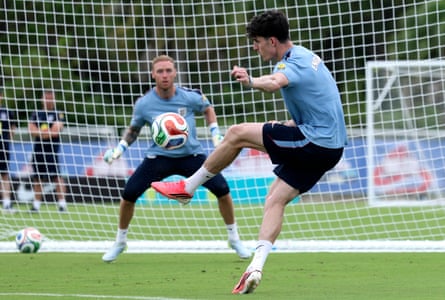
The buildup to England’s arrival was further coloured by the theft of some of their kit in transit from Florida, including boots and footballs. Again, it did not feel like much of an issue. Everything was recovered; two arrests have been made. “My boots?” said the goalkeeper, Dean Henderson. “I’ve got them on my feet so it’s all good. We got them all back so it’s nice.”

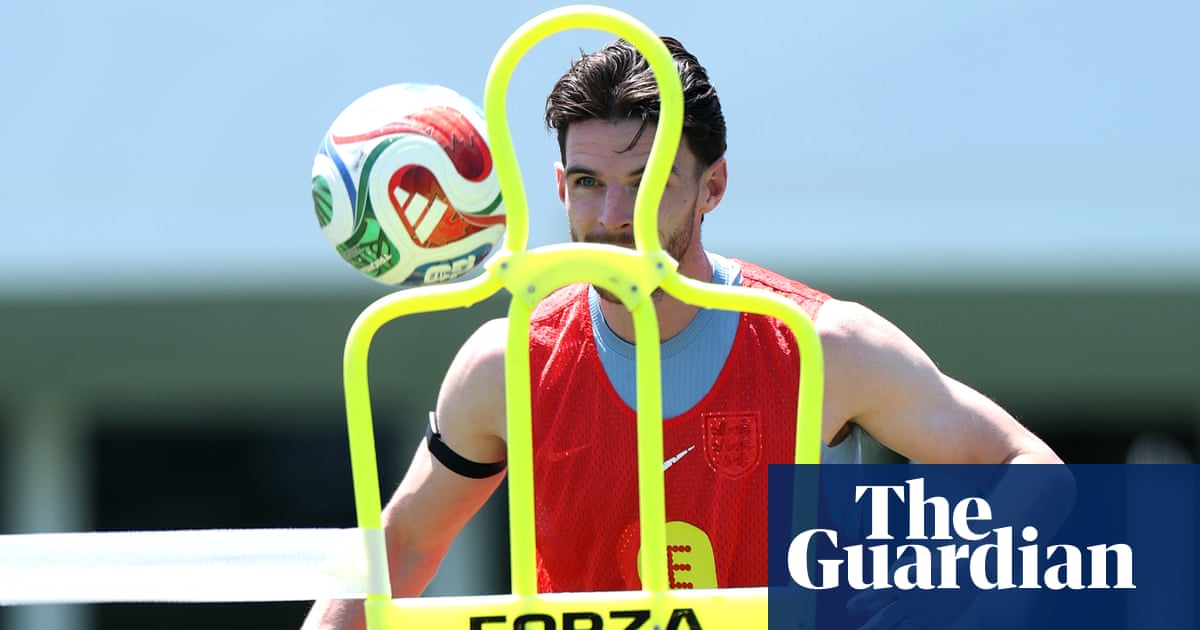
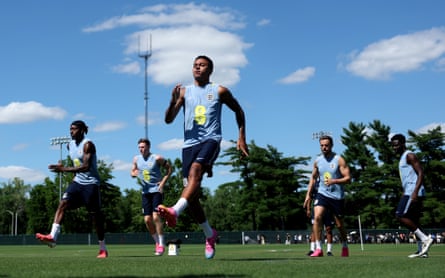
There did not seem to be much to fret about as the players went through a light session that lasted about an hour – if training under blue skies and a blazing sun that pushed the mercury to 29C can be described as light. The second chapter of England’s summer adventure has started and if the focus is about to narrow and the intensity pick up, then the excitement has gone up a few notches, too.

The opening game against Croatia in Dallas on Wednesday is edging closer and the good news is that England seem to have what they need at Swope and, indeed, their hotel – the four-star, 54-room Inn at Meadowbrook, which is a 20-minute drive away.

England always wanted to stay in Kansas City because of its location in the centre of the US and how it would mitigate their travel distances to matches; the plan is to fly in and out for each assignment, the FA having been clear about the benefits of a fixed base, a home.

England were denied the first pick of Kansas City’s training bases and even the second because they were not drawn to play any of their group games here. Argentina and the Netherlands were and the former bagged the best facility – Sporting Kansas City’s performance centre. The latter went for the training ground of the women’s team, the KC Current, which is newer than Swope, perhaps a little slicker-looking. As an aside, a fourth nation – Algeria, who have matches in Kansas City – have ended up at the University of Kansas facility.

But Swope, which is home to Sporting KC’s second team and their academy sides, ticked the boxes for Tuchel and the FA. It was particularly reassuring to see the quality of the pitch they used on Saturday – in light of scare stories about that aspect of things. England will rely on a different grass surface which is around the back of the main building but the reality is that it is of the same standard. And the standard is high. Local media described all three grass pitches at Swope – the other six are artificial – as among the best in the state. They are absolutely comparable to those that Argentina and the Netherlands will use.

The FA has put a new gym in at Swope and created a lounge for the players and they are happy, too, with the intimate Inn at Meadowbrook, which they have taken over exclusively. There are a number of permanent residents that live in condos close to the site and their access to areas such as the principal restaurant will be restricted while England stay there. To say thank you, Tuchel’s players will have a meet-and-greet with them.

The training session at Swope was open to a number of local children, who were specially invited and thrilled to be there. Harry Kane felt a lot of love. “Harry, you’re better than Bellingham,” screamed one overexcited youngster. There were banks of media at one end of the pitch.

What stood out for England was the warmth of the welcome. Local people were out in force with flags and signs as they drove up to the hotel – a massive police escort having helped them there from the airport. As the players walked in, they heard music from the Kansas City Chiefs’ band and saw the NFL team’s cheerleaders. Even the mascot, KC Wolf, was there.

Kansas City was not supposed to be a host venue for matches but they got the invitation from Fifa after Chicago said no. The people here are overwhelmingly delighted to have been asked. It is a city of jazz music heritage, the birthplace of Charlie Parker. It is a city of fountains, with more than 200 of them, some spectacular. There are 220 parks and 29 lakes. It is a city of barbecued meats, smoked ribs and burnt ends among the specialities. It is a city of charm and friendliness, which has a love affair with the heart symbol, partly because it is in the heart of the US. “We like to say that we greet people with a smile and a wink,” said one local.

Most urgent, perhaps, it is a city of sporting passion, headlined by the Chiefs, who have won three of the last seven Super Bowls. Also the baseball team, the Kansas City Royals. Football is big, too, thanks to Sporting KC and the Current, whose CPKC Stadium was the first in the world to be purpose-built exclusively for a professional women’s sports team.

The World Cup fan fest, which has been designed by the global architects Populous and holds 25,000, was rocking on Friday night as the US thrashed Paraguay in their opening World Cup game. Fans enter it through a 65ft high heart. England intend to thrive off the positive vibes.

Is ‘ripen at home’ fruit the supermarkets’ idea of a joke? | Life and style | The Guardian

Keyword – Life and style
Trefwoorden – Life and style
Title – Is ‘ripen at home’ fruit the supermarkets’ idea of a joke? | Life and style | The Guardian
Author –
Link – Is ‘ripen at home’ fruit the supermarkets’ idea of a joke? | Life and style | The Guardian
Publish date – 2026-06-14T13:00:45.000Z
Category – Lifestyle
URL – https://www.theguardian.com/lifeandstyle/2026/jun/14/ripen-at-home-fruit-supermarkets

I can’t be the only person who has become deeply distrustful of “ripen at home” fruit and veg. I’ve tried many varieties – peaches, pears, avocados – but either they stay rock-hard for weeks or they turn overnight and I find them oozing in the fruit bowl. When and how did we start having to pay extra for produce we can actually eat? Graeme McIntyre, Edinburgh

Post your answers (and new questions) below or send them to nq@theguardian.com . A selection will be published next Sunday.