Football’s greatest showman shows Mbappé and Haaland who’s boss | Football | The Guardian

Keyword – Football
Trefwoorden – Football, Sport
Title – Football’s greatest showman shows Mbappé and Haaland who’s boss | Football | The Guardian
Author – https://www.theguardian.com/profile/yara-el-shaboury
Link – Football’s greatest showman shows Mbappé and Haaland who’s boss | Football | The Guardian
Publish date – 2026-06-17T13:44:16.000Z
Category – Sport
URL – https://www.theguardian.com/football/2026/jun/17/football-daily-greatest-showman-messi-mbappe-haaland

Here comes the Messi-ah

The GWC has barely had time to unpack its suitcase and already the goals are flying in like overenthusiastic airline baggage. Stadiums are full, scoreboards are busy and, most importantly, football’s three marquee attractions decided that now would be a good time to remind everyone why they dominate highlight reels, sponsorship campaigns and social media algorithms.

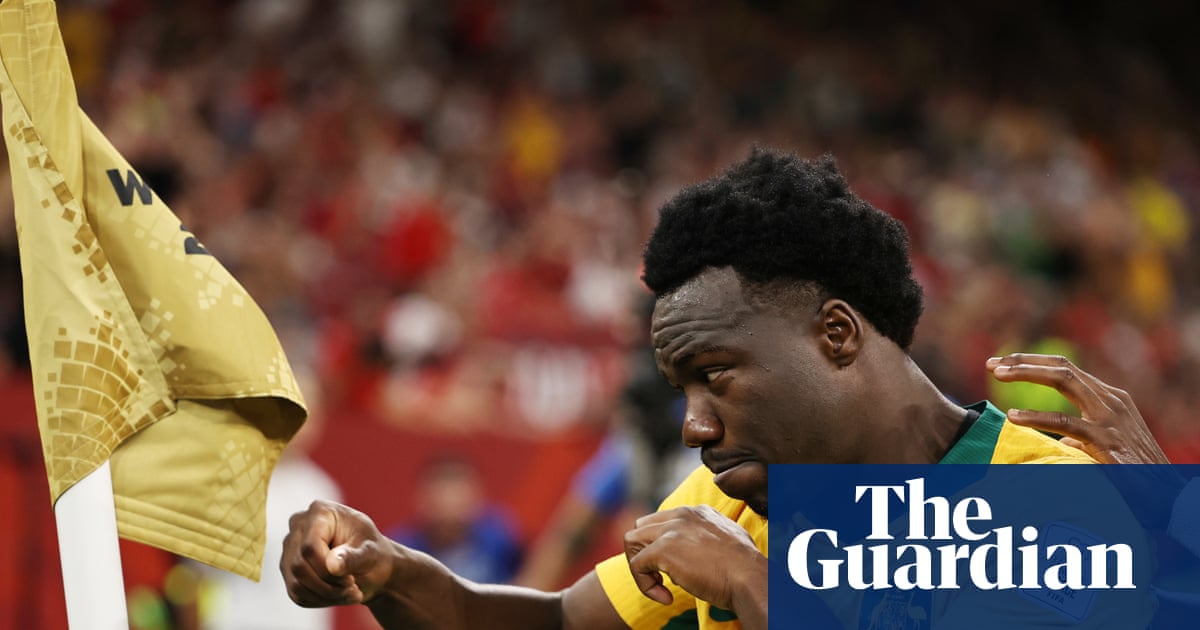
First up, Kylian Mbappé. France’s resident cheat code arrived in New Jersey with a mission and left with a place in the history books. Senegal did a respectable job of standing in his way until Mbappé remembered who he actually is. A low finish broke the deadlock before a thunderous long-range effort in stoppage time effectively put a bow on proceedings and a crown on his head.

A 3-1 win for France , 58 international goals for Mbappé and a new national scoring record. We would apologise to the previous record holder, Olivier Giroud, but he did not seem that fussed. “Congratulations Kylian,” Giroud tooted on BBC One, where he is working as a not-so-great pundit. “I’m happy for him. It makes sense, it was expected. He will beat every single record – the number of caps and goals.”

Mbappé’s goals for France have come in just 99 appearances and his double against Senegal moved him to 14 World Cup goals, leaving Miroslav Klose’s all-time record of 16 looking less like a countdown.

“I think he can easily reach 100 goals and maybe [beat] Miroslav Klose’s World Cup record,” predicted Giroud. “He’s delivered great performances in World Cups and big games.”

On to Norway’s Erling Haaland. Big Cup debut? Hat-trick. Bundesliga debut? Hat-trick. Premier League debut? Two goals. GWC debut? Naturally, two goals in a 4-1 win over Iraq .

The Norway manager, Ståle Solbakken, certainly was not surprised. “You can see he lived up to the occasion – it wasn’t too big for him. I had a good feeling before the game, the last training session was very good. I had a feeling he would do it for us today.”

Yet for all the brilliance of Mbappé and Haaland, football’s greatest showman was not about to accept third billing. Hours after the younger generation had dazzled, Lionel Messi wandered on to the stage and reminded us sequels rarely outperform the original.

A first World Cup hat-trick . A record-equalling 16th World Cup goal. Another entry in the ever-expanding folder labelled “proof he still has it”. Argentina beat Algeria 3-0 and Messi was involved in absolutely everything that mattered, including a raking challenge on Aissa Mandi that surely would have been a red card for mere mortals. Perhaps not inconsequentially, Gianni Infantino was in Kansas, watching on through misty eyes.

As the sun dipped behind the Kansas City skyline, the 38-year-old became the first player in history to appear at six World Cups, beating his old rival Cristiano Ronaldo to the landmark by a single day. Twenty years after making his World Cup debut as a teenager in Germany, and on his 200th international appearance, Messi looked a man casually ignoring the passage of time.

Afterwards, he cheered: “To enjoy this with my family, with my teammates, the ones who are always there, is a really beautiful moment. The squad, it’s a very united, very strong group. I feel good; we were lucky enough to win a tough match. It’s important to start off with a win in the first game.

“I’m grateful to the fans, because once again they’ve shown that Argentina is crazy about this – we packed the stadium again. Everything I’m experiencing now is a bonus. I’ve been fortunate enough to achieve all my dreams – or even more than I ever dreamed of achieving – professionally and personally.”

So then. Mbappé has broken more records. Haaland has continued his full-time hobby of terrorising defenders. And Messi has once again bent time and logic to his will.

Ronaldo and Harry Kane, over to you.

LIVE ON BIG WEBSITE

Join Daniel Harris for live updates from Portugal 1-0 DR Congo from 6pm BST (1pm EDT), before Scott Murray guides you through England 1-1 Croatia from 9pm BST (4pm EDT). Then, it’s Rob Smyth in the hot seat for Ghana 2-0 Panama at midnight BST (7pm EDT), with Jonathan Howcroft taking over for Uzbekistan 0-2 Colombia (10pm EDT, Thu 3am BST). Then you can sleep.

QUOTE OF THE DAY

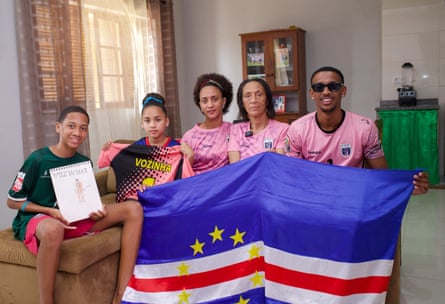
“I said that no ball would enter his goal and that is exactly ⁠what happened. He is a great goalkeeper. I am very proud to be Vozinha’s mother and I hope he continues to save every ball that comes his way” – Ana Candida Évora hails her boy’s performance in keeping Spain at bay for Cape Verde, after hacks popped up at the family home in Mindelo on São Vicente.
FOOTBALL DAILY LETTERS

First we have Football Daily on the weekend, and now we have Tuuka Tomperi stating in yesterday’s letters : ‘Football Daily is the best newsletter in the world, by far!’ The first I can pass off as GWC Fever, but the second is inexplicable and means I will be visiting my general practitioner as soon as the group stage is over” – Alex Bull.

Before kick-off on Sunday I was pessimistic about having to slog through three Curaçao matches in the GWC. But, after seeing them torn apart by Germany, 7-1, I can safely say that it’s just like watching Brazil. 2014-era Brazil , but still” – R Reisman.

You could argue that Vozinha is actually better than Pat Jennings ( yesterday’s Football Daily ). Vozinha’s given first name is Josimar, after the Brazilian defender who was a star of Mexico ‘86. That Josimar not only played in the game against Northern Ireland (and Jennings) that you referenced, he scored the second Brazilian goal, with a shot from way out on the right touchline if I remember correctly. Surely that’s conclusive proof that a Josimar is better than a Jennings?” – Richard O’Hagan.

The late music legend Cesaria Évora had a voice that reached the ends of the earth. She was from the same town in Cape Verde as the goalkeeper Vozinha, whose nickname is Portuguese for ‘little voice’. That little voice produced a massive roar heard around the world” – Peter Oh.

I wanted to add my Roy Hattersley recollection ( yesterday’s Football Daily letters ). His column was my favourite part of the Guardian, bar none. The man wrote exquisitely, so I was delighted to bump into him at Priestfield before a Gillingham v Sheffield Wednesday game about 25 years ago. He was polite and charming for our brief chat and responded with ‘I hope not’ when I bid him adieu, having said ‘may the better team win’. Wednesday duly lost to my beloved Gills. RIP Roy” – Martin Griffiths.

If you have any, please send letters to the.boss@theguardian.com . Today’s prizeless letter o’ the day is … Alex Bull. Terms and conditions for our competitions, when we run them, are here .

RECOMMENDED LISTENING

Get listening to World Cup Daily ! Max Rushden is joined by Barry Glendenning, Ben Fisher, Lars Sivertsen and Philippe Auclair as Kylian Mbappé, Erling Haaland and Lionel Messi all hit their stride.

RECOMMENDED WATCHING

With the World Cup expanding to 104 matches, navigating the “morass of endless football” can feel a bit overwhelming. Thankfully, Barney Ronay, has done the heavy lifting. He breaks down the group fixtures you absolutely cannot miss .

This is an extract from our daily football email … Football Daily. To get the full version, just visit this page and follow the instructions .

BBC presenter Ashley Cain called women ‘slags’, ‘sluts’ and ‘bitches’ | BBC | The Guardian

Keyword – Media
Trefwoorden – BBC, Media, Sexual harassment, Television industry, Television & radio, UK news
Title – BBC presenter Ashley Cain called women ‘slags’, ‘sluts’ and ‘bitches’ | BBC | The Guardian
Author – https://www.theguardian.com/profile/sirin-kale
Link – BBC presenter Ashley Cain called women ‘slags’, ‘sluts’ and ‘bitches’ | BBC | The Guardian
Publish date – 2026-06-17T05:00:24.000Z
Category – News
URL – https://www.theguardian.com/media/2026/jun/17/bbc-presenter-ashley-cain-called-women-slags-sluts-bitches

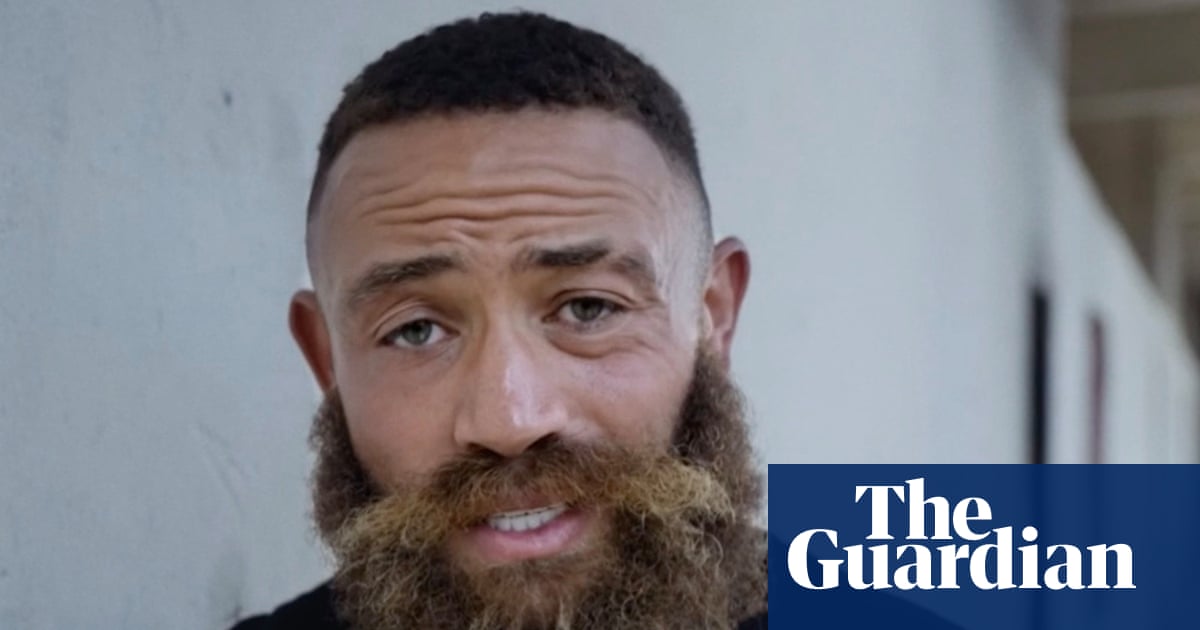
A BBC presenter lauded by the corporation for his appeal to young male audiences has a history of making abusive and misogynistic remarks about women, whom he has variously called “slags”, “sluts”, “psychos” and “bitches”, the Guardian can reveal.

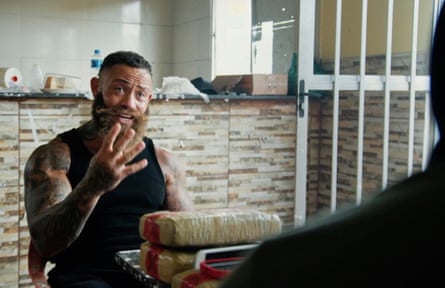
Ashley Cain is the presenter of the BBC Three documentary series Ashley Cain: Into the Danger Zone , which was filmed on location earlier this year after the BBC commissioned a second series.

A former footballer turned reality TV star, Cain travels to the world’s most dangerous places, interviewing young men who live on the fringes of society.

Before Cain began working with the BBC, he was a prolific user of X, which was then known as Twitter. He frequently referred to women in tweets using abusive terms, making jokes about hitting women and degrading sexual practices.

He also sent female users of the social media platform abusive messages with offensive sexualised language. In 2014, in response to a since-deleted tweet he perceived to be homophobic, Cain tweeted that one female user should “go and choke on a cock you slut”.

To another female user in 2015 he wrote: “The only thing that’s desperate around here is your pictures with your shit tits. Now suck a dick, and fuck off.”

These and dozens of other similar posts, all of which were publicly available, raise questions for the BBC about what, if any, vetting was conducted before his appointment. Late on Wednesday, Cain’s X account appeared to have been removed from the platform.

Cain did not respond to multiple requests for comment. A BBC spokesperson said: “We are very clear we expect the highest standards of behaviour from everyone who works with or for the BBC. When allegations are brought to our attention we take them seriously. We will consider this information carefully and do not intend to comment further at this stage.”

A source at the BBC said the corporation had been unaware of Cain’s social media posts. The revelations could pose the first big test for the BBC’s new director general, Matt Brittin , who joined the corporation last month after a string of scandals related to misconduct by BBC presenters.

BBC executives have in the past praised Cain’s “exceptional” ability to connect with young men, and promoted him on the broadcaster’s youth-focused channel, describing him as “what BBC Three is about”. He also appeared on the BBC’s flagship Celebrity MasterChef in 2025, reaching the semi-final.

When Cain was first commissioned by the BBC for Into the Danger Zone, which was filmed in 2024 and aired in 2025, there were ample warnings in the public domain about his controversial background.

He had previously appeared on an MTV reality TV show, where he was known for using the phrase “you can’t turn a hoe into a housewife”.

And a newspaper article from 2015, which is easily discoverable online, reported an incident in which a woman alleged that he uploaded footage of them having sex on to Snapchat without her consent. At the time, Cain said the woman consented to the footage being shared, saying: “Everyone knows what happens on my Snapchat.”

Misogynistic and sexualised language

It was around the time of the Snapchat incident that Cain was frequently tweeting abusive jokes about hitting and slapping women. While watching an episode of the ITV reality show Love Island in 2015, Cain tweeted that if he were a contestant he “would have to choke slam” the female contestant Jessica Hayes “real quick”.

On a separate occasion, he abused Hayes again, saying he would like to “dick fuck her and her big mouth, spit in her face and then fuck her off”. While watching a 2012 Channel 4 documentary, Cain tweeted that he wanted to “talcum powder pimp slap these bitches already!”

Cain also posted about sexual practices that blur the boundaries of consent, or that many would regard as offensive. In 2011, he joked about an extreme sex act involving semen, describing how it would be perpetrated against a “chick” or “bitch”.

Two years later, in 2013, Cain posted a tweet which joked that “eating bad food at weekends is like when a girl says, ‘Don’t cum in me’, but you do it anyway, then think ‘shit’,” adding three laughing emojis.

In 2014 he tweeted: “A girl bangs 100 guys = Slag A guy bangs 100 girls = Ledge.” The same year he tweeted: “I DO NOT.. I repeat I DO NOT think EVERY girl is a slag! There are some absolute PHENOMENAL women out there.. They’re just a rare commodity.”

In 2015, he wrote: “I know some sluts that think they’re not sluts cuz they slut discreetly. Lol.” In 2017, he wrote: “You’ll never see a good girl trying to prove to you she’s a good girl, she’s naturally different.”

While the comments are several years old, the fact most of them have been available on Cain’s public X account for more than a decade raise questions about the BBC’s vetting procedures given his controversial background.

A former reality TV star with 2.1 million followers on Instagram, Cain came to prominence through the MTV reality show Ex on the Beach, leading him to adopt the moniker “[the] bad boy of MTV”. During its first season, which aired in 2014, Cain twice tried to attack male contributors, being sent home early from the show due to his second attempted assault.

His on-screen girlfriend described him as “controlling”. Referring to her in an on-camera interview after an argument, Cain said: “I’m quite a lenient guy, and I kind of let her do what she wants to do, and I don’t put the reins on her, but obviously it’s gone to show that that’s not a good thing.” Cain later returned for subsequent seasons of the show.

Since the death of his daughter Azaylia in 2021 from leukaemia, he has become a prominent fundraiser, setting up a foundation in his daughter’s name and taking part in extreme physical challenges to raise money for childhood cancer research and treatment.

BBC executives perceived Cain as someone who could appeal to younger male audiences, particularly on Instagram and YouTube. In a press release to announce season one of Into the Danger Zone, Ricky Cooper, a BBC commissioning editor, described Cain as someone who “connects with young men in a truly exceptional way”. In an event for the Royal Television Society in 2025 , another BBC commissioning editor, Nasfim Haque, said: “Ashley is what BBC Three is about – a new talent giving us a new perspective.”

The BBC first hired Cain to present his own series in 2024, when he filmed the first season of Into the Danger Zone on location in France, South Africa, Brazil, Colombia, Sweden and the Philippines. The series was made by True North Productions, in association with Cain’s own production company, House of Panthera.

The revelations over Cain’s background will reignite a debate over the BBC and its treatment of prominent talent.

In April 2025, a BBC-commissioned external review of its culture found evidence that “a minority of people” behaved “unacceptably” within the corporation and that their behaviour “is not addressed”. The review was conducted after BBC scandals involving on-screen talent including the newsreader Huw Edwards and the MasterChef host Gregg Wallace.

The report recommended clear “standards for everyone who works with or for the BBC”, emphasising that BBC staff had a responsibility to “take appropriate action” in response to “sexist” or “abusive” behaviour.

Had the BBC conducted even a basic internet search of Cain’s background, executives are likely to have discovered Cain’s extensive history of offensive social media postings, as well as the 2015 report in the Daily Star alleging that he had posted sexually explicit footage of a woman without her consent.

‘There was no consent’

Speaking to the Daily Star at the time, the woman, Rachel Roftis, said she “definitely didn’t give him permission to take photos of me or film me at all” and that she had been abused online after Cain uploaded the footage to Snapchat.

Contacted by the Guardian this month, Roftis, 33, who lives in Bexley, south-east London, said she met Cain on 27 March 2015, after he made an appearance at Pure-bar nightclub in Bexleyheath. Roftis said they had consensual sex at a local hotel.

She said she only discovered later that Cain recorded videos and took photos of her naked without her consent, and uploaded these to Snapchat.

The following morning, Roftis recalled, she received calls and messages from friends and family. In one, sent to Roftis at 11.26am on 28 March, a friend wrote: “Rachel I know it’s none of my business, but do you know there’s videos of you on Ashley’s Snapchat of you having sex? And videos of your vagina?”

Roftis said that upon learning that Cain had shared explicit imagery of her online, she “screamed” at him and made him delete the images and footage, but by then they had gone viral. Posts still available on X show users using the hashtag #Room303, an apparent reference to Cain’s hotel room number that night, and making other references to the explicit content on his Snapchat.

Roftis said that she neither consented to Cain taking photographs or videos of her during sexual activity, nor to him sharing them online. A close friend whom she confided in at the time said Roftis had always been clear “there was no consent” and that the experience “massively affected her relationships with men. She doesn’t trust anybody really now.”

Cain himself made light of the events in posts on 28 March 2015. After deleting the Snapchat posts, he tweeted: “Some of the explicit Snapchats had to be removed ;(.” When a user responded to say that they were “the most explicit Snapchats I’ve ever seen”, Cain replied “that’s why they call me the Snapchat king”. Later that day, Cain himself tweeted “#Room303🔞.”

Roftis recalled that she received online abuse, including death threats. She also suffered in-person harassment at the bar she then worked at. She said: “I went into work the next day and I had people coming in there, basically shouting abuse at me, throwing things at me.”

The incident boosted Cain’s popularity, and days later he was booked to appear on O’Brien, an ITV daytime talkshow. On 3 April 2015, Cain described himself on the programme as a “modern-day playboy” who slept with up to “15 girls a week, every week”. He said he “openly” had sex with women on Snapchat, who “know what they are doing with me” and consented. He said he received up to 60,000 views on his Snapchat videos.

“I believe in respect and respect is mutual,” said Cain. “If you are a lady, I respect you. But if you don’t respect yourself, how can you expect me to respect you?” When challenged by a panellist, who asked how he would feel if a man treated his sister disrespectfully, Cain said he would “like to think” that his sister “was brought up in a good enough way not to do” what his sexual partners do.

After the Daily Star story was published later that month, Cain denied that the footage of Roftis was recorded and uploaded without her consent. In posts that tagged her on Twitter on 23 April 2015, Cain said she “tried to get her 5 mins of fame by selling a story claiming she was unaware” and that “she knew about it…she consented to it…& she fucking loved it!” He tagged Roftis in a post that read “if you need the money that bad, send me your acc number and sort code and I’ll fire you over a grand now!”

Roftis told the Guardian that, contrary to Cain’s claims, she was not paid by the Daily Star for the interview. Cain’s tweets prompted further misogynistic abuse, with users calling her a “slag”, “hoe” and “attention seeking little slut”. The experience was traumatic, she said. “I was made out to be this horrible person, that girl, a slag,” she said.

Roftis added that no one from the BBC had ever contacted her in relation to the incident. When she sees Cain on TV, Roftis said she “can’t physically watch”. She added: “I get angry at any TV thing that I see him on, because I’m just like, really ? It makes me angry that everybody, including these TV producers, are either not doing their research, or they just don’t care.”

NetJets aircraft crashes on Texas highway, killing one and injuring five | Texas | The Guardian

Keyword – US news
Trefwoorden – Texas, Plane crashes, US news, Mexico
Title – NetJets aircraft crashes on Texas highway, killing one and injuring five | Texas | The Guardian
Author – https://www.theguardian.com/profile/anna-betts
Link – NetJets aircraft crashes on Texas highway, killing one and injuring five | Texas | The Guardian
Publish date – 2026-06-17T14:31:34.000Z
Category – News
URL – https://www.theguardian.com/us-news/2026/jun/17/netjets-deadly-crash-laredo-texas

A private jet carrying six people crashed on a highway in Laredo, Texas on Tuesday night, killing one person, local police said.

Videos shared online by the Laredo police department showed the wreckage of the aircraft and firefighters working at the scene. Other footage, shared by the Associated Press , captured the immediate aftermath of the crash, with flames rising from the plane as police and others worked to pull people from it.

The plane had left San José del Cabo in Mexico and was bound for Austin, Texas, according to the Federal Aviation Administration (FAA). NetJets, a private plane company owned by Warren Buffett ’s Berkshire Hathaway, said in a statement on Wednesday that one of its aircraft was involved in the accident.

“What we have tonight is a tragic event,” Jose Baeza, an investigator with the Laredo police department, told reporters on Tuesday night.

Baeza said officers received a radio call from the local airport control tower just before 10pm local time, “indicating that they had an aircraft that was in trouble, that they had lost communication with the aircraft”.

“Regrettably and tragically” one person onboard the aircraft died, Baeza said. The five other passengers were transported to local hospitals, he said, and were reported to be in stable condition.

Authorities are withholding the identity of the deceased pending notification of next of kin.

In a statement to the Guardian, Laredo international airport (LRD) officials said that “at approximately 9:58 pm CDT on June 16, 2026, LRD Air Traffic Control received notification from the flight crew of a Cessna 680 Citation Latitude business jet reporting mechanical difficulties and declaring an emergency while en route from Los Cabos, Mexico , to Austin, Texas.

“The aircraft was attempting to divert to LRD when it went down on Loop 20, several miles short of the airfield, and came to rest after striking a passenger vehicle on the highway,” the airport officials said.

The statement confirmed that “six individuals were aboard the aircraft” and that “one person was fatally injured”. The “remaining five occupants, along with the driver of the affected vehicle, were transported to local hospitals and are reported to be in stable condition”.

The airport officials commended the “swift response of the Laredo Police Department, Laredo Fire Department, area first responders, and the bystanders who acted without hesitation to assist those aboard the aircraft” and said that “five police officers sustained injuries related to smoke inhalation during rescue operations and were treated accordingly”.

Replying to questions on Wednesday, the FAA said the aircraft was a “Cessna 680A business jet” and confirmed it crashed south of Laredo around 10pm local time on Tuesday with six people on board.

“The FAA and National Transportation Safety Board (NTSB) will investigate,” the FAA said, with the NTSB in charge of the investigation.

NetJets confirmed that an aircraft with tail number N523QS was involved in the accident. “Our immediate concern is for the well-being of our Crewmembers, our passengers, and their families during this time,” the company said in a statement. “We are activating our crisis response and family support teams to support those affected and their loved ones, and we are deploying a team of experts to the site of the accident.

“The NTSB has been notified and is investigating,” it said. “Until investigators release information or findings, NetJets cannot comment further and will not speculate on the cause of this accident.”

Laredo international airport said in its statement that the NTSB and FAA “have opened a joint investigation into the cause of this incident”.

“Laredo International Airport (LRD) extends its deepest condolences to the family and loved ones of the individual who lost their life in last night’s aircraft incident,” the airport’s statement added. “Our thoughts are also with the five surviving passengers and crew, as well as the occupant of the ground vehicle involved, all of whom are receiving medical care.”

As USA World Cup barbs fly, the Socceroos get motivated to have the final word | World Cup 2026 | The Guardian

Keyword – Football
Trefwoorden – World Cup 2026, Australia, USA, World Cup, Australia sport, Football, Sport, US sports
Title – As USA World Cup barbs fly, the Socceroos get motivated to have the final word | World Cup 2026 | The Guardian
Author – https://www.theguardian.com/profile/jack-snape
Link – As USA World Cup barbs fly, the Socceroos get motivated to have the final word | World Cup 2026 | The Guardian
Publish date – 2026-06-17T15:00:34.000Z
Category – Sport
URL – https://www.theguardian.com/football/2026/jun/18/usa-usmnt-barbs-australia-socceroos-world-cup-group-d-match

T he poisoned words have added sizzle to the Socceroos’ clash against the USA, and underlined the Australians’ belief in their status as underdogs. Commentators have described the Socceroos as a “lay up” for the Americans. That they don’t have any good players. That they are nothing but an average team with a “smug” coach.

USA midfielder Sebastian Berhalter – even as some teammates took a more conciliatory tone on Wednesday – chose to continue the war of words: “I think one [of this team’s core beliefs] is that we’re American. We don’t take shit.”

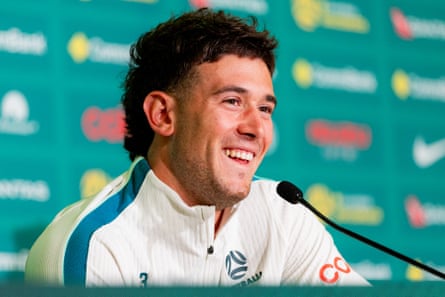
It was a surprisingly aggressive contribution to the escalating hype around the match which has not often been respectful. Socceroos defender Alessandro Circati offered a simple reply to Berhalter later in the day. “I’ve got no response to that,” he said.

“I mean, we don’t take it [shit] either. We’re just out there to play a game of football, to win, and to do our best.”

The slandering began late last year when the USA were drawn against Australia. Former professional player and now TV pundit Mike Grella said the Socceroos represented a “lay-up” for the hosts.

Grella addressed the backlash to his comments on Wednesday: “I’ve got tell you something, I don’t think they’ve ever been more united as a football side. If they do something in this tournament – which they won’t – if they do something in this tournament, they should make a statue of me there in Australia, because I’ve unified an entire country.”

The barbs didn’t stop with him. Former USA player Landon Donovan also dismissed the Socceroos’ chances after the draw, and took aim at Australia’s “smug” coach. “You can get on the Qantas airplane and head back home,” he said.

Circati, asked to offer his own adjective on Wednesday to describe Popovic, used the word “smart”. “He doesn’t let these things get to him,” the defender said. “People spoke probably about him before Turkey … and he sort of just shut them all up because we got a result.”

The team have also been targeted by Alexi Lalas, another former USA player, who described the Socceroos as “average”. He doubled down, encouraging the Australians to use his words as motivation. “I hope that they print it out,” he said. “Make sure you spell my name correctly. I hope that it’s wallpaper all around the Australian dressing room, because they’re going to need all the help they can get.”

Australian fans and media jumped on the comments, inflaming tensions ahead of an already a highly anticipated clash which is likely to decide the winner of Group D. Harry Kewell even weighed in, claiming he hadn’t heard of Grella even though the American had a brief stint at Kewell’s former club Leeds.

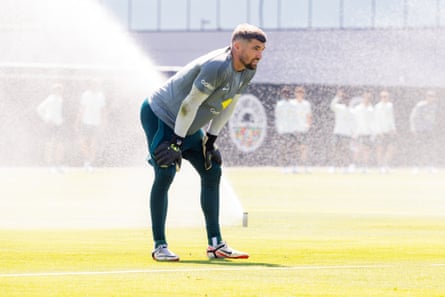
Former Australian rugby league player Josh Mansour asked Socceroos goalkeeper Maty Ryan about the vitriol on his podcast two weeks ago. Ryan’s response was seen as controversial, even if it was offered half in jest. “I’ve heard there’s been some Americans saying comments and to be honest I have a chuckle to myself because actions speak louder than words and I try to let my football do the talking,” he said, adding he was confident Australia could beat the hosts. “Ain’t no C-word scoring against me.”

Strictly speaking, the goalkeeper may have been right, given he lost his place to Patrick Beach . But the contributions from Ryan and Berhalter are the exception, as the players appear to be going out of their way to avoid giving their opponents any additional motivation.

USA midfielder Tim Weah said the rhetoric from TV pundits was “nonsense” and the Australian team “has a lot of fight, a lot of grit, and a lot of hunger, just like us”. His teammate Tyler Adams addressed Grella’s comment specifically: “It’s not going to be a lay-up. If anything, it’s going to be one of the most difficult games we play.”

Circati and USA winger Christian Pulisic are friends – both playing in Serie A. “I know him very well and I think he’s a great player,” the Australian said. “His season has been a little bit stop and start, but keeping that aside, I think he’s phenomenal.”

The negativity towards the Socceroos has mostly been confected by broadcasters and commentators with incentives to inflame in the polarised age of social media. But there is no doubt the Socceroos go into the match as underdogs, despite their impressive victory over Turkey .

The USA have three highly rated Premier League players in midfielder Tyler Adams (Bournemouth), defender Chris Richards (Crystal Palace) and fullback Antonee Robinson (Fulham) – while the Socceroos have none. Pulisic is at AC Milan, with teammates playing in Germany’s Bundesliga and France’s Ligue 1. By comparison, the only Australian at a top-division European club is Ryan, and he just lost his job as No 1 goalkeeper to Beach.

After his heroics against Turkey, Beach said that whatever people say, the Socceroos know they are outsiders and that is motivation enough. “They are a great opposition, they’ve got great players, and we just don’t worry about that stuff,” he said. “We know we’re the underdogs in the minds of a lot of other people and a lot of teams, and we’re happy with that.”

Why farmers see Colombia’s knife-edge election as a battle for the Amazon’s future | Colombia | The Guardian

Keyword – Global development
Trefwoorden – Colombia, Amazon rainforest, Farming, Deforestation, Conservation, Trees and forests, Environment, World news, Americas
Title – Why farmers see Colombia’s knife-edge election as a battle for the Amazon’s future | Colombia | The Guardian
Author – https://www.theguardian.com/profile/natalia-torres-garzon
Link – Why farmers see Colombia’s knife-edge election as a battle for the Amazon’s future | Colombia | The Guardian
Publish date – 2026-06-17T11:00:29.000Z
Category – News
URL – https://www.theguardian.com/global-development/2026/jun/17/armed-groups-colombian-farmers-election-run-off-guaviare-small-landowners-security-candidate

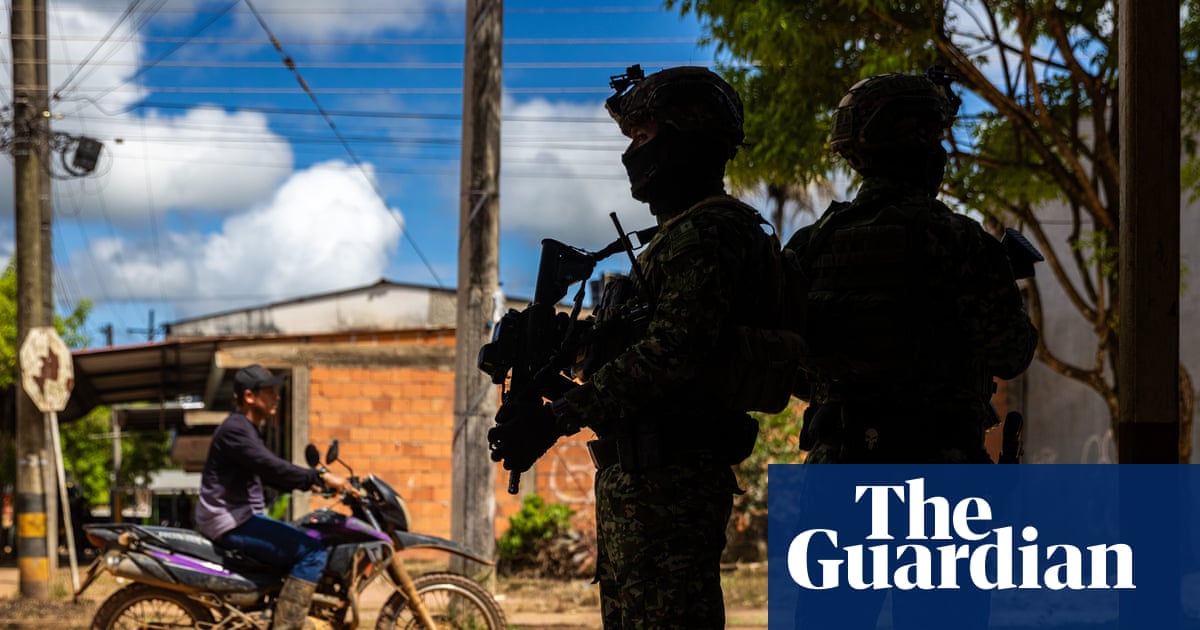
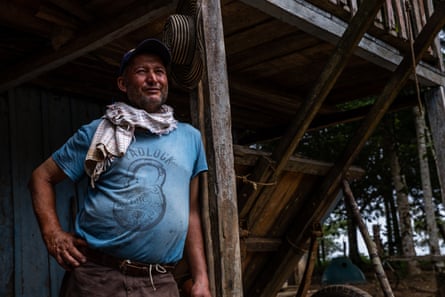
L ike most people settling in the area, Pablo Peña was seeking to escape violence and make a living from a patch of land when he moved to Guaviare in central Colombia . While his life has been strongly marked by conflict and deforestation, more than 30 years on he now focuses on community work and conservation.

Peña first visited Guaviare during his mandatory military service. Years later, in 1994, he settled down to farm in Guaviare’s Calamar, a town in a remote corner of the Amazon.

“When the guerrillas went to Havana [in 2012] to negotiate the peace treaty with [former president Juan Manuel] Santos, we realised that we didn’t even know where we had settled or the boundaries of our land,” says Peña. “Then we decided to protect our land.”

In 2018, Peña and his fellow campesinos began the process of creating a peasant reserve zone (ZRC), a designated land-use area aimed at safeguarding rural communities, supporting local farmers and stabilising their territories amid conflict that remains ongoing despite the 2016 ceasefire.

Reserve zones have been at the heart of President Gustavo Petro’s plans to improve farmers’ livelihoods while tackling deforestation and protecting biodiversity in the Amazon. During the past four years, his government has created 20 of the 27 existing zones.

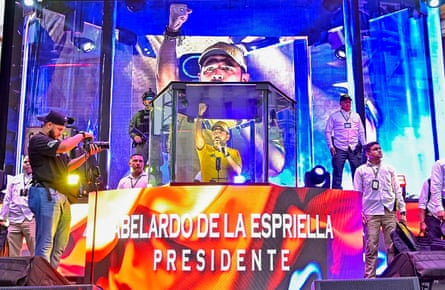
The Colombian government officially approved the request for a ZRC in 2025. But Petro’s presidential term is coming to an end and a far-right candidate, Abelardo de la Espriella, is competing with the leftwing Iván Cepeda in a highly polarised election . Farmers such as Peña fear for the future of the ZRCs if the far right wins in the second round on 21 June.

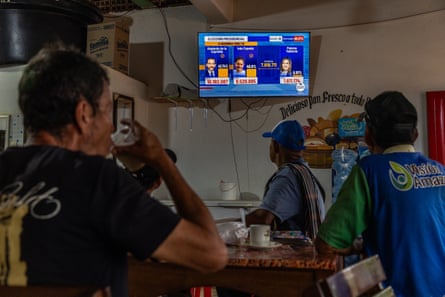
De la Espriella won the first round by a narrow margin over Cepeda on 31 May. The run-off election will show whether Colombians support a continuation of Petro’s policies, based on dialogue and reform, or return to a hardline militarised strategy proposed by De la Espriella.

Like many others, Peña was drawn to Guaviare by a surge in coca leaf production in Colombia. A few years later, he bought his first plot of land – which lacked title deeds. The price: a kilo of coca paste.

The land Peña occupied was within a forest reserve, further complicating property rights under Colombian law. According to the ministry of agriculture, before the peace treaty this was not an exceptional situation, as at least 40% of rural land in Colombia lacked formal titles .
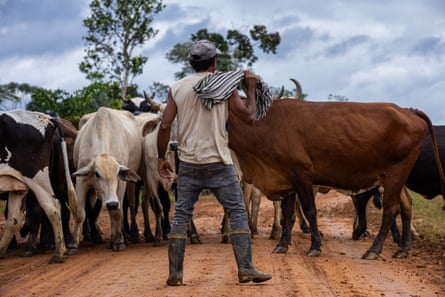
With the “ war on drugs ” and intensive programmes to eradicate plantations in Colombia, many farmers, including Peña, who had been growing coca leaves shifted to raising cattle, leading to increased deforestation. Between 2002 and 2025, Guaviare lost 350,000 hectares (865,000 acres) of forest – an area nearly five times the size of Singapore.

“While you could survive with five hectares of coca, cattle needed larger extensions of land,” Peña says.

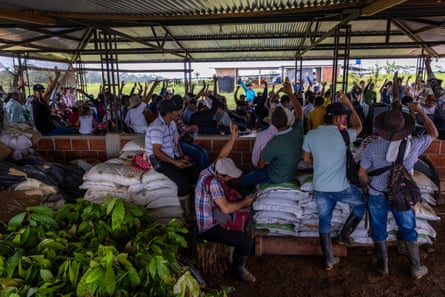
S ome ZRCs have become more sustainable, however. In Calamar, the Guardian of Chiribiquete , a peasant reserve covering 183,200 hectares and supporting 4,430 people, was officially established in 2025. It is named after the nearby Chiribiquete national park, a Unesco world heritage site , which has inspired the community’s efforts to develop sustainable economies.

ZRCs are essentially a mechanism for bringing farmers into the institutional framework and away from armed groups’ territorial control, but they have also had a positive impact on the environment when followed by investments in sustainable development, according to Camilo González Posso, founder of Indepaz, a peacebuilding NGO, and a former government peace negotiator.

“The law requires that these zones create sustainable development plans in collaboration with institutions, while the government has a commitment to contributing to the development of sustainable economies through investment and programmes,” González Posso says.

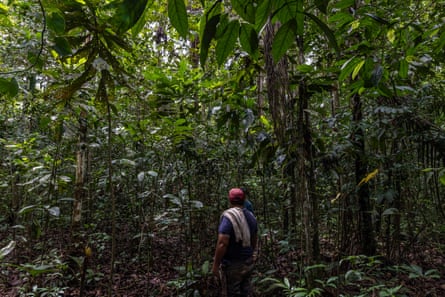
Within the Guardian of Chiribiquete, almost half of the native forest remains intact . Community members work to protect the area while planting native trees and Amazonian fruits, such as cacao and copoazú , to generate income.

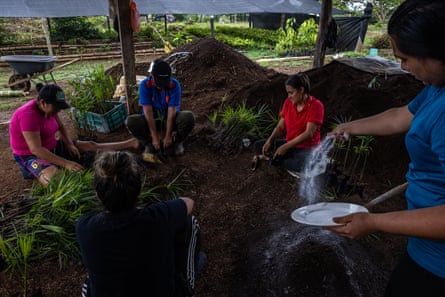
Supported by organisations such as the conservation charity WWF and the reforestation programme Visión Amazonía , residents have been establishing plant nurseries, restoring waterways and receiving training in woodworking.

While its members recognise the need to reduce deforestation, cattle remain an important part of people’s lives and livelihoods, so many hope that a smooth transition to sustainable practices can take place without affecting their finances.

“Although we live in a hidden corner of the country, we understand the damage caused to nature, and we are trying to compensate for the damage caused without affecting our economies,” says Leydy Janneth García, a representative of the conservation project Green Amazon .

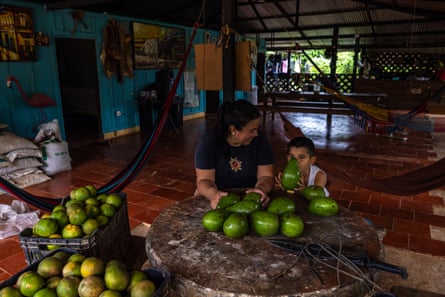
García and her family arrived in Guaviare in 2018 after fleeing conflict. They bought land previously used for coca cultivation and planted cacao, which thrived as the coca trees withered. Their farm now also produces oranges, avocados, chontaduro (also known as peach palm) and tamarind, sharing spaces with a small herd of cattle. Nearly half of their land, 14.5 hectares, is set aside for conservation.

Yet most farmers in ZRCs feel unsure about what will happen to them and to the Amazon after the general election. Many feel Petro has ensured the right to land but not security, as he failed to bring armed groups under control. They believe Cepeda would follow the same path. There are also fears that a far-right government led by De la Espriella would bring back the conflict and prioritise large landowners, extensive farming and agribusiness growth at the expense of the environment.

“History shows that the current government has demonstrated this determination, but political will alone, without security, is not enough,” says Jesús Cuestas, a farmer and ZRC member.

While acknowledging progress made by Petro’s government in land rights, farmers remain concerned about guerrillas’ increasing influence. “Under Petro’s administration, armed groups have expanded, and we fear that if Cepeda wins, this trend will continue,” says García.

On the other hand, the prospect of a rightwing administration is even more concerning for experts such as González Posso. De La Espriella supports fracking and intends to expand its use, leading to fears about the impact on the environment and local communities. He has also urged Colombia to withdraw from the UN , which could impact international investment in rural initiatives and peace efforts.

“De la Espriella links development to extractivism, supporting an extensive livestock model and benefiting the wealthy landowners,” he says.

González Posso fears that a far-right administration could bring more violence, not just from armed groups. He says farmers are likely to resist being expelled from their lands to benefit the agroindustry, and guerrillas would be empowered by extensive livestock farming, which is more lucrative, so they could increase extortion practices by charging landowners for each head of cattle and hectare of pasture, and imposing a fine for each hectare of deforested land.

“Cepeda aims to strengthen a sustainable economy created with and for the people. It’s crucial to develop a medium-term strategy that integrates ZRCs, peace initiatives and environmental considerations,” says González Posso.

Whoever wins the election, campesinos agree that the next government will have to bring about far-reaching changes to the country’s rural economy.

“We need to shift focus from discussion to action. A great deal of money has been spent, yet not a single peasant survives on conservation or rainforest resources,” says Cuestas. “The day a hectare of rainforest becomes more expensive than a hectare of grass, we will finally have achieved balance.”

Federal Reserve holds rates steady but signals possible hike before year’s end | Federal Reserve | The Guardian

Keyword – Business
Trefwoorden – Federal Reserve, Business, US economy, US interest rates, US politics, World news, US news
Title – Federal Reserve holds interest rates steady for fourth time this year | Federal Reserve | The Guardian
Author – https://www.theguardian.com/profile/gaya-gupta
Link – Federal Reserve holds interest rates steady for fourth time this year | Federal Reserve | The Guardian
Publish date – 2026-06-17T18:50:28.000Z
Category – News
URL – https://www.theguardian.com/business/2026/jun/17/federal-reserve-interest-rates

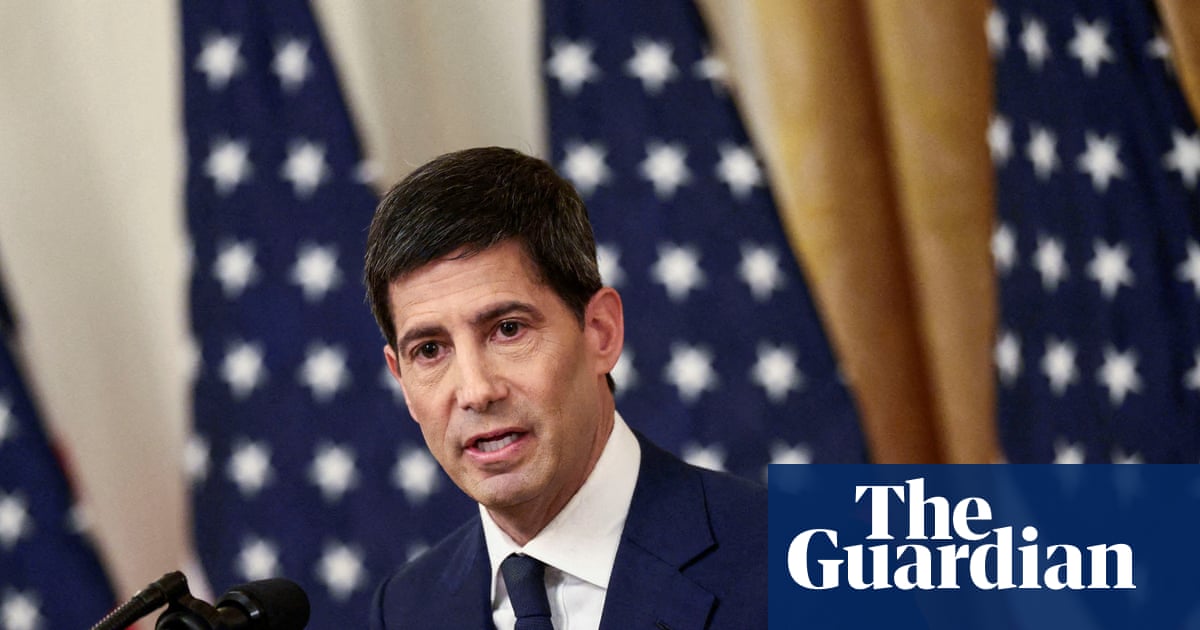
The US Federal Reserve left interest rates unchanged for the fourth time this year after its first meeting under new chair, Kevin Warsh, a Donald Trump appointee who has taken over the central bank during a tumultuous time for the US economy.

“Economic activity is expanding at a solid pace despite elevated uncertainty that owes, in part, to the conflict in the Middle East,” the Fed’s open market committee said in a short statement. “Productivity growth and capital investment are strong. Job gains have kept pace with the workforce, and the unemployment rate has changed little.”

The Fed was widely expected to keep rates at a range of 3.5% to 3.75%, where it has remained since December. The decision was unanimously supported by the Fed’s voting committee.

The committee’s monthly policy statement was notably shorter compared to previous statements. The statement acknowledged that “inflation remains elevated relative to the committee’s 2% goal, in part reflecting supply shocks that have driven price increases in certain sectors, including energy”, and said the central bank “will deliver price stability”.

The Fed released a slate of projections illustrating when individual officials predict rate changes will occur. Nine members projected at least one rate increase this year. Warsh confirmed he was the sole board member who did not contribute to the projections.

The projections mark a U-turn in outlook from just a few months ago: the last time Fed released projections, in March, 12 of the 19 officials projected at least one rate cut by the end of this year.

Warsh begins his four-year term as chair at a time when the US economy has been rattled by heightened inflation and geopolitical uncertainty.

A sharp spike in energy prices caused by the war in the Middle East has pushed inflation to 4.2% – the highest level the US has seen since 2023 and far from the Fed’s 2% target. Though the announcement of a ceasefire deal between the US and Iran sent oil prices tumbling to a three-month low, it will likely take months for energy prices to return to prewar levels.

Meanwhile, hourly earnings dropped to a seasonally adjusted 0.7%, indicating that price increases have stripped out wage gains over the past year.

But it’s unclear whether higher inflation will ever convince a majority of the Fed’s 12 voting members to call for a rate increase. Core inflation, which strips out volatile food and energy prices, has increased only mildly, to 2.9% from the year prior. The country’s labor market has also remained relatively strong, with the unemployment rate holding steady at 4.3%.

Even as Americans continue to balk at higher prices, Trump has continued to advocate for lower rates but said last week that he doesn’t “want to have a big influence” on Warsh.

“Kevin is fantastic, and I want him to do whatever he wants,” Trump said in an interview with Meet the Press on NBC News, while also reiterating his desire for a rate cut.

Before he was first nominated by Trump in January, Warsh argued for the importance of rate cuts – publicly agreeing with the president at a shaky time between the White House and the Fed.

Warsh is likely to receive more favorable treatment from the president compared to his predecessor, Jerome Powell, who Trump repeatedly harassed for holding off on cut rates.

In January, Powell was put under a federal investigation over renovations at the Fed headquarters that went over budget, which the justice department dropped after political pressure. Powell said that the investigation was a”pretext” meant to pressure the central bank to lower rates.

When accepting the John F Kennedy Profile in Courage award earlier this month, Powell warned that politicizing the Fed could permanently damage trust in the central bank.

“The public would lose faith that the central bank will make decisions based only on what’s best for all Americans,” Powell said. “The Fed’s credibility would be lost.”

Cross purposes: how the England flag got caught in a tug-of-war between rightwing nationalists and football fans | Communities | The Guardian

Keyword – Society
Trefwoorden – Communities, England, UK news, Far right, Politics, World Cup, World Cup 2026, Society, London, Sheffield
Title – Cross purposes: how the England flag got caught in a tug-of-war between rightwing nationalists and football fans | Communities | The Guardian
Author – https://www.theguardian.com/profile/steverose
Link – Cross purposes: how the England flag got caught in a tug-of-war between rightwing nationalists and football fans | Communities | The Guardian
Publish date – 2026-06-17T15:14:14.000Z
Category – News
URL – https://www.theguardian.com/society/2026/jun/17/england-flag-rightwing-nationalists-football-fans-sheffield-kirby-estate-bermondsey-world-cup

A s I drove into London with my daughter a week ago, we passed a roadside pub festooned with dozens of England flags. Our eyes met in recognition: we were in one of those areas, we assumed. In the eyes of many, St George’s cross flags have become a kind of territorial marker in the English landscape, signifying a certain kind of identity, a certain kind of politics, not necessarily welcoming to all. As we got closer, though, we realised the pub was actually preparing for the start of the World Cup . Flags of other nations were also on display. We laughed at our mistake and relaxed a bit.

It’s a feeling many Britons might have experienced. We’re gearing up for a summer of both exciting international football and ugly far-right protests and riots, as recent events in Belfast and Southampton have shown. The England flag will be a prominent fixture of both – great news for flag sellers, but a confusing and anxious time for the rest of us. How did England’s national symbol come to evoke such mixed feelings and carry such contradictory meanings? Are we really at the stage of “good flags” and “bad flags”? What are we supposed to think when we see an England flag?

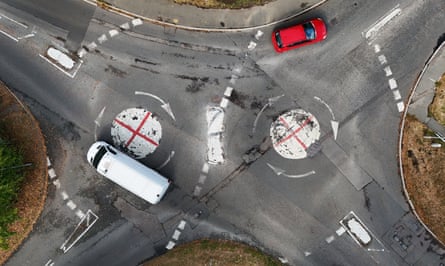
Our politicians have been as uncertain about this as everyone else. That became clear last summer, when England flags and union jacks suddenly began to appear on lamp-posts in towns and cities across the country. St George’s crosses were painted on roads, roundabouts and elsewhere, sometimes accompanied by offensive graffiti . The initiative was pushed by groups such as Raise the Colours, a self-described “grassroots movement” that proclaimed it was campaigning “to cover Britain in symbols of unity and patriotism” – but it clearly generated local support too.

Some councils took steps to remove the flags – often citing “safety concerns” or rules against tampering with public property – but others leaped to their defence. Nigel Farage wrote a supportive opinion piece in the Sun: “We have had enough of our country and its history being trashed.” Conservative leader Kemi Badenoch said it was “shameful that some councils have scrambled to remove them at the first opportunity”. Reform MP Lee Anderson said that officials who supported removing the flags “should be removed from office for betraying the very country they serve”. Predictably, Stephen Yaxley-Lennon, AKA Tommy Robinson, supported the initiative: “The message to the councils actively seeking to take down England flags is … Operation raise the colours,” he posted on X last August. At about the same time, one “grassroots” activist putting up England flags in Lichfield, who claimed to have no political affiliations, admitted to a Sky News reporter that he’d been given the flags by Robinson himself the night before.

In early September Keir Starmer said: “I’m very encouraging of flags. I think they’re patriotic, and I think they’re a great symbol of our nation.” But he responded more robustly after the Unite the Kingdom rally a couple of weeks later, when more than 100,000 protesters gathered in London, many bearing and wearing British and English flags, to listen to far-right figures such as Robinson, France’s Éric Zemmour and Elon Musk (who told the crowd: “You either fight back or you die”). The next day Starmer stated: “Our flag represents our diverse country and we will never surrender it to those that use it as a symbol of violence, fear and division.”

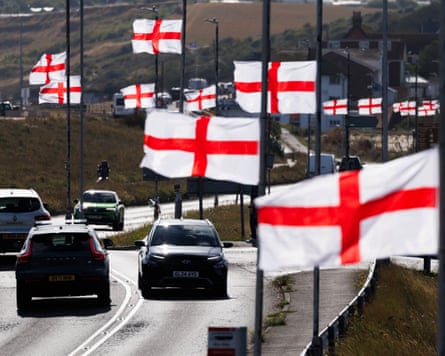
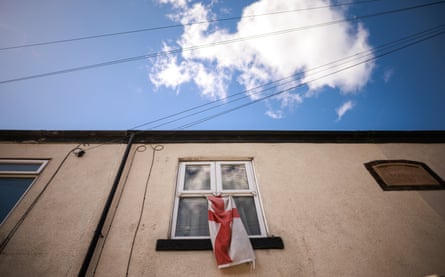
The fear and division have not gone away, though. Nor have the flags. In the Southey Green area of Sheffield on Monday, every lamp-post along the main street still has both a St George’s cross and a union jack on it. One lamp-post at the top of the hill sports six flags: two St George’s crosses, a union jack, the Welsh and Scottish national flags, and a remembrance flag with poppies and planes. In March, an attempt by three young men to put up flags outside Chaucer secondary school, just around the corner, reportedly turned into an angry confrontation when teachers came out to object. “You see that? Unity. Save our children,” one of the young men shouted at them, pointing up at the flag.

Talking to people in the area – which swung from Labour to Reform in the recent local elections – most appear to be either in favour of the flags or indifferent to them. “There’s a lot of people who say: ‘Ooh, it’s racist.’ How is it racist?” asks Danny, a 37-year-old white man, from the porch of a house draped in several England flags. Alongside the weathered lamp-post flags, many homes in the area are displaying bright new England flags in support of the World Cup, Danny’s included. To him, he says, the flag simply means: “We’re proud of this country. And we want to be proud of his country again because in all fairness it’s gone to shit.”

He is not racist, he says, but he’s opposed to “the ones that are coming across and getting everything for nowt”. He claims to know of eastern European migrants who laugh and joke about different benefits and student grants they are getting from the government. Everyone knows the individual who puts up the flags around here, he says. “He’s a sound guy … He’s just fed up with us getting shitted on, and they come across illegally and they get put in a hotel and given a credit card and a phone and a driver’s licence and shit like that.”

Many of the locals I spoke to evoked military patriotism in relation to the flags, saying they had relatives in the armed forces or had served themselves. There was a lot of national pride but also a sense of wounded pride, perhaps, mixed with nostalgia. “This used to be a steel town with plenty of jobs; now everyone feels like there’s no work,” an Algerian-born teacher who has lived here for 40 years tells me. Then again, he came here from Sussex to do his teacher training but never left: “It’s much friendlier up here.”

Those who are less enthusiastic about the flags in Southey Green tend to keep quiet about it. An African-born resident tells me she avoids raising the issue with her white neighbours but she finds the flags “threatening”: “I thought we were a diverse, tolerant nation, but what, suddenly now we don’t want to be?” Her daughter agrees: “They say it’s being patriotic. I’m patriotic too. What’s patriotic about excluding others?” A man of Pakistani heritage also says he finds them “a bit intimidating. I don’t mind the flags – it’s the ideology behind the flag. That’s scary.”

Outside Southey Green, most parts of Sheffield are now flag-free, in part thanks to the city council but also because of local groups such as Sheffield Communities Against Racism and Fascism (Scarf), which routinely respond to requests from locals across the city to remove flags put up against their wishes. The group must have taken down nearly 1,000 flags over the past year, four of Scarf’s members tell me when we meet in a local pub. It’s not that difficult, explains Mick, a software engineer: “Long extendable pole, carpet tape on the end. You just touch the carpet tape, the flag sticks on, twist it up, pull it off.”

They operate mostly at night now, they say. There have been confrontations with the other side, including a standoff between locals and a hired cherrypicker trying to put up flags in Walkley, west Sheffield, last October . And city council contractors in Sheffield removing flags have reported “shocking” levels of “threatening and aggressive” behaviour from members of the public, including from children, and said they had to work in groups rather than as individuals.

The line between flagging as a “grassroots” initiative and as a provocation by the organised far right has begun to evaporate. Scarf and Hope Not Hate have both identified Raise the Colours figures as former members of far-right groups such as the English Defence League, the National Front, Britain First and the UK Independence party (which is now a Christian nationalist group). Many former members of Raise the Colours have reportedly left the organisation as it has become more extreme and anti-migrant.

Raise the Colours’ influence appears to be waning. Last Saturday, the group organised a flag-waving protest march in Sheffield city centre, ostensibly against “two-tier policing” and “corruption against the British people”, though the route passed a hotel accommodating refugees. “They got emboldened by the flagging, and now they’re going out on the streets and shouting: ‘Send them home’ and ‘We don’t care if you drown’ – that kind of stuff,” says Dani, a mechanic and a member of Scarf. There were only about 50 to 60 protesters, he estimates, and 500 to 600 counter-protesters.

“Their movement has done quite a good job of toxifying a symbol and painting anyone who’s against them as anti-patriotic or anti-British,” Dani continues – but it has also galvanised groups such as Scarf. “I think we have much more of a mandate as the people of Sheffield, but also we are right.” His point is that minority groups should be protected and far-right ideologies rejected as a matter of principle, no matter how many people might agree with them locally.

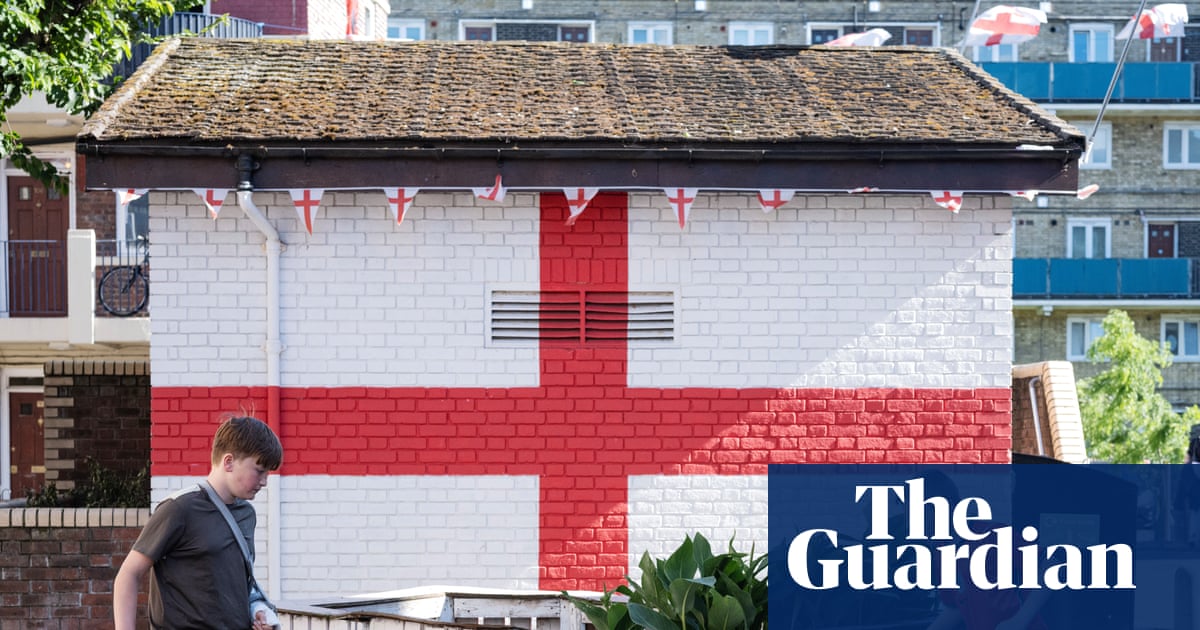
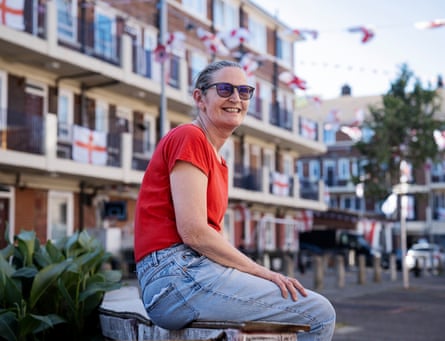
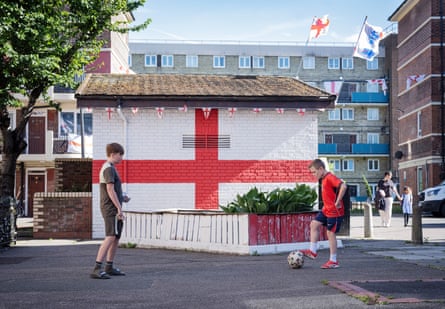
Meanwhile, in south London , a very different eruption of England flags is taking place, in stark contrast to Raise the Colours, even if at first glance it is superficially similar. The four-storey Kirby estate in Bermondsey is absolutely dripping with St George’s cross flags – on balconies and walkways, on bunting across the courtyard, painted on to walls.

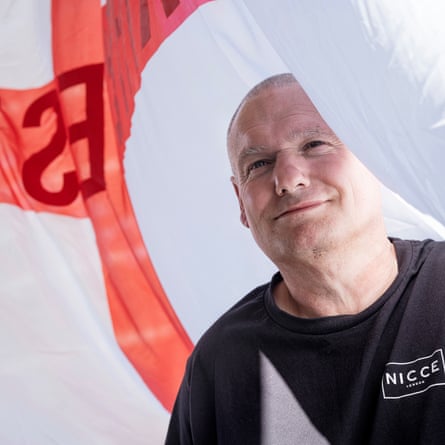
“It’s nothing to do with politics at all,” says Geraldine Howard, one of the key instigators of this flag initiative. This is World Cup fever at its peak. “It’s just in support of the England football team, the men’s and the women’s, and that’s all it’s about – to get the community together.” The Kirby estate does this at every major tournament, Howard explains. “Let’s just hope it works on the men’s this year – I was two months old when they won it last time.”

It started with the men’s European championship in 2012, when she decided one day to put up a big England flag on her balcony. Her neighbour, Alan Putnam, saw it. “I liked it, so I bought a flag for myself,” he says. “Then we both started buying more and more.” Their neighbour Chris Dowse joined in, and it spiralled from there.

“When we decided to first do the entire estate, we went door to door and we asked everyone if they minded if we were going to do it – and they were all for it,” says Dowse. “People now come to us and say: ‘When are you putting the flags up?’” Now there are about 400 flags draped across the estate, as well as permanent murals depicting footballing heroes Fran Kirby and Eberechi Eze.

When they first starting doing this, comments online completely misinterpreted their intentions, Dowse recalls: “It was like: ‘Racist estate, far-right estate, Tommy Robinson’s safe haven, not one GCSE between them, all living on benefits …’ They’ve finally realised that we’re not actually like that.”

People are also welcome to put up flags of their own country, says Dowse. Draped over the balconies are flags from Colombia, France, Scotland and, confusingly, Greenland. In the past they’ve had dozens of other national flags on display. The estate is pretty multicultural, and apparently harmonious. No one I meet has a problem with the flags – quite the opposite. “I love to see how passionate people are about football here,” says Brazilian student Livia Ribolla, 22, who has lived here for seven years with her parents. “It’s probably one of the most patriotic estates in the country, but not in a way where they exclude the other nations.” She hasn’t hung out a Brazilian flag yet but she might. “We also love England; it’s a great team right now.”

News crews and social media posters come from all over the world to the Kirby estate. “I had an interview here this morning at half past six before work,” says Dowse, who works in recycling and is also a DJ. On the day of my visit, the BBC and GB News were also talking to him. The only people they don’t like coming are politicians, says Putnam. “We’ve had some MPs who’ve wanted to come down, but we’ve asked them not to because we know they probably just want to use them for their own thing.”

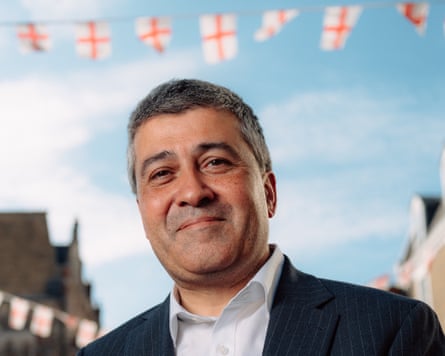
How can one flag be so divisive and yet so uniting? Clearly, context matters. Some England supporters are displaying St George’s crosses with obvious football slogans across them rather than the unadorned original. Many observers have suggested that football fans might be less inclined to display their allegiance this year – although we’re still in the early stages of the World Cup.

According to recent research by British Future , a non-partisan thinktank concerned with issues of integration, migration, identity and race, 62% of people in England agreed that: “I would like to be able to fly an England flag without appearing to support the far right.” And 81% of people in England, and 74% of ethnic minorities, saw the flying of England flags to support the country’s football teams in major tournaments as “a healthy expression of English national pride”.

“I personally find flags on lamp-posts a very sort of Belfast [ie sectarian] thing, and flags in shop windows and car windows and houses a very good thing,” says Sunder Katwala, director of British Future. Part of the reason the picture is so confusing, he suggests, is that the English are not really sure who they are these days. All Britons, even non-immigrants, are effectively dual nationals: we are British and we are also English, Scottish, Welsh, Northern Irish and so on. But defining or celebrating “Englishness” has become both difficult and politically charged. Restore, Reform and other rightwing groups are continually debating which politicians and public figures “belong” here, and drawing arbitrary lines based on skin colour, ancestry and place of birth.

Meanwhile, discussing Englishness in an inclusive, uncomplicated, inoffensive way has become a bit of a minefield, says Katwala: “We’ve got people hiding under the table because, you know: ‘What if I say something that the far right will disrupt?’ Or: ‘What if I say something and I didn’t quite get the tone right for the second-generation British, English, ethnic minorities? Maybe it’s best I just don’t do it.’ And that just creates the vacuum.”

Sport is one of the few things that gives people a genuinely uncomplicated sense of shared Englishness, British Future has found. The England football team is a case in point: no one bats an eyelid at the inclusion of Black and mixed-race players. This is more than just “being polite to people who score goals for us,” says Katwala. There’s no debate over whether or not Bukayo Saka or Marcus Rashford are “really” English. “We’re actually doing what we’ve always done, which is that the children, the grandchildren of migrants to Britain become English as well as British.”

It can’t only work when the football’s on, though. Nor, as the evidence shows, can we leave it to politicians and public figures to lead the way. Katwala would like to see others step up, as the Church of England did in December when it pushed back against Tommy Robinson and the far right’s attempt to co-opt Christianity. “I don’t think the large British institutions in London know how to think of England, because they associate themselves with ‘British’, so that leaves a bit of a gap,” he says.

When we have more of a settled understanding what it means to be English, perhaps the English will have a more stable relationship with their flag. Katwala, who was born in England and has Indian and Irish heritage, is also a devoted England fan. “I’m on record saying that we will win it this year,” he says. He regularly attends England matches, wearing an England shirt, waving an England flag. He even painted his nails with St George’s crosses on a recent visit to Wembley (it was his daughter’s idea, he tells me).

“It’s not so much about reclaiming the flag,” he says. “It’s about not retreating from something that we should have had a stake in all along.”

‘At first, the idea does sound crazy’: meet the scientists trying to refreeze the Arctic | Sea ice | The Guardian

Keyword – Environment
Trefwoorden – Sea ice, Polar regions, Geoengineering, Climate crisis, Arctic, World news, Environment
Title – ‘At first, the idea does sound crazy’: meet the scientists trying to refreeze the Arctic | Sea ice | The Guardian
Author – https://www.theguardian.com/profile/damiancarrington
Link – ‘At first, the idea does sound crazy’: meet the scientists trying to refreeze the Arctic | Sea ice | The Guardian
Publish date – 2026-06-16T14:00:01.000Z
Category – News
URL – https://www.theguardian.com/environment/2026/jun/16/arctic-sea-ice-rethickening-climate-geoengineering

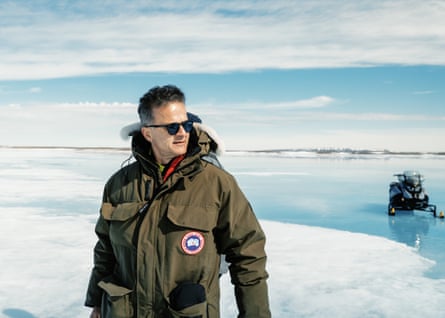
‘T his would have been a wild dream a year ago,” says Andrea Ceccolini, standing on Arctic sea ice just a 4-mile snowmobile ride from the Inuit town of Cambridge Bay, northern Canada. To his left are sky blue ponds of meltwater created in the last few days by a sun that no longer sets in the high north summer. To his right, the sea ice is still a brilliant white, the light dusting of snow on top continuing to sparkle.

“It’s incredibly different, the boundary – I mean, you can point to it,” he says. The difference is the result of a bold geoengineering experiment being conducted by Ceccolini’s company, Real Ice, funded by the UK government.

Five months earlier, the team had braved temperatures of -40C on the sea ice to drill holes and pump 50,000 tonnes of ocean water up on to its surface. It froze almost immediately, thickening the 1.5-metre-deep ice by about 50cm, according to the new measurements.

That has protected the ice, at the start of the melt season at least, and is an early sign that one day, perhaps, it may be possible to refreeze a significant part of the Arctic.

‘The coldest was -63C’

All around us now, the ice is melting fast, turning the crunchy white surface into shin-deep blue pools and revealing air bubbles in the clear ice below. Temperatures in the bay are above 5C, much higher than the normal -6C to 1C expected at this time of year. “It’s really out of whack,” says Ceccolini.

It’s happening not just in Cambridge Bay, called Ikaluktutiak by Inuit, which means “the place of good fishing”. Across the Arctic, sea ice is vanishing rapidly because of the climate crisis. Summer ice has shrunk by about 40% in the last 45 years . That has triggered one of the climate system’s most dangerous vicious circles.

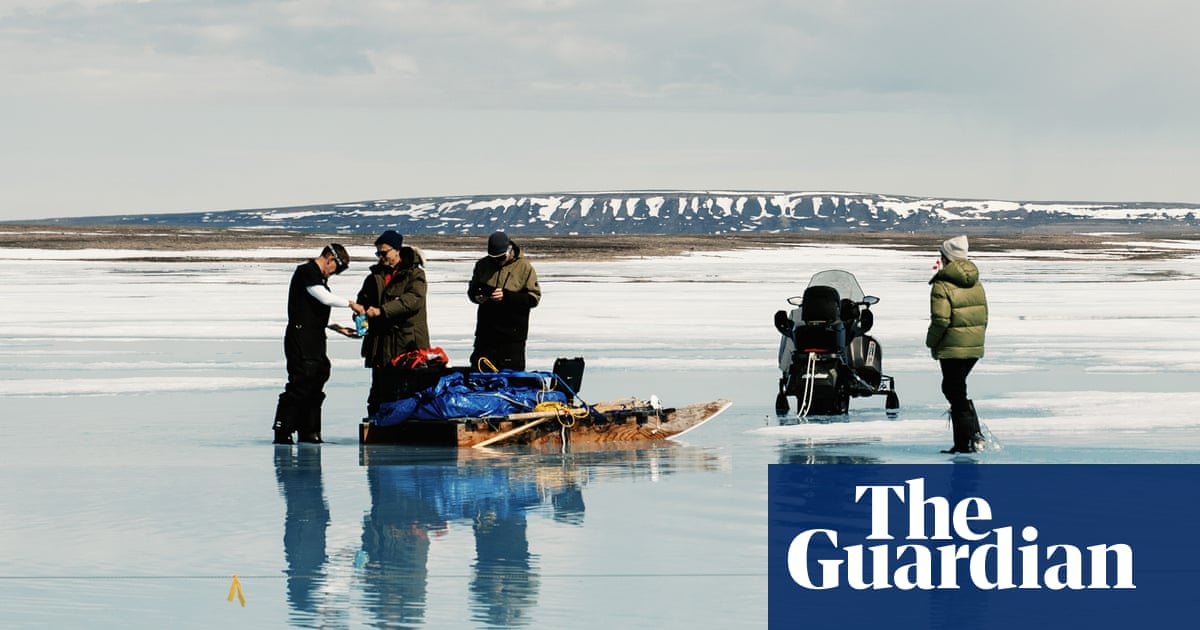
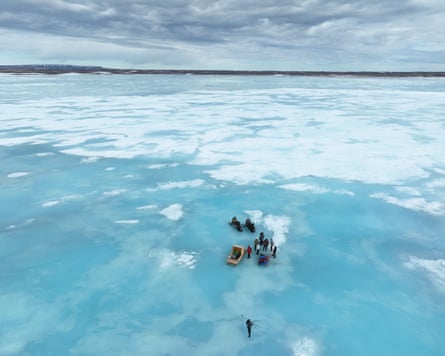
The treated area is apparent as a white island in the blue meltwater. Photograph: Cìan Sherwin/Damian Carrington

Ice reflects 70% of the sun’s heat back into space, while open ocean reflects just 7%. The more that melting exposes the sea, the warmer it gets and the more melting there is. Summer sea ice could be gone as early as the 2030s and scientists worry that the heat boost could push the climate beyond catastrophic and irreversible tipping points .

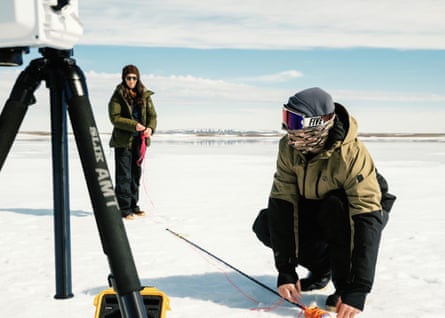
On the ice, the team are busy measuring everything they can: temperature every 2cm down through the ice, long cores for salinity, ice structure and biological analysis and, crucially, how reflective is the area they have re-iced. A drone buzzes through its daily circuit overhead, recording the area down to 5cm resolution.

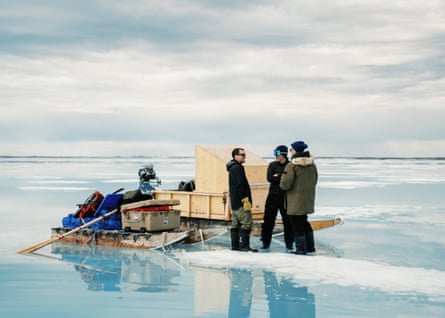
Despite the blue sky and strong sun, it’s still chilly on the ice thanks to the wind. But winter was a whole different level of cold. “The coldest day was -63C with wind chill,” says Simon Woods, Real Ice’s cofounder with Cían Sherwin. The extreme temperatures kept the team off the ice then, but they worked in temperatures of -40C, keeping a keen eye on each other for signs of frostbite.

Ceccolini says: “In a whiteout, without the Inuit guides we would not know how to get home – you can’t see anything 10m in front of you.” Wildlife is another hazard, from the possibility of polar bears to arctic foxes chewing through the cables of the equipment.

In January and February, the pumps ran for a total of 1,080 hours, icing over a square area about 450 metres on a side. The small pumps require less power than a toaster as they are only lifting the water from just under the ice to just on top.

The results can now be seen from space, with the team members excited to view the latest satellite images in their morning meeting. They show the test area emerging as an island of white in a sea of blue a few days after the melt season began.

The ice-thickening process gets a boost because the pumped seawater turns the highly insulating snow layer on top into slush and then ice. This means the extreme cold of the air penetrates through the ice better, stimulating extra ice growth on the bottom.

The team now pump later in the winter, so a new snow layer has less time to build up, and they have also found that doing two separate rounds of pumping improves results.

Last year, Real Ice added about 30cm , and this year’s extra thickness is 50cm, Ceccolini says. That may not sound huge, but a pickup truck can drive over 30cm of ice, and it may add 7-10 days to the lifespan of the ice, he says.

There’s also been a bonus: the ice created by the team is brighter and more reflective than the surrounding natural ice. “That was totally unexpected,” Ceccolini says. A possible explanation is that the fast-frozen artificial ice traps more air bubbles, which make the ice more opaque than the gradually frozen natural ice.

Andrea Ceccolini is the chief executive of Real Ice. Photograph: Brodie Larocque/The Guardian

Sea ice experts from the University of Washington are working independently at the site to determine the answer. Prof Roger Marchand and Melinda Webster spend hours every day on the ice to measure precisely how reflective the ice is, and how salty. The latter is important as salty ice will melt at a lower temperature.

Webster, a polar scientist who has worked in the Arctic every year since 2009, says global heating has radically changed the landscape over that time. “It looks so different because the ice has been thinning over the decades.”

Sherwin, who cofounded Real Ice with Woods, is watching a gleaming whirlpool where water is rushing into a hole in the ice. It’s a test of another tool to fight the melting of the Arctic. A couple of years ago, the team noticed a few such holes formed naturally, so they decided to drill test holes themselves.

The researchers Cìan Sherwin, a cofounder of Real Ice, and Melinda Webster taking measurements. Photograph: Brodie Larocque/The Guardian

The day before, Sherwin drove a long silver drill bit into the ice, its whirring leaving half a dozen holes, each 5cm wide. It was like pulling the plug out of a bath. Within a few minutes, water was swirling down the hole.

But that was just the start: the ice holes rapidly widen themselves, most likely due to the warmth of the meltwater. “It’ll be the size of a dinner plate in 45 minutes,” Sherwin said. A day later, the holes are the size of maintenance hole covers – and a new hazard for the researchers.

By draining the melt pools, the bright ice underneath is exposed once again, boosting reflection of the sun’s heat. The aerial drone images show the six test holes drilled have visibly brightened the area. The experiment is in its early stages but Ceccolini says: “Perhaps that will give the ice an extra week.”

‘Everybody uses the ice’

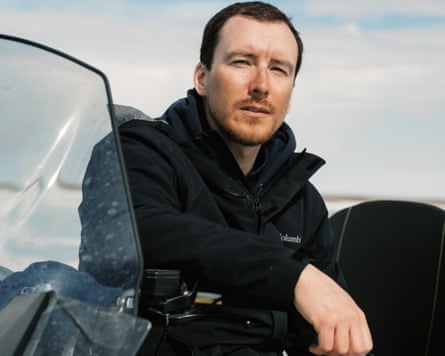
“The ice is very important to us,” says Kyle Weese, one of the Inuit guides working with Real Ice. About 83% of the population of Cambridge Bay are Inuit. “Everybody uses the ice for transport, gathering food, fishing. You use it to get across to the mainland and do some good caribou or moose hunting. It’s very plentiful there.”

Weese, 34, has seen climate change up close. “The ice is thinner. The freeze-up takes longer than normal and the thaw happens faster now. It’s definitely changing.” The warming is also bringing new risks from the south: “Grizzly bears are coming around too.” His rifle is close at hand.

Kyle Weese: ‘The ice is very important to us.’ Photograph: Brodie Larocque/The Guardian

Weese is happy to work with Real Ice: “At first, the idea does sound crazy but it is not trying to hurt the environment, it’s actually trying to help it. It’s good to know how it’s changing so we can try to adapt with it and try to preserve it.”

Real Ice, which has a £3.5m grant from the UK’s Advanced Research and Invention Agency (Aria) as part of the agency’s rethickening Arctic sea ice programme, consulted with the community and was given approval for the research from local authorities and, importantly, the Ekaluktutiak Hunters and Trappers Organization.

“The biggest thing is that we learn from the Inuit,” says Sherwin, including in determining the exact location of the test site – away from hunting areas – how to travel on the ice and where best to make the holes.

There’s no sign of opposition to the project in Cambridge Bay, with one local official telling the Guardian: “Their local engagement is the best I have seen – it’s been community-first from the beginning.”

Underwater drones

The big question is: if further research can show this experiment is effective and safe in restoring sea ice, could it be done at scale? Using teams of people on the ice to do this would be unfeasibly expensive, but an alternative is being tested: autonomous underwater drones.

A prototype undertook trials this February in Finland’s Gulf of Bothnia, poking holes in the sea ice using an electrically heated probe. It is now being refined in collaboration with the BioRobotics Institute in Pisa, Italy. Doing everything from under the ice, perhaps counterintuitively, is far easier than trying to navigate across ice fields in extreme cold, says Ceccolini.

Below the sea surface, the temperature is a constant -1.6C. “Everything works comfortably: electronics, batteries, pumps – you just stick your nose out of the ice, pump water and go back in,” he says. The vision is of a swarm of hydrogen-powered underwater drones targeting key areas at the leading edge of ice loss.

The area of summer sea ice that has vanished since 1979 is about 3m square kilometres – about the size of India. A further 80,000km 2 is lost every year on average – the area of Scotland or Kansas.

“So that’s a possible start,” says Ceccolini. “Even if you have just 20cm of ice, you still reflect the sun.” And at a much more local level, sea ice rethickening could make the routes relied on by Inuit people safer.

If the underwater drones cost about $5,000 each, Real Ice’s rough estimate is that bringing the annual shrinking of Arctic sea ice to a halt would cost $10bn over the longer term. For comparison, that is the same as the windfall profits made by the top 100 oil companies in less than a fortnight after the Iran war sent the oil price soaring. If only drilling drainage holes is effective, that would be substantially cheaper as no pumping is needed.

Marchand, from the University of Washington in Seattle, says: “Whether you can do this on a scale that’s large enough to be climatically important is a difficult and open question.

“But I feel like Real Ice are doing the right things. They’re trying to understand the physics of what’s going on and then using that knowledge to answer the question, rather than just assuming that this is doable. They’re going step by step.”

Environmentally dangerous?

Geoengineering is controversial, and a significant number of polar scientists are opposed to the idea of sea ice thickening: they published a critique in September arguing that it was unfeasible, would be “environmentally dangerous” and posed a dangerous distraction to the core climate need to cut carbon emissions rapidly.

Prof Shaun Fitzgerald, the director of the Centre for Climate Repair at the University of Cambridge, who is regularly on the ice with the team, agrees that emissions reduction is “critically necessary” but thinks it is important to understand additional options.

“Anything new has the potential for unintended consequences,” he says. “I liken it to clinical trials: new drugs have the potential to really help people, but we have to go incredibly carefully and understand what the risks are.”

Fitzgerald is concerned about the potential for moral hazard, that geoengineering could be seen as a magic bullet and lessen the drive for emissions cuts, though he argues there is little evidence for that to date. “I think doing research is the right thing to do. But I do respect those who have a different viewpoint.”

Ceccolini says: “We are here to resolve the research questions. Is ice thickening effective, does it have side-effects and can it be scaled economically? Then there are bigger questions, like: are governments, policymakers, communities interested? Is a society open to this type of solution?”

Researchers discuss the conditions of the research site. Photograph: Brodie Larocque/The Guardian

One outstanding question is what effect pumping seawater on to the ice has on ecology. On the ice, signs of wildlife sit in little wells of water: scraps of seaweed, fox scat, goose droppings. Their dark colour soaks up the sun and melts them into the ice.

Natural sea ice tastes fresh because virtually all the salt is squeezed out as the water molecules form ice crystals. Pumping seawater on to ice brings the salt up, as well as nutrients and microbes. Samples are now being examined by a biologist at the University of Cambridge.

Another possible concern is that drowning the winter snow with seawater could prevent polar bears and seals from digging dens for their cubs and pups, though none use the Cambridge Bay site to reproduce.

“It’s all research that has to be done and will be done as we go forward,” says Sherwin, who trained as a zoologist and was obsessed with wildlife from early in his childhood in County Cavan in the Republic of Ireland.

When Woods and Sherwin founded the project, the first thing they did was go up to the Arctic. “We went up to Iqaluit [the capital of Nunavut in Canada] and simply asked key stakeholders the question: ‘Is this interesting or valuable to your community?’,” says Woods. “We got an overwhelmingly positive answer and thought, OK, let’s try to do this.” Real Ice, which is in effect a non-profit company, was formed in 2022.

It is not the only group trying to refreeze the Arctic. This year Arctic Reflections , also funded by Aria, produced a similar-sized patch to Real Ice, which preliminary results indicate was up to 45cm thicker. However, these researchers are pursuing a different strategy, aiming to strengthen “ice arches” that span narrow straits and could hold back sea ice from flowing south and melting, and it is still too early to tell if the idea can work.

Back on the ice, Sherwin is taking the latest set of measurements. His view of the future is straightforward: “We’d like to see the research just continue to go forward in a way that we can have an informed opinion on what this looks like at scale, if it scales at all.”

Ceccolini says: “The dream is that sea ice thickening will be undertaken by the Indigenous communities. Imagine what they are going through, with the risk of losing their culture, losing their youth, people just moving away.

“They could do something that can help preserve their culture, basically doing conservation, because this is what we are talking about. This is an ecosystem conservation project.”

UK critical infrastructure hit by 200 cyber incidents in a year, agency says | UK security and counter-terrorism | The Guardian

Keyword – UK news
Trefwoorden – UK security and counter-terrorism, Cybercrime, UK news, Technology
Title – UK critical infrastructure hit by 200 cyber incidents in a year, agency says | UK security and counter-terrorism | The Guardian
Author – https://www.theguardian.com/profile/danmilmo
Link – UK critical infrastructure hit by 200 cyber incidents in a year, agency says | UK security and counter-terrorism | The Guardian
Publish date – 2026-06-17T15:00:35.000Z
Category – News
URL – https://www.theguardian.com/uk-news/2026/jun/17/uk-critical-infrastructure-cyber-incidents-ncsc

The UK’s critical national infrastructure has been hit by more than 200 cyber incidents over the past year and state-linked assailants were behind three-quarters of the attacks, according to the state cybersecurity body.

Richard Horne, the chief executive of the National Cyber Security Centre (NCSC), said hostile states such as Russia, China and Iran were increasingly targeting systems behind the UK’s key services. Examples of critical national infrastructure include the UK’s nuclear deterrent, power plants, hospitals and airports.

Horne said the UK was engaged in an “ongoing contest with capable adversaries”. “This contest is not confined to a compact space. It is not like a wrestling match in a closely defined territory, as some have suggested,” he said in a speech at the Royal United Services Institute. “It is far more akin to a football or basketball game, played across a large field of play, where success depends on how you operate across the entire pitch.”

The NCSC , part of the GCHQ intelligence agency, defines a cyber incident as an “attempt to damage, disrupt or gain unauthorised access to computer systems, networks or devices.”

Horne said the NCSC responded to more than 200 cyber incidents affecting the UK’s critical national infrastructure and its “supporting ecosystem” in the year to May, with about 75% of those “believed to be linked to state actors”.

Horne said advances in AI were likely to accelerate the threat, exposing cyber-flaws in national infrastructure, with 2028 likely to be the year when such a threat crystalised.

He said organisations needed to concentrate on the “fundamentals” of cybersecurity, such as ensuring they could recover quickly from attacks.

“The many vulnerabilities that organisations tolerate today will be exploited in conflict tomorrow. If they are too expensive or hard to fix in peacetime, then they certainly will be in war,” he said.

The emergence of Anthropic’s Claude Mythos AI model has raised concerns that organisations face a heightened risk of AI-enabled cyber-attacks. However, experts caution that most breaches still come from well-established risks such as weak authentication and already known vulnerabilities that have not been patched.

Horne described the cyber-threat as affecting a range of places, from “boardrooms to IT help desks, to sofas at home”.

“If we collectively embrace the contest, understand the urgency and believe we can be a match for any opponent, then we can and will prevail,” he said.

In 2024, the then chancellor of the duchy of Lancaster, Pat McFadden, warned that AI could be weaponised against the UK and that Russia was targeting key infrastructure. He said: “Russia has targeted our media, our telecoms, our political and democratic institutions and our energy infrastructure,” adding it could “shut down the power grids”.

In a speech in April , Horne said the UK could face “hacktivist attacks at scale” if it became embroiled in a conflict, and the impact could be similar to recent high-profile ransomware incidents .

Horne’s comments echoed a warning last year from Blaise Metreweli , the head of the UK spy agency MI6, who said the country was caught in “a space between peace and war” as tensions with Russia mounted.

The NCSC recommended in April that consumers drop passwords and adopt passkeys . It said passkeys – described as a “digital stamp” stored on your devices that allows you to sign in to apps and websites – should be consumers’ first choice of login across all digital services because passwords were not secure enough to stand up to modern cyber-threats.

Legislation proposed to stop lawsuits used to silence journalists and whistleblowers | Media law | The Guardian

Keyword – Media
Trefwoorden – Media law, Press freedom, Freedom of speech, Libel reform, Law, Politics, UK news, Business, House of Lords, House of Commons, John Whittingdale, Censorship, Media, Newspapers, Digital media, Newspapers & magazines
Title – Legislation proposed to stop lawsuits used to silence journalists and whistleblowers | Media law | The Guardian
Author – https://www.theguardian.com/profile/juliette-garside,https://www.theguardian.com/profile/jessica-elgot
Link – Legislation proposed to stop lawsuits used to silence journalists and whistleblowers | Media law | The Guardian
Publish date – 2026-06-17T14:55:28.000Z
Category – News
URL – https://www.theguardian.com/media/2026/jun/17/slapps-legislation-stop-lawfare-journalists-whistleblowers

A coordinated push to protect whistleblowers, journalists and victims of sexual assault from being sued by those who wish to silence them has been launched in both houses of parliament.

Two private members’ bills designed to crack down on strategic lawsuits against public participation, known as Slapps, have been introduced by Conservative members within 24 hours of each other, and are likely to attract cross-party support.

Labour ministers are understood to be supportive of the bills after frustration in the Ministry of Justice that similar measures did not form part of the king’s speech .

However, sources said progress was at an early stage given the political turmoil about a potential leadership challenge to Keir Starmer – though the MoJ would offer advice on the drafting.

The bills follow a long campaign for better protection from financially crippling lawsuits for those speaking up on issues of public interest. Claims that go all the way to trial can cost as much as £1m a party in legal fees, with the losing party paying the other side’s costs.

Tina Stowell, a former BBC communications chief who was leader of the House of Lords under David Cameron, published a draft bill on Tuesday, followed by John Whittingdale , the MP for Maldon and former Conservative culture secretary, who presented his strategic litigation against public participation bill on Wednesday.

Whittingdale said his bill, which is due to be debated in November, had support “across parliament” and from “all sections of the media”. He said Slapps “represent an abuse of the legal system and for too long have been used by the rich and powerful to suppress legitimate investigative journalism and to muzzle free expression”.

Lady Stowell said: “The attack on free speech represented by Slapps is a stain on our legal system and a threat to a functioning democracy. For too long British courts have been used to hush up unethical behaviour and corporate abuses.”

Her draft bill allows defendants facing libel suits, and other forms of legal action, to ask a judge to dismiss the case early in the process before costs rack up, if they can show that it relates to a matter of public interest.

Defendants whose cases are dismissed can also be awarded costs, and the court can impose penalties on claimants who deliberately prolong the process or cause delays.

Susan Coughtrie, a co-chair of the UK Anti-Slapps Coalition, said: “Now we have the opportunity to turn this support into robust, accessible and universal protections for everyone, ensuring justice is available to all, not just those who can afford it.

“Left unaddressed, Slapps allow bad-faith actors to control and restrict the information available to the public, impacting our knowledge of the world around us. As a result, protections, such as those announced this week, not only protect the person speaking out but the public interest information that sustains democracy.”

The Guardian and other media have highlighted how the wealthy and powerful, from oligarchs to corporations, have used the threat of legal action to silence those with fewer resources. In a number of high-profile cases, women reporting rape and sexual abuse have also been dragged to court after speaking out.

Both Conservative and Labour leaders have supported reform. In 2023, the Conservatives introduced limited protections for those speaking up on economic crimes such as money laundering. But the legislation does not help those raising issues related to human rights, for example.

In October 2024 Keir Starmer promised action , describing abuse of courts by the rich and powerful as “intolerable”, but the government has yet to bring forward any legislation of its own.

Other countries already have anti-Slapp laws. In many states in the US, judges have broad powers to dismiss abusive cases. In the EU, a directive was introduced in 2024 but member states have been slow to bring it into law.

The new EU law is limited in that it excludes criminal matters. However, it does allow EU citizens being sued abroad to challenge those targeting them in EU courts. Greenpeace has already put this provision to the test in the Netherlands, in a case involving a US oil pipeline company.