Tag Archives: Culture

Inglourious baristas: why is Brad Pitt making coffee for 16 abusive dogs? | Brad Pitt | The Guardian

Keyword – Film
Trefwoorden – Brad Pitt, Film, Culture, Advertising, Dogs, Animals, World news
Title – Inglourious baristas: why is Brad Pitt making coffee for 16 abusive dogs? | Brad Pitt | The Guardian
Author – https://www.theguardian.com/profile/stuart-heritage
Link – Inglourious baristas: why is Brad Pitt making coffee for 16 abusive dogs? | Brad Pitt | The Guardian
Publish date – 2026-09-09T10:30:04.000Z
Category – Culture
URL – https://www.theguardian.com/film/2026/sep/09/brad-pitt-coffee-the-heart-of-the-beast

B rad Pitt has a new movie out this month, The Heart of the Beast, about an emotionally damaged man who forms a life-saving bond with a dog. If that sounds familiar, maybe it is because you have seen The Call of the Wild. Or maybe it is because you have seen A Dog’s Way Home. Or maybe it is because you have seen Dog. Or, look, you get the idea.

But perhaps Brad Pitt knows that getting people to see something as unimaginative as The Heart of the Beast is an uphill struggle, because that would explain why he has just made an advert that looks and feels much more like the Brad Pitt dog movie that deserves to be made. In short, it is an advert where Brad Pitt gets loudly disparaged by a number of dogs for an extended period of time.

As reported by Variety, the commercial is for the De’Longhi Magnifica Duo, an all-singing, all-dancing coffee machine that retails in the UK for about £700. But really the product is beside the point. The main point is that the advert, running to almost two minutes, sees Brad Pitt stumble around cluelessly while a small army of real dogs – all of whom have names, some of whom are dressed in human clothes – shout insults at him.

As he wanders into his living room, some of the dogs (in subtitle) tell him that he woke up too late. They tell him to make a hot coffee and, even though he has started to make a cold one, he drops his head and sullenly obliges. Then another dog says that he can’t have any coffee at all until his attitude improves. “OK,” he mumbles in return, like a put-upon sitcom dad. The dogs berate him for his slovenliness and his stupidity and, when he finally snaps and tells them to go and fetch a stick, they make him fetch a stick for them instead.

It’s a weird advert. It is slightly reminiscent of that bizarre Chinese commercial for Chinese vitamins from a few years back, when Tom Hiddleston cooks you breakfast before looking straight into your eyes and promising that he’s going to have sex with you. The difference is that, while you could tell that Hiddleston desperately hoped that nobody would see his ad, Pitt’s has been made for an American market. He wants you to see this.

Of course, it helps that the weirdness is deliberate. The commercial was directed by Spike Jonze, the visionary director of no films at all for the last 13 years. The world has been crying out for a new film by Jonze, and if the closest we’re going to get is a film where Brad Pitt gets insulted by a dog named Kyle, then that will have to do.

In fact, the more you consider it, the better a move this advert seems for Pitt. Compared with the derivative grit-jawed Americana of The Heart of the Beast, it demonstrates that he’s much better when he’s allowed to be funny. And if it underlines a connection between Pitt and dogs along the way, creating an implied synergy with his movie, then that’s OK too.

It’s also a big step up from Pitt’s previous De’Longhi commercials, the majority of which just required him to stand still and smoulder for a while . Those commercials could have starred anyone. You could have put a carrot on human growth hormones and it would have adequately done the job. At least this one has a bit of personality.

But perhaps it also serves a greater purpose. After all, Brad Pitt is a man with something of a reputation problem, thanks to his messy split with Angelina Jolie and her allegations of intoxication and violent behaviour. It’s a similar (although less dramatic) predicament to the one that Johnny Depp finds himself in. But while Depp decided to announce his comeback by playing literature’s biggest arsehole Ebenezer Scrooge , Pitt has instead chosen to surround himself with loads of cute dogs. What’s more, he’s being subservient to them. Look at him! How could you possibly stay mad at him?

Only the De’Longhi sales team will know if this has been a successful gambit or not, but speaking personally I think it works perfectly. With any luck it will bring Spike Jonze out of retirement, and Brad Pitt Gets Shit-Talked by Some Dogs will be a motion picture by next Christmas.

Blue Film review – polarising sex worker drama is well-acted and deeply disturbing | Film | The Guardian

Keyword – Film
Trefwoorden – Film, Drama films, Sex work, Culture, Society
Title – Blue Film review – polarising sex worker drama is well-acted and deeply disturbing | Film | The Guardian
Author – https://www.theguardian.com/profile/cathclarke
Link – Blue Film review – polarising sex worker drama is well-acted and deeply disturbing | Film | The Guardian
Publish date – 2026-09-09T10:00:05.000Z
Category – Culture
URL – https://www.theguardian.com/film/2026/sep/09/blue-film-review-polarising-sex-worker-drama-is-well-acted-and-deeply-disturbing

T here have reportedly been audience walk-outs at screenings of this indie drama from young American film-maker Elliot Tuttle, a two-hander about a sex worker hired for the night by his former English teacher, a convicted paedophile. In interviews Tuttle has said his film was rejected by several major festivals. What makes it so uncomfortable is not the sex; mostly what we see on screen is two men talking. But early on a mood of skin-crawling unease seeps in, and it remains for every second of the film’s 82-minute run time.

Kieron Moore plays Aaron Eagle (not his real name), a Los Angeles sex worker and camboy. In the video content he livestreams, Aaron is a dom; gym-perfected and tattooed, he hurls homophobic insults at his fans. One night, he arranges to meet a client who offers to pay $50,000 for one night. The retirement-age man who answers the door of the Airbnb turns out to be Aaron’s former English teacher Mr Grant (Reed Birney), who was sacked after attempting to rape a 12-year-old pupil. Aaron was not the victim, but the teacher says he has always been in love with Aaron – though he is no longer sexually attracted to him.

It’s a film about the stories we tell about ourselves, re-remembering narratives to fit who think we are. Grant does have flickers of self-awareness. But he’s also monstrously self-justifying, pompously telling Aaron that his paedophilia would have been accepted in ancient Rome. The script’s attempts to empathise with his character felt a little simplistic to me, but Birney’s performance is horribly convincing, and Moore is also very good as Aaron, vulnerable under the swagger. It’s a difficult watch: at times feeling like the emotional equivalent of watching these people getting their skin peeled off, layer by layer.

Blue Film is in UK and Irish cinemas from 11 September.

Grand Theft Auto VI: can playing a video game count as cheating on your partner? | Grand Theft Auto VI | The Guardian

Keyword – Games
Trefwoorden – Grand Theft Auto VI, Games, Grand Theft Auto, Culture
Title – Grand Theft Auto VI: can playing a video game count as cheating on your partner? | Grand Theft Auto VI | The Guardian
Author – Emma Flint
Link – Grand Theft Auto VI: can playing a video game count as cheating on your partner? | Grand Theft Auto VI | The Guardian
Publish date – 2026-09-09T09:30:55.000Z
Category – Culture
URL – https://www.theguardian.com/games/2026/sep/09/grand-theft-auto-vi-can-playing-a-video-game-count-as-cheating-on-your-partner

T here was never any doubt that Grand Theft Auto VI’s extended look would elicit a viral reaction from the internet. Having won the Game Awards’ Most Anticipated award twice consecutively, Rockstar’s forthcoming crime opus is one of the most frothed-over games in recent memory, or indeed ever. It’s nothing short of a cultural phenomenon .

One aspect of the game has provoked an unexpectedly vehement response on social media: not violence, but romance. Protagonists Lucia and Jason are in love, you see, and as a player, part of your job is keeping their spark alive and their relationship strong, so that their criminal escapades are underpinned by a strong connection to one another. Holding hands, enjoying a date at the beach, spontaneously texting one another when apart – all of these interactions will strengthen their bond. You’ll be putting in a lot of work to ensure this couple thrives, which is why some people have come to believe that playing GTA VI counts as micro-cheating.

Takes on this are all over social media. Multiple users have shared posts claiming that if you romance characters in video games such as GTA VI you’ve been unfaithful to your partner; TikTok account El Michelle remarked that simply playing the game is cheating. “In absolutely no human way is my fiance playing GTA VI,” posted Shelby Haas , another TikTok user. “You literally have to maintain a relationship with a girl […] you have to take her on dates, and you can have sex with her. […] Don’t let your boyfriend or fiance or husband play GTA 6.”

Over on TikTok, a post by Landry states that GTA VI “is basically the same as cheating”, continuing: “I guarantee you, if your man is playing GTA VI and keeping his little girlfriend alive on that video game, he’s most definitely the type that’s following models.”

GTA VI is by no means the inventor of in-game dating – hello, Baldur’s Gate 3 , in which you can romance and have sex with any (or several) of your eight companions, including a druid who transforms into a bear. And surely we all remember trying to persuade our Sims to get off with each other. For at least 20 years dating and romance have been a significant element of all sorts of different titles; there is an entire (immensely popular) genre of dating games devoted to playfully living out virtual relationships.

Even so, due to its unrivalled online presence, GTA VI will be many people’s first exposure to the idea. Video game newcomers on TikTok seem especially exercised about the lengths their partners will go to to maintain a happy in-game relationship with Lucia, though it’s worth pointing out that it goes both ways: playing as Lucia, you’ll have to put just as much effort into maintaining a strong relationship with Jason. (The notion of maxing out the romance with Jason hasn’t provoked nearly as intense a response.)

It’s easy for people to revert to off-the-shelf misogynistic accusations about “jealous” and “overreactive” spouses in a situation like this, and indeed, many counter-commentators have done just that. “‘GTA VI is literally cheating’ is something I would say if I was a jealous, insecure hag […]” declares one TikToker. In the comments on one Instagram video , someone opined that GTA VI “promotes lust”, resulting in a massive pile-on.

But what if this isn’t knee-jerk jealousy? Behind these rather laughable concerns about virtual girlfriends, there are valid insecurities here over the idea of one’s real-life partner being more invested in a fictional character than a real-life relationship. Especially for young people, we’re in an age of loneliness and disconnection, fuelled by being chronically online. It’s one of the greatest paradoxes of modern society: despite being able to instantly engage with anyone or anything, these interactions are superficial and fleeting.

The dating scene right now is bleak. Dating columnist-cum-novelist Annie Lord believes the way we treat each other is part of the problem: “People treat each other as disposable because they’ve got the mindset of an app.” Factor in the growing influence of the manosphere, which many say has “ruined dating” , and it’s not hard to comprehend why experts say we’re experiencing a global dating crisis. Since 2014, the number of young people without close friendships/relationships has “risen fivefold” . Joke all you want about oversensitive gen Zs, but they are experiencing life in a social vacuum.

If you’re dealing in real life with men who don’t even text you back, let alone take you on a date, it’s easy to see why it would sting to watch them engage enthusiastically in a video-game relationship with a virtual woman whom they shower with expensive gifts, bouquets, and thoughtful messages. As TikToker RawTJR’s post joked: this is “how mfs gonna be treating Lucia in GTA 6 while treating their irl gf like shi”.

“I will NOT stand for people calling these partners ‘jealous’ or ‘overreacting’ when they clearly are trying to voice real concerns about their relationships,” wrote trans activist and sex educator Dee Whitnell in an Instagram post . “If someone feels underappreciated in their relationship but sees their partner fulfilling these needs for someone else (even if it is a game character), it’s totally understandable why they would feel a bit frustrated.”

As someone who explores every romance option in all games that allow it, I personally think it’s absurd to class in-game romances as a form of cheating – though I appreciate that individual boundaries can differ. People might more reasonably channel their concerns into conversations around AI companionship sites, such as Candy AI and DreamGF, that offer virtual sexbots. As far back as 2023 we were asking if an AI chatbot could be classed as cheating – and the technology has vastly improved since then.

More than anything else, this unexpected controversy around GTA VI highlights how dissatisfied and lonely many people are within their relationships. And a video game isn’t going to change that one way or another.

‘Who do you really believe?’: the true crime fans who became a part of the story | Documentary | The Guardian

Keyword – Television & radio
Trefwoorden – Documentary, HBO, Factual TV, TV crime drama, Television, US television, Culture, Television & radio, US crime, Kansas, Media
Title – ‘Who do you really believe?’: the true crime fans who became a part of the story | Documentary | The Guardian
Author – https://www.theguardian.com/profile/andrew-lawrence
Link – ‘Who do you really believe?’: the true crime fans who became a part of the story | Documentary | The Guardian
Publish date – 2026-09-09T09:00:04.000Z
Category – Culture
URL – https://www.theguardian.com/tv-and-radio/2026/sep/09/a-killer-story-series-review

A man and a woman are murdered in cold blood inside their Topeka, Kansas bedroom under cover of darkness in 2002. Suspicion quickly falls on the man’s ex-wife, Dana Chandler, with family and forensic evidence painting her as the jealous type. But the county prosecutor at the time declines to pursue charges in large part because nothing places Chandler at the scene of the crime. It’s only after a politically motivated prosecutor is appointed and CBS’s 48 Hours airs a 2009 report rehashing the case that Chandler is arrested on two counts of premeditated first-degree murder in 2011 and condemned to consecutive life sentences the following year.

No doubt: the story is hot copy. And more than likely, Chandler’s conviction marks the conclusion if a husband-and-wife team of true crime enthusiasts hadn’t become convinced that the real killer was still walking free. “There’s a lot of questions that remain,” says film-maker Matthew Galkin. “But when you start to unpack the crime itself, there’s a lot of hoops to jump through and a very high bar to clear in order for her to have pulled this off.”

A Killer Story, HBO’s latest true crime deep dive, takes Galkin and producing partner Josh Levine on a six-year-long steeplechase to answer the burning question of who murdered Mike Sisco and Karen Harkness. It’s a three-part journey driven not just by their collective skepticism of its three bombshell legal outcomes, but led by one of the country’’s foremost cynics.

Joe Sexton doesn’t just look the part of a hardscrabble newsman, with his resplendent gray mane and goatee for doubtful stroking. “We would talk about noir films, a Sam Spade-type character,” Levine says. “But he also had this [flavor] of Capote in In Cold Blood.” Sexton makes himself unmistakable to the ear with his Brooklyn pottymouth and easy enough to spot in his bright North Face windbreaker vests. “At the end of the second trial, we interviewed the foreman in the jury, and one of the things he told us was that they had given nicknames to different people,” Sexton recalls. “The bald 6ft 8in prosecutor with the big beard was the Son of Anarchy. The older defense lawyer with glasses was Mr Magoo. The nickname they gave me, which I’ve kind of leaned into, was Tracksuit Jesus.”

A Pulitzer prize-winning veteran of the New York Times and ProPublica, Sexton has a deep wariness of the juicy lead. In the first episode, Sexton still radiates with contempt as he recalls the 3,000 unsolicited emails he received from Eileen Umbehr, a self-described pyjamas housewife who couldn’t let Chandler’s conviction stand. It wasn’t until Umbehr wrote Sexton to tell him that the Kansas supreme court would hear an appeal of Chandler’s sentence in 2016 that Sexton conceded there was no more avoiding a trip to Topeka, site of the landmark school-segregation case that reached the US supreme court.

It’s at that point the lens widens on Umbehr, who proves to be more than just a concerned citizen. Her husband, Keen, is a lifelong good troublemaker who went from toiling as a garbageman to uncovering local government corruption for the town newspaper with scoops collected along his garbage route. When the county moved to cancel his garbage contract in retaliation for his muckraking, Keen filed a first amendment lawsuit that went all the way to the US supreme court and won a 7-2 decision in 1996. It was all the motivation Keen needed to go to law school and open his own practice. (Fun fact: he also ran for governor as a libertarian, losing in 2014 to Republican former US senator Sam Brownback.) Years later, Keen and Eileen helped assemble the materials and arguments that prompted the Kansas supreme court to review Dana Chandler’s conviction – and overturn it.

That final revelation, of these plucky underdogs winning yet another challenge to the legal system against all discernible odds, marked the first time I pumped my fist watching a documentary. Gaskin and Levine really make viewers fall hard for the Umbehrs – who offload 200 acres of inherited family property to fund the legal defense for Chandler, who goes from crusade cause to actual client. And the doubts they raise about Chandler’s guilt aren’t trivial.

There’s a reason why she wasn’t prosecuted initially, after all. The Sisco-Harkness murder bore the classic hallmarks of a hit job, with the assailant breaking into their home undetected, spraying them at close-range with machine gun fire without hitting anything else even once, and leaving without a trace. Chandler, meanwhile, lived more than 500 miles away in Denver. But because she had recently sent a series of exasperated messages about Sisco, with whom she had a tumultuous marriage and shares two children, and bought two spare fuel canisters at an auto parts store – with her credit card – then, naturally, she had to be the one and only suspect.

Astonishingly, the idea of a frail midwest divorcee hypermiling her Mitsubishi econobox across state lines to go full Tony Montana with a subsonic machine gun that was once reserved for the Israeli military wasn’t enough to stoke reasonable doubt, let alone seed it. “Over the three prosecutions, the basic gameplan was, ‘Let’s make her as ugly and unpleasant as we can,’” Sexton says. “I used to think there were limitations about what could be entered into evidence as prior bad acts. But that’s all it was: ‘well, she showed up and cursed out her husband at a soccer game …’”

The alternate-killer theory the Umbehrs present, casting suspicion on Harkness’s son-in-law Jeff Sutton, falls apart – ultimately revealing a legal beef between Keen and Sutton dating to the latter’s days as a county attorney and leaving the garrulous Eileen at a notable loss for words. After that second trial in 2022 ends in a hung jury, Chandler is tried a third time, shocks everyone by representing herself and goes down in flames – despite the prosecution manufacturing a witness. (The witness even admits as much on camera!)

“It’s the same evidence in each trial, actually even less because they start throwing things out,” Levine says. “You go from the second trial where there’s a six-day deliberation and they can’t come to a decision in an hour and a half in the third trial. I think it dovetails nicely with our interest in all these people telling their stories for all these years. So it’s like, who do you really believe?”

Once again, you can’t help feeling most for the Umbehrs, who literally bet the farm on Chandler’s exoneration, view her legal Hail Mary as the height of betrayal and cut off all communication and support. That leaves Sexton, Galkin and Levine without a tidy ending for their documentary, but with plenty of observations to offer on the complexities of the criminal justice system, the persuasive effects of true crime mills like 48 Hours and the dangers of confirmation bias – especially when it compounds. “Honestly, I believe she would’ve been free had she not fired her lawyers and represented herself in a massively self-destructive move that almost never turns out well for anyone who chooses it,” Galkin says. “Joe says it well in the series: knowing your case really well and arguing it effectively are two different things.”

In her defense, though, one could also see how failing to win freedom after more than a decade behind bars might make someone with the best counsel act rashly. It’s also difficult to overlook the role a more robust press might have played in, at the very least, underscoring the undeniable reasonable doubt in Chandler’s case. “Certainly local coverage in Topeka at the time of her arrest was in the pocket of prosecutors,” Sexton says. “They’re in bed with 48 Hours, tipped local reporters off to her arrest. Topeka, like many towns its size in America, has had its local press eviscerated. But CBS 48 Hours comes in and does a show and has a bunch of crying family members saying, ‘This woman did it.’ Well, that’s all you need.”

A Killer Story starts on HBO on 10 September and will be available on HBO Max

Yuja review – portrait of star pianist who is intellectually curious and deeply musically attuned | Film | The Guardian

Keyword – Film
Trefwoorden – Film, Documentary films, Music documentary, Yuja Wang, Classical music, Culture, Music, China, Asia Pacific, World news
Title – Yuja review – portrait of star pianist who is intellectually curious and deeply musically attuned | Film | The Guardian
Author – https://www.theguardian.com/profile/lesliefelperin
Link – Yuja review – portrait of star pianist who is intellectually curious and deeply musically attuned | Film | The Guardian
Publish date – 2026-09-09T08:00:04.000Z
Category – Culture
URL – https://www.theguardian.com/film/2026/sep/09/yuja-review-portrait-of-star-pianist-who-is-intellectually-curious-and-deeply-musically-attuned

A s well as her film about her own difficult teenage years , British director Lorna Tucker is probably best known for her documentaries on famous women with big personalities: Vivienne Westwood ( Westwood: Punk, Icon, Activist ), Katharine Hepburn (Call Me Kate) and Greta Garbo ( Garbo: Where Did You Go? ). Her latest subject, pianist Yuja Wang, is another high-achiever – but not someone with quite the same name recognition unless you’re a devotee of classical music, a field in which she is ranked among the very best alive. Wang certainly has a flamboyant side, expressed in her highly expressive, virtuoso performances and her sartorial style on stage. In fact some shocking pull quotes illustrate how her dress sense has been bizarrely over-examined in the press; she has been likened to a stripper for her outfits, and the New Yorker, of all publications, once described her as “fat” , which hardly seems germane to any discussion of her ability to play Tchaikovsky or Ligeti.

But Wang’s biography and the texture of her daily life are very different from that of Tucker’s previous subjects. She was a child prodigy from an artistic Beijing family who came of age just in time to break records for views on YouTube. Sure, her life here looks glamorous in one way, with a lush New York apartment she barely ever sees because she’s constantly on the road. But her life is also one of perpetual practice and striving for perfection, the loneliness of the long-distance soloist. It’s a regimen that leaves almost no time for relationships or family, or even many friendships with peers who understand what she is going through – apart from a few mentors or collaborators such as fellow pianist Emanuel Ax or composer Teddy Abrams, with whom she recently won a Grammy. Still, she comes across as an effervescent character, intellectually curious and deeply attuned to the music she plays.

This film doesn’t necessarily rise to the same level of technical perfection, but the cinematography by Seamus McGarvey is full of unexpected reflections and lovely slanting light falling through rooms towards dusk. In the interludes where Wang plays an assortment of pieces (while those pull quotes appear onscreen) there is more abstract imagery – out of focus sunlight, dappling water, drone shots of assorted landscapes – that is a bit screensaver chic, but it’s the music that counts in the end, and that’s divine.

Yuja is in UK cinemas from 11 September.

‘That was a dumbass play’: De’Aaron Fox’s gaffe leaves door open for historic Knicks comeback | NBA finals | The Guardian

Keyword – Sport
Trefwoorden – NBA finals, San Antonio Spurs, New York Knicks, Basketball, NBA, Sport, US sports, Victor Wembanyama
Title – ‘That was a dumbass play’: De’Aaron Fox’s gaffe leaves door open for historic Knicks comeback | NBA finals | The Guardian
Author – https://www.theguardian.com/profile/bryan-armen-graham
Link – ‘That was a dumbass play’: De’Aaron Fox’s gaffe leaves door open for historic Knicks comeback | NBA finals | The Guardian
Publish date – 2026-06-11T07:43:15.000Z
Category – Sport
URL – https://www.theguardian.com/sport/2026/jun/11/deaaron-fox-spurs-knicks-game-4-collapse-nba-finals
For nearly 47 minutes, the San Antonio Spurs looked poised to leave New York with the NBA finals level at two games apiece.

They’d led by 81-52 in the third quarter, brought a frenzied Madison Square Garden crowd to heel and put themselves on the verge of reclaiming home-court advantage after having dropped the first two games at home. Even after the Knicks mounted a furious second-half fightback and wiped out the entirety of San Antonio’s 29-point cushion, the Spurs still appeared to have one final lifeline.

Then came a decision that could haunt San Antonio for years if the Knicks go on to end their 53-year championship drought.

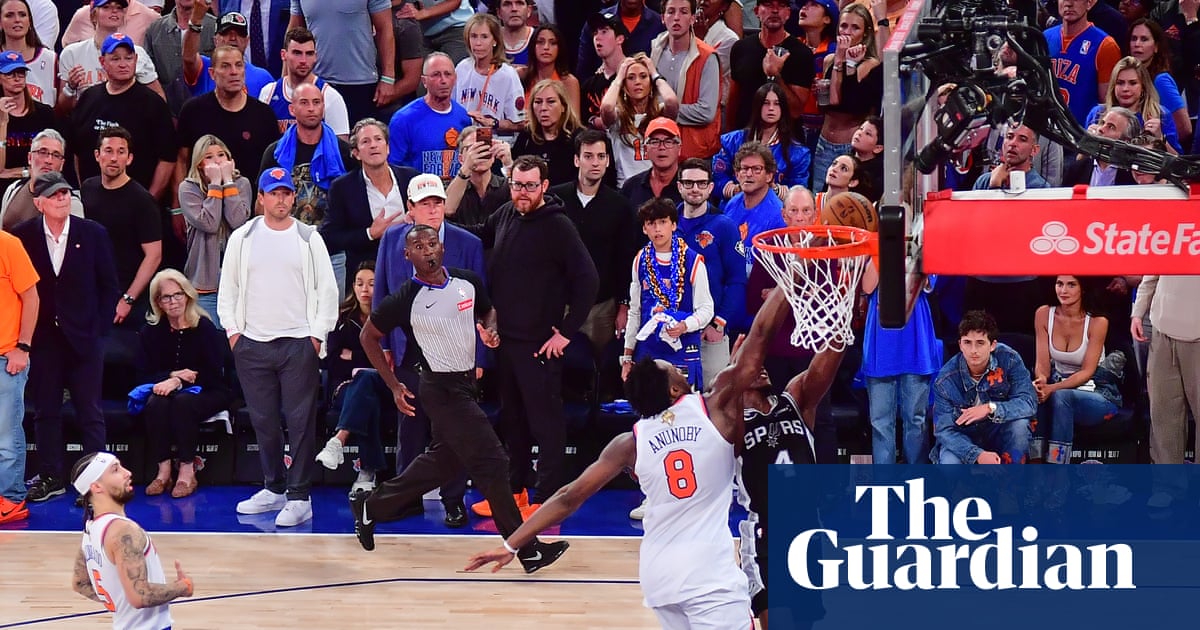
The Spurs led 106-105 with less than 15 seconds remaining Wednesday night when Jalen Brunson’s floating bank shot ricocheted into the backcourt. The loose ball bounced toward De’Aaron Fox, who sprinted after it and found himself racing toward the basket with only a trailing OG Anunoby between him and what looked like a game-clinching score.

Instead of pulling the ball out and forcing New York to foul, Fox attacked the rim. But Anunoby chased him down and blocked the lay-up attempt.

Seconds later, the Knicks had the ball back. Brunson missed a 31-footer off the front of the rim, but Anunoby soared in from the top of the key and tipped home the winner with 1.2 seconds remaining, completing an improbable 107-106 victory and the largest comeback in NBA finals history.

Fox did not shy away from explaining his thought process afterward.

“You have to score. Try to get a lay-up, get up three [points]. Force them to need a three,” Fox said. “OG made a good block.”

Asked why he went for the basket rather than dribbling out the clock and forcing a foul, the ninth-year point guard was to the point.

“I just thought I’d be able to outrun them. That’s it.”

The explanation did little to quell the criticism.

On ESPN’s post-game show, Charles Barkley delivered a verdict that quickly spread across social media and sports television.

“That was a dumbass play,” Barkley said. “He did not have to shoot that ball.”

The blunt assessment reflected the reaction around the basketball world. With the Spurs clinging to a one-point lead, Fox had safer options available. He could have retreated from pressure and waited to be fouled, shaving precious seconds off the clock. He could have used San Antonio’s final timeout. Instead, he chose the most aggressive path – a gamble Anunoby made him pay dearly for.

Of course, reducing the collapse to a single possession would let the Spurs off too easily. The final mistake merely capped a spectacular unraveling that had begun long before Fox found himself alone in the open floor. San Antonio scored 76 points in the first half but just 30 after half-time. The crisp ball movement and long-distance sharpshooting that had carved apart New York’s defense evaporated as the Knicks chipped away at the deficit.

“Obviously let that get away, being up [29 points],” Fox said. “Got away from doing the things that got us up and put ourselves in that position.”

“I think we played a little slower,” he added. “The ball wasn’t moving the same way that it did in the second half like it did in the first half. We didn’t get a flow on the offensive end in the second half.”

Spurs coach Mitch Johnson saw the same thing.

“We got away from what got us the 76 points in the first half,” Johnson said. “Then you saw at times the aggressiveness and just conviction that we played with early on dissipate a little bit. They made some shots. That’s where you felt the momentum a little bit. We just needed few more tough-minded plays to finish the job.”

He added: “To put as much good work into that first half as we did, get the lead that we had and not finish the job, is disappointing to say the least.”

Wembanyama said he was unable to see Fox’s fateful lay-up attempt after tumbling to the floor during the play, but he offered a curt appraisal of the Spurs’ second-half performance.

“We clearly weren’t the most hungry in the second half,” Wembanyama said. “Stopped moving the ball. Stopped executing.”

That reality may ultimately be what stings most for San Antonio. Fox’s snap decision did not create the collapse. The Spurs had already let a 29-point lead fritter away by then. What the play did was quash their last best chance to survive it.

“Going down 3-1 is obviously very different,” Fox said. “But we feel like we have a team to be able to come back from this.”

Two minutes earlier, the Spurs were still on course to turn these finals into a best-of-three with all the momentum on their side. One costly miscue later, they were staring at the brink instead.