Cross purposes: how the England flag got caught in a tug-of-war between rightwing nationalists and football fans | Communities | The Guardian

Keyword – Society
Trefwoorden – Communities, England, UK news, Far right, Politics, World Cup, World Cup 2026, Society, London, Sheffield
Title – Cross purposes: how the England flag got caught in a tug-of-war between rightwing nationalists and football fans | Communities | The Guardian
Author – https://www.theguardian.com/profile/steverose
Link – Cross purposes: how the England flag got caught in a tug-of-war between rightwing nationalists and football fans | Communities | The Guardian
Publish date – 2026-06-17T15:14:14.000Z
Category – News
URL – https://www.theguardian.com/society/2026/jun/17/england-flag-rightwing-nationalists-football-fans-sheffield-kirby-estate-bermondsey-world-cup

A s I drove into London with my daughter a week ago, we passed a roadside pub festooned with dozens of England flags. Our eyes met in recognition: we were in one of those areas, we assumed. In the eyes of many, St George’s cross flags have become a kind of territorial marker in the English landscape, signifying a certain kind of identity, a certain kind of politics, not necessarily welcoming to all. As we got closer, though, we realised the pub was actually preparing for the start of the World Cup . Flags of other nations were also on display. We laughed at our mistake and relaxed a bit.

It’s a feeling many Britons might have experienced. We’re gearing up for a summer of both exciting international football and ugly far-right protests and riots, as recent events in Belfast and Southampton have shown. The England flag will be a prominent fixture of both – great news for flag sellers, but a confusing and anxious time for the rest of us. How did England’s national symbol come to evoke such mixed feelings and carry such contradictory meanings? Are we really at the stage of “good flags” and “bad flags”? What are we supposed to think when we see an England flag?

Our politicians have been as uncertain about this as everyone else. That became clear last summer, when England flags and union jacks suddenly began to appear on lamp-posts in towns and cities across the country. St George’s crosses were painted on roads, roundabouts and elsewhere, sometimes accompanied by offensive graffiti . The initiative was pushed by groups such as Raise the Colours, a self-described “grassroots movement” that proclaimed it was campaigning “to cover Britain in symbols of unity and patriotism” – but it clearly generated local support too.

Some councils took steps to remove the flags – often citing “safety concerns” or rules against tampering with public property – but others leaped to their defence. Nigel Farage wrote a supportive opinion piece in the Sun: “We have had enough of our country and its history being trashed.” Conservative leader Kemi Badenoch said it was “shameful that some councils have scrambled to remove them at the first opportunity”. Reform MP Lee Anderson said that officials who supported removing the flags “should be removed from office for betraying the very country they serve”. Predictably, Stephen Yaxley-Lennon, AKA Tommy Robinson, supported the initiative: “The message to the councils actively seeking to take down England flags is … Operation raise the colours,” he posted on X last August. At about the same time, one “grassroots” activist putting up England flags in Lichfield, who claimed to have no political affiliations, admitted to a Sky News reporter that he’d been given the flags by Robinson himself the night before.

In early September Keir Starmer said: “I’m very encouraging of flags. I think they’re patriotic, and I think they’re a great symbol of our nation.” But he responded more robustly after the Unite the Kingdom rally a couple of weeks later, when more than 100,000 protesters gathered in London, many bearing and wearing British and English flags, to listen to far-right figures such as Robinson, France’s Éric Zemmour and Elon Musk (who told the crowd: “You either fight back or you die”). The next day Starmer stated: “Our flag represents our diverse country and we will never surrender it to those that use it as a symbol of violence, fear and division.”

The fear and division have not gone away, though. Nor have the flags. In the Southey Green area of Sheffield on Monday, every lamp-post along the main street still has both a St George’s cross and a union jack on it. One lamp-post at the top of the hill sports six flags: two St George’s crosses, a union jack, the Welsh and Scottish national flags, and a remembrance flag with poppies and planes. In March, an attempt by three young men to put up flags outside Chaucer secondary school, just around the corner, reportedly turned into an angry confrontation when teachers came out to object. “You see that? Unity. Save our children,” one of the young men shouted at them, pointing up at the flag.

Talking to people in the area – which swung from Labour to Reform in the recent local elections – most appear to be either in favour of the flags or indifferent to them. “There’s a lot of people who say: ‘Ooh, it’s racist.’ How is it racist?” asks Danny, a 37-year-old white man, from the porch of a house draped in several England flags. Alongside the weathered lamp-post flags, many homes in the area are displaying bright new England flags in support of the World Cup, Danny’s included. To him, he says, the flag simply means: “We’re proud of this country. And we want to be proud of his country again because in all fairness it’s gone to shit.”

He is not racist, he says, but he’s opposed to “the ones that are coming across and getting everything for nowt”. He claims to know of eastern European migrants who laugh and joke about different benefits and student grants they are getting from the government. Everyone knows the individual who puts up the flags around here, he says. “He’s a sound guy … He’s just fed up with us getting shitted on, and they come across illegally and they get put in a hotel and given a credit card and a phone and a driver’s licence and shit like that.”

Many of the locals I spoke to evoked military patriotism in relation to the flags, saying they had relatives in the armed forces or had served themselves. There was a lot of national pride but also a sense of wounded pride, perhaps, mixed with nostalgia. “This used to be a steel town with plenty of jobs; now everyone feels like there’s no work,” an Algerian-born teacher who has lived here for 40 years tells me. Then again, he came here from Sussex to do his teacher training but never left: “It’s much friendlier up here.”

Those who are less enthusiastic about the flags in Southey Green tend to keep quiet about it. An African-born resident tells me she avoids raising the issue with her white neighbours but she finds the flags “threatening”: “I thought we were a diverse, tolerant nation, but what, suddenly now we don’t want to be?” Her daughter agrees: “They say it’s being patriotic. I’m patriotic too. What’s patriotic about excluding others?” A man of Pakistani heritage also says he finds them “a bit intimidating. I don’t mind the flags – it’s the ideology behind the flag. That’s scary.”

Outside Southey Green, most parts of Sheffield are now flag-free, in part thanks to the city council but also because of local groups such as Sheffield Communities Against Racism and Fascism (Scarf), which routinely respond to requests from locals across the city to remove flags put up against their wishes. The group must have taken down nearly 1,000 flags over the past year, four of Scarf’s members tell me when we meet in a local pub. It’s not that difficult, explains Mick, a software engineer: “Long extendable pole, carpet tape on the end. You just touch the carpet tape, the flag sticks on, twist it up, pull it off.”

They operate mostly at night now, they say. There have been confrontations with the other side, including a standoff between locals and a hired cherrypicker trying to put up flags in Walkley, west Sheffield, last October . And city council contractors in Sheffield removing flags have reported “shocking” levels of “threatening and aggressive” behaviour from members of the public, including from children, and said they had to work in groups rather than as individuals.

The line between flagging as a “grassroots” initiative and as a provocation by the organised far right has begun to evaporate. Scarf and Hope Not Hate have both identified Raise the Colours figures as former members of far-right groups such as the English Defence League, the National Front, Britain First and the UK Independence party (which is now a Christian nationalist group). Many former members of Raise the Colours have reportedly left the organisation as it has become more extreme and anti-migrant.

Raise the Colours’ influence appears to be waning. Last Saturday, the group organised a flag-waving protest march in Sheffield city centre, ostensibly against “two-tier policing” and “corruption against the British people”, though the route passed a hotel accommodating refugees. “They got emboldened by the flagging, and now they’re going out on the streets and shouting: ‘Send them home’ and ‘We don’t care if you drown’ – that kind of stuff,” says Dani, a mechanic and a member of Scarf. There were only about 50 to 60 protesters, he estimates, and 500 to 600 counter-protesters.

“Their movement has done quite a good job of toxifying a symbol and painting anyone who’s against them as anti-patriotic or anti-British,” Dani continues – but it has also galvanised groups such as Scarf. “I think we have much more of a mandate as the people of Sheffield, but also we are right.” His point is that minority groups should be protected and far-right ideologies rejected as a matter of principle, no matter how many people might agree with them locally.

Meanwhile, in south London , a very different eruption of England flags is taking place, in stark contrast to Raise the Colours, even if at first glance it is superficially similar. The four-storey Kirby estate in Bermondsey is absolutely dripping with St George’s cross flags – on balconies and walkways, on bunting across the courtyard, painted on to walls.

“It’s nothing to do with politics at all,” says Geraldine Howard, one of the key instigators of this flag initiative. This is World Cup fever at its peak. “It’s just in support of the England football team, the men’s and the women’s, and that’s all it’s about – to get the community together.” The Kirby estate does this at every major tournament, Howard explains. “Let’s just hope it works on the men’s this year – I was two months old when they won it last time.”

It started with the men’s European championship in 2012, when she decided one day to put up a big England flag on her balcony. Her neighbour, Alan Putnam, saw it. “I liked it, so I bought a flag for myself,” he says. “Then we both started buying more and more.” Their neighbour Chris Dowse joined in, and it spiralled from there.

“When we decided to first do the entire estate, we went door to door and we asked everyone if they minded if we were going to do it – and they were all for it,” says Dowse. “People now come to us and say: ‘When are you putting the flags up?’” Now there are about 400 flags draped across the estate, as well as permanent murals depicting footballing heroes Fran Kirby and Eberechi Eze.

When they first starting doing this, comments online completely misinterpreted their intentions, Dowse recalls: “It was like: ‘Racist estate, far-right estate, Tommy Robinson’s safe haven, not one GCSE between them, all living on benefits …’ They’ve finally realised that we’re not actually like that.”

People are also welcome to put up flags of their own country, says Dowse. Draped over the balconies are flags from Colombia, France, Scotland and, confusingly, Greenland. In the past they’ve had dozens of other national flags on display. The estate is pretty multicultural, and apparently harmonious. No one I meet has a problem with the flags – quite the opposite. “I love to see how passionate people are about football here,” says Brazilian student Livia Ribolla, 22, who has lived here for seven years with her parents. “It’s probably one of the most patriotic estates in the country, but not in a way where they exclude the other nations.” She hasn’t hung out a Brazilian flag yet but she might. “We also love England; it’s a great team right now.”

News crews and social media posters come from all over the world to the Kirby estate. “I had an interview here this morning at half past six before work,” says Dowse, who works in recycling and is also a DJ. On the day of my visit, the BBC and GB News were also talking to him. The only people they don’t like coming are politicians, says Putnam. “We’ve had some MPs who’ve wanted to come down, but we’ve asked them not to because we know they probably just want to use them for their own thing.”

How can one flag be so divisive and yet so uniting? Clearly, context matters. Some England supporters are displaying St George’s crosses with obvious football slogans across them rather than the unadorned original. Many observers have suggested that football fans might be less inclined to display their allegiance this year – although we’re still in the early stages of the World Cup.

According to recent research by British Future , a non-partisan thinktank concerned with issues of integration, migration, identity and race, 62% of people in England agreed that: “I would like to be able to fly an England flag without appearing to support the far right.” And 81% of people in England, and 74% of ethnic minorities, saw the flying of England flags to support the country’s football teams in major tournaments as “a healthy expression of English national pride”.

“I personally find flags on lamp-posts a very sort of Belfast [ie sectarian] thing, and flags in shop windows and car windows and houses a very good thing,” says Sunder Katwala, director of British Future. Part of the reason the picture is so confusing, he suggests, is that the English are not really sure who they are these days. All Britons, even non-immigrants, are effectively dual nationals: we are British and we are also English, Scottish, Welsh, Northern Irish and so on. But defining or celebrating “Englishness” has become both difficult and politically charged. Restore, Reform and other rightwing groups are continually debating which politicians and public figures “belong” here, and drawing arbitrary lines based on skin colour, ancestry and place of birth.

Meanwhile, discussing Englishness in an inclusive, uncomplicated, inoffensive way has become a bit of a minefield, says Katwala: “We’ve got people hiding under the table because, you know: ‘What if I say something that the far right will disrupt?’ Or: ‘What if I say something and I didn’t quite get the tone right for the second-generation British, English, ethnic minorities? Maybe it’s best I just don’t do it.’ And that just creates the vacuum.”

Sport is one of the few things that gives people a genuinely uncomplicated sense of shared Englishness, British Future has found. The England football team is a case in point: no one bats an eyelid at the inclusion of Black and mixed-race players. This is more than just “being polite to people who score goals for us,” says Katwala. There’s no debate over whether or not Bukayo Saka or Marcus Rashford are “really” English. “We’re actually doing what we’ve always done, which is that the children, the grandchildren of migrants to Britain become English as well as British.”

It can’t only work when the football’s on, though. Nor, as the evidence shows, can we leave it to politicians and public figures to lead the way. Katwala would like to see others step up, as the Church of England did in December when it pushed back against Tommy Robinson and the far right’s attempt to co-opt Christianity. “I don’t think the large British institutions in London know how to think of England, because they associate themselves with ‘British’, so that leaves a bit of a gap,” he says.

When we have more of a settled understanding what it means to be English, perhaps the English will have a more stable relationship with their flag. Katwala, who was born in England and has Indian and Irish heritage, is also a devoted England fan. “I’m on record saying that we will win it this year,” he says. He regularly attends England matches, wearing an England shirt, waving an England flag. He even painted his nails with St George’s crosses on a recent visit to Wembley (it was his daughter’s idea, he tells me).

“It’s not so much about reclaiming the flag,” he says. “It’s about not retreating from something that we should have had a stake in all along.”

‘At first, the idea does sound crazy’: meet the scientists trying to refreeze the Arctic | Sea ice | The Guardian

Keyword – Environment
Trefwoorden – Sea ice, Polar regions, Geoengineering, Climate crisis, Arctic, World news, Environment
Title – ‘At first, the idea does sound crazy’: meet the scientists trying to refreeze the Arctic | Sea ice | The Guardian
Author – https://www.theguardian.com/profile/damiancarrington
Link – ‘At first, the idea does sound crazy’: meet the scientists trying to refreeze the Arctic | Sea ice | The Guardian
Publish date – 2026-06-16T14:00:01.000Z
Category – News
URL – https://www.theguardian.com/environment/2026/jun/16/arctic-sea-ice-rethickening-climate-geoengineering

‘T his would have been a wild dream a year ago,” says Andrea Ceccolini, standing on Arctic sea ice just a 4-mile snowmobile ride from the Inuit town of Cambridge Bay, northern Canada. To his left are sky blue ponds of meltwater created in the last few days by a sun that no longer sets in the high north summer. To his right, the sea ice is still a brilliant white, the light dusting of snow on top continuing to sparkle.

“It’s incredibly different, the boundary – I mean, you can point to it,” he says. The difference is the result of a bold geoengineering experiment being conducted by Ceccolini’s company, Real Ice, funded by the UK government.

Five months earlier, the team had braved temperatures of -40C on the sea ice to drill holes and pump 50,000 tonnes of ocean water up on to its surface. It froze almost immediately, thickening the 1.5-metre-deep ice by about 50cm, according to the new measurements.

That has protected the ice, at the start of the melt season at least, and is an early sign that one day, perhaps, it may be possible to refreeze a significant part of the Arctic.

‘The coldest was -63C’

All around us now, the ice is melting fast, turning the crunchy white surface into shin-deep blue pools and revealing air bubbles in the clear ice below. Temperatures in the bay are above 5C, much higher than the normal -6C to 1C expected at this time of year. “It’s really out of whack,” says Ceccolini.

It’s happening not just in Cambridge Bay, called Ikaluktutiak by Inuit, which means “the place of good fishing”. Across the Arctic, sea ice is vanishing rapidly because of the climate crisis. Summer ice has shrunk by about 40% in the last 45 years . That has triggered one of the climate system’s most dangerous vicious circles.

The treated area is apparent as a white island in the blue meltwater. Photograph: Cìan Sherwin/Damian Carrington

Ice reflects 70% of the sun’s heat back into space, while open ocean reflects just 7%. The more that melting exposes the sea, the warmer it gets and the more melting there is. Summer sea ice could be gone as early as the 2030s and scientists worry that the heat boost could push the climate beyond catastrophic and irreversible tipping points .

On the ice, the team are busy measuring everything they can: temperature every 2cm down through the ice, long cores for salinity, ice structure and biological analysis and, crucially, how reflective is the area they have re-iced. A drone buzzes through its daily circuit overhead, recording the area down to 5cm resolution.

Despite the blue sky and strong sun, it’s still chilly on the ice thanks to the wind. But winter was a whole different level of cold. “The coldest day was -63C with wind chill,” says Simon Woods, Real Ice’s cofounder with Cían Sherwin. The extreme temperatures kept the team off the ice then, but they worked in temperatures of -40C, keeping a keen eye on each other for signs of frostbite.

Ceccolini says: “In a whiteout, without the Inuit guides we would not know how to get home – you can’t see anything 10m in front of you.” Wildlife is another hazard, from the possibility of polar bears to arctic foxes chewing through the cables of the equipment.

In January and February, the pumps ran for a total of 1,080 hours, icing over a square area about 450 metres on a side. The small pumps require less power than a toaster as they are only lifting the water from just under the ice to just on top.

The results can now be seen from space, with the team members excited to view the latest satellite images in their morning meeting. They show the test area emerging as an island of white in a sea of blue a few days after the melt season began.

The ice-thickening process gets a boost because the pumped seawater turns the highly insulating snow layer on top into slush and then ice. This means the extreme cold of the air penetrates through the ice better, stimulating extra ice growth on the bottom.

The team now pump later in the winter, so a new snow layer has less time to build up, and they have also found that doing two separate rounds of pumping improves results.

Last year, Real Ice added about 30cm , and this year’s extra thickness is 50cm, Ceccolini says. That may not sound huge, but a pickup truck can drive over 30cm of ice, and it may add 7-10 days to the lifespan of the ice, he says.

There’s also been a bonus: the ice created by the team is brighter and more reflective than the surrounding natural ice. “That was totally unexpected,” Ceccolini says. A possible explanation is that the fast-frozen artificial ice traps more air bubbles, which make the ice more opaque than the gradually frozen natural ice.

Andrea Ceccolini is the chief executive of Real Ice. Photograph: Brodie Larocque/The Guardian

Sea ice experts from the University of Washington are working independently at the site to determine the answer. Prof Roger Marchand and Melinda Webster spend hours every day on the ice to measure precisely how reflective the ice is, and how salty. The latter is important as salty ice will melt at a lower temperature.

Webster, a polar scientist who has worked in the Arctic every year since 2009, says global heating has radically changed the landscape over that time. “It looks so different because the ice has been thinning over the decades.”

Sherwin, who cofounded Real Ice with Woods, is watching a gleaming whirlpool where water is rushing into a hole in the ice. It’s a test of another tool to fight the melting of the Arctic. A couple of years ago, the team noticed a few such holes formed naturally, so they decided to drill test holes themselves.

The researchers Cìan Sherwin, a cofounder of Real Ice, and Melinda Webster taking measurements. Photograph: Brodie Larocque/The Guardian

The day before, Sherwin drove a long silver drill bit into the ice, its whirring leaving half a dozen holes, each 5cm wide. It was like pulling the plug out of a bath. Within a few minutes, water was swirling down the hole.

But that was just the start: the ice holes rapidly widen themselves, most likely due to the warmth of the meltwater. “It’ll be the size of a dinner plate in 45 minutes,” Sherwin said. A day later, the holes are the size of maintenance hole covers – and a new hazard for the researchers.

By draining the melt pools, the bright ice underneath is exposed once again, boosting reflection of the sun’s heat. The aerial drone images show the six test holes drilled have visibly brightened the area. The experiment is in its early stages but Ceccolini says: “Perhaps that will give the ice an extra week.”

‘Everybody uses the ice’

“The ice is very important to us,” says Kyle Weese, one of the Inuit guides working with Real Ice. About 83% of the population of Cambridge Bay are Inuit. “Everybody uses the ice for transport, gathering food, fishing. You use it to get across to the mainland and do some good caribou or moose hunting. It’s very plentiful there.”

Weese, 34, has seen climate change up close. “The ice is thinner. The freeze-up takes longer than normal and the thaw happens faster now. It’s definitely changing.” The warming is also bringing new risks from the south: “Grizzly bears are coming around too.” His rifle is close at hand.

Kyle Weese: ‘The ice is very important to us.’ Photograph: Brodie Larocque/The Guardian

Weese is happy to work with Real Ice: “At first, the idea does sound crazy but it is not trying to hurt the environment, it’s actually trying to help it. It’s good to know how it’s changing so we can try to adapt with it and try to preserve it.”

Real Ice, which has a £3.5m grant from the UK’s Advanced Research and Invention Agency (Aria) as part of the agency’s rethickening Arctic sea ice programme, consulted with the community and was given approval for the research from local authorities and, importantly, the Ekaluktutiak Hunters and Trappers Organization.

“The biggest thing is that we learn from the Inuit,” says Sherwin, including in determining the exact location of the test site – away from hunting areas – how to travel on the ice and where best to make the holes.

There’s no sign of opposition to the project in Cambridge Bay, with one local official telling the Guardian: “Their local engagement is the best I have seen – it’s been community-first from the beginning.”

Underwater drones

The big question is: if further research can show this experiment is effective and safe in restoring sea ice, could it be done at scale? Using teams of people on the ice to do this would be unfeasibly expensive, but an alternative is being tested: autonomous underwater drones.

A prototype undertook trials this February in Finland’s Gulf of Bothnia, poking holes in the sea ice using an electrically heated probe. It is now being refined in collaboration with the BioRobotics Institute in Pisa, Italy. Doing everything from under the ice, perhaps counterintuitively, is far easier than trying to navigate across ice fields in extreme cold, says Ceccolini.

Below the sea surface, the temperature is a constant -1.6C. “Everything works comfortably: electronics, batteries, pumps – you just stick your nose out of the ice, pump water and go back in,” he says. The vision is of a swarm of hydrogen-powered underwater drones targeting key areas at the leading edge of ice loss.

The area of summer sea ice that has vanished since 1979 is about 3m square kilometres – about the size of India. A further 80,000km 2 is lost every year on average – the area of Scotland or Kansas.

“So that’s a possible start,” says Ceccolini. “Even if you have just 20cm of ice, you still reflect the sun.” And at a much more local level, sea ice rethickening could make the routes relied on by Inuit people safer.

If the underwater drones cost about $5,000 each, Real Ice’s rough estimate is that bringing the annual shrinking of Arctic sea ice to a halt would cost $10bn over the longer term. For comparison, that is the same as the windfall profits made by the top 100 oil companies in less than a fortnight after the Iran war sent the oil price soaring. If only drilling drainage holes is effective, that would be substantially cheaper as no pumping is needed.

Marchand, from the University of Washington in Seattle, says: “Whether you can do this on a scale that’s large enough to be climatically important is a difficult and open question.

“But I feel like Real Ice are doing the right things. They’re trying to understand the physics of what’s going on and then using that knowledge to answer the question, rather than just assuming that this is doable. They’re going step by step.”

Environmentally dangerous?

Geoengineering is controversial, and a significant number of polar scientists are opposed to the idea of sea ice thickening: they published a critique in September arguing that it was unfeasible, would be “environmentally dangerous” and posed a dangerous distraction to the core climate need to cut carbon emissions rapidly.

Prof Shaun Fitzgerald, the director of the Centre for Climate Repair at the University of Cambridge, who is regularly on the ice with the team, agrees that emissions reduction is “critically necessary” but thinks it is important to understand additional options.

“Anything new has the potential for unintended consequences,” he says. “I liken it to clinical trials: new drugs have the potential to really help people, but we have to go incredibly carefully and understand what the risks are.”

Fitzgerald is concerned about the potential for moral hazard, that geoengineering could be seen as a magic bullet and lessen the drive for emissions cuts, though he argues there is little evidence for that to date. “I think doing research is the right thing to do. But I do respect those who have a different viewpoint.”

Ceccolini says: “We are here to resolve the research questions. Is ice thickening effective, does it have side-effects and can it be scaled economically? Then there are bigger questions, like: are governments, policymakers, communities interested? Is a society open to this type of solution?”

Researchers discuss the conditions of the research site. Photograph: Brodie Larocque/The Guardian

One outstanding question is what effect pumping seawater on to the ice has on ecology. On the ice, signs of wildlife sit in little wells of water: scraps of seaweed, fox scat, goose droppings. Their dark colour soaks up the sun and melts them into the ice.

Natural sea ice tastes fresh because virtually all the salt is squeezed out as the water molecules form ice crystals. Pumping seawater on to ice brings the salt up, as well as nutrients and microbes. Samples are now being examined by a biologist at the University of Cambridge.

Another possible concern is that drowning the winter snow with seawater could prevent polar bears and seals from digging dens for their cubs and pups, though none use the Cambridge Bay site to reproduce.

“It’s all research that has to be done and will be done as we go forward,” says Sherwin, who trained as a zoologist and was obsessed with wildlife from early in his childhood in County Cavan in the Republic of Ireland.

When Woods and Sherwin founded the project, the first thing they did was go up to the Arctic. “We went up to Iqaluit [the capital of Nunavut in Canada] and simply asked key stakeholders the question: ‘Is this interesting or valuable to your community?’,” says Woods. “We got an overwhelmingly positive answer and thought, OK, let’s try to do this.” Real Ice, which is in effect a non-profit company, was formed in 2022.

It is not the only group trying to refreeze the Arctic. This year Arctic Reflections , also funded by Aria, produced a similar-sized patch to Real Ice, which preliminary results indicate was up to 45cm thicker. However, these researchers are pursuing a different strategy, aiming to strengthen “ice arches” that span narrow straits and could hold back sea ice from flowing south and melting, and it is still too early to tell if the idea can work.

Back on the ice, Sherwin is taking the latest set of measurements. His view of the future is straightforward: “We’d like to see the research just continue to go forward in a way that we can have an informed opinion on what this looks like at scale, if it scales at all.”

Ceccolini says: “The dream is that sea ice thickening will be undertaken by the Indigenous communities. Imagine what they are going through, with the risk of losing their culture, losing their youth, people just moving away.

“They could do something that can help preserve their culture, basically doing conservation, because this is what we are talking about. This is an ecosystem conservation project.”

UK critical infrastructure hit by 200 cyber incidents in a year, agency says | UK security and counter-terrorism | The Guardian

Keyword – UK news
Trefwoorden – UK security and counter-terrorism, Cybercrime, UK news, Technology
Title – UK critical infrastructure hit by 200 cyber incidents in a year, agency says | UK security and counter-terrorism | The Guardian
Author – https://www.theguardian.com/profile/danmilmo
Link – UK critical infrastructure hit by 200 cyber incidents in a year, agency says | UK security and counter-terrorism | The Guardian
Publish date – 2026-06-17T15:00:35.000Z
Category – News
URL – https://www.theguardian.com/uk-news/2026/jun/17/uk-critical-infrastructure-cyber-incidents-ncsc

The UK’s critical national infrastructure has been hit by more than 200 cyber incidents over the past year and state-linked assailants were behind three-quarters of the attacks, according to the state cybersecurity body.

Richard Horne, the chief executive of the National Cyber Security Centre (NCSC), said hostile states such as Russia, China and Iran were increasingly targeting systems behind the UK’s key services. Examples of critical national infrastructure include the UK’s nuclear deterrent, power plants, hospitals and airports.

Horne said the UK was engaged in an “ongoing contest with capable adversaries”. “This contest is not confined to a compact space. It is not like a wrestling match in a closely defined territory, as some have suggested,” he said in a speech at the Royal United Services Institute. “It is far more akin to a football or basketball game, played across a large field of play, where success depends on how you operate across the entire pitch.”

The NCSC , part of the GCHQ intelligence agency, defines a cyber incident as an “attempt to damage, disrupt or gain unauthorised access to computer systems, networks or devices.”

Horne said the NCSC responded to more than 200 cyber incidents affecting the UK’s critical national infrastructure and its “supporting ecosystem” in the year to May, with about 75% of those “believed to be linked to state actors”.

Horne said advances in AI were likely to accelerate the threat, exposing cyber-flaws in national infrastructure, with 2028 likely to be the year when such a threat crystalised.

He said organisations needed to concentrate on the “fundamentals” of cybersecurity, such as ensuring they could recover quickly from attacks.

“The many vulnerabilities that organisations tolerate today will be exploited in conflict tomorrow. If they are too expensive or hard to fix in peacetime, then they certainly will be in war,” he said.

The emergence of Anthropic’s Claude Mythos AI model has raised concerns that organisations face a heightened risk of AI-enabled cyber-attacks. However, experts caution that most breaches still come from well-established risks such as weak authentication and already known vulnerabilities that have not been patched.

Horne described the cyber-threat as affecting a range of places, from “boardrooms to IT help desks, to sofas at home”.

“If we collectively embrace the contest, understand the urgency and believe we can be a match for any opponent, then we can and will prevail,” he said.

In 2024, the then chancellor of the duchy of Lancaster, Pat McFadden, warned that AI could be weaponised against the UK and that Russia was targeting key infrastructure. He said: “Russia has targeted our media, our telecoms, our political and democratic institutions and our energy infrastructure,” adding it could “shut down the power grids”.

In a speech in April , Horne said the UK could face “hacktivist attacks at scale” if it became embroiled in a conflict, and the impact could be similar to recent high-profile ransomware incidents .

Horne’s comments echoed a warning last year from Blaise Metreweli , the head of the UK spy agency MI6, who said the country was caught in “a space between peace and war” as tensions with Russia mounted.

The NCSC recommended in April that consumers drop passwords and adopt passkeys . It said passkeys – described as a “digital stamp” stored on your devices that allows you to sign in to apps and websites – should be consumers’ first choice of login across all digital services because passwords were not secure enough to stand up to modern cyber-threats.

Legislation proposed to stop lawsuits used to silence journalists and whistleblowers | Media law | The Guardian

Keyword – Media
Trefwoorden – Media law, Press freedom, Freedom of speech, Libel reform, Law, Politics, UK news, Business, House of Lords, House of Commons, John Whittingdale, Censorship, Media, Newspapers, Digital media, Newspapers & magazines
Title – Legislation proposed to stop lawsuits used to silence journalists and whistleblowers | Media law | The Guardian
Author – https://www.theguardian.com/profile/juliette-garside,https://www.theguardian.com/profile/jessica-elgot
Link – Legislation proposed to stop lawsuits used to silence journalists and whistleblowers | Media law | The Guardian
Publish date – 2026-06-17T14:55:28.000Z
Category – News
URL – https://www.theguardian.com/media/2026/jun/17/slapps-legislation-stop-lawfare-journalists-whistleblowers

A coordinated push to protect whistleblowers, journalists and victims of sexual assault from being sued by those who wish to silence them has been launched in both houses of parliament.

Two private members’ bills designed to crack down on strategic lawsuits against public participation, known as Slapps, have been introduced by Conservative members within 24 hours of each other, and are likely to attract cross-party support.

Labour ministers are understood to be supportive of the bills after frustration in the Ministry of Justice that similar measures did not form part of the king’s speech .

However, sources said progress was at an early stage given the political turmoil about a potential leadership challenge to Keir Starmer – though the MoJ would offer advice on the drafting.

The bills follow a long campaign for better protection from financially crippling lawsuits for those speaking up on issues of public interest. Claims that go all the way to trial can cost as much as £1m a party in legal fees, with the losing party paying the other side’s costs.

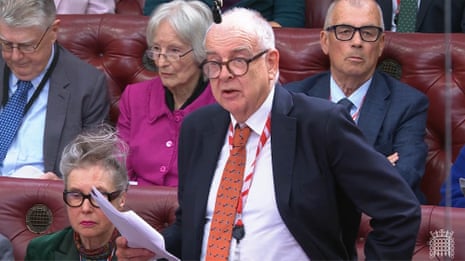
Tina Stowell, a former BBC communications chief who was leader of the House of Lords under David Cameron, published a draft bill on Tuesday, followed by John Whittingdale , the MP for Maldon and former Conservative culture secretary, who presented his strategic litigation against public participation bill on Wednesday.

Whittingdale said his bill, which is due to be debated in November, had support “across parliament” and from “all sections of the media”. He said Slapps “represent an abuse of the legal system and for too long have been used by the rich and powerful to suppress legitimate investigative journalism and to muzzle free expression”.

Lady Stowell said: “The attack on free speech represented by Slapps is a stain on our legal system and a threat to a functioning democracy. For too long British courts have been used to hush up unethical behaviour and corporate abuses.”

Her draft bill allows defendants facing libel suits, and other forms of legal action, to ask a judge to dismiss the case early in the process before costs rack up, if they can show that it relates to a matter of public interest.

Defendants whose cases are dismissed can also be awarded costs, and the court can impose penalties on claimants who deliberately prolong the process or cause delays.

Susan Coughtrie, a co-chair of the UK Anti-Slapps Coalition, said: “Now we have the opportunity to turn this support into robust, accessible and universal protections for everyone, ensuring justice is available to all, not just those who can afford it.

“Left unaddressed, Slapps allow bad-faith actors to control and restrict the information available to the public, impacting our knowledge of the world around us. As a result, protections, such as those announced this week, not only protect the person speaking out but the public interest information that sustains democracy.”

The Guardian and other media have highlighted how the wealthy and powerful, from oligarchs to corporations, have used the threat of legal action to silence those with fewer resources. In a number of high-profile cases, women reporting rape and sexual abuse have also been dragged to court after speaking out.

Both Conservative and Labour leaders have supported reform. In 2023, the Conservatives introduced limited protections for those speaking up on economic crimes such as money laundering. But the legislation does not help those raising issues related to human rights, for example.

In October 2024 Keir Starmer promised action , describing abuse of courts by the rich and powerful as “intolerable”, but the government has yet to bring forward any legislation of its own.

Other countries already have anti-Slapp laws. In many states in the US, judges have broad powers to dismiss abusive cases. In the EU, a directive was introduced in 2024 but member states have been slow to bring it into law.

The new EU law is limited in that it excludes criminal matters. However, it does allow EU citizens being sued abroad to challenge those targeting them in EU courts. Greenpeace has already put this provision to the test in the Netherlands, in a case involving a US oil pipeline company.

The year of New York and the Thunder weren’t inevitable: 15 things we learned from the NBA playoffs | NBA | The Guardian

Keyword – Sport
Trefwoorden – NBA, NBA finals, New York Knicks, San Antonio Spurs, Victor Wembanyama, Basketball, US sports, Sport, Zohran Mamdani, Oklahoma City Thunder
Title – The year of New York and the Thunder weren’t inevitable: 15 things we learned from the NBA playoffs | NBA | The Guardian
Author – https://www.theguardian.com/profile/claire-de-lune
Link – The year of New York and the Thunder weren’t inevitable: 15 things we learned from the NBA playoffs | NBA | The Guardian
Publish date – 2026-06-16T09:00:18.000Z
Category – Sport
URL – https://www.theguardian.com/sport/2026/jun/16/tktktktk-15-things-we-learned-from-the-nba-playoffs

The year of New York

Sometimes it’s just your year. When infectiously optimistic young mayor Zohran Mamdani was elected this past fall, there was a palpable vibe shift in the city. That’s not to say that there’s a direct correlation between the New York Knicks being NBA champions and the era of buoyant positivity permeating the city, but it’s also not to say there’s not one. Other American cities will, inevitably, have their moment in the sun again soon. But 2026 is the year of New York (someone get that memo to the Mets).

The Spurs aren’t going anywhere

It may come across as condescending to you’ll get ‘em next time a group of professional athletes who were on the verge of a championship, but it doesn’t feel like the San Antonio Spurs just squandered a golden opportunity. If anything, they far, far overachieved this year: it’s almost entirely unheard of for a young team to make it all the way to the finals in their first rodeo. The core of Victor Wembanyama (22 years old), Stephon Castle (21) and Dylan Harper (20) certainly took their lumps along the way, and lessons learned are often painful. But it’s not looking through rose-colored glasses to say that this Spurs team will be rodeo-ing for many seasons to come.

The Thunder are not inevitable

As the saying goes, that’s why they play the games. I’m old enough to remember nine months ago, when the Oklahoma City Thunder seemingly didn’t know how to lose and everyone in the NBA media ecosystem was talking about how they were going to cruise to a repeat championship. Flash forward to the present: where the formidable Thunder met their end against the pugnacious Spurs in Game 7 of the Western Conference finals. Oklahoma City will absolutely be heard from again, and it wouldn’t be shocking if they wound up back in the finals next year. But let this be a lesson: in an era of parity, dynasties are best left labeled in hindsight, not prematurely.

LeBron shouldn’t retire yet

A 41-year-old with a beard full of grey being the guy to single-handedly backpack his team to a first-round playoff victory sounds fantastical. But there is one timeline in which it’s possible: the one with LeBron James. James has been asked about retirement relentlessly for the past several seasons, and the question is understandable. He is old enough that his own son is now his teammate. But he is, quite frankly, still too damn good to hang it up. When the Lakers found themselves without their top two scorers – All-NBA first-teamer Luka Dončić and guard Austin Reaves – the then-third option had to pull his cape out of the closet. He responded by dragging Los Angeles through the first round almost by force of will. Wherever James ends up next season, it simply cannot be retirement.

It’s a 48-minute game

Everyone who has played any level of organized basketball has heard the same refrain: “We gotta play all 48.” But it’s rare that playing 46 or 47 minutes worth of high-level hoop comes back to bite you … anywhere besides the NBA playoffs. This year’s eventual champions, the Knicks, are that fact personified: clawing back from down 29 points in the second half of Game 4 to complete the largest comeback in NBA finals history . They knew what all great, connected, fearless teams know: it’s never over until it’s over. All it takes is, as captain Jalen Brunson put it after the Game 4 comeback, “chipping away”.

Steph needs help

Listen, maybe it’s just over. But Stephen Curry is still really, really good, and I for one am tired of watching him flame out in the play-in or, at best, the first round year after year. At this point, the 2022 championship feels like a fever dream. Maybe the answer is a 2024 Olympics-style reunion with old rival LeBron James. Maybe the long-rumored Giannis Antetokounmpo pipedream somehow comes to fruition. The Golden State Warriors are running short on time. They need solutions, and quickly. Otherwise, the flashes of brilliance Curry still delivers every spring will become increasingly fleeting, until one day they’re gone.

The Twitter DMs were real

Do we have concrete proof that the controversial, mean (and, if we’re honest, occasionally hilarious) Twitter DMs leaked earlier this season actually came from the keyboard of Kevin Durant? Not exactly. But the evidence is mounting. The most damning exhibit may have been the first round of the playoffs, where Durant’s Houston Rockets were bounced by a Lakers squad relying on meaningful postseason minutes from not only LeBron James Sr, but also junior . Death by Luke Kennard is a pretty scathing indictment all by itself. The Rockets were a walking reminder that talent and chemistry are not the same thing. They looked discombobulated and unmoored with or without Durant in the lineup, but they often seemed to be having a lot more fun when he wasn’t.

The Hawks will be great next season

The Knicks won 16 of 19 games during their march to the title, but two of those three losses came in the first three games of the opening round. The opponent? A feisty Atlanta Hawks team that finally admitted defeat on the Trae Young experiment and embraced the future in the form of Jalen Johnson and his Most Improved Player running mate Nickeil Alexander-Walker. In exchange for Young, Atlanta landed the perfect veteran steward in CJ McCollum, who, as shocking as it may sound, was the only player in the entire postseason to consistently make the Knicks look mortal. Add in all that athleticism and depth, plus the No 8 pick in this year’s draft courtesy of the New Orleans Pelicans, and the Hawks should enter next season with a puncher’s chance in what promises to be a fascinating Eastern Conference.

Philly need to turn the page

Speaking of embracing the youth movement, there’s another team in the Eastern Conference that could stand to do the same. For a brief moment – around the start of the second round – it looked as though the stars were finally aligning for this moribund version of the Philadelphia 76ers. Joel Embiid looked like an MVP candidate again. Paul George didn’t look like a walking contractual albatross. Everything was clicking in a way that seemed to validate the grand vision that Daryl Morey had spent years chasing. Then the wheels came off. Morey is out of a job, and the underlying reality has reasserted itself. If there’s a path forward for Philadelphia, it probably doesn’t involve squeezing one more run out of Embiid and George. It involves turning the page, embracing the future, and building around Tyrese Maxey and VJ Edgecombe instead.

The Celtics should shake it up

There will be several coaches on the hot seat this summer. Joe Mazzulla, fresh off a Coach of the Year award, probably won’t be one of them. But he showed some serious warts in these playoffs – and, honestly, last year’s too – with his apparent unwillingness to stray from a three-point-heavy dogma even when circumstances demanded it. The pithy press conference quotes are cute and all. They become a lot less charming when your team keeps running aground on the same shoals every postseason. Beyond any tactical adjustments, the Boston Celtics have a major personnel decision to make. Jaylen Brown, the mercurial star who appeared to relish his months-long stint as the team’s No 1 option, may never have more trade value than he does right now. My takeaway? Sell high on Brown, and use the return to retool both the roster and the philosophy underpinning it.

The Timberwolves lost the trade

There was a time, not all that long ago, when the blockbuster trade that sent Julius Randle and Donte DiVincenzo to the Minnesota Timberwolves in exchange for Karl-Anthony Towns looked like a genuine win-win. While Towns didn’t exactly cover himself in glory during the title-clinching Game 5 of the NBA finals , that debate was settled this postseason. Randle once again proved more liability than asset when the games mattered most, while DiVincenzo will spend most, if not all, of next season recovering from an achilles tear. Meanwhile, Towns was indispensable during the Knicks’ march to the championship. He was particularly brilliant in Games 1 and 2 of the finals, helping set the tone for a dominant series victory and validating the gamble New York made when it acquired him.

Don’t make too much (or too little) of the regular season …

Somewhere between “the NBA regular season is irrelevant” and “the NBA regular season is the bible” lies a more nuanced truth: there is plenty to be gleaned from the six months between October and April, but none of it is definitive. Take, for example, the Detroit Pistons, who steamrolled the Eastern Conference for much of the regular season but carried glaring playoff-centric flaws that were obvious to anyone looking closely enough. Or the Knicks, who faced the opposite problem: a team that wasn’t blowing the doors off opponents during the 82-game marathon because it was clearly ironing out wrinkles in preparation for the 16-game sprint. The signs were there all along, not least when they captured the NBA Cup in December. On the other side of the ledger sat the Spurs. Their regular-season dominance over the Thunder turned out to be more than a curiosity; it was a preview. When the Spurs knocked Oklahoma City out in the conference finals, the warning signs had already been there for months. So by all means, take lessons from the regular season. Just don’t mistake them for gospel.

… and don’t trade for James Harden

There’s a famous meme, born from a scene in Arrested Development, in which one character asks: “Did it work for those people?” The response: “No, it never does. I mean, these people somehow delude themselves into thinking it might … but it might work for us.” That, in a nutshell, is the James Harden experience. Every few years, a different NBA front office succumbs to a kind of selective amnesia. Executives are charmed by Harden’s remarkably regular-season production and convince themselves that this time will be different. They willingly suppress the memory of the playoff shortcomings that have followed him throughout his career until, inevitably, those memories come flooding back in painful fashion. Then comes the disappointment. Then the trade request. Then the wheel spins again. I will never fully understand how the optimism persists, but the Cleveland Cavaliers became the latest franchise to learn the same lesson as so many before them: when the calendar turns to April, May and June, Harden simply cannot be treated as a dependable No 1 option.

A savvy front office is paramount

There was one trait shared by the three best teams in the playoff field – the Thunder, Spurs and Knicks – they were run by smart, shrewd front offices. Their intelligence manifested in different ways. Oklahoma City and San Antonio largely built through the draft. New York took a more aggressive path, assembling their core through trades and free agency. But all three organizations excelled at the same fundamental task: roster construction. You may not have the Thunder’s seemingly endless depth. You may not have the Spurs’ lottery fortune. You may not possess the je ne sais quoi , culture and sheer stubborn resilience that powered the Knicks to a championship. But putting smart people in charge is one of the few competitive advantages available to every franchise.

You can win with a small guard

Becky Hammon is a brilliant basketball mind, a damn good coach and, unfortunately, the source of a quote that will live in infamy. “If your best player is small, you’re not winning,” Hammon said in 2023 while arguing that Brunson, listed at 6ft 2in, could never be a true No 1 option on a championship team. Given that Brunson now possesses both an Eastern Conference finals MVP and an NBA finals MVP trophy, it goes without saying that the take did not age particularly well. If the NBA teaches the same lesson over and over, this season hammered it home more forcefully than most: there is no single blueprint for superstardom. Brunson has flaws. Plenty of them. He is also one of the most outrageously clutch players the league has ever seen. The goal is not to find a flawless basketball demigod molded in the image of ames or Michael Jordan. The goal is to find a truly great player, one capable of leading a locker room and elevating teammates, then intelligently and relentlessly build a roster that amplifies his strengths. The Knicks’ radio broadcaster Tyler Murray captured it perfectly in his final call of the season: “The 2026 New York Knicks will forever be remembered as the team that proved no lead is too big, and no guard is too small.”

Cactus Pears review – tender and subtle story of forbidden love and a poignant awakening in India | Film | The Guardian

Keyword – Film
Trefwoorden – Film, Drama films, Romance films, LGBTQ+ rights, India, Culture, Bollywood, South and central Asia, World news
Title – Cactus Pears review – tender and subtle story of forbidden love and a poignant awakening in India | Film | The Guardian
Author – https://www.theguardian.com/profile/peterbradshaw
Link – Cactus Pears review – tender and subtle story of forbidden love and a poignant awakening in India | Film | The Guardian
Publish date – 2026-06-17T06:00:25.000Z
Category – Culture
URL – https://www.theguardian.com/film/2026/jun/17/cactus-pears-review-forbidden-love-india-rohan-kanawade

H ere is a really impressive directorial debut from Mumbai film-maker Rohan Kanawade: tender, subtle, candid, scrupulously observed. It is a story of forbidden and unacknowledged love, or maybe semi-forbidden and semi-unacknowledged, and an emotional flowering that reveals the oppressive importance of family, status and class.

Anand (Bhushaan Manoj) is a 30-year-old Mumbai call-centre worker who must return to his remote home village when his father dies, where he is expected to stay for the full 10-day mourning period, an absence for which he must grovellingly apologise to his boss over the phone. His dad’s final words, incidentally, were that he wanted his wife Suman (Jayshri Jagtap) to cook him a really nice meal, and the poignancy of that request is cleverly revealed by Kanawade in the later scene in which Anand’s elderly, blind grandfather reminisces about why he agreed to marry the lowly and uneducated Suman in the first place.

This widow, in one of the film’s many murmuringly subdued dialogue exchanges, advises Anand to stay discreet about his reasons for leaving and why he is still unmarried; the story they are sticking to is that a “girl” broke his heart. Anand painfully ponders whether to send this person a text revealing that he is back in the old neighbourhood. But more importantly, Anand reconnects with Balya (Suraaj Suman), a poor goatherd and casual worker whose family money was long since expended on his sister’s dowry, who shares Anand’s dormant feelings for him. But Balya is under pressure to get married within a community which is collectively aware, at some level of denial, about why he is single and wants him to stop embarrassing everyone.

As the 10-day observance continues, and the time of his father’s funeral ceremony draws closer, Anand becomes more resolved about what he wants his future to look like. The cactus pears of the title are a shy gift to Anand from Balya; he has symbolically removed their prickles in advance, a touching act which only points up how the prickles are not to be removed so easily in any other aspect of their lives.

Cactus Pears is in UK and Irish cinemas from 19 June.

The peptide boom: how the US got hooked on unregulated ‘miracle’ drugs | On the Ground | US news | The Guardian

Keyword – US news
Trefwoorden – US news, Health & wellbeing, US healthcare, Health, Pharmaceuticals industry, Drugs
Title – The peptide boom: how the US got hooked on unregulated ‘miracle’ drugs | On the Ground | US news | The Guardian
Author – Adam Gabbatt
Link – The peptide boom: how the US got hooked on unregulated ‘miracle’ drugs | On the Ground | US news | The Guardian
Publish date – 2026-06-16T09:16:37.000Z
Category – News
URL – https://www.theguardian.com/us-news/video/2026/jun/16/the-peptide-boom-how-the-us-got-hooked-on-unregulated-miracle-drugs-on-the-ground

From cool Marseille to a photo-feast in Arles – an art trail through Provence | Cultural trips | The Guardian

Keyword – Travel
Trefwoorden – Cultural trips, France holidays, Marseille holidays, Art, Europe holidays, Art and design, Travel, Culture
Title – From cool Marseille to a photo-feast in Arles – an art trail through Provence | Cultural trips | The Guardian
Author – Jarred McGinnis
Link – From cool Marseille to a photo-feast in Arles – an art trail through Provence | Cultural trips | The Guardian
Publish date – 2026-06-16T06:00:46.000Z
Category – Lifestyle
URL – https://www.theguardian.com/travel/2026/jun/16/art-trail-through-provence-france-marseille-arles-aix-avignon

M y wife and I moved from London to Marseille a little over five years ago when our British passports still conferred “right to reside” in France. That first winter on the beach, in short sleeves, as our daughters played in the topaz-coloured Mediterranean and the sun set across an ever-clear blue sky, I understood why this part of southern France has always been popular with artists.

I was recently speaking about this with the painter Fanny Nushka and her sailor husband, Benoît Bouchet, on the terrace of Café la Muse in Marseille’s “coolest” neighbourhood . She said: “It took a long time to go back to blue. It’s like being in Paris and painting the Eiffel Tower. It’s dangerous to paint the Calanques [limestone coves] as an artist from here.”

We moved to Marseille for the same reason that has attracted countless artists: it’s cheaper to live here. Marseille’s affordability enables Fanny to paint full-time and Benoît to sail without being away from his family for weeks. Benoît runs daily catered cruises on a listed sailing yacht, Le Don du Vent . For €135, you get a taste of Mediterranean luxury with swimming, snorkelling and sunbathing in the unspoiled sea coves around Marseille, pausing briefly for wine and a lunch prepared onboard.

Céline Ghisleri, co-president of Provence Contemporary Art , which represents 62 arts organisations in and around Marseille, tells me the city has always had a dynamic art scene. However, the turning point came when Marseille was named European Capital of Culture in 2013. Since then, large institutions such as Frac Sud , Mac and the Museum of European and Mediterranean Civilisations ( Mucem ) have expanded the city’s offering with bigger exhibitions from more widely recognised artists.

This summer, the Mucem’s exhibitions are Bonnes Mères, a collection of contemporary and historical works on the theme of motherhood, and Clément Cogitore’s fascinating Ferdinandea, l’île éphémère, a body of work centred on the brief existence of a volcanic Mediterranean island. At the end of August, the art fair Art-O-Rama will be hosted at La Friche La Belle de Mai . La Friche (the Wasteland) was a tobacco factory and is now an enormous warren of a multidisciplinary arts centre that is always buzzing, especially in the summer when they set up a movie screen and food trucks on the roof. La Friche is emblematic of the art scene in Marseille: absolute chaos, but somehow it works.

Outside Marseille, Plein Sud , a network of contemporary art organisations between Monaco and Montpellier, produces a guide with travel itineraries. It’s how I discovered the charming Gallifet art centre in nearby Aix-en-Provence, which is only about 40 minutes from Marseille but exists in a completely different universe.

You couldn’t be further away from Marseille’s port city energy than Aix’s daily market at Place Richelme, where you can grab a coffee and, if you are lucky, an outdoor seat at the patisserie and salon de thé Maison Weibel . For lunch, I recommend Drôle d’Endroit (Funny Place). It is tucked down an alley off a sidestreet, but the meals are always pleasing and the atmosphere friendly. Another solid choice is Tita for Levantine street food.

As tiny and quiet as Aix is, it has an abundance of museums, such as the Granet Museum , the Caumont Art Centre and the Vasarely Foundation , but they tend to lean heavily on art that historians have already anointed. For example, it wasn’t until 1984 that the Granet acquired any works by the local boy done good, Cézanne, whose preserved studio is just up the hill.

That’s why it was refreshing to find Gallifet trying something different. The owners, Nicolas Mazet and Kate Davis, have a mission to bring contemporary art to conservative Aix. Located on the ground floor of an 18th-century townhouse, the courtyard’s striking red sculpture of a swimmer mid-stroke, by Diadji Diop , hints that Gallifet is more than just a home (the owners live above the art centre).

This summer’s exhibition features a retrospective of the photographer François Halard , with more than 100 works spanning more than three decades. Until the end of September, Gallifet also hosts a seasonal restaurant and chef’s residency. This year, two Paris-based chefs, Lisa Desforges and Bruno Hammerle, will use Provence’s abundant and delicious ingredients to create menus including entrees such as smoked ricotta gnocchi with peas and a peapod veloute. Gallifet also offers two apartments (from €200 and €160 per night), both decorated with pieces from previous exhibitions and filled with Provençal features such as marble fireplaces and tomette terracotta tiles.

A little further up the Rhône, Avignon nestles against the river, enclosed by preserved medieval walls. The Palais des Papes overlooks the renowned vineyards of Châteauneuf-du-Pape to the north and lavender fields to the south. Each July, the town is taken over by the Avignon festival , one of the oldest performance arts festivals.

After a visit, take a walk along the most picturesque and charming street in Avignon, La Rue Peyrolerie. A winding medieval cobbled alley leads to an equally charming restaurant, L’Épicerie , situated in a square beside a small 14th-century gothic church with an ornately carved walnut-wood door. The cuisine is classic French, served in generous portions by friendly staff. Every time we visit Avignon, we dine here and have never been disappointed, but be warned that the terrace fills up quickly. This is a well-known and well-loved spot among locals. Another safe bet for outdoor courtyard dining is Numéro 75 .

The most notable address for contemporary art in Avignon is the Lambert Collection , housed in two stunning 18th-century townhouses, Hôtel de Caumont and Hôtel de Montfaucon. The collection is the legacy of Yvon Lambert, a celebrated gallerist and collector who made his reputation in the latter half of the 20th century championing American artists such as Nan Goldin, Donald Judd, Lawrence Weiner and Cy Twombly. The collection continues to support up-and-coming local artists in its Antechamber of Summer exhibition. This year’s exhibition is by Melika Sadeghzadeh , an Iranian artist living and working in Montpellier.

Just south of Avignon, Arles has at its centre a nearly 2,000-year-old Roman amphitheatre, which hosts plays and concerts. The Vincent van Gogh Foundation and Luma host several exhibitions throughout the year, but the real treat comes in July during the Rencontres d’Arles . For 50 years, venues across town, from galleries to grocery stores, have showcased a wide range of contemporary and historical photography.

Recently, we went to Arles for its Festival of Drawing . After a wander through the picturesque medieval streets of the Roquette district on the east side of town, popping into venues as we went, we discovered the tiny restaurant Páou in the quaint Place Paul Doumer. The menu promised sharing plates starring local produce and wines. So we sat down for another meal at another terrace table, under another clear blue sky.

Jarred McGinnis ’s latest book is There is No Meant to Be ( Harvill , £ 20 ). To support the Guardian, order your copy at guardianbookshop.com . Delivery charges may apply

Lil Nas X shares update after getting mental health care: ‘There’s less fear in my heart’ | US news | The Guardian

Keyword – US news
Trefwoorden – US news, Lil Nas X, Mental health, Los Angeles, Atlanta, Music, Culture, Bipolar disorder
Title – Lil Nas X shares update after getting mental health care: ‘There’s less fear in my heart’ | US news | The Guardian
Author – Associated Press
Link – Lil Nas X shares update after getting mental health care: ‘There’s less fear in my heart’ | US news | The Guardian
Publish date – 2026-06-17T17:59:17.000Z
Category – News
URL – https://www.theguardian.com/us-news/2026/jun/17/lil-nas-x-mental-health-instagram-video

The musician Lil Nas X posted a moving video update to his Instagram on Wednesday morning. In the nearly three-minute clip, the artist – born Montero Lamar Hill – shared that he “has been in rehab for a few months” and since then, has returned home to Atlanta, where he is from and his family lives, and Los Angeles, where he resides.

The update comes in response to an event last summer in which the musician was charged with attacking Los Angeles police officers.

In April, a judge allowed the 27-year-old to enter a mental health diversion program intended to lead to the charges being dismissed. The musician was eligible for the program because the court found that the encounter involving police was the result of his since-diagnosed bipolar disorder and appeared to be an aberration compared with his usual behavior.

In Wednesday’s video, Lil Nas X publicly discussed his mental health diagnosis. “I have a therapist now and a psychiatrist, which has been really helpful. When I got my bipolar disorder diagnosis, I feel like I had known for the past few years, but I didn’t want to admit to it ‘cause I didn’t want to have to take medication and, I don’t know, have people think different of me.”

“I’m doing much better,” he continued after joking that he’s “living life on extreme hard mode”.

“I’m feeling better. I’m creating freely. And there’s less fear in my heart,” he said.

Bipolar disorder is a mental illness that causes dramatic shifts in mood, energy, activity levels and concentration. These range from periods of extremely elated, irritable or energized behavior – known as manic episodes – to very sad, indifferent or hopeless periods, known as depressive episodes.

“I’ve been doing music for seven years now,” Lil Nas X said in switching gears near the end of the clip. “I wanted to let you guys know there is new music on the way.”

Then he addressed his fans directly. “I love you and all I want to do is continue to try to make you proud and make myself proud.”

Lil Nas X was arrested and briefly taken to a hospital for a suspected overdose in August after Los Angeles police say he charged at officers responding to a report of a naked man walking on a busy boulevard.

Authorities allege the musician was walking nude down a street in LA’s San Fernando valley and charged at police officers who were responding to calls about him. A criminal complaint says three officers were hurt. Photos and video apparently shot before the police confrontation showed Lil Nas X walking in the street in only white briefs and white boots.

After spending three days in jail, he was released on $75,000 bail on the condition that he attend drug treatment. He pleaded not guilty in a court appearance to three counts of battery with injury on a police officer and one count of resisting an executive officer.

In his first public comments shortly thereafter, the artist posted a video to Instagram saying: “These last four days have been terrifying.”

But he added with a laugh, speaking of himself, that “your girl is going to be OK. She’s going to be all right.”

Then two months ago, Judge Alan Schneider allowed Lil Nas X to enter the mental health diversion program. If he sticks to his treatment program and obeys all laws for two years, the four felony counts against him will be dismissed.

The Atlanta -raised artist is best known for 2018’s country and hip-hop merging Old Town Road , which spent a record 19 weeks at No 1 on the Billboard Hot 100 and won him two Grammys. It is one of the most popular singles of all time, and in 2019 broke the Billboard record set by Mariah Carey’s One Sweet Day for most weeks at No 1.

Known for his genre-bending, innovating sounds and style, Lil Nas X’s first full studio album, 2021’s Montero , went to No 2 on the Billboard album chart and received a Grammy nomination for album of the year. Other hits have included Industry Baby and Montero (Call Me by Your Name) .

What happened on a historic night for Argentina? ‘Messi things’ | World Cup 2026 | The Guardian

Keyword – Football
Trefwoorden – World Cup 2026, Lionel Messi, Argentina, World Cup, Football, Sport
Title – What happened on a historic night for Argentina? ‘Messi things’ | World Cup 2026 | The Guardian
Author – https://www.theguardian.com/profile/pablo-iglesias-maurer
Link – What happened on a historic night for Argentina? ‘Messi things’ | World Cup 2026 | The Guardian
Publish date – 2026-06-17T05:59:04.000Z
Category – Sport
URL – https://www.theguardian.com/football/2026/jun/17/lionel-messi-hat-trick-algeria-argentina-world-cup

L ong after the dust had settled on Argentina’s 3-0 group-stage victory over Algeria on Tuesday night, Algeria and Bayern Munich midfielder Ibrahim Maza emerged wearily from behind a curtain and stepped up to the microphone.

Maza had played well, even assisting on Algeria’s disallowed first goal. He had also had a front-row seat to a Lionel Messi masterclass, just a few yards away from Argentina’s captain when he scored his third goal of the evening and tied Miroslav Klose as the World Cup’s all-time leading scorer. In short order, he was asked to expand on what made Messi unplayable on Tuesday evening.

“Messi things,” Maza said, a smile creeping across his face. “I don’t think I need to explain to you [what that means]. You just have to watch the game and then you’ll know what I mean by Messi things. He can decide the game on his own, as we saw today.”

Messi did indeed decide the game on his own on Tuesday, scoring a trio of clinically taken goals to bury Algeria and push Argentina to the verge of the knockout round. He did so 20 years to the day after scoring his first World Cup goal for Argentina.

It feels sometimes like Messi is ageless, but rolling the tape on that strike – which came in Argentina’s 2006 group‑stage opener against Serbia and Montenegro – reveals a mop‑headed teenager with alien‑like speed and reflexes. He blurs across the area and smashes a finish across the face of goal, announcing his presence on the world stage.

He became Argentina’s youngest World Cup goalscorer that day and on Tuesday he became their oldest, eclipsing former Argentina great Martin Palermo’s record by more than two full years. Messi moves slower now and undoubtedly enjoys the space he is frequently given by defenders who fear humiliation at his hands. Twenty years on, Messi lacks a little pace but his mind is as sharp as ever, as is his ability to find space where there isn’t any to be found. He remains awe-inspiring.

Not long after Maza slipped back through the curtain and headed towards the team bus, Messi himself emerged, smiling and clutching a Michelob Ultra “Superior Player of the Match” trophy, probably the least important silverware he has ever touched.

Messi, of course, is famously competitive and frequently minimizes these types of individual accomplishments. “Honestly [the record doesn’t matter],” he said. “It’s an honor to be there, for what it means to be next to Klose, [the Brazilian] Ronaldo is also there. [Kylian] Mbappé too, he scored twice today. It’s just a statistic and nothing more. ”

It is easy to question the veracity of Messi’s feelings, of course. He is relentlessly competitive, sometimes to the point of pettiness. The mere mention of Mbappé’s goals, scored hours earlier , and of the other participants on the list, demonstrates his interest. Messi’s Argentina and Inter Miami teammate Rodrigo De Paul, who assisted on Messi’s first goal, laughed when he was asked about Messi’s record.

“I swear he doesn’t care. Sometimes we’ll be in a room drinking mate and we’ll tell him: ‘Hey man, you’re just one away or two away’, or whatever. And I swear he has no idea. I don’t know how that works.”

Messi left after 80 minutes to a thunderous ovation. The crowd of nearly 70,000 chanted his name, and Messi raised his arms in acknowledgement. His head coach, Lionel Scaloni, met him at the touchline. He was holding back tears as he eventually sat on the bench next to Messi. It was not the only time that emotion got the best of him. He welled up after Messi’s third goal, and again on the field as Argentina supporters serenaded their team after the match.

“There are no words; anything I say would be superfluous,” Scaloni said after the match. “It’s what he’s been doing for 20 years, it’s what the people of this sport want to see.”

De Paul said: “He’s an animal. What makes me the happiest is that I feel like he’s enjoying it. That he doesn’t feel the weight of the pressure that he felt for so long. Everyone knows his mentality. He doesn’t let himself enjoy things much because he’s always focused in helping us and the team. But I see him good now, I see him happy. That’s contagious among the group.”

Messi’s happiness was easy enough to see. He beamed after every goal, celebrating much like the 19-year-old who found the back of the net for the first time 20 years ago. He lingered on the pitch after the final whistle, waving at fans and embracing his teammates, a smile on his face even as he walked towards the team bus in the wee hours of the morning.