Keyword – US news
Trefwoorden – Trump administration, US politics, Donald Trump, Washington DC, US-Israel war on Iran, Iran, Chicago
Title – Federal judge blocks Trump administration efforts to subpoena Minnesota governor Tim Walz and others – live | Trump administration | The Guardian
Author – https://www.theguardian.com/profile/tom-ambrose,https://www.theguardian.com/profile/lucy-campbell,https://www.theguardian.com/profile/vivian-ho,https://www.theguardian.com/profile/fran-lawther,https://www.theguardian.com/profile/robert-mackey,https://www.theguardian.com/profile/rachel-leingang,https://www.theguardian.com/profile/fabiola-cineas,https://www.theguardian.com/profile/yohannes-lowe,https://www.theguardian.com/profile/niamh-rowe,https://www.theguardian.com/profile/michael-sainato
Link – Federal judge blocks Trump administration efforts to subpoena Minnesota governor Tim Walz and others – live | Trump administration | The Guardian
Publish date – 2026-06-22T19:46:50.000Z
Category – News
URL – https://www.theguardian.com/us-news/live/2026/jun/22/trump-reflecting-pool-vandalized-lincoln-memorial-iran-us-politics-latest-news-updates
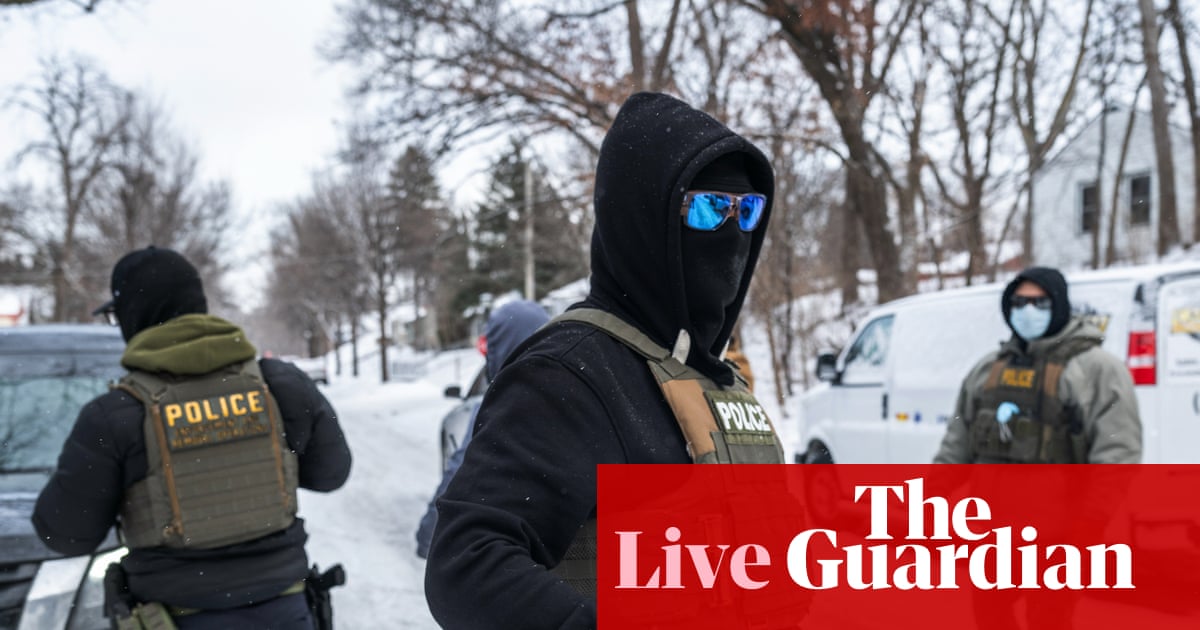
Federal judge blocks effort to subpoena Minnesota governor Tim Walz and officials
A federal judge has blocked efforts to subpoena Tim Walz and other Minnesota officials, calling it an attempt to “harass and retaliate against them”, the AP reports.
US district judge Patrick Schlitz ruled that the main purpose of the subpoenas – part of a Trump administration investigation into alleged obstruction of deadly ICE raids in the state earlier this year – was to “coerce Minnesota officials into assisting the federal government with enforcing civil immigration law and to harass and retaliate against them for failing to do so.”
Minnesota governor Walz said the ruling was “a victory for the rule of law and our democracy”.
Despite an adverse court ruling, the US Department of Justice is refusing to back off its claim that Minnesota’s governor, Tim Walz , attorney general, Keith Ellison , and the Minneapolis mayor, Jacob Frey , should all be investigated for breaking the law by refusing to cooperate with federal immigration raids in the state that led to the killing of two peaceful protesters, Renee Good and Alex Pretti , by federal officers.
Earlier on Monday, the US district court for Minnesota unsealed an order from Chief Judge Patrick Schiltz rejecting subpoenas for the elected Democrats as politically motivated.
Schiltz, a former Republican Senate staffer who clerked for supreme court justice Antonin Scalia before being nominated to the federal bench by George W Bush , wrote that initiating an investigation “in order to ‘harass political opponents or to coerce them into taking official action – particularly official action that the federal government cannot directly require those political opponents to take – is a blatantly unlawful and unethical use the grand-jury process”.
Despite this stinging rebuke from a conservative jurist, a spokesperson for the Department of Justice insisted in a statement to the Guardian that it was simply investigating unlawful behavior.
“The Department takes the unlawful obstruction of federal law enforcement operations extremely seriously and will continue to act in full compliance with the law to investigate these matters”, the spokesperson said.
Here’s a more in-depth report on a federal judge blocking the justice department’s attempt to subpoena Minnesota’s governor, Tim Walz , attorney general, Keith Ellison , and the Minneapolis mayor, Jacob Frey , from our Minneapolis-based Midwest political correspondent, Rachel Leingang.
A federal judge agreed to quash the US federal government’s subpoenas of leaders in Minnesota issued during the Trump administration’s controversial immigration crackdown on the state earlier this year.
The US Department of Justice issued subpoenas to the Minnesota governor, Tim Walz , the attorney general, Keith Ellison, the Minneapolis mayor, Jacob Frey, and other local officials in the Twin Cities in January.
The department said it was investigating the officials for obstructing federal immigration enforcement. Local and state officials largely did not support the federal enforcement surge, during which federal agents killed two US citizens, Renee Good and Alex Pretti, in the streets.
The US district court for Minnesota unsealed an order from Chief Judge Patrick J Schiltz on Monday that showed the subpoenas were rejected as politically motivated. Ellison posted the unsealed order on Monday, saying the decision to quash the subpoenas was an “extremely rare step” by the court.
In the order, Schiltz wrote that the Trump administration had been “threatening and attempting to punish states and localities that have adopted ‘sanctuary’ policies”. He noted that initiating an investigation “in order to ‘harass political opponents or to coerce them into taking official action – particularly official action that the federal government cannot directly require those political opponents to take – is a blatantly unlawful and unethical use the grand-jury process”.
Read Rachel’s full report here:
Trump’s effort to subvert mail-in voting suffers another setback in Maryland
A federal judge ruled on Monday that Maryland election officials do not have to comply with a demand from the Trump administration to turn over the state’s complete list of registered voters, dealing another legal setback to Donald Trump ’s plan to subvert mail-in voting by asserting federal control.
In her opinion , US district judge Stephanie Agli Gallagher , who was nominated to the court by Trump in 2019, rejected the Department of Justice’s claim that the Civil Rights Act of 1960 required states to turn over complete voter rolls as “absurd”.
The Democratic election and voting rights attorney Marc Elias celebrated the decision in his Democracy Docket newsletter, writing:
Donald Trump desperately wants to build a national database of voters. His plan is to have his administration control who stays on the list and who gets removed. He has issued unconstitutional executive orders to accomplish this goal, and the U.S. Postal Service has proposed a new rule to do his bidding.
The problem for Trump is that his Department of Justice keeps losing cases that it needs to access this critical data. This humiliating string of defeats threatens to derail Trump’s signature plan to subvert the 2026 midterm elections.
This morning, a federal judge in Maryland handed the DOJ its ninth defeat in a series of 31 cases the department has filed to gain access to state voter files. The DOJ has yet to win a single one. The court wrote that it “joins every court to have addressed this issue in concluding that [a state voter file] is not a record or paper that a state must produce to the United States.”
Importantly, of the nine cases the DOJ has lost, five were decided by judges nominated by Trump.
As the Guardian reported in May, the US Postal Service could throw the upcoming midterm elections into chaos by requiring states to provide lists of voters who received mail ballots, according to a draft rule .
Nearly one in three Americans voted by mail in 2024 , but Trump, who wants to restrict the number of voters by limiting ballots cast by mail, signed an executive order in March that prohibits the USPS from delivering ballots to any voters not on a federal list of citizens deemed eligible to vote in each state by the Department of Homeland Security.
The USPS proposal to implement this order seeks to require states to give the postal service the names and barcodes tied to mail-in ballots for federal elections. The public will have until 2 July to comment on the proposed rule before the Trump administration can finalize it.
Vance says he did not feel snubbed by Iran’s foreign minister during viral moment before talks
Before boarding his flight home from Switzerland, the US vice-president JD Vance spoke to reporters on the tarmac and was asked if he felt snubbed by Iran’s foreign minister, Abbas Araghchi , when Iran’s top negotiator came into the same room as him but did not greet the American.
“No,” Vance said. “I’ve spent a lot of time dealing with the Iranians over the last few months. Sometimes I find them extremely confusing as negotiators.
“What I did find kind of funny is that after that initial meeting, there was this, you know, sort of social media firestorm where everybody said the Iranians are going to leave, and then we proceeded to talk to them for like the next nine hours,” Vance added. “So I would just encourage the media, mistrust a little bit what you see coming out of Iranian social media. They could be confusing negotiators, but we feel like we’re making progress.”
Video of Iran’s foreign minister leaving the room without acknowledging Vance was indeed viewed millions of times on social media.
The vice-president also said: “We continue to make progress on these technical negotiations. We left a lot of our team, the Iranians left a lot of their team at the resort there to keep on working at it.”
Minneapolis mayor Jacob Frey said the investigation was “never about justice, law, and order, but the absence of it”.
“Subpoenaing political opponents because they spoke on behalf of their constituents violates the core tenets of our democracy and human decency,” he said, according to AP reports.
Frey also observed that criticizing government action is not a crime. “One of the defining strengths of our democracy is the ability to challenge those in power without fear of retribution. Elected officials have both the right and the responsibility to speak honestly about how government decisions affect the people they serve,” he said.
Keith Ellison , the Minnesota attorney general, said “it should disturb every American that Donald Trump is weaponizing the criminal justice system against people he disagrees with”.
Kaohly Her , St Paul mayor, said the subpoenas were “a politically motivated retaliation against our city for lawfully standing up to ICE and fighting for our residents”.
Walz says case is example of DoJ going after Trump’s political opponents
The subpoenas were first issued in January amid a violent immigration crackdown in Minnesota that led to the killings of Minneapolis residents Alex Pretti and Renee Nicole Good.
As well as Tim Walz, the Trump administration issued subpoenas for Minneapolis mayor Jacob Frey , the offices of the state attorney general, Keith Ellison , the Hennepin county attorney, Mary Moriarty , the St Paul mayor, Kaohly Her , and the Ramsey county attorney, John Choi .
On Monday, Walz – who was Kamala Harris’s running mate in the 2024 election – issued a statement after the ruling, saying: “The US justice department is pursuing criminal investigations into the president’s political opponents. This case was just one example of that, but we are seeing daily reminders of this administration’s lawlessness — in Minnesota and around the country. We all must continue to seek justice and uphold the rule of law.”
Here’s more from the AP on the federal judge’s ruling:
The ruling is the latest rebuke by the federal judiciary of Justice Department efforts to aggressively implement the Trump administration agenda in courts and target the president’s political adversaries through subpoenas and similar demands.
The judge ruled that there appeared to be “extremely weak to nonexistent” connections between the information sought in the subpoenas and any possible criminal violation. The subpoenas seek materials “that largely if not entirely relate to constitutionally protected conduct,” the judge wrote, noting that Minnesota has the legal right not to devote its resources to enforcing federal immigration law.
The Justice Department “is not conducting a criminal investigation,” the judge wrote, “but is instead using the grand jury process for other (unlawful) purposes.”
The evidence that the subpoenas were issued for unlawful reasons is overwhelming, the judge said, arguing that the Justice Department “has struggled — without success — to identify a single plausible investigatory justification” for them.
The DoJ has yet to comment on the ruling.
Federal judge blocks effort to subpoena Minnesota governor Tim Walz and officials
A federal judge has blocked efforts to subpoena Tim Walz and other Minnesota officials, calling it an attempt to “harass and retaliate against them”, the AP reports.
US district judge Patrick Schlitz ruled that the main purpose of the subpoenas – part of a Trump administration investigation into alleged obstruction of deadly ICE raids in the state earlier this year – was to “coerce Minnesota officials into assisting the federal government with enforcing civil immigration law and to harass and retaliate against them for failing to do so.”
Minnesota governor Walz said the ruling was “a victory for the rule of law and our democracy”.
Donald Trump said Iran will agree to have weapons inspections in future to ensure what he called “nuclear honesty”.
The president’s Truth Social post on Monday echoed comments made by his vice-president, JD Vance, who said Tehran had agreed to allow nuclear inspectors back into the country “as soon as today”.
Trump said: “Everybody is fully aware that Iran will agree to have Major Weapons Inspections in order to ensure “Nuclear Honesty” long into the future.”
California sues EPA over vehicle emissions rules
California sued the Environmental Protection Agency on Monday after the agency sent Congress landmark state vehicle emissions rules for potential repeal, Reuters reports.
According to the EPA, waivers under the Clean Air Act for California environmental regulations that had been approved under prior Democratic administrations should have been sent to lawmakers under the Congressional Review Act .
However, California argued that this action was illegal and should be blocked by a federal court. The state has accused the EPA of seeking to “wave a magic wand” and turn a waiver into a rule.
The Trump administration’s new Medicaid rules , issued this month as part of the One Big, Beautiful Bill Act , require millions of low-income Americans to prove they are working, studying or otherwise active for at least 80 hours a month just to keep their health coverage. It’s a paperwork hurdle that could cost 5 million to 10 million people their Medicaid by 2028, the Urban Institute estimates. For the roughly 40% of Americans with HIV who rely on Medicaid at any given time, and the 85% who depend on it at some point in their lives, the new rules could cost them their lives.
“For people with HIV, that’s a matter of life or death, because if your treatment is interrupted, even for a short time, you can lose viral load suppression,” said Virginia Shubert, a senior policy adviser at Housing Works, the New York City advocacy organization dedicated to ending the HIV/Aids and homelessness crises. “It goes beyond the law, and it’s very cruel.”
In New York state, where HIV infection rates have increased in recent years, the Medicaid rules could lead to a surge of new cases. Half of all New Yorkers living with HIV, an estimated 55,000 people , rely on Medicaid for their healthcare, according to Housing Works.
Aside from cuts to Medicaid, the US House has also proposed cutting $225m from the Ryan White HIV/Aids program , which delivers low-cost care to about half of all people with HIV in the US. Several states’ Aids drug assistance programs, which supply antiretrovirals to uninsured people, are running out of money, forcing waitlists in states including Florida.
More here:
Secretary of State Marco Rubio will begin a trip to three Gulf countries tomorrow amid negotiations with Iran to end the war, his spokesperson said.
Visiting the United Arab Emirates , Kuwait and Bahrain , Rubio will discuss “the memorandum of understanding with Iran, efforts to secure full and free safe transit through the strait of Hormuz, and the importance of peace and stability in the region,” state department spokesman Tommy Pigott said in a statement.
US stocks are drifting near their records after trading resumed following a three-day weekend for Wall Street, the Associated Press reports.
The S+P 500 slipped 0.3%, coming off its 11th winning week in the last 12, and pulled 1.7% below its all-time high set early this month. The Dow Jones Industrial Average was up 131 points, or 0.3%, as of 10:45 a.m. Eastern time, and the Nasdaq composite was 1% lower.
In the oil market, prices eased following talks over the weekend between the United States and Iran . JD Vance said today that they had created a “good foundation for a successful final deal” (see my earlier post ).
An end to the war could clear the strait of Hormuz for oil tankers and allow for the undisputed resumption of deliveries from the Persian Gulf. Iran’s military had said on Saturday that it closed the critical waterway again, though US Central Command has disputed that.
The price for a barrel of Brent crude oil fell 2.8% to $78.29, closer to its roughly $70 price from before the war. Benchmark US crude oil fell 2.3% to $74.14 per barrel.
The lower oil prices, though, did not pull down Treasury yields in the bond market. Yields have been climbing because of speculation that the Federal Reserve may have to hike interest rates this year in order to keep a lid on inflation, which has been accelerating because of expensive oil caused by the Iran war.
Economists expect a report on Thursday to show a measure of inflation for US consumers sped up to 4.1% in May from 3.8% in April.
The US Treasury said it was temporarily lifting sanctions on Iran to allow the Islamic Republic to produce, sell and deliver crude oil and related products until 21 August.
“All transactions” that were previously prohibited involving the production, sale, and transport of Iranian-origin crude oil “are authorized through 12:01 am eastern daylight time, 21 August, 2026,” according to a license published by the Treasury Department, which administers US economic sanctions.
US Treasury secretary Scott Bessent cited Tehran’s commitment in ongoing negotiations to “free and open transit” in the strait of Hormuz and permission for International Atomic Energy Agency inspectors to enter their country as a reason for pausing the sanctions.
Trump continues evidence-free and changing claims about reflecting pool
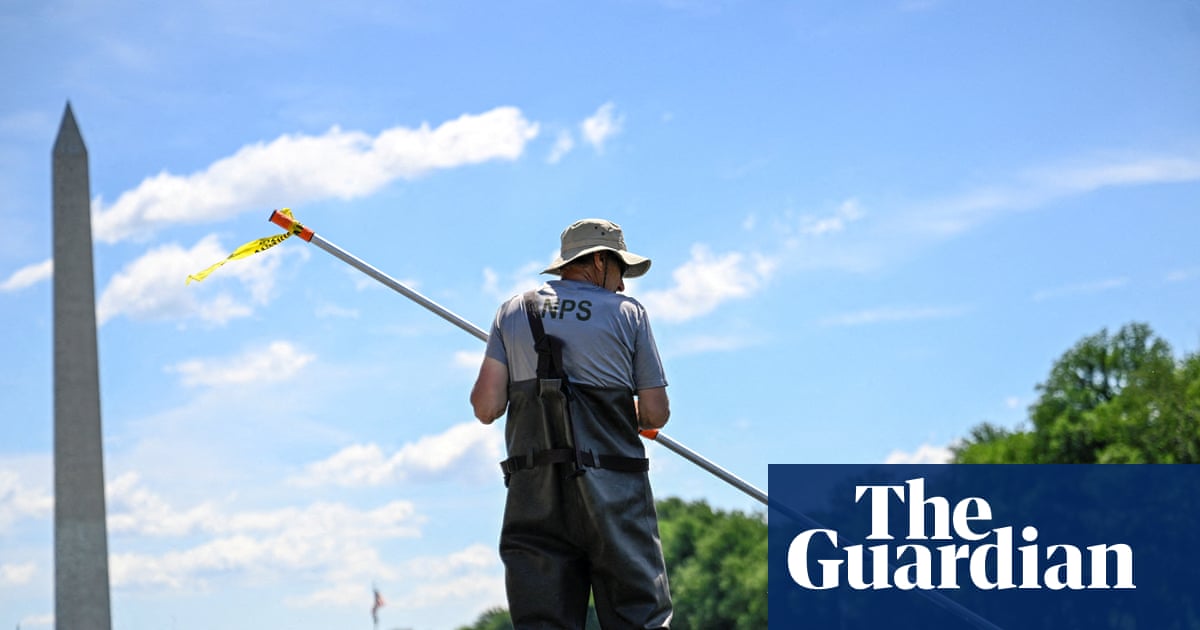
Further to our earlier post about the reported arrests made and federal citations issued after the Lincoln Memorial reflecting pool was allegedly “vandalized”, Donald Trump has claimed that the pool “has been given a 300 foot long gash, chemicals have been illegally placed in the water, and the beautiful new grass field has been destroyed with a gigantic 86 47 chemically carved into it.”
It’s worth noting that on Saturday, Trump alleged a “250 foot gash” and has still not provided evidence of that, and now appears to be claiming it was actually 300 ft.
Also, authorities have been investigating the 86 47 that was recently etched onto a vast patch of grass on the National Mall. It’s unclear if Trump is referring to that as one of the subjects of the aforementioned arrests or federal citations, or if he’s just running through some of the “real problems” the pool has faced in general.
The Trump administration spent over $16m to renovate the reflecting pool , only for it to be swiftly plagued by algae blooms and peeling paint .
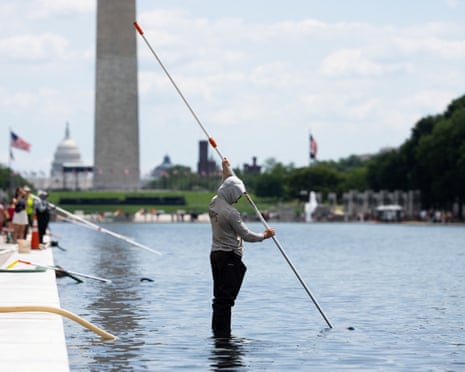
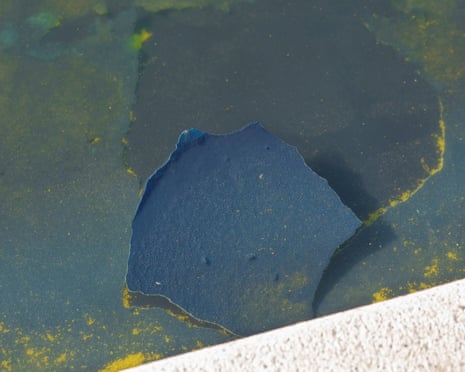
Here’s what the president posted on Truth Social:
Of the MANY Statues and Fountains that we rebuilt, renovated, cleaned, and fixed, the only one that was Vandalized was the Reflecting Pool, which is being taken care of, ASAP! It has been given a 300 foot long gash, chemicals have been illegally placed in the water, and the beautiful new grass field has been destroyed with a gigantic 86 47 chemically carved into it (Probably inspired by Dirty Cop, James Comey!). Please remember that there is a 10 year prison sentence for the destruction, or even the attempted destruction, of such things – Which will be fully enforced!
A reminder that “86” is frequently used across the restaurant industry to mean “stop” or to get rid of something, while Trump is the 47th president of the US. Former FBI director James Comey was indicted by a federal grand jury earlier this year over an Instagram photo he posted of seashells arranged to spell out “8647”.
The artificial intelligence industry is spending heavily in the 2026 midterms , hoping to secure influence over the technology’s first generation of legislation – and New York City’s primary has emerged as the key battleground.
AI-focused Super Pacs have raised roughly $100m this cycle, of which $44m has been spent so far, in dozens of congressional races across the country. Nearly half of all spending has converged on a single Manhattan race: tomorrow’s Democratic primary in the district of NY-12.
And much of that spending has targeted a single candidate: Democratic assemblymember Alex Bores , who is running to represent New York’s 12th House district. Bores, who worked in tech before his pivot to politics, has found himself at the unlikely center of a proxy battle for the industry’s tussle for regulatory influence.
Here’s Niamh’s report:
Vance says US-Iran talks have laid ‘very good foundation for a successful final deal’
Earlier, JD Vance said the US and Iranian teams made “great progress” in talks yesterday, with the help of mediation from Qatar and Pakistan, and had created a “good foundation for a successful final deal” to end the war.
“ The final deal is the house ,” the US vice president told reporters in Bürgenstock. “ We set the foundation. We haven’t built the house, but we’ve laid a successful foundation to get to a good place for the American people .”
He said Iran has agreed to invite International Atomic Energy Agency (IAEA) inspectors back into their country.
“ This is probably what we are most excited about as Americans ,” Vance told reporters, as he confirmed that he will head back to the US as technical negotiations in Switzerland continue.
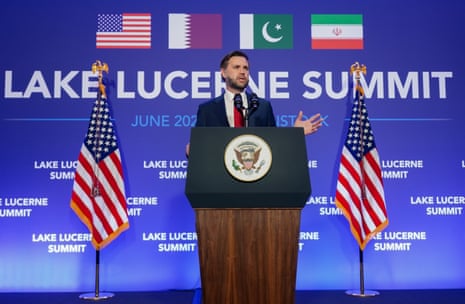
Talking about the return of IAEA inspectors, Vance added that it represented “ a major milestone for the American people and the first step in permanently ending a nuclear weapons programme in Iran ”.
When asked how soon IAEA inspectors could come to Iran , Vance said: “I expect that will happen at the minimum this week, but we think even some of those conversations with the inspectors and with the IAEA could happen as soon as today.”
Vance also suggested that the US could agree to unfreeze Iranian assets for purchases of American soy, corn and wheat .
A progressive Democrat challenging a veteran congressman to represent the party in a closely watched New York race for US Congress has claimed the city has deteriorated on his watch.
Darializa Avila Chevalier, one of three allies that New York City’s mayor, Zohran Mamdani , has endorsed in competitive congressional Democratic primaries in the city on Tuesday, is seeking to unseat incumbent Adriano Espaillat in the state’s 13th congressional district.
During a recent candidate forum held by WNYC, Espaillat – the five-term Democrat who chairs the influential Congressional Hispanic caucus – claimed Avila Chevalier was not experienced enough. “Getting results in Congress is not a PhD program,” he declared, referencing her studies at the City University of New York.
But in an interview with the Guardian, Avila Chevalier argued Espaillat had failed to produce such results since taking office.
“You just have to look around our district and ask: have things gotten any better in the nine years that he’s been in office?” she said. “I would argue the answer is no, because we’ve seen an exodus of over 200,000 Black New Yorkers leave the city in the last two decades.”
Trump-appointed official threatens prosecution after five arrested in relation to reflection pool problems
Hello and welcome to the US politics live blog.
Five people have reportedly been arrested for vandalizing Lincoln Memorial reflecting pool in Washington DC , with Donald Trump insisting repair work will begin “immediately”.
CBS News reporter Emma Nicholson tweeted on Sunday that an administration official told her five people had been arrested for vandalizing the pool and another five issued federal citations, bring the total number of police reports filed to 14, including one related to an alleged 250ft gash in the pool.
It has been plagued by algae blooms and peeling paint following the controversial recent renovation efforts for America’s 250th anniversary celebrations next month.
On Sunday, Trump said he had personally surveyed the damage. “Work will begin immediately on fixing the seriously vandalized Reflecting Pool,” Trump said in a Truth Social post on Sunday evening.
“I just inspected it, and could only say to myself, and those gathered around me, WOW, who would do such a thing?” the president added, without offering further details. He said the pool would “probably” be drained as part of the repair works.
Three-time Olympian David Hearn, who was apprehended, told the Washington Post that he had merely stopped by the pool to touch one of the peeling pieces of paint liner to see how it felt, when he was arrested by US park police on a misdemeanor charge.
Trump gave no details on any other apparent arrests and exact details of such apprehensions remained scant on Sunday afternoon.
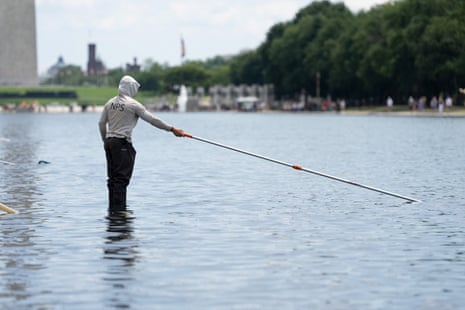
Meanwhile, the US attorney for the District of Columbia, Jeanine Pirro, said on Sunday afternoon that citations for vandalism had been issued and people caught vandalizing the 2,000-ft-long reflecting pool will be fully prosecuted.
“Anyone who is in a position of vandalizing or attempting to vandalize will face the criminal justice system in DC,” Pirro told Fox News’s Sunday Briefing. Anyone adding products to the pool that can generate algae could face more severe charges, Pirro added, but did not offer statistics or specific details of arrests.
Read the full story here:
In other developments:
Donald Trump threatened to resume war with Iran even as his vice-president JD Vance met Iranian officials to begin peace talks in Switzerland. Also overshadowing negotiations in Bürgenstock was Tehran’s announcement it had again closed the strait of Hormuz, a threat made because of ongoing Israeli strikes on southern Lebanon.
US political figures from left and right have voiced fresh objections to Trump’s provisional deal with Iran. Outgoing Republican senator John Cornyn posted a line on X from a Wall Street Journal article on how rogue regimes evade US economic warfare. Senior Democratic figure Susan Rice added to her recent description of the US-Iran deal as a “horrific surrender” by Trump, calling it “egregious” because “so many concessions were granted up front”.
At least seven people have been killed and dozens injured in several shootings in Chicago since Friday, police said, with Trump again calling for military intervention in the midwestern city. In a post on Truth Social, the president questioned why Illinois’s governor, JB Pritzker, had not welcomed military deployment.
Nine months after Trump ordered an anti-crime taskforce on to the streets of Memphis, a small band of dedicated observers is attempting to monitor its actions. They have alleged widespread intimidation by agents, who stand accused in a lawsuit filed by the American Civil Liberties Union of Tennessee of having tailed cars, surveilled homes and even “falsely arrested” one community observer.
Public health resources across the US are failing to keep pace with the rapid growth of online gambling , problem health advocates warned, after Trump endorsed the controversial nationwide surge of prediction markets.