What am I bid for a blown-up van? The bizarre art auction aiming to build an eco power station in Reform-held Clacton

Art and design
What am I bid for a blown-up van? The bizarre art auction aiming to build an eco power station in Reform-held Clacton
Stuart Jeffries
Fri 22 May 2026 16.14 CESTLast modified on Fri 22 May 2026 16.15 CEST
News
https://www.theguardian.com/artanddesign/2026/may/22/hilary-powell-dan-edelstyn-reform-power-station-clacton
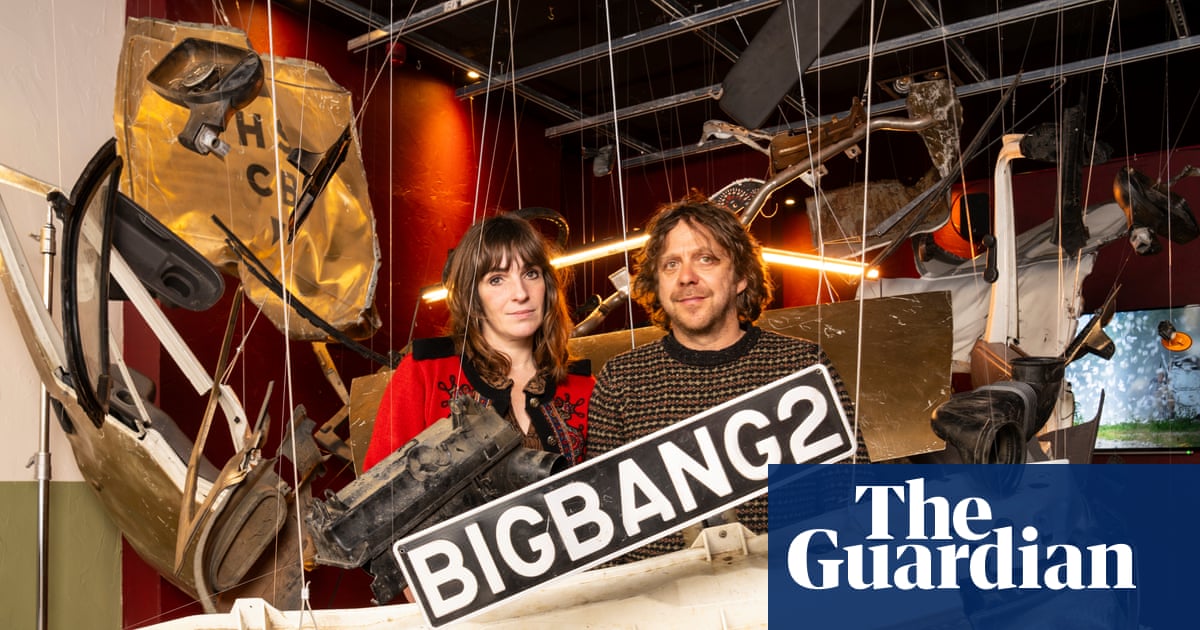
T his Saturday, artists Hilary Powell and Dan Edelstyn are auctioning off their work from the past decade and a half. The reason? To help fund a community-led renewable power station in Nigel Farage’s Clacton constituency. Former YBA Gavin Turk will be wielding the gavel and the couple hope to raise at least £250,000 for the project.

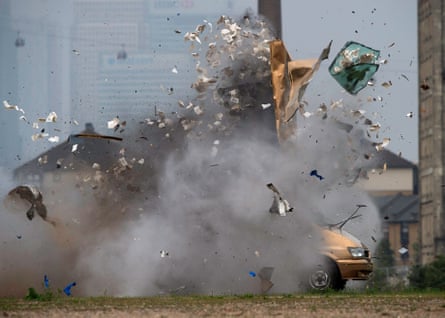
The big-ticket item going under the hammer will be the remnants of a gold Ford Transit van containing £1.2m in fake banknotes that the pair blew up in London’s Docklands in 2019 as the climax – or money shot, if you will – of Bank Job , a film about their attempts to fight toxic debt culture with art, a battle that involved printing cash to wipe out more than £1m debt .

Van wreckage and charred banknotes were gathered up and reconstituted as an Alexander Calder-like mobile that, for a while, hung in Cambridge’s Fitzwilliam Museum. Now, for perhaps £100,000, this sculpture could be the centrepiece of your living room. (You’d need a pretty big living room.)

Powell hopes that the exploded van will be bought by a public institution, and has been contacting the likes of the V&A and the Arts Council to see if they are interested in buying it for their collections. “I’ve spent a week sending off many, many emails and then getting quite patronising replies,” she says.
Also up for grabs will be bottles of vodka from a 2009 project for which Edelstyn traced his family’s Jewish ancestry back to a Ukrainian village. Once there, he attempted to revive his ancestors’ distillery – and ended up selling high-end Zorokovich 1917 vodka to Selfridges.

Alongside the in-person auction, the pair are hosting an online iteration that will run until 31 May. “We have £750 at the moment,” says Edelstyn. “We need about 250 times that to fund the project.”

But what exactly is the point of building a power station in Clacton? Edelstyn refers to a report by climate campaigners DeSmog claiming that Reform UK has received more than £2.3m from oil and gas interests, highly polluting industries, and climate science deniers since December 2019, amounting to 92% of the party’s donations. “Building a community-owned renewable power station in Reform’s first seat,” he says, “is the most direct response we can think of.”

The pair call what they do Method Art. Which is? “Living ideas into existence rather than representing them. The work is the action: abolishing real debt, building a real power station, planning a real community-owned renewable in Clacton. Artists not as commentators but as people who get the thing built.”
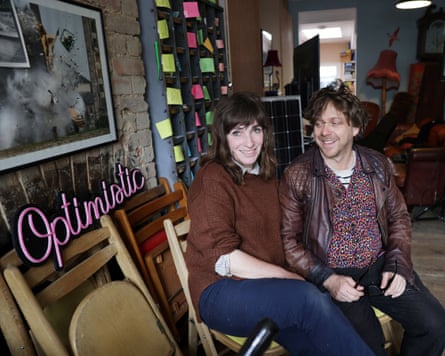
The pair’s conviction that art should change the world came after Edelystn made a film about his Ukrainian vodka enterprise , and had an existential crisis. It was brought about, he says, by a Guardian review (it happens) that called him a businessman rather than an artist. “Just calling me that made me wonder what I was doing.”

Two writers, George Orwell and Viktor Frankl, helped him to come up with answers. “In [the 1946 essay] Why I Write, Orwell laid out all the different reasons people do so: to participate in the crazy world around us; to look clever; to take revenge on people who told you you’d never amount to anything. And then there was the pure joy of aesthetic expression. Orwell suggested that there can be all these desires in varying degrees in one person as they create, and that thought inspired me.”

Holocaust survivor, psychiatrist and neurologist Frankl inspired Edelstyn in a different way. “In his book Man’s Search for Meaning, Frankl disagreed with Freud and Adler and said the desire to lead a meaningful life was the primary driver for human lives. I thought that was beautiful and it helped me want to participate and live meaningfully, usefully.”

In the middle of his crisis, he and Powell learned about an American group that was buying and abolishing debts. “That was the inspiration for Bank Job,” says Powell. “We were going to really participate and consciously shape the world we live in, engage with political and economic arguments. And it was from there that Power Station came about.”

He is referring to how, on the street where they live in London’s Waltham Forest, the couple helped fund, build and operate a community-owned solar power station. How was this possible? “There are about 20,000 high net worth people across Britain who buy shares in community benefit societies that fund these sort of things,” says Powell. “Shareholders put in the capital that buys the solar panels, then the host building gets solar panels for no upfront cost, but buys the energy from the community benefit society at a cheaper rate than it would cost from the grid.”

Edelystn says more than 130 streets in Waltham Forest have signed up to follow suit, with another 50 across the UK.

The proceeds from Saturday’s auction won’t directly fund the mooted power station’s solar installations. Rather, they will bankroll the work the pair are doing to set up in Clacton and to make a film about the project. If they sell the blown-up van, the proceeds will be core funding for their not-for-profit production company. The funding for the power station will come from issuing shares and other fund-raising to create a community benefit society.

The idea of going off-grid may seem appealing to those of us struggling with rising fuel bills, but there is a problem with this model. “Most solar co-ops prefer to work with councils or long-term businesses that have security and stability,” says Edelstyn. “Domestic is really complicated because you get mixed tenureships in one street. Some people are renting, some people are in council houses, and some people have got mortgages. That’s hard to organise.”

Yet, inspired by Frankl, the pair are determined to make the seemingly impossible exist. “That utopian sensibility, against all the odds, is definitely why we are the kind of artists we are.”

Their Power Station film has already influenced UK community energy policy: apparently, Ed Miliband came to visit the pair two weeks ago. Now they are taking their model to the stronghold of Reform UK and hoping that there will be enough local enthusiasm to make it work there, ideally on Clacton’s Electric Avenue, which runs from the pier and includes Reform UK’s local office. Winning over locals is key to the project’s success. To that end they’ve arranged a screening of the film at Walthamstow’s Forest Cinema and invited councillors and other bigwigs from the Essex seaside resort to attend. But aren’t the couple missing a trick? Surely their first port of call should be to approach Clacton’s MP for some funding. After all, the £5m Farage received from a Thai-based crypto billionaire suggests he isn’t short of a bob or two. “I mean, he would presumably want to get the bills down of everyone on the street where the power station would be,” muses Edelstyn. “So why wouldn’t he put some of his money behind what we’re doing?”

Quite. Mr Farage, if you’re reading this, do consider getting in touch with the artists to support what, I’m sure you’ll agree, is just what your constituency needs at this difficult time.

The Everything Must Go auction takes place 23 May 2026 . Visit the online auction here

Fraudster trying to sell fake ancient statues to Sotheby’s foiled over bogus invoices

Crime
Fraudster trying to sell fake ancient statues to Sotheby’s foiled over bogus invoices
Nadeem Badshah
Sat 23 May 2026 09.00 CESTLast modified on Sat 23 May 2026 09.02 CEST
News
https://www.theguardian.com/uk-news/2026/may/23/fraudster-trying-to-sell-fake-ancient-statues-to-sothebys-foiled-over-bogus-invoices

A fraudster who tried to sell fake ancient statues to Sotheby’s was foiled when his bogus accompanying paperwork was found to be written with printing methods that were 25 years too modern, a court has heard.

Andrew Crowley, 46, asked the auctioneers to value three Cycladic figures and one Anatolian stargazer statuette that he had inherited from his grandfather, Southwark crown court in London was told on Friday.

Prosecutors alleged that, if real, the items collectively would have been worth about £680,000 based on previous sales.

However, Judge Rimmer said that estimate hinged on multiple hypotheticals and therefore reduced the value to £340,000.

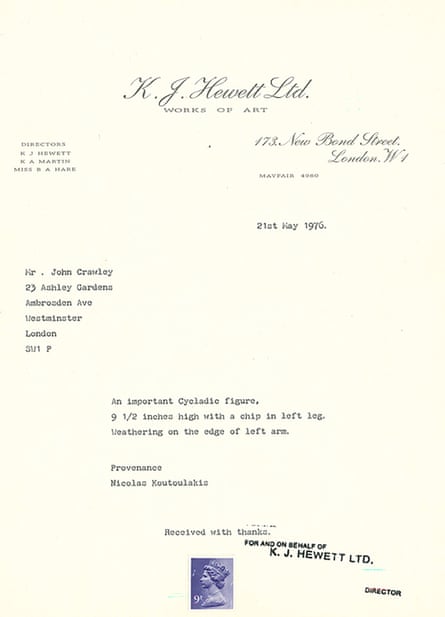
Crowley, of Longwell Green, Gloucestershire, had presented spurious invoices for the statues that purported to be written in 1976, using a typewriter on paper embossed with an antique’s dealers logo and a nine-pence stamp.

However, his forgery was discovered after forensic scientists found they were made using printing methods invented in 2001. Sotheby’s experts also spotted spelling mistakes, including in the supplier’s title.

Handing Crowley a two-year suspended sentence, the judge said: “It was a crude attempt because Sotheby’s rumbled, to use the vernacular, or spotted, these documents as bogus fairly early on.”

The judge accepted that Crowley inherited the statues from his grandfather and did not at any point believe they were counterfeits. The Cycladic statues were each about 30cm (12in) tall weighing about 1kg, police said.

Legitimate Cycladics were made in the Cyclades islands in Greece during the bronze age, about 3,000 years ago. Therefore, “the offending and dishonesty in this case must turn around the paperwork”, the judge said.

Crowley previously admitted dishonestly making a false representation to Sotheby’s auction house intending to make gain between 4 November 2022 and 27 July 2023.

He was also ordered to complete 200 hours of unpaid work and pay £1,630 in costs over three months.

DC Ray Swan, who led the Metropolitan police’s investigation, said in a statement: “This case also highlights the crucial role played by industry experts in helping to protect the integrity of the London art market.

“Sotheby’s staff acted responsibly and swiftly in raising their concerns, and their cooperation was instrumental in preventing a significant fraud.”

A spokesperson for the auctioneers praised the force’s “meticulous and superbly executed investigation that has helped prevent fraudulent material entering the market”.

‘They tell me I am being sectioned. I am not concerned’: Game of Thrones’ Hannah Murray on being sent to a psychiatric hospital

Game of Thrones
‘They tell me I am being sectioned. I am not concerned’: Game of Thrones’ Hannah Murray on being sent to a psychiatric hospital

Sat 23 May 2026 07.00 CEST
News
https://www.theguardian.com/tv-and-radio/2026/may/23/hannah-murray-game-of-thrones-the-make-believe-book-extract-sectioned-cult

T he door to the room opens. A man enters the room. He is a Black man, bald and overweight. He is dressed in uniform. Blue uniform, a blue lanyard that reads “NHS”. But I know Steve, the leader of the organisation that introduced me to magic, is a magician. I know he can appear in disguise.

I approach the man and try to kiss him.

He does not let me kiss him. Then no. It is not Steve.

The man has brought me a plate of toast. He has brought me a cup of tea. I add sugar to the tea, which I would never have done in my former life, but a spoonful of sugar helps the medicine go down !

I do not eat the toast. I drink the tea. I am alone in the room again and I urinate into the cup and drink that too.

I am a Ritual Master. And this, drinking my own urine, is a powerful ritual. This is all I need now to survive. It is the most potent of potions I can drink. I am a self-contained, utterly self-sufficient being. I will never need to eat again. I survive on liquids and air and light.

I decide to explore outside the room. Outside my sanctuary. He has not come. So maybe I need to go searching for him …

T ime jumps. I am in a corridor lit by overhead strip lights. The electric light is pale yellow in tone. I am sat on one of three chairs in a row against the wall. The chairs are purple, curved plastic. I am still waiting for him to appear.

There are two doors in front of me. One is the door to the blue room with the blue sofa and chair. Behind the other door is an office of some kind, and there is a woman in there, shuffling papers and talking on the phone.

The woman comes out of the office. She is holding out my phone. My only possession ​now – the one artefact from my previous life. There is someone she wants me to speak to.

Him .

When I hold the phone to my ear, I hear a voice I recognise.

But the voice belongs to my mother.

“Hannah?” she says. “Where are you? What’s going on?”

There is distress in her voice. Her voice is trembling with pain and anxiety.

I do not want to hear it.

This is a test. A horrible test, certainly, but one that I can pass. They are trying to tempt me back into the human. They are trying to lure me back into the past.

I hang up the phone.

But, after a moment, it starts to ring. The word Mum lights up the screen.

“Talk to her,” says the woman.

I answer the call.

My mother sounds different now. Calmer. She asks again what’s going on but gently, even cheerfully. I tell her everything’s OK. That I’m fine. I tell her not to worry. I’m in a good place.

This is the last time I will ever hear her voice, I think. This is the way I say goodbye.

They tell me I am being sectioned.

The words jar with my beliefs.

“Section 2 … the Mental Health Act … 28 days … right to appeal … ”

I cock my head.

This does not fit at all. It does not fit in the world of Steve, of Ritual Master, of Shambhala and the invention of magic.

I am not concerned. I am concerned only with the energy I can feel spiralling up through my body and the voices I can hear in my head.

I pace the hospital corridors, delivering a tearful monologue, delivering the greatest performance of my life. A phrase comes to me. The Girl With All the Gifts . The title of a post-apocalyptic horror film released in 2016, starring Gemma Arterton.

I am a magician. I am an actress. I am a writer. I have superhuman strength. I can fly. Anything that can be imagined, I can perform it. Every skill and every ability is mine.

The film came out as a warning, and a prophecy.

And because of me, the apocalypse has been averted.

I am the saviour of the planet. I am the girl with all the gifts.

I t was very hard, the journey to get here. It took 27 years. The path was twisting and full of setbacks, there were challenges and so much pain. There were  times I wanted to give up. It was very hard. Everyone will have to make their own journey, and their journeys will be their own, unique as snowflakes or fingerprints. That is the beauty of it, the joy of it. Everyone has to figure it out for themselves.

But I have laid the groundwork. I have walked the path. It starts with the energy healing, and it goes on and on through the seven dimensions, through increasingly magical planes. It goes on and on until you meet your soulmate, like I met mine.

I was in a TV show called Game of Thrones , hidden in plain sight in the midst of a cultural phenomenon. I, the key to the world’s salvation, wore the face of a character called Gilly, but really I played every role. Then I worked on a film called Detroit in Boston. David Benioff and Dan Weiss and Kathryn Bigelow were the four horsemen of the apocalypse. Numbers are irrelevant. Three counts as four. David and Dan and Kathryn cast me in the roles that brought about my destiny. The end and beginning of the world.

I am the Ur-actress. I am every actress. Every performance ever given has been animated by my energy, my talent, by the gestures and facial expressions I am performing here and now.

This is an edited extract from The Make-Believe: A Memoir of Magic and Madness by Hannah Murray, published by Cornerstone (£18.99). To support the Guardian, order your copy at guardianbookshop.com. Delivery charges may apply.

Hannah Murray will be in conversation with Jessie Cave at Kings Place in London on 5 June.

Top image: Murray wears blazer, by Marina Rinaldi; trousers, by River Island; top, by Phase Eight

Final frontier for meds? UK startup sends drug-making into space

Pharmaceuticals industry
Final frontier for meds? UK startup sends drug-making into space
Julia Kollewe
Sat 23 May 2026 11.00 CEST
News
https://www.theguardian.com/business/2026/may/23/meds-uk-startup-drug-making-space-bioorbit-cancer

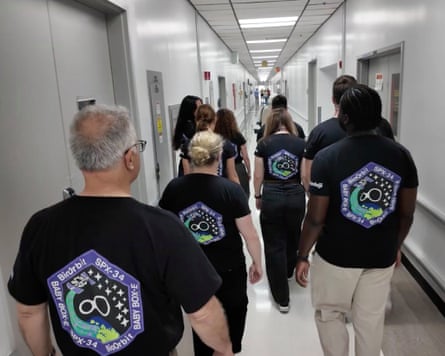
O nboard a SpaceX flight last week was a remarkable piece of cargo – a hi-tech box destined for the International Space Station to grow ultra-pure protein crystals, with the aim of producing self-injected cancer drugs.

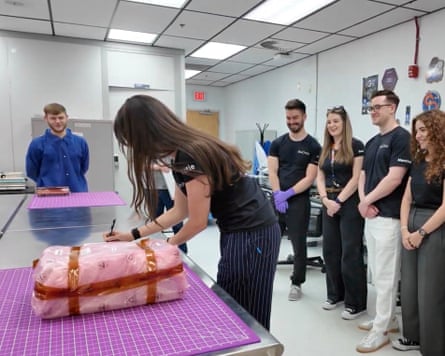
A British startup, BioOrbit, has developed the drug-crystallisation technology at its labs in London and launched Box-E, a compact unit the size of a microwave, on the 15 May rocket from Kennedy Space Center in Florida.

The unit will stay in orbit for about six weeks where the effective weightlessness, or microgravity, enables pharmaceutical compounds to crystallise into pure, highly stable structures that enable drug formulations not achievable on Earth.

Once back on terra firma, these crystals can be turned into cancer medications that patients can keep in a fridge and inject themselves at home or at work, instead of having to go to hospital to have immunotherapies infused intravenously over several hours. The drugs also have a longer shelf life.

Dr Katie King, co-founder and chief executive of BioOrbit, who completed her PhD in nanomedicine at Cambridge University and did an internship at Nasa, describes the orbital tests as a “big step change towards large-scale production of protein crystals in space”. Gravity negatively impacts crystallisation, she says.

“That becomes really critical for protein drugs, antibody drugs because they are very large and very flexible molecules. So through going to space you see a much better, more superior crystallisation process than what you can achieve here on Earth.”

For cancer treatments, a big dose is needed and the liquid can become too thick to use in an injection pen, King says. “Which is why we don’t have these treatments at home already. Through using crystals, you can get these really concentrated formulations that will have a low enough viscosity that they can still flow through the needle.”

Hundreds of experiments onboard the space station have already shown that the process works. Scientists from the US pharma company Merck produced protein crystals for its bestselling cancer medicine Keytruda to turn it into a quick injection instead of a lengthy IV infusion. This new route of delivery was approved by the US health regulator in September.

“Box-E is the first step moving towards mass manufacture in a way that will transform cancer treatment, reduce hospital visits and support patients in receiving therapies at home,” says King, who is the daughter of the TV presenter and maths whiz Carol Vorderman.

Despite the huge expense of sending the drugs into space, King argues the switch to self-injection at home could end up saving the NHS and other health systems “millions, potentially billions” of pounds.

Assuming the orbital tests are successful, multiple Box-E units could be stacked together to ramp up the pace of pharmaceutical manufacturing in space. BioOrbit is aiming to process thousands of litres of fluid per box every year, and is confident it could produce enough for a blockbuster drug with a handful of boxes in constant use.

Last month BioOrbit, founded in 2023 by King and the medical doctor and cancer researcher Leonor Teles, raised £9.8m from investors, led by the UK venture capital group LocalGlobe and Paris-based VC firm Breega, to take its technology into orbit and build the hardware to mass produce crystals.

BioOrbit won a £250,000 contract from the UK’s Space Agency in March to manufacture drugs in microgravity.

This week Elon Musk’s SpaceX set out its stock market flotation prospectus, which mentions in-space manufacturing of pharmaceuticals and other materials as a key revenue stream, and estimates a $22.7tn market in enterprise applications. BioOrbit wants to be part of that.

However, King says it will take at least five years until the new cancer drug formulations hit the market, as they need to be tested in clinical trials and get approved by health regulators.

She adds that the crystallisation technology can also be used for other treatments. About 70% of the world’s biggest-selling drugs are administered intravenously at hospitals or doctor’s offices.

To make its cancer drugs, BioOrbit will partner up with pharmaceutical companies, and has already had interest from several multinational groups, including in the UK and the US.

The Californian startup Varda Space Industries has also flown small capsules into space to process pharmaceuticals, and is working with the US biotech United Therapeutics Corporation to develop improved treatments for rare lung disease.

The show might go on: what happens to late-night TV without Stephen Colbert?

Stephen Colbert
The show might go on: what happens to late-night TV without Stephen Colbert?
Jesse Hassenger
Sat 23 May 2026 11.00 CESTLast modified on Sat 23 May 2026 11.01 CEST
News
https://www.theguardian.com/tv-and-radio/2026/may/23/stephen-colbert-late-night

I n a way, it’s a shock every time the biggest talkshow hosts assemble into their “ Strike Force Five ”, the podcast-born group consisting of Stephen Colbert , Jimmy Fallon, Jimmy Kimmel, Seth Meyers and John Oliver. No, the shock isn’t the lack of Greg Gutfeld, the highly viewed Fox News talkshow host who has nonetheless only ever been funny as a punchline unto himself, and was playfully name-checked on the final episode of Colbert’s The Late Show, after the deposed king of late-night was informed the highest-rated host was getting the boot. (“They’re canceling Gutfeld?!” he cried in fake panic.) The real repeated surprise is the realization that there are (or were) five major late-night hosts still standing.

OK, even before Colbert got the axe , it was actually four: Oliver hails from a weekly perch on HBO, which, given similar jobs held by Dennis Miller for nine years and Bill Maher for 24, seems likely to last for at least 200 seasons. But still: four big-name network talkshows? In this economy?! Strike that down to three, now that Colbert’s tenure is officially over , and his David Letterman -founded late-night franchise with it. Though Colbert is the exact wrong one to cull – the group’s best interviewer, strongest comedy bona fides, and highest-rated show to boot! – it’s hard to argue that network TV is in need of the late-night chatshows that used to be such a major status symbol and, presumably, cash cow. Though the shows are notoriously expensive (such that CBS was able to claim that their king of late-night also lost money), they must have once generated substantial revenue, given the amount of jockeying the 11pm-and-beyond slot inspired throughout the 1980s and especially 90s.

Today the landscape is becoming both more and less competitive; fewer actual late-night shows, their numbers decreasing because a lot of people can watch any number of things at whatever time works best for them. (Basically, everything is now a late-night show if you want to stay up.) NBC’s Saturday Night Live has managed to remain relevant, much to the consternation of its most virulent anti-fans , by providing stuff that other late-night shows, or TV shows in general, do not. It offers a comedy focus that, mainstream and toothless as it can appear, doesn’t pull punches in quite the same way as a talkshow forced to rely so heavily on current events; a sketch-variety format and expanded running time, allowing it to hit all of the late-night hallmarks (monologue, topical jokes, sketches, musical performances) without (always) feeling rushed; and the event status of actually broadcasting live, rather than taping the same day (even if much of the audience catches up with it via YouTube – a format even friendlier to sketches than it is to interview segments).

But it’s sort of the exception that proves the rule: every time there’s talk of SNL head honcho Lorne Michaels retiring (or dying at his desk), someone at the network will salivate via the press about how much more profitable the notoriously expensive show could be with just about anyone else producing it and some major budget tweaks. As untouchable as it seems as one of the highest-rated entertainment shows on network TV – including primetime stuff – it can’t be considered fully exempt from the overall warning issued on Colbert’s finale: “At some point, this may come for all our shows,” the Strike Force Five mused about the sucking CG void symbolizing his cancellation.

Are we, as the former kids might say, losing the recipes by letting these network standbys drop out of sight? On one hand, there have been plenty of stretches of TV history where not every major network carried a talkshow with the fairly rigid format, followed by the last three standing. As such, some retreat may only be a natural after-effect, perhaps overdue, of the decades-ago late-night boom. On the other, it’s been the shows and hosts more prone to format-breaking that have been earlier to go, such as Craig Ferguson ’s more freewheeling version of the Late Late Show (the former companion piece to the Late Show, later hosted by James Corden) or Conan O’Brien ’s quirkier, funnier iteration of The Tonight Show. The sorta-gameshow After Midnight (which replaced Corden’s Late Late Show) died as soon as host Taylor Tomlinson wanted to move on. With so few options, traditionalism reigns – or worse, those Fallon mini-gameshows will count as innovation!

The real shame is that the CBS slot isn’t up for grabs: not for a new Late Show host, which Colbert has publicly wished for, and not even for a new CBS show trying out something else in late night. Byron Allen has made a “time buy” for the Late Show time slot (and the one after it), meaning he’ll pay CBS for the airtime, into which he will plug his longtime, low-budget hackfest Comics Unleashed, a formerly syndicated showcase for low-wattage comedians to do their bits while sitting down. (Think something like Politically Incorrect or Tough Crowd from the 90s or 00s, only with fewer celebrities and far less chance that anyone will care about anything anyone says.)

Maybe you have to hand it to CBS and Allen for engineering something genuinely retro: this is the kind of show you used to be able to catch at 1am during a bout of insomnia, just before a time when you could stream 30 Rock episodes instead. By letting that kind of low-rent, after-hours programming creep on the air before midnight, it feels like CBS is abandoning exactly the totems that should make them an obvious national network. Sure, buzzy prestige shows and laugh-out-loud comedies might migrate to streaming services with fewer content restrictions, but now-imperiled institutions such as a nightly news broadcast or a late-night talkshow serve as flags planted on the airwaves in ways that streamers have approached, but can’t quite replace. John Mulaney had a beloved and inventive talkshow on Netflix – airing weekly, to the tune of just 12 episodes a year (like one of the aforementioned HBO talkshows, but way less of it).

If there’s an upside to this inevitable loss of the actual airwaves, maybe it’s that people as brilliant as Colbert, O’Brien and future talent like them will be freed of the compulsion to become part of that TV-history firmament. As great as O’Brien has been as a talkshow host, awards show host and traveling improviser, the man wrote for some of the best eras of SNL and The Simpsons – he penned Marge vs the Monorail , for God’s sake! Shouldn’t he be creating stuff outside the jolly-emcee grind? Colbert, too, has a rich history of satire as a co-creator of Strangers With Candy and the face of the overtly satirical Colbert Report. He’s apparently going to be involved with a Lord of the Rings project in some capacity, which won’t necessarily play to his comedy roots but at least will be a change of pace from monologue jokes about Donald Trump’s shenanigans. Look at all of the shows Tina Fey has been able to work on, apparently unburdened with the desire to host a talkshow. Colbert or Conan or whoever else could make their own Unbreakable Kimmy Schmidt, The Four Seasons, Girls5Eva, or The Fall and Rise of Reggie Dinkins. Or they could, you know, write a novel or make a movie. O’Brien was great in If I Had Legs I’d Kick You .

Really, network TV should count itself lucky that guys including Colbert or O’Brien were such enthusiastic employees for so long. If they’re now looking at hawking their airtime like a tinpot real estate mogul instead of programming it like a network, maybe someone who cares about comedy, or variety, or television in general, will buy it up. Or maybe the networks will start to look like vacant lots, in a neighborhood where no one wants to live any more.

‘You can’t control everything’: the rise in plastic surgeons asked to create ‘AI face’

AI (artificial intelligence)
‘You can’t control everything’: the rise in plastic surgeons asked to create ‘AI face’
Isaaq Tomkins
Sat 23 May 2026 13.00 CEST
News
https://www.theguardian.com/technology/2026/may/23/rise-in-plastic-surgeons-asked-to-create-ai-face-cosmetic-surgery

Plastic surgeons are increasingly concerned about the rise of “AI face”, as more and more clients arrive in their offices with unrealistic AI-generated visions of what they want to look like.

Dr Nora Nugent, a cosmetic surgeon from Tunbridge Wells, has seen this first hand. Clients have started coming to her office with photos of themselves beautified by AI and a false expectation that those results are achievable with surgery. She is also the president of the British Association of Aesthetic Plastic Surgeons, and says many colleagues are having similar experiences.

“I can only predict an increase, given the rate AI has been incorporated into every aspect of life,” she said.

People using AI chatbots to generate their ideal faces are increasingly arriving at surgeons’ offices with briefs demanding flawless skin, sharply sculpted cheekbones, refined noses and near-perfect symmetry – standards that are too time consuming, prohibitively expensive and, in many cases, physically unattainable.

While AI can control every single pixel, “surgery certainly doesn’t work on that microscopic detailed level”, according Dr Alex Karidis, a surgeon based in west London.

For many clients, however, those expectations are shaped long before they ever meet a surgeon. Karidis and Nugent describe how psychologically effective AI-generated images can be in defining – and reinforcing – clients’ aesthetic ideals.

Nugent said: “Once you see an image, it’s wired into you.”Karidis agreed, describing AI images as being “seared” into patients’ minds, and said colleagues had recently been inundated with them.

Surgeons are also keen to emphasise that cosmetic surgery outcomes are far from guaranteed.

“The patient has to understand that there is human variation in how they heal, how they age and what can be done” said Nugent. “I say to patients beforehand: it’s not limitless what I can do in surgery. Neither of us control everything.”

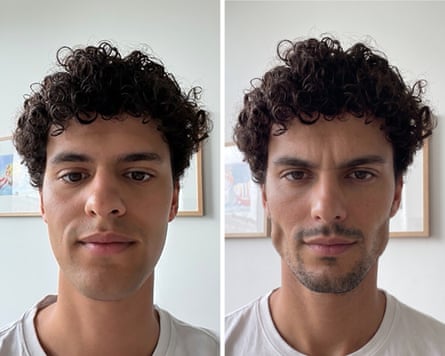
To better understand the phenomenon, I asked an AI agent to recommend cosmetic procedures and generate images for Karidis to review. As I requested increasingly dramatic alterations to my appearance, the agent eventually began warning me about the feasibility of the operations I was proposing.

But Karidis says that when clients do their deep-dive research into cosmetic procedures, they often fixate on the images and ignore “all the noise” around them.

“That’s the bottom line for everybody. The moment you show them something like that, that’s it,” he said.

Surgeons have also noticed consistencies in the aesthetics of “AI face”, particularly hyper-symmetry – something AI can generate effortlessly but which is often impossible to recreate in real life.

If one of your eyes is a few millimetres higher than the other, AI can alter that in seconds, according to Dr Julian de Silva, a Harley Street cosmetic surgeon. But rearranging pixels is not the same as rearranging anatomy.

“It’s impossible to change [eye level] because that’s actually set in bone, and your brain sits behind the orbits. You cannot safely change the position of the orbits,” he said.

De Silva added that when AI edits a client’s photo, it frequently defaults to widely accepted beauty ideals: for women, a V-shaped jawline, a sweeping “ogee curve” along the cheekbones and a heart-shaped face; for men, broader jawlines, lower eyebrows and fuller upper eyelids.

But De Silva is also concerned about another growing trend: clinicians sharing surgery results on social media that appear astonishingly effective, but which he suspects may themselves be AI-generated.

“I remember looking at one of these last week and I looked at it over and over,” he said, recalling a video in which a patient appeared to have been made to look 30 years younger. “And then the third time I watched it, I could see … the hands had six fingers.”

My trip to the surgeon

Having generated some beautified versions of myself, I asked Karidis to share his thoughts on AI’s recommendations.

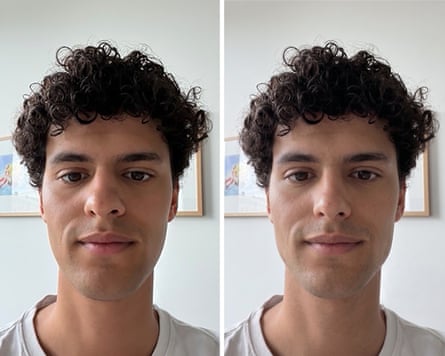
I told the chatbot I was considering cosmetic surgery and asked for “some enhancements” to my photo. I also asked it to explain the virtual surgeries it had performed. It gave me a rhinoplasty and septoplasty, “refining the nasal tip and straightening the bridge”. It also applied “a subtle blepharoplasty [eyelid lift] and brow refinement”.

Karidis said the rhinoplasty was relatively modest and the blepharoplasty barely noticeable, but estimated the work would still cost about £25,000.

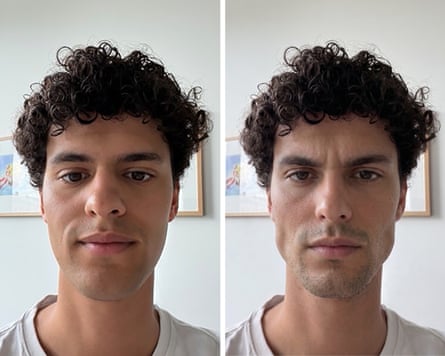
I then asked my virtual assistant to give me “hunter eyes and a more masculine face”. It recommended chin implants, buccal fat removal, infraorbital augmentation, another blepharoplasty, facial stubble grafts and a handful of other procedures.

“This is where things start to get a bit silly,” Karidis said. “It looks like its given you someone else’s eyes.” He says the chin implant is unnecessary, and that I would “pay the price” for the buccal fat removal later on in life as my face naturally became more gaunt with age.

“If one were to theoretically do everything it suggests, it would easily be £100,000-plus and still probably wouldn’t look anything like this, not to mention you’d be exposed to potential significant side-effects and recovery.”

“Make me look like more of a chad,” I then instructed the chatbot. It responded with further recommendations, including a neck lift, brow lift, two types of custom implant and full ablative laser resurfacing to create “perfectly even, fresh skin”.

“This is where things start to look scary,” Karidis said. “What’s with the whopping great big dents along your jawline angle? It looks like chunks of tissue have been removed.

“As to neck lift and brow lift, that’s frankly untrue. I don’t see any evidence of any lifting in these areas. Tissues like the eyebrows seem to have been lowered rather than lifted. Your original complexion looks much better than this.”

Trump’s justice department scrubs its website of news releases about January 6 defendants

US Capitol attack
Trump’s justice department scrubs its website of news releases about January 6 defendants

Sat 23 May 2026 16.23 CEST
News
https://www.theguardian.com/us-news/2026/may/23/trump-justice-department-scrubs-website-january-6-defendants

The Department of Justice is acknowledging it has removed from its website news releases about criminal cases related to the 6 January 2021 Capitol attack , calling the information about the prosecutions “partisan propaganda”.

The purge of news releases documenting criminal charges, convictions and sentencings is the latest step by the Trump administration to dramatically rewrite the history of the assault on the US Capitol, when hundreds of supporters of Donald Trump stormed the building in an effort to halt the congressional certification of his 2020 election loss to Democrat Joe Biden .

Trump, on his first day back in office in January 2025 , pardoned, commuted the prison sentences or vowed to dismiss the cases of all of the 1,500-plus people charged with crimes during the Capitol assault, including those convicted of attacking officers with makeshift weapons such as flagpoles, a hockey stick and a crutch.

On Monday, the justice department announced the creation of a $1.776bn fund meant to compensate Trump allies who feel they were unjustly investigated and prosecuted. The acting attorney general, Todd Blanche, has not ruled out that rioters convicted of violence will be eligible for payouts, prompting bipartisan anger in Congress.

After a journalist on Friday observed on the social media platform X that the justice department was “quietly” removing news releases on its website that were related to the January 6 attack, including about a Texas man who pleaded guilty to assault and also faced separate state charges of soliciting a minor, the department responded through its “rapid response” account that there was “nothing ‘quiet’ about it”.

“We are proud to reverse the [justice department’s] weaponization under the Biden administration. We will do everything in our power to make whole those who were persecuted for political purposes,” the post said. “This includes stripping [the justice department’s] website of partisan propaganda.”

Among the releases removed from the site were those concerning seditious conspiracy cases against members of the Proud Boys and the Oath Keepers, far-right extremist groups. The justice department, in an unopposed motion last month, asked a federal appeals court to vacate those seditious conspiracy convictions, a request that was granted on Thursday. The department on Friday moved to dismiss the cases against the group members.

UK’s ‘anxious generation’ of young people struggling to adapt to workplace

Young people
UK’s ‘anxious generation’ of young people struggling to adapt to workplace
Geraldine McKelvie
Sat 23 May 2026 12.55 CESTLast modified on Sat 23 May 2026 14.44 CEST
News
https://www.theguardian.com/society/2026/may/23/uk-young-people-workplace-anxiety-alan-milburn

An “anxious generation” of young people is struggling to adapt to the outdated world of work, according to the government’s jobs adviser.

Alan Milburn, a former Labour health secretary, will say this week in a report that businesses must adapt by offering more flexibility and mental health support for young people to stave off an “economic catastrophe.”

In November last year, Milburn, who served in various government roles under Tony Blair, was asked by prime minister Keir Starmer to examine why almost 1 million 16- to 24-year-olds – about one in eight – were not in education, employment or training.

His interim report on this cohort, known as Neets, will be published next week. According to the Times , it will say that “a rising tide of mental ill-health, anxiety, depression [and] neurodiversity” is a central driver of high economic inactivity among young people.

The review is also expected to address the rising influence of social media on the mental health of young adults, with Milburn asserting that their brains have been “rewired” by smartphones.

“The system is trapping people in worklessness rather than enabling them into work,” Milburn told the Times. “We’re at a risk of just writing a whole generation off.

“This is a bedroom generation. They are sort of living in their bedrooms. They are on all the time, they’re never off. [Social media] is leading to some evidence of functional impairment, changing their sleep patterns, concentration levels. That is having an impact on their ability to work.

“They are not snowflakes. People say it’s a soft generation. My view unequivocally is that it isn’t. It is an anxious generation.”

More than half of the UK’s 946,000 Neets have never worked, and a quarter are classed as unable to work due to a long-term sickness or disability. Of these, 43% say that mental health problems are the primary reason they are unable to work, up from 24% in 2011.

The government said last year that the proportion of Neets in the UK is significantly higher than in many other developed countries.

The country has about double the number of Neets as Japan or Ireland, and three times as many as the Netherlands. Unemployment under the age of 23 has been linked to lower wages even two decades later.

Milburn’s report will say: “[Young people] are different, not worse, not lazier, not less intelligent. They have grown up in a digital world that has rewired how they communicate, form relationships and manage stress. They have fewer experiences of workplaces and they present with higher levels of anxiety and depression.”

Milburn is expected to argue that Neets could present a solution for British businesses who are struggling to find skilled labour amid falling immigration. Figures released on Thursday showed that net migration to the UK dropped to 171,000 last year, compared with a peak of 891,00 in 2022.

In an interview with the Guardian earlier this week, Peter Hyman, a former headteacher and adviser to Blair and Starmer, said schools were becoming a “pipeline” to worklessness and called on the government to enact radical change, including a social media ban.

Gaza flotilla activists allege sexual assault and rape in Israeli detention

Israel
Gaza flotilla activists allege sexual assault and rape in Israeli detention

Fri 22 May 2026 17.36 CESTLast modified on Sat 23 May 2026 13.06 CEST
News
https://www.theguardian.com/world/2026/may/22/gaza-flotilla-activists-allege-sexual-assault-and-in-israeli-detention

Activists released from Israeli custody after being detained on a flotilla trying to take aid to Gaza were subjected to abuse, organisers have alleged, with several hospitalised with injuries and at least 15 reporting sexual assaults, including rape.

Israel’s prison service denied the allegations, and Reuters was not able to verify them independently.

Germany said some of its nationals had been injured and that some accusations were “serious”, without giving further details. A legal source in Italy said prosecutors there were investigating possible crimes, including kidnapping and sexual assault.

An Israeli prison service spokesperson said in a statement: “The allegations raised are false and entirely without factual basis.

“All prisoners and detainees are held in accordance with the law, with full regard for their basic rights and under the supervision of professional and trained prison staff,” they said.

“Medical care is provided according to professional medical judgment and in accordance with ministry of health guidelines.”

The Israeli military referred queries to the foreign ministry, which referred them to the prison service.

Israeli forces arrested 430 people onboard 50 ships in international waters on Tuesday to halt the flotilla of volunteers trying to take aid supplies to the Gaza Strip.

The allegations of abuse will add to pressure on Israeli authorities to explain the treatment of the detainees, after video footage of the Israeli security minister mocking some of the activists in prison sparked an international outcry.

Italy said EU members were discussing imposing sanctions on the minister, Itamar Ben-Gvir.

“At least 15 cases of sexual assaults, including rape,” organisers of the Global Sumud Flotilla posted on the Telegram social media app. “Shot with rubber bullets at close range. Tens of people’s bones broken.

“While the world’s eye is trained on the suffering of our participants, we cannot emphasise enough that this is a mere glimpse of the brutality Israel imposes daily on Palestinian hostages.”

Luca Poggi, an Italian economist among those detained from the flotilla, told Reuters on his arrival in Rome: “We were stripped, thrown to the ground, kicked. Many of us were Tasered, some were sexually assaulted, and some were denied access to a lawyer.”

Prosecutors in Rome were investigating the possible crimes of kidnapping, torture and sexual assault and would hear testimony from activists who had returned to Italy, the Italian legal source said.

A German foreign ministry spokesperson said consular officials who met German activists on their arrival in Istanbul reported that a number had injuries and were undergoing medical checks.

Humane treatment of German nationals was an “absolute priority”, the spokesperson said, adding: “We naturally expect a full explanation, as some of the allegations that have been made are serious.”

Sabrina Charik, who helped organise the return of 37 French citizens from the flotilla, told Reuters that five French participants had been hospitalised in Turkey, some with broken ribs or fractured vertebrae. Some had made detailed accusations of sexual violence, including of rape, she said.

In an Instagram post by an activist group verified by Reuters, a French national, Adrien Jouan, showed bruises across his back and on his forearms.

Activists said some of the alleged abuse took place at sea after their interception by Israeli naval forces, and some after their arrest and imprisonment in Israel.

Activists from several European countries were expected to arrive home on flights from Turkey after they were deported from Israel on Thursday.

Spain’s foreign minister, José Manuel Albares, told reporters that 44 Spanish flotilla members were expected to arrive throughout Friday on flights from Istanbul to Madrid and Barcelona. Four of them had received medical treatment for their injuries, he added.

Western governments expressed their anger on Thursday after Ben-Gvir posted a video of himself mocking activists being pinned to the ground in a prison.

The Italian foreign minister, Antonio Tajani, said on the sidelines of the Nato meeting in Sweden that he was in touch with all his EU counterparts “so that there may be a quick decision to impose sanctions” on Ben-Gvir.