Have no doubt: the campaign to sack Misan Harriman is part of an assault on black figures in public life | Afua Hirsch

Race
Have no doubt: the campaign to sack Misan Harriman is part of an assault on black figures in public life
Afua Hirsch
Thu 21 May 2026 07.00 CESTLast modified on Thu 21 May 2026 09.06 CEST
News
https://www.theguardian.com/commentisfree/2026/may/21/misan-harriman-black-figures-public-life-london-southbank-centre-uk-culture

I met Tommy Robinson once. It was 10 years ago exactly, during one of his many failed attempts to mainstream Islamophobia in British politics with a new “movement” called Pegida – a copycat of Germany’s far-right Patriotic Europeans Against the Islamisation of the West.

There was little memorable about this “launch”, which as a social affairs editor for Sky News I was sent to cover , only to discover a pitiful gathering of a few blokes at a pub near Luton. The thing that does stand out in my memory is what Robinson, whose real name is Stephen Yaxley-Lennon, said to me. “It’s the Muslims that are a problem,” he said. “But you’re all right. You speak English. You’re like us.”

Never has something intended as a compliment been so utterly offensive.

Pegida died quickly. But the sentiment stayed with me – the idea that rightwing men are the arbiters of whether black and brown British people are an acceptable presence in our own country. That is a notion that has only gained strength in the decade since, culminating this weekend when Robinson and his followers gathered to launch an attack of unprecedented viciousness against British Muslims, calling for “re-migration” – an idea otherwise known as ethnic cleansing.

Meanwhile, a more rarefied, superficially respectable group is launching a gentrified version of a similar sort of assault. Unlikely to be found fraternising with union-jack clad Robinson fans, their weapon of choice is the rightwing media – and their current target is Misan Harriman.

Harriman is a popular figure on social media and in British cultural life. Oscar-nominated for his film The After , he became the first black man to shoot the cover of British Vogue , and his images of the Black Lives Matter protests went viral and then global, becoming the starting point for a documentary film Shoot the People.

Some of his most moving images are his photographs of Jewish people, including Holocaust survivors. Many of them interpret their trauma, including the ongoing trauma of a rise in antisemitism, as an imperative to stand together with all those who denounce hate – including towards Palestinians in Gaza and Muslims in Britain, as well as members of their own British Jewish community. If you were to seek a visual reference for what rejecting division and seeking unity looks like in 2026, Harriman’s photographs would be it .

Since 2021, Harriman has been chair of the Southbank Centre , one of Europe’s largest cultural centres, a role that is by definition focused on protecting inclusive spaces for creativity and free expression. Given his high profile, his own enjoyment of free expression is deployed with incredible care.

A small group of rightwing white men would like to see Harriman removed from this role and have issued an astonishing range of attacks across the establishment media in a concerted campaign to achieve this. Like Robinson, they seem interested not so much in his track record, but whether he is the right sort of ethnic minority to be permitted in their milieu.

He is being assailed from many directions, in many and varied ways. Despite being “educated at English private schools”, he “seems to have developed little interest or expertise in classical music or any other performing art form – something of a hindrance, one may think, for a man chairing an organisation with three concert halls and six resident orchestras,” writes the Times chief culture writer, Richard Morrison , for example. Apparently being an Oscar-nominated director pales in comparison to his failure to play the cello. He also “has a well-documented friendship with the Duke and Duchess of Sussex”, laments the Telegraph arts correspondent Craig Simpson – surely a disqualifying feature in itself. He is, Telegraph readers are told by way of description, a “Nigerian born British photographer”, the “pro Palestinian arts boss”.

Harriman is also the son of a billionaire, these commentators frequently remind us. So I was particularly tickled to see none other than Lord Roberts of Belgravia – the historian and notoriously underprivileged grandee of rightwing life – endorse Morrison’s piece as one of the signatories of a letter to the Times saying that Morrison was right to voice “growing concerns for the Southbank Centre”.

Roberts’ intervention hints, perhaps, to a darker agenda – the broader campaign to discipline cultural institutions that give expression to different perspectives and values in British public life. Roberts has been a vocal opponent of efforts by the National Trust to recognise the scars of slavery and colonialism across its historical properties – a measure he called “foul”. He is a defender of empire in general – “ a noble endeavour that for the vast majority of time brought great benefits for most of its native inhabitants” – and, hilariously in this regard, a great critic of cancel culture .

Harriman no doubt presents the uncomfortable spectre of those “native inhabitants” stepping into the great and high profile institutions of British life.

And then there is the fact that Harriman’s detractors dislike his critique of Israel and have consistently attempted to confuse this with antisemitism – and this is the focus of the concerted move against him. Some have alleged that comments by Harriman compared Reform UK’s electoral success to the Holocaust . But what Harriman actually did was quote the philosopher Susan Sontag, using the context of pre-war Germany to describe how the majority of people are persuadable, and can be swayed towards or away from extremism. The campaign against Harriman also perpetuates another cynical allegation, that he shared a “conspiracy theory” about last month’s Golders Green attacks.

In fact, Harriman’s first response to the attack was an unambiguous post expressing “ solidarity to the Jewish community ”. When Harriman correctly discovered that there had been a third, Muslim victim of the same attacker on the same day, he – like many of us – asked why many news headlines, in news organisations including HuffPost and Sky, and why the Metropolitan police itself, did not immediately give this victim the same status and prominence. This seems to speak to an unwritten rule in the British media – that a zero-sum game exists between recognising Jewish victims and Muslim victims, between recognising antisemitism and equally recognising Islamophobia.

It’s a toxic idea, one correctly identified by Amnesty, which also posted denouncing these smear-like attempts against Harriman: “when we allow one community’s trauma to be played off against another’s, we weaken the foundation of safety for everyone.” A campaign supporting a complaint to the Independent Press Standards Organisation (Ipso) about the Telegraph’s coverage has now garnered over 100,000 signatures.

As anyone concerned by the Tommy Robinson march will discover, for the British establishment – our political leaders, police forces and rightwing media – violent Islamophobia is not a priority. All black British people are expected to take note, for fear of equally stepping out of line. As Britain’s oldest black newspaper, The Voice , noted with concern , “this is not accountability culture, it’s more reputational warfare”. The effect of the message could not be more clear: the experiment with “allowing” black figures into positions like Harriman’s could all be over in a heartbeat, if we dare to step out of line.

Afua Hirsch is a writer and film-maker

Do you have an opinion on the issues raised in this article? If you would like to submit a response of up to 300 words by email to be considered for publication in our letters section, please click here .

Stephen Sondheim by Daniel Okrent review – a superb biography of the musical master

Biography books
Stephen Sondheim by Daniel Okrent review – a superb biography of the musical master
Emma Brockes
Thu 21 May 2026 08.01 CEST
News
https://www.theguardian.com/books/2026/may/21/stephen-sondheim-by-daniel-okrent-review-a-superb-biography-of-the-musical-master

A mong the many great pleasures of Daniel Okrent’s new biography of Stephen Sondheim – a book perfectly weighted between the gossipy and erudite – is its rendering of the milieu beyond its immediate subject. You come for the biography and stay for the world of mid-20th-century New York, in which Leonard Bernstein says terrible things about Sweeney Todd (“disgusting”), Sondheim says terrible things about Barbra Streisand (“doesn’t have one sincere moment left inside her”), and Arthur Laurents says terrible things about everyone. In the early 2000s, during a particularly poisonous exchange of letters between Laurents and Sondheim, the latter told his old collaborator, “you’re just good enough to know you’re mediocre”.

The entire book is sheer delight and Okrent, formerly an editor at the New York Times and a baseball fanatic who effectively invented the modern fantasy baseball league, does a terrific job of telling Sondheim’s life story alongside shrewd analysis of his body of work. We meet Sondheim’s mother, known as Foxy, whom the writer and composer made an elaborate play of hating his entire life and who Okrent brings to life in order to get behind that particular performance.

We see the young Sondheim taken under the wing of Oscar Hammerstein, the great man of musical theatre, who called out the young Stevie, as he knew him, for early missteps: “You’re writing like me,” said Hammerstein. “You’re imitating me, you’re talking about nature and things like that. You don’t believe in those things.” He then gave Sondheim a piece of advice the younger man would carry close to his chest throughout his career: “Write what you believe, and you’ll be 99% ahead of the game.”

The early chapters are a fascinating study in the gestation of genius. Sondheim attended Williams College, Massachusetts, where he switched from studying maths to music once he understood the latter could have the same “exactitude and rigor”. This shift was largely down to his tutor, Robert Barrow, an unpopular figure among students for being dry and doctrinaire but a perfect fit for Sondheim. Barrow’s instruction was pivotal; on Claude Debussy’s La Mer, Barrow said, “Anybody here hear the sea? Well, even if you do, that’s not what it’s about. What the piece is about is the whole tone scale.” Music to Sondheim’s ears, who later credited that moment for teaching him “that music is a thought-out process, that it is craft, not inspiration”. (Forty years later, he would make the hero of Sunday in the Park With George have similar insights.)

In those early years of his career, we see Sondheim at the mercy of the big beasts of musical theatre – in 1958, Ethel Merman rejects him as a potential composer for Gypsy because, as she sees it, he is “a beginner” (Sondheim later referred to her as a “loud, vulgar, cheap, small-eyed lady”). Instead, he was relegated to writing the lyrics, a job Sondheim considered far inferior to composing. This story made me laugh: when Sondheim shared his lyrics for Everything’s Coming Up Roses with Jerome Robbins, the show’s director, Robbins asked: “Everything’s coming up Rose’s what ?”

Throughout these episodes we see Sondheim struggling to emerge from the generation of theatre composers before him – to get out from under the influence of the Jule Stynes and Leonard Bernsteins and find his own style. A note on his abilities: as Okrent writes, during a cast recording, “Sondheim would sit in the control room, seemingly not engaged, idly reading the New Yorker. Then he’d look up and say, ‘The French horn just played an E instead of an E-flat.’

At the same time, he was struggling to settle into his sexuality. For many years, Sondheim tried his hardest to date women, most convincingly Mary Rodgers, daughter of Richard Rodgers, and the actor Lee Remick, before throwing in the towel in the late 1960s. As Arthur Laurents, a more open gay man in that impossible era, believed, Sondheim had been involved with women, “because he hoped”.

It was this ambivalence and instability – “I’m ambivalent about most things,” said Sondheim in 1976 – that fed his work and would eventually result in some of the greatest musicals of the late 20th century. But in the 60s, the legend was still building. After the film rights for Gypsy delivered a cash windfall, Sondheim bought the five-storey townhouse on 246 East 49th Street, next door to Katharine Hepburn, where he would live for the next six decades. He went to parties featuring the A-list New York crowd of the day, including Mike Nichols, Lauren Bacall and Richard Avedon, whose pretensions he gently sent up. Among them, Sondheim remained idiosyncratic. Okrent writes, “in their social circle, the unattached, unemotional, sexually unresolved Sondheim was the magnetic core”.

In the early 1960s, Sondheim was busy writing Anyone Can Whistle, the show Frank Rich described as his “cult flop” and a genre in which Sondheim would excel. “On his 40th birthday,” writes Okrent, “his entire body of recorded music consisted of twenty-eight songs from the cast albums of A Funny Thing Happened on the Way to the Forum and Anyone Can Whistle. Then came the first preview of Company, and Sondheim’s life changed utterly and forever. So did the history of the American musical.”

As in most biographies, the successful years are slightly less enjoyable than the slog to the top. But even after his greatest hits – Company, A Little Night Music, Sunday in the Park and Into the Woods – turned him into an icon, the dynamics around Sondheim were still dynamite. Bernstein never recovered from the younger man eclipsing him. (As the playwright John Guare says, “as Steve got more famous, Lenny became more hostile.”) There are moments in the book that capture the precise moment of Broadway’s changing of the guards. In 1970, after Company opened to critical adulation, Okrent writes, “Alan Jay Lerner, the lyricist of Brigadoon, My Fair Lady, and Camelot … came home from the opening night performance, broke into tears and told his wife, ‘My way of writing musicals is over.’”

In his art, Sondheim was precise, exacting, and in his life, not so much. “His personal habits were deplorable,” writes Okrent. “[Mary] Rodgers said ‘he was a pig’ who ‘never washed, never shaved’.” He was also, writes Okrent, “by any definition of the word, an alcoholic”. Sondheim left everything, including writing, to the last minute then let anxiety and adrenaline carry him through. This is how, in the early 1970s, he wrote one of his most famous songs, Send in the Clowns, from A Little Night Music – in 36 hours of total panic just days before the show previewed. He would pull off a similar trick with Children and Art, and Lesson #8, two extremely late additions to Sunday in the Park With George, which Sondheim wrote days before the show went into its off-Broadway trial in 1983, while Mandy Patinkin, the star, tore out his hair.

I could go on. The book is brimming with delicious incident. Towards the end, we see Sondheim offer himself as a mentor to younger writers including Jonathan Larson (Rent) and Lin-Manuel Miranda (Hamilton). He remained generous, and extremely cranky, well into his 70s, when he settled into a relationship and lived with someone for the first time – Jeff Romley, a man 50 years his junior who, to Sondheim’s amazement, brought an Xbox and Facebook-scrolling into his life. By all accounts, he was happier in this period than he had ever been and the pair were still together when Sondheim died in 2021 at the age of 91. One of his great regrets, he said towards the end of his life, was the absence of children. “I really do miss not having had a family.” But, he added, ambivalent to the end, “I suppose if I had one I wouldn’t have had anything to write about.”

Stephen Sondheim: Art Isn’t Easy by Daniel Okrent is published by Yale (£22). To support the Guardian, order your copy at guardianbookshop.com . Delivery charges may apply.

How Arteta overcame setbacks, crises and boos to defy doubters at Arsenal

Mikel Arteta
How Arteta overcame setbacks, crises and boos to defy doubters at Arsenal
Rob Draper
Wed 20 May 2026 18.07 CESTLast modified on Thu 21 May 2026 06.10 CEST
News
https://www.theguardian.com/football/2026/may/20/mikel-arteta-arsenal-overcame-setbacks-crises-boos-defy-doubters

I t didn’t start well for Mikel Arteta and Arsenal. On a crisp December night in 2019 at about 1am in a Manchester suburb, Vinai Venkatesham stepped out of Arteta’s home. The Arsenal managing director looked around, satisfied with his meeting. Arteta had just outlined a “hugely impressive” five-year plan to rebuild a club reeling from Arsène Wenger’s departure and Unai Emery’s failed succession. Venkatesham stepped into his car and was driven away with his colleague Huss Fahmy.

The club were about to take a huge gamble, but one with which they were increasingly comfortable. For many Arsenal executives, Arteta had won the interview round in 2018 when Wenger left. Yet it seemed too much to ask a 36-year-old rookie to manage a seismic transition and Emery had pedigree and experience; Arteta had charisma and a strong playing record.

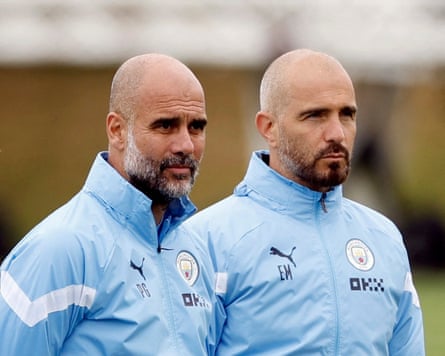
Now Venkatesham was pushing Arteta as the principal candidate to replace Emery. It was important not to antagonise Manchester City , where he was Pep Guardiola’s assistant. Discretion was essential. Which was why Venkatesham was puzzled to be woken early that morning by a phone call from Arsenal’s media chief telling him to look at the Sun. The first he knew he had been photographed leaving Arteta’s house was when the images were published online. It was, to put it mildly, an embarrassment. There was “displeasure” from City, said one source. “Noises were made at boardroom level.”

Arteta, who was announced as head coach a week later after several days of somewhat fraught negotiations, could have joined Arsenal’s staff when he quit as a player in 2016 . But even some at the club told him that joining Guardiola at City would be “the equivalent of a master’s degree in coaching”.

The prognosis for the new Arsenal manager did not look promising when he stepped out at Bournemouth on Boxing Day for his first game. His five-year plan outlined how the club had fallen behind. He and the sporting director, Edu, wanted to rebuild a squad of 22 high-quality, tactically flexible players. For that they needed money, which is where Arteta fits Napoleon’s maxim of requiring “lucky generals”.

“It was much better to be the manager that followed the manager who succeeded Wenger,” said one source. Even more fortuitously, his arrival came two transfer windows after the Kroenke family had finally bought out the 30% stake of the now-sanctioned Russian-Uzbek oligarch Alisher Usmanov. The Kroenkes had always said they would invest when they had full control; most assumed that was deflection yet it turned out to be true. “Mikel had money Unai and even Arsène didn’t really have,” said a former employee.

“It was the perfect storm in that you had a really driven young manager, bright, well-schooled, ambitious and enthusiastic. You’ve got the money and you had a board that gave him time,” said one former senior employee at the club who was close to Arteta. “He told them it would take five years.”

All the senior Arsenal sources spoken to for this article have praised the Kroenke family and some pointed to the more active involvement of Josh Kroenke, the 46-year-old son of the patriarch Stan, as a key player at that point. “I had the impression he persuaded the board to pull the emergency cord on funding,” said one.

FA Cup and Community Shield wins in Arteta’s first eight months were somewhat overshadowed by Covid restrictions, before a terrible 2020-21 season meant Arteta looked doomed to outsiders. “There were never internal discussions about that,” said a source familiar with board meetings at the time. However, in December 2020, Arsenal lost 2-1 at Everton , a run of seven Premier League games without a win, five of which were defeats. They then lost a Carabao Cup tie 4-1 at home to Manchester City before Chelsea came to the Emirates. Arteta’s intensity is extreme even in good times; this looked like terminal pressure.

“They looked poor at Everton,” said one executive. “His future wasn’t being discussed, but I feared for him.”

The board did not waver. Arsenal beat Chelsea 3-1 on Boxing Day to relieve immediate pressure and although Arteta struggled and finished eighth that season he remained backed to the hilt, evident by the departure of Mesut Özil in January 2021. “That was totemic,” said one source. “It cost the club a lot of money [to pay up his contract], but they backed Mikel’s judgment.”

Arteta had made clear there were certain characters he would not tolerate; Özil’s friend Shkodran Mustafi left in the same window. A line had been drawn and when Pierre-Emerick Aubameyang attempted to cross it a year later he, too, was sold, even though Arsenal were in a race for Champions League places and desperate for his goals.

A key scene in the Amazon Prime documentary that chronicled the 2021-22 season was Rob Holding and Mohamed Elneny discussing Aubameyang’s departure. “Boss had balls,” says Elneny. “Yeah, boss had balls,” agrees Holding. The message had landed.

That said, the 2021-22 season started shambolically, Arsenal losing at promoted Brentford, to Chelsea at home to jeers and boos, then 5-0 at City, with Granit Xhaka sent off and indiscipline a clear problem. Insiders say Arteta did not waver. “Mikel is not the type of person to get overwhelmed about anything,” said one senior member of the football staff. “He’s very driven and very solid in his mind. There were difficult times and then obviously Arsenal had invested massively. But the Kroenkes deserve credit.”

Arteta has left his own distinctive stamp of the club – he is most definitely the manager not head coach, a development Arsenal initially wanted to avoid in the post-Wenger era to avoid the personality-cult syndrome – but was also bequeathed building blocks of a first-class side.

William Saliba had been signed by a scouting team subsequently dismantled by Edu, and Arteta almost lost him, sending him away on loan, unimpressed, until he was persuaded to take him back; a deal for Gabriel Magalhães had been put in place by the same scouts and he arrived in September 2020; and he had Bukayo Saka coming through from the academy.

No one at Arsenal doubts the significance of the summer of 2023 in making the step from good to great: the £200m spent to bring in Declan Rice, Kai Havertz, Jurriën Timber and David Raya indicated not only an intent to take on nation-state funded teams. It also showed Arteta’s charisma was a key part of a recruitment success story, with Rice rejecting Chelsea, Manchester United and City. “The project seemed more exciting and I believe we’re on to big things here,” he said.

Over the past couple of seasons, Rice might have privately questioned that. Now his words look uncannily prescient.

Struggling with the nine times table? I have a failsafe method | Adrian Chiles

Mathematics
Struggling with the nine times table? I have a failsafe method
Adrian Chiles
Thu 21 May 2026 12.00 CESTLast modified on Thu 21 May 2026 12.09 CEST
News
https://www.theguardian.com/commentisfree/2026/may/21/struggling-with-the-nine-times-table-i-have-a-failsafe-method

M aths was never my thing. I quite enjoyed it at O-level, to the extent that I chose to do it at A-level. As early as the first week of the A-level course, however, it became abundantly clear that the subject was quite beyond me. I simply couldn’t make head or tail of what the teacher was on about.

Looking around at the rest of the class quietly getting on with it, I remember wondering if there had been some primer course over the summer that everyone but me had attended. I just didn’t get it. There didn’t seem to be any certainties any more, rarely anything so straightforward as a right or wrong answer. There were enough grey areas in my other subjects – English and history. From my maths I wanted certainty, objective truth, which as far as I could see wasn’t part of it any more.

Where were the times tables, for example? I’d nailed those good and proper at a very early age. In ascending order of difficulty I would rate them as follows: two, 10, five, 11, three, four, six, eight, seven and 12. You’ll notice that the nine times table does not feature on this list. Why? Well, I found it too easy. It was my speciality. But that’s because I was cheating – or so it felt – as someone had showed me a quick trick with which to nail the nines, as it were.

For this reason, I was fascinated to read that in an analysis of times tables answers by primary school children, it was ones that involved the number nine that were most often wrong. They’re not the only ones. When the then school standards minister Nick Gibb announced the rollout of national multiplication tests in 2018, he refused to attempt 8×9 on ITV’s Good Morning Britain.

What’s the matter with everyone? Nines are easy! If you kind of cheat, like me.

What you do is this. Hold your hands up, palms facing you. If it’s 8×9 you’re interested in, just fold down the eighth digit from the left, which will be the middle finger of your right hand. Now count the number of digits still standing to the left of the one you’ve folded down. There will be seven. Now count the number still standing to the right of the one you’ve folded down. There will be two. And there’s your answer: 8×9=72. And it works for every digit , right up to 10×9.

After that, admittedly, I’m stumped. Thank God for calculators.

Adrian Chiles is a broadcaster, writer and Guardian columnist

Jess Cartner-Morley on fashion: Posh Grandpa is fashion’s new main character

Fashion
Jess Cartner-Morley on fashion: Posh Grandpa is fashion’s new main character
Jess Cartner-Morley
Wed 20 May 2026 15.00 CESTLast modified on Wed 20 May 2026 17.06 CEST
News
https://www.theguardian.com/fashion/2026/may/20/jess-cartner-morley-on-fashion-posh-grandpa-is-fashions-new-main-character

W elcome to the season of the Posh Grandpa, fashion’s newest main character. We’ve had Brat , we did Coastal Grandma , we loved Tomato Girl Summer . The world is pretty heavy right now, as you’ll have noticed, so any opportunity to lighten up is precious. The nonsense is the point.

Character dressing is style that makes you smile, but it’s not just that. There is infinitely more joy in these looks, however silly they are, than there is in aspiring to look rich and pretty, which is where the aesthetic centre of gravity of our culture swings back to again and again. The esoteric sides of fashion’s personality capture something important about style, which is that it needs a bit of friction to make it interesting. The pebble in the boot, the surprise to snag the eye. This is where the magic happens.

I am all in with Posh Grandpa dressing, and not just for the lols, although I am also very much enjoying the spectacularly ridiculous vibe name. This is exactly how I want to dress most of the time. Slip-on shoes? Check. Comfy trousers? Copy that. Henley button-ups, or maybe a sensible quarter-zip? All over it.

Taking inspiration from menswear is the oldest trick in the chic woman’s playbook, but if streetwear was about dressing like an adolescent boy and normcore was a nod to the dads, Posh Grandpa is retro and refined.

If you want to know where fashion is going next, the best place to look is not the catwalk but vintage stores and car boot sales. Vintage shoppers are the most fashion-forward demographic, so what they are wearing now you’ll be wearing in a year or so. The look is Harry Styles, A$AP Rocky and David Hockney. It is Timothée Chalamet in Marty Supreme and Cillian Murphy in Peaky Blinders . It is Alexa Chung in a perfect navy crewneck sweater, and Bella Freud in a trouser suit.

This look is mellow but never dull. Muted colours and classic cuts are undercut by a sly sense of humour. You can play it straight, all soft tailoring and thoughtful layering, or you can lean into the eccentricity. For evening, instead of the usual tropes of glamour – sparkle, skin – embrace camp and drama. Velvet trousers with a silky shirt. Possibly a smoking jacket? Keep the jewellery minimal, the hair simple: we want louche glamour not Dynasty power dressing.

But start, always, from the ground up. The right shoes will do a lot of the heavy lifting. Tasselled loafers are encouraged, as is shoe polish. If loafers feel too obvious, consider a slim lace-up jazz shoe. A velvet slipper, if you are feeling bold. From there, the silhouette builds itself quite naturally.

Trousers, crucially, not jeans. Denim is a little too blunt an instrument here, because you want something with drape: pleated fronts, a slightly higher waist, a leg that falls cleanly rather than clings. There is something marvellously liberating about a trouser that isn’t trying to be sexy. A Henley instead of a white T-shirt is a good starting point for layers on top – faintly old-timey, but also very modern-utility, especially under an overshirt. Or layer a shirt under a cardigan or a quarter-zip.

And then (this bit is important) you need to interrupt it with something modern that jolts the eye. A leather jacket thrown over the top is perfect to stop things from veering into pastiche. Or something as simple as a contemporary belt or a pair of angular sunglasses can shift the balance.

Beneath the tongue-in-cheek name and the nostalgic references, the Posh Grandpa trend speaks to a desire for comfort but also character. In a fashion landscape that can feel relentlessly polished, there is romance in a look that finds beauty in the slightly off-kilter. Instead of a fantasy of youth or wealth, it is an allure that leans on less obvious signifiers. Impeccable taste, a favourite armchair and great shoes? A life well-lived is always a good look.

Model: Fu at Milk Management. Hair and makeup: Delilah Blakeney using Hair by Sam McKnight and Charlotte Tilbury Styling assistant: Charlotte Gornall. Jacket , £69.99, Zara. Jumper , £49.99, John Lewis. Shirt , £29.90, Uniqlo. Trousers , £29.99, Zara. Shoes , £165, by Camper from Schuh. Chair , £199, John Lewis

Football fans: are you excited about the World Cup? We would like to hear from you

World Cup 2026
Football fans: are you excited about the World Cup? We would like to hear from you
Guardian community team
Thu 21 May 2026 11.00 CEST
News
https://www.theguardian.com/football/2026/may/21/football-fans-world-cup-we-would-like-to-hear-from-you

The men’s World Cup in the US, Mexico and Canada is nearly upon us, kicking off on 11 June.

Amid the excitement around the tournament, there has been controversy over Fifa’s ticketing process, the cost of travel, and security concerns for fans travelling to the US.

We would like to hear from football fans from around the world, including the host countries. Are you looking forward to the tournament? Have you made plans to go to matches? Or are you watching from home? And have you been following the storylines around this World Cup ? What do you think about them?

If you’re having trouble using the form click here . Read terms of service here and privacy policy here .

Don’t be scared of acid exfoliants – they can be gentler and better than scrubs

Women
Don’t be scared of acid exfoliants – they can be gentler and better than scrubs
Sali Hughes
Wed 20 May 2026 11.00 CEST
News
https://www.theguardian.com/fashion/2026/may/20/dont-be-scared-of-acid-exfoliants-better-than-scrubs

The words “acid exfoliant” scare the bejesus out of those with more sensitive skin, but they can be a godsend in making texture more even and makeup smoother and more long-lasting.

In fact, a liquid containing the right blend of dead-skin-sloughing alpha or beta hydroxy acids will be infinitely more gentle, effective and even than those gritty physical scrub exfoliants many still reach for.

The influence of South Korea’s wildly popular milky toners, with their focus on hydration and skin-barrier protection, can be seen in a new crop of milky acid exfoliants. These combine sturdy skin-clearing acids with skin-softening, soothing ingredients to cushion the blow.

I love most things from US brand Naturium, but its recent launch of Multi Bright Milky Toner (£19), is a smash. This is a blend of exfoliating polyhydroxy acid gluconolactone (already gentler than most), azelaic acid (for uneven tone) and moisturising ingredients such as squalane, glycerin and rice bran oil that smooths and brightens.

It’s a great option for those who’ve previously craved the glow of glycolic acid toners, but have found them too tingly, harsh and/or reddening. (Sturdier skin more experienced with acid may instead wish to try Naturium’s matching serum , £26, which uses lactic and glycolic acids for more punch.) I’ve worn the toner a lot in recent weeks and found it to be as effective as any exfoliant, but with no sting in its tail.

Trinny Woodall is of the same mind. Her company Trinny London’s new Tiptoe In exfoliant (£36) is a milky non-watery serum, that is applied with hands straight after cleansing. Offered as a gentler alternative to the brand’s popular Reveal Yourself exfoliant, this uses gluconolactone to exfoliate, but also includes lactobionic, another polyhydroxy acid with a gentle touch. Add in humectant trehalose and you have a plumping, comfy layer that earns its keep throughout the day.

Sensitive skin doesn’t necessarily lack moisture, of course – oilier skins can be just as tetchy when it comes to harsh chemicals. The Ordinary’s Saccharomyces Ferment 30% Milky Toner (£12.40), is a gorgeous product at a brilliant price that’s equally suitable for dry and oily skins (and all types in between). A drenched cotton pad sweeps away dead skin and excess oil gently, without leaving even my dry skin parched.

I would use these products maybe four times a week, after cleansing, then increasing to daily use if all is calm.

Pedro Sánchez is loved everywhere – but not so much in Spain. Here’s why | María Ramírez

Pedro Sánchez
Sánchez is loved everywhere – but not so much in Spain, say Andalusia’s voters. Can he pull off another comeback?
María Ramírez
Thu 21 May 2026 06.00 CESTLast modified on Thu 21 May 2026 10.29 CEST
News
https://www.theguardian.com/commentisfree/2026/may/21/pedro-sanchez-loved-everywhere-not-so-much-spain-andalusia-voters-another-comeback

L ately, I often meet people outside Spain who praise the prime minister, Pedro Sánchez . In Britain, Italy or the US, friends, acquaintances or random people who learn I am Spanish offer admiring words about his positions on Gaza and Iran. It’s understandable.

Sánchez spoke out against Benjamin Netanyahu and Donald Trump earlier and more forcefully than most European leaders did, with a powerful message on international law. And the Spanish leader has been one of the clearest and most effective advocates for immigration in one of the fastest-growing countries in the west.

Most Spaniards back Sanchez’s outspoken positions on Israel-Palestine and his economic case for immigration . So how can it be that his party, the centre-left PSOE, has just lost its fourth regional election in six months and appears headed for defeat in next year’s general election?

The results in Andalucía , the most populous region in Spain and one of the nation’s poorest, are particularly devastating for the socialists, who governed there for almost 40 years. The party’s first prime minister after Franco’s death, Felipe González, is from the regional capital, Seville, and the PSOE’s national successes in the 1980s were deeply rooted in Andalucía. On Sunday, María Jesús Montero, a former minister in Sánchez’s government, delivered the party’s worst result in the region since the restoration of democracy in Spain, securing just 22.7% of the vote – about half the tally the party was securing at elections in the 2000s .

The beneficiary of the socialists’ defeat is not just their traditional opponent, the centre-right Partido Popular (PP), but the far-right Vox, because the PP’s insufficient majority means it will need Vox support to govern. The PP’s own national corruption scandals and public health service mismanagement saw Andalucían president Juanma Moreno lose seats on Sunday too. Meanwhile the leftist, regionalist Adelante Andalucía emerged as the other unexpected winner of the election, going from two seats to eight .

The socialists’ result in Andalucía can partly be explained by local factors, such as the popularity of a mild-mannered conservative president and voter resentment toward a PSOE candidate perceived to have been parachuted in from the national government. But it’s also another sign of Sánchez’s weakening position.

The PP has been leading the national polls for more than a year now, amid corruption scandals involving former socialist officials and even Sánchez’s wife, who has been charged in a legal case brought against her by a far-right group – she denies any wrongdoing. And only this week, another major scandal involving a socialist grandee has emerged: a judge has put former prime minister José Luis Rodríguez Zapatero under investigation for alleged influence peddling. He too denies any wrongdoing.

All this is unfolding in a context in which every aspect of public life in Spain is hyper-partisan and highly contested. Even judges and journalists are increasingly drawn into political conflict, and it is often difficult to clarify the basic facts of any issue. The natural attrition that comes after eight years in power is another explanation for Sánchez’s declining popularity during a period in which so many incumbent governments have been struggling.

In Spain, the decline in trust in politicians and institutions is often fuelled by this constant confrontation between parties. This dynamic tends to demobilise voters, particularly on the left, as the Andalucían results suggest. Even the recent outbreak of hantavirus became an excuse for acrimonious political squabbles. After the Spanish government allowed the affected cruise ship, the MV Hondius, to dock in the Canary Islands , every aspect of the episode turned into a partisan spat, from (imaginary) infected rats swimming ashore to the World Health Organization’s response.

The irony is that beneath the toxicity of Spanish political debate, the country’s economy remains strong. Growth continues to exceed expectations, driven by exports, services and immigration. Sure, the cost of living is a challenge in Spain, as it is elsewhere: house prices are soaring in major cities and salaries have been flat for several decades . But energy bills remain lower than in Germany, France, Italy or the UK, thanks to the country’s heavy investment in renewable energy. Meanwhile, public transport is clean, affordable and extensive – and life expectancy is among the highest in the world.

Immigration, mostly from Latin American countries, has made Spain a more diverse and open society than ever before, while also helping to sustain economic growth and offset demographic decline. The far right is now refocusing its messaging on immigration, but some conservative leaders are reluctant to join the backlash. In some cases, they’ve openly pushed back against Vox’s xenophobic rhetoric.

Sánchez’s calculus is that enough Spanish voters will look at what the new rightwing regional governments do in power and come back to PSOE. Administrations where Vox are a governing party have already changed policies on immigration, gender equality and even bike lanes.

Spain’s next general election must be held by August 2027. Pedro Sánchez could still pull off a comeback, as he has done several times before. But the increasing fragmentation of Spanish politics and the weakness of the parties to the PSOE’s left will make his path to victory far more difficult this time. He has just one year left to turn things around.

María Ramírez is a journalist and deputy managing editor of elDiario.es, a news outlet in Spain

All this talk about ‘difficult’ cuts, yet the largest part of Britain’s welfare bill is never mentioned. Why? | Zoe Williams

Pensions
All this talk about ‘difficult’ cuts, yet the largest part of Britain’s welfare bill is never mentioned. Why?
Zoe Williams
Thu 21 May 2026 09.00 CESTLast modified on Thu 21 May 2026 09.49 CEST
News
https://www.theguardian.com/commentisfree/2026/may/21/politicians-hard-choices-welfare-bill-pensions

N othing makes you feel more like a de-developing nation than being reprimanded by the International Monetary Fund (IMF). Rachel Reeves can take solace in trace amounts from the fact that the IMF advised her only to “ stay the course ” on spending limits – whatever energy or inflation crises are down the line, she shouldn’t cave to demands for government support. Basically, “when the facts change, do not change your mind” – the opposite of the economists’ classic, but then, haven’t we all had enough of classics?

It’s a milder rebuke than the one delivered to the then chancellor, Kwasi Kwarteng, in 2022, about which the BBC’s economics editor, Faisal Islam, admitted “ even I was taken aback ”, creating a ripple effect: other, lesser economy-watchers were taken aback at the abackness that had taken the unflappable Islam. But it still has a sting in its tail, enjoining Reeves to keep her focus on “controlling the rising welfare bill, as well as delivering further efficiency measures in public services, while protecting the most vulnerable”.

After 16 years of austerity or austerity-lite, there isn’t much to trim from disability or unemployment benefits, which is why we see analysis slide instead into unserious questions about who deserves what. Is that person claiming welfare suffering from a “real” disability or an endlessly contestable mental illness? Is the unemployment rate a result of lack of opportunity or lifestyle choices? Where it is discussed in any detail, the problem is always young people. They are unfit for the labour market because of the school curriculum, unfit for any market since they’re in the grip of a mental health crisis, and the jobs aren’t there anyway – this was the “perfect storm” identified in February by Alan Milburn , ahead of his report on Neets (young people not in education, employment or training) this summer. The more urgently the welfare bill needs to be slashed, the more heated this debate becomes, until we’re all rightwing pundits asking each other whether ADHD is real or just a fig leaf for a generation that can’t concentrate on anything longer than a TikTok video – and whatever the balance of truth and fairness in that, it surely can’t fall on you, the taxpayer, to fund it?

The numerate younger voter – of which there are legion, the curriculum isn’t that bad – can be forgiven for asking a couple of follow-up questions. Why, when low-income benefits mostly go to in-work parents rather than Neets anyway, are pensioner benefits (a total of £31bn, excluding the state pension) untouchable? Not only have they been defacto ringfenced by the government’s U-turn on means testing the winter fuel allowance, the new consensus is that even trying to reserve that benefit for people who truly needed it was the stupidest thing an incoming government has ever done.

Why, when pension benefits and the state pension amount to £178bn annually – which is greater than the housing benefit, disability benefit and unemployment or low-income benefits bills combined – do we never talk about the triple lock?

Nor do we ever look directly at the tapered tax relief on private pensions , which straightforwardly delivers more, pound for pound, to higher earners. This alone is the most expensive non-structural tax relief in the country, costing nearly £35bn a year – roughly 10 times the amount we spend on affordable housing annually. What would happen if you flipped that? Would young people be able to pay their rent?

These figures, or at least the skewing they describe, are all so familiar that it feels almost rude to mention it, like blundering into a conversation about Brexit to say that it actually hasn’t made us richer. The centre ground of politics cleaves to a particular etiquette where you don’t repeat things everyone has heard before, even while they remain unresolved. And the rationale – offered as a gentle truism, a level of political cynicism that we can handle – is that pensioners vote and young people do not.

That electoral calculus may have made sense when the triple lock was introduced in 2011, along with the obvious benefit of protecting one group so the whole country wouldn’t unite against austerity. But as this generational imbalance reaches maturity, it is no longer rational. Voters are coming of age now whose first experience of the state was when their Sure Start centre closed and their child trust fund was scrapped . Their prospects of home ownership depend almost entirely on intergenerational transfer, their further-education debt the Treasury will decide on a whim, and their value in the job market, vaunted as the fruit of their degree, could only be realised in vacancies that don’t exist .

If they make any demand on the social safety net, their problems are minimised as self-created, and whenever there’s a book that needs to be balanced – whether to boost defence spending or unspook the bond markets – the spotlight is back on the snowflakes. Young people can see what policies that actively seek to prevent hardship look like, but they have never seen one applied to them. They will not vote for a party that thinks this is OK. It is not because they are too woke.

The paradox is, nobody asked for this generational imbalance – it’s the most fundamental building block of nation-building and social cohesion, to want things to be better for the next lot. But we’ll be frozen here until we stop staying “welfare bill”, start saying “pensions bill” and just see where the conversation takes us.

Zoe Williams is a Guardian columnist

Football quiz: when English clubs play in European finals

Football
Football quiz: when English clubs play in European finals
Richard Foster
Tue 19 May 2026 16.26 CESTLast modified on Tue 19 May 2026 19.16 CEST
News
https://www.theguardian.com/football/2026/may/19/football-quiz-english-clubs-european-finals-arsenal-aston-villa-crystal-palace

This is a quiz by Richard Foster, who presents the It Started With A Kick podcast and writes a daily quiz on the Seventh Heaven Football Quiz App , which is available on Apple and Google.