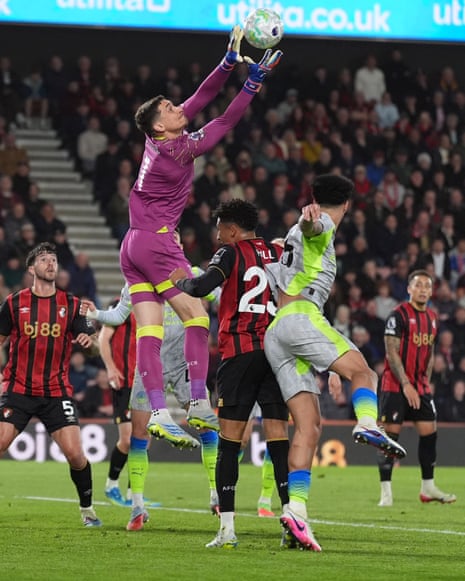
Kroupi goal hands title to Arsenal as Bournemouth hold off late City rally

Premier League
Kroupi goal hands title to Arsenal as Bournemouth hold off late City rally
John Brewin
Tue 19 May 2026 22.37 CESTLast modified on Tue 19 May 2026 23.02 CEST
News
https://www.theguardian.com/football/2026/may/19/kroupi-goal-hands-title-to-arsenal-as-bournemouth-hold-off-late-city-rally

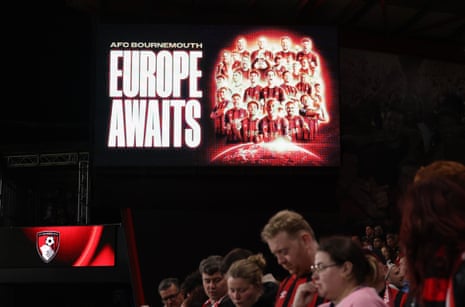
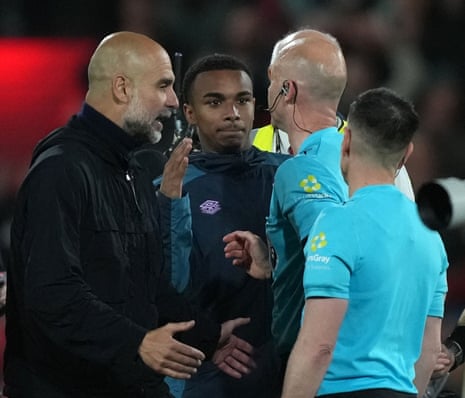
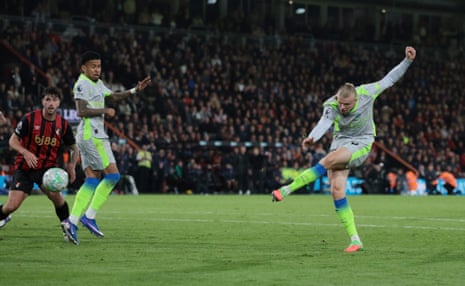
Here is where the story ends. Congratulations, Arsenal, champions of England after 22 years . Farewell then, Pep Guardiola, 10 years of dominance ending in anticlimax. Two domestic cups counts as a disappointment in Pep terms. There will be no treble celebration at Manchester’s Co-op Arena leaving party on Monday. Eli Junior Kroupi wrote his name in north ­London legend for ever, as the title race reached its conclusion on the south coast. Erling Haaland’s late equaliser was nowhere near enough.

Andoni Iraola has been able to keep his future movements secret and he received a post-match send-off from a club grateful for three seasons of progressive, exciting football, capped off by qualifying for Europe for the first time. A point was enough to claim that. His team’s determination to complete the job was too much for opponents who cracked under the pressure of their situation, perhaps distracted by overnight news of the huge change coming their way.

Beyond the serial collection of silver­ware, Guardiola’s bequest to City is rich. A considerable rebuild has taken place since, in ­November 2024, a 2-1 defeat at the ­Vitality ­Stadium ­signalled the end of an empire for his treble ­winners of 2023, the scoreline flattering City. The next manager in, presumed to be Enzo Maresca, will inherit the new breed, players brought in since then such as Abdukodir Khusanov, Nico O’Reilly, Gianluigi Donnarumma and Antoine Semenyo. “Pep stay” read one placard among away fans who begged their manager for “one more year”. In pre-match, Guardiola continued the club policy of avoiding the elephant in the room by saying Monday’s breaking news would have “absolutely zero” effect on his team.

For Bournemouth, with Ryan Christie suspended after his red card at Fulham, Tyler Adams returned to central midfield, where he faced Mateo Kovacic. One last wildcard from the Catalan grandmaster of perplexing selection decisions? The Croatian veteran had played only 40 minutes of Premier League football all season. FA Cup final hero Semenyo lined up against the club he graced until January and who continue to flourish in his absence. Alongside Kovacic, two of Guardiola’s ­favourite generals, Bernardo Silva, another set to wave goodbye to Manchester, and Rodri, who has been linked with a return to Spain.


Bournemouth, with their own ends to tie up, began by ­swarming over their opponents, pressing high up while leaving a high line. Jérémy Doku had the first shot as City ­eventually advanced. On the ­sidelines, ­Guardiola, in grey slacks and polished brogues, was far less active than Iraola, his face solemn during bitty early stages where ­neither team could find any momentum. The expected pattern of City possession with Bournemouth ­looking to speedy transitions soon came to pass.

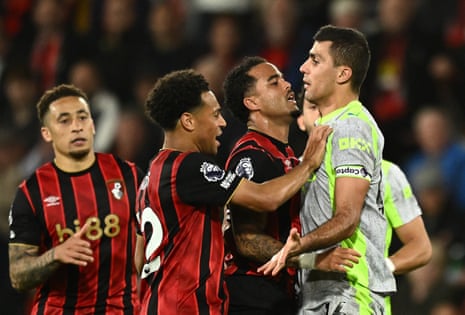
City, though, were below their best. Semenyo had the ball in the net in the 13th minute, only to be ruled offside. Soon after that, ­Evanilson’s blushes were spared when he produced a howling miss of an open net only for a flag to ­protect his ­modesty. When Marc Guéhi, another cog in City’s reboot, wrestled down Evanilson, he was ­fortunate the ­referee, Anthony ­Taylor, ruled the shoving match in his favour.

Haaland, after continuing his Wembley duck, was struggling for touch, forced to drop deeper than is customary, though he did have a shot blocked by a sliding Adam Smith. When Kroupi scored his brilliant strike, laid on by Adrien Truffert’s overlap, ­Haaland grabbed the ball in frustration, ­barking instructions at Silva.

Guardiola wore a similarly mournful expression as the ­second half resumed. Deep in ­conversation with Pepijn Lijnders, his ­assistant, he rubbed his cranium in ­trademark fashion. Within seconds of the ­whistle, he was bellowing ­commands. It almost had the desired effect, O’Reilly carving towards a Haaland pass and forcing a fine save from Djordje Petrovic.


The better chances were still falling Bournemouth’s way, Evanilson drawing a Donnarumma save after another rapid counter. Soon enough, Guardiola was rolling the dice with the introduction of Rayan Cherki, Phil Foden and Savinho, youthful legs introduced as Silva and Kovacic departed, Semenyo also coming off to applause from home fans.

Bournemouth sought to take advantage of Guardiola’s turning of the dial. Kroupi might have scored his second, after Evanilson’s flick. Rayan hit the post after chaos at a corner, and had a low shot saved. City rocked on their heels. When Donnarumma took his time over a goal-kick, he was barracked by a manager demanding his team hurry up.

City fought desperately for their way back, determined to show why they were once serial champions, but the ball would not fall their way. As pressure was piled on, Bournemouth did their best to preserve an unbeaten record that stretched longer than any club in Europe’s top five leagues.

On the touchline, Guardiola went through the public agonies that have been a full part of his persona, the supremacy that has dominated English football for the last decade. The old magic was not to be found, ­Haaland’s thumped goal came too late. A dynasty had reached journey’s end.

‘Her crotchless trousers are etched in my brain for ever’: Valie Export remembered by the artists she influenced

Art
‘Her crotchless trousers are etched in my brain for ever’: Valie Export remembered by the artists she influenced

Tue 19 May 2026 12.42 CESTLast modified on Tue 19 May 2026 13.59 CEST
News
https://www.theguardian.com/artanddesign/2026/may/19/valie-export-remembered-by-the-artists-she-influenced

‘As important as Yoko Ono’s Cut Piece’

Peaches

I still remember the first time I came across that poster of Valie Export wearing crotchless trousers, her legs spread apart, a gun in her hand. It was a fearless image that took my breath away and is etched in my brain for ever.

Over the years, her work served as an inspiration to my music. Her Tapp-und-Tast kino (Tap and Touch Cinema) performance, where she strapped a miniature theatre to her bare chest and invited passersby to reach through a tiny curtain, felt as important as Yoko Ono’s Cut Piece . It was up to the spectators how they interacted with her, which could make for painful watching but always felt telling. I’m saddened that she is gone.

Peaches is a Canadian musician and producer

‘The female body is not a polite object’

Florentina Holzinger

I wrote a paper on Valie Export back in high school when I was 14. I have always taken legacy seriously; much of my own work evolves around what has been, and what those histories mean for us today.

It is 1969 when Genital Panic happens. Valie walks into an experimental cinema in Munich wearing crotchless jeans. She moves slowly, row by row, forcing her exposed genitalia to eye-level with the seated audience.


Fast forward to today. We find ourselves in an entirely new landscape: We are drowning in algorithmic thirst traps, free internet porn etc, not to mention the rotting political backlash trying to legislate bodies back into the dark ages. So yes: the core political necessity to subvert how we handle nudity and real bodies endures. In fact, it has become more urgent and complicated than ever.

Thank you, Valie, for paving the way and for articulating this reality with such crystal clarity: the female body is not a polite object. It can be a registered trademark – a weapon to be exported directly against the structures we choose to battle. Rest in peace.

Florentina Holzinger is an Austrian choreographer and theatre director

‘Passionate, brave and certainly generous’

Joan Jonas

Valie Export was a very important artist. In remembering her, certain words come to mind such as bold, radical, innovative, passionate, brave and certainly generous. Her body was central, in confronting architecture by men, for instance, and in general as vehicle for her many interactions. Several works are unforgettable, such as 1968’s Grope and Touch, 1969’s Genital Panic, and 1976’s Encirclement.


Her own words [about Homo Meter II (1976) ] explain her position: “When I went out on the street with the loaf of bread tied around me and offered it as a gift people were disturbed, perturbed and curious. They did not dare to cut off a piece with a knife. The loaf of bread was also meant as an extension of the body, a provocation … as an artist I was alone in many ways and especially the confrontation with the public in the public space was something very isolating.”

Joan Jonas is an American artist

‘She made a virtue of civil disobedience’

Candice Breitz


Valie demonstrated to so many of us – with her fierce attitude and badass flair – that it was not necessary to live by the rules of those we could not respect. As a feminist provocateur, she made a virtue of civil disobedience, consistently claiming space that had for far too long been dominated by men. In an intervention staged in 1968, she quite literally put patriarchy on a leash, dragging the legendary curator Peter Weibel through the streets of Vienna on all fours. Her legacy will live on not only in her work, but also through her empowerment of those of us who continue in her footsteps.

Candice Breitz is a South African artist

‘She understood the tools of mainstream media’

Shoair Mavlian

Photography played a central role in Valie Export’s practice. In her iconic Body Configurations series she placed her body in urban public spaces, contorting to the architectural structures of the built environment. She understood the power of engaging with the tools of mainstream media and became one of the first female artists to critically examine representations of women in mass media using photography and film. During her exhibition at the Photographers’ Gallery in 2024 she commented on her use of photography in relation to feminist practice from the 1960s onwards, saying: “We used the aperture of the film camera in the way to see things with our own eyes, with our own thoughts.” Her radical use of photography as a tool to document, record and question influenced generations of female artists to follow.

Shoair Mavlian is director of The Photographers’ Gallery, London

Arsenal crowned Premier League champions for first time in 22 years – as it happened

Arsenal
Arsenal crowned Premier League champions for first time in 22 years – live reaction
Niall McVeigh
Tue 19 May 2026 23.02 CESTFirst published on Tue 19 May 2026 22.26 CEST
News
https://www.theguardian.com/football/live/2026/may/19/arsenal-premier-league-champions-first-time-in-22-years-live-reaction

We’ll keep the focus here on Arsenal’s title win – so Gunners fans, drop me a line here wherever you are. I have to give a shoutout to my friends from uni, Andy and James. We watched the Invicibles’ parade on a beaten-up telly at our student digs in Cardiff, and it’s been a long, long wait for them to celebrate again. Congratulations, chaps.

Pep Guardiola has offered his congratulations to Arsenal and Arteta, his former assistant at Manchester City. “We were close. On behalf of everyone at Manchester City, we congratulate Mikel and all the staff, players and fans on winning the Premier League . They deserve it, for so much hard work and effort.

Despite the widespread reports this week, Guardiola did not confirm his departure, telling Sky that he has a year on his contract and needs to speak to the club hierarchy. It still feels like he is leaving it to City to make it official later this week, though.

Kari Tulinius writes: “It’s said to be anticlimactic to win the title by having your main rival lose. If this is an anticlimax, I’ll take it.” Personally, I think when your team wins a title like this, it’s different to sealing it on the pitch, but no less wonderful. Shame it’s a school night, is all.


Bournemouth 1-1 Manchester City: match report

John Brewin was at the Vitality to see a game that Manchester City never really looked like winning, until a frantic 90-second spell in stoppage time.

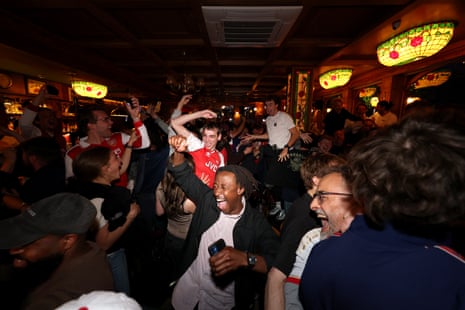
A mass celebration is underway outside the Emirates Stadium as delirious Arsenal fans celebrate their first league title in 22 years. Young and old, male and female, people of all shapes and colours are spilling from the pubs on to the local streets, thronging around the concourse, singing and somehow trying to make sense of what has just occurred.

Arsenal’s Instagram admin marks their historic moment …

Arsenal’s 14th title cements their third place in English football’s roll of honour:

20 Liverpool, Manchester United 14 Arsenal 10 Manchester City 9 Everton 7 Aston Villa 6 Chelsea, Sunderland 4 Newcastle, Sheffield Wednesday 3 Blackburn, Huddersfield, Leeds, Wolves 2 Burnley, Derby, Portsmouth, Preston, Tottenham 1 Ipswich, Leicester, Nottm Forest, Sheffield United, West Brom

And in the Premier League era, this is how things stand:

13 Manchester United 8 Manchester City 5 Chelsea 4 Arsenal 2 Liverpool 1 Blackburn, Leicester

Here’s more on how Arsenal sealed Premier League glory tonight.

Preamble

On 26 April 2004, Arsenal secured the English title – their 13th in total –with a 2-2 draw at White Hart Lane, with four games still to play and an unbeaten league season to complete. Few of the delirious fans in attendance that day would have believed another 22 years would pass before their team would win it again, and take their tally to 14.

White Hart Lane has been bulldozed and rebuilt while Highbury is now a block of flats, with the Emirates Stadium overseeing a painful period of decline under Arsène Wenger, before Unai Emery’s brief tenure. Mikel Arteta, an Arsenal player from 2011 to 2016, took charge in 2019 and has made the team title contenders again.

In the last six seasons, Arteta has led Arsenal to finish eighth, fifth, second, second, second … and now first. Gooners around the globe, rejoice. The day is finally here – Arsenal are champions of England again.

How Forza Horizon took on Japan with deep research – and 360-degree cameras

Games
How Forza Horizon took on Japan with deep research – and 360-degree cameras
Keith Stuart
Fri 15 May 2026 12.20 CESTLast modified on Fri 15 May 2026 18.28 CEST
News
https://www.theguardian.com/games/2026/may/15/how-forza-horizon-took-on-japan-with-deep-research-and-360-degree-cameras

S ince the arrival of the original Forza Horizon in 2012, a game that revolutionised open world driving sims by setting players loose in a virtual Colorado, British developer Playground Games has promised authenticity with its settings. For each instalment, design teams are sent out on location to take thousands of photos, hours of video, even detailed captures of the sky, before construction of a virtual copy begins. It’s a huge undertaking. But it seems that for much of the past decade, one country remained slightly out of reach – an intimidating prospect. “Japan has been on our shortlist for several games now,” says design director, Torben Ellert. “But we just didn’t feel like we were ready to take on the challenge of building it.”

It’s not just about the sheer variety of the country’s landscape. There’s something else going on. Most video game players hold an image of what it is like to explore Japan. It may be inspired by the fictitious rural town of Inaba in Persona 4, or the busy docks of Yokosuka in Shenmue , or perhaps the neon-drenched Kabukichō district of Tokyo, which forms a regular backdrop in the Yakuza series. For decades, gamers around the world have been bombarded with images of the country that are often highly stylised and fragmented, but nonetheless potent and persuasive. As art director Don Arceta puts it, “with Japan there’s such an expectation [of] what gamers want – it’s a certain version of Japan that they picture.”


Playground’s answer was to get away from the Japan depicted in other games, as well as legendary street-racing manga such as Initial D and Wangan Midnight. Instead, it hired cultural consultant and one time Porsche ambassador Kyoko Yamashita, who worked with the team for three years advising on their depiction of the country and racing scene. According to Xbox Wire , she was able to point out tiny details, such as the traditional colours of store signs and what they symbolise. The dev team also worked with famed Kyoto-based bodyshop Rocket Bunny and car culture photographer Larry Chen, who appears in the game and fronted a series of YouTube documentaries named Art of Driving , looking at the cars and locations in Forza Horizon 6. “Because it’s a culture we see a lot, there’s a temptation to think you know it better than you do,” says Ellert. “Which is why we tried really hard to get people to course correct us if we were drifting.”

On the subject of drifting, Playground has sought to replicate the major elements of the Japanese street-racing scene. Seminal drift and wangan cars such as the Nissan Skyline, Toyota Supra and Mazda RX-7 are in there, and so are the narrow, winding mountain roads of the illicit touge racing scene which emerged in the 1960s and hit peak popularity in the late 1990s. “We knew we wanted to do a touge experience, but we also knew that if you get 50 people in a room and ask them to define a touge experience you’d get 50 different descriptions,” says Ellert. “We’re imposing some class restrictions, delivering interesting liveried vehicles and putting players on to super iconic roads such as Hakone Nanamagari or Mount Haruna. Someone will go, ‘Oh, that’s not what I thought Initial D would look like in Horizon’ – and it’s like, well, yes, this is our take on that experience.”


As with the countries featured in previous instalments, the Forza Horizon 6 map (the largest so far) is a sort of curated amalgam of scenic types. “We looked at iconic roads, landmarks, car culture, interesting biomes,” explains Arceta. “There was a lot of reference photography, a lot of scans, trips out there to capture the vibe and all the nuances that make Japan so special. [In previous games] we’d drive out with a Go-Pro on the dashboard, but this time we did the reference photography with 360-degree cameras which allowed us to capture the whole environment in both 2D and 3D – it was like our own version of Google maps. That helped us generate how we set dressed the world, but we also had proper scale and dimension – it really gave a sense of the space.”

You can zoom through bamboo forests and rice fields, you can run close to the railway tracks and watch a bullet train rocket past. The landscape is filled with little details – the little roadside temples, the pristine vending machines in rural lay-bys. “It’s the car-culture-adjacent elements,” says Arceta, when asked about his favourite elements. “The petrol stations, garages, the grassroots time attack circuits, just capturing that vibe … Those were the things that were exciting to work on.”

In the south of the map is a condensed yet still sprawling version of Tokyo. It takes in the bustle of Shibuya, the densely stacked electrical stores of Akihabara and the quaint suburban outskirts. Ellert seems particularly proud of the city: “When the preview version of the game was released I followed content produced by Japanese streamers, and one called out our representation of Tokyo railway station saying, I worked there and this looks really good. Honestly, for us to make a place with all the research, consultancy and support we can get and then for someone who lives there to say, ‘I recognise this place’ – that suggests we went in the right direction.”

Arceta concurs. “[Tokyo] is probably one of my favourite area, specifically Daikoku, because that’s basically a church – a church for cars. It’s so sacred. So us getting that right and capturing that type of car meet – it was really important.”

Those of us who have been playing Forza Horizon from the beginning have had many moments where we’ve spotted places we recognise. A little pub in a Cotswold village, the sun setting over the port town of Castelletto, a storm over the Maroondah rainforest. It will be fascinating to see how Japan comes together as a racing location, and if the game can give us elements of the country we have not experienced in games, cinema and anime, or even as tourists. We’re no longer in the era of open world racers – The Crew, Test Drive Unlimited, Midnight Club, Burnout Paradise have all come and mostly passed by. Horizon is still here. Its biggest test awaits.

Forza Horizon 6 is released on 19 May

Blind date: ‘Distance shouldn’t stand in the way of love … I did have to catch the last train home though’

Dating
Blind date: ‘Distance shouldn’t stand in the way of love … I did have to catch the last train home though’

Sat 16 May 2026 07.00 CEST
News
https://www.theguardian.com/lifeandstyle/2026/may/16/blind-date-frances-eddie


Frances on Eddie

What were you hoping for? A lovely evening with pleasant company.

First impressions? Eddie looked much younger and fitter than I had expected. He had bought me flowers and a thoughtful card which helped break the ice.

What did you talk about? Politics. His interest in animal rights and protests. My interests in golf and volunteering. Everything!

Most awkward moment? None.

Good table manners? Excellent.

Best thing about Eddie? His openness to other views. Although he has strong opinions on politics and animal rights, he was willing to accept different points of view. He was very thoughtful, kind and caring.

Would you introduce Eddie to your friends? I’m not sure many of them would have a lot in common.

Describe Eddie in three words Political, fit and caring.

What do you think Eddie made of you? I hope he thought I was OK, and with my heart in the right place.

Did you go on somewhere? Only to the bus stop.

And … did you kiss? Just a hug on arrival and departure.

If you could change one thing about the evening what would it be? I don’t think I’d change anything. Eddie was good company and the food and drink in the restaurant were excellent.

Marks out of 10? A strong 8.

Would you meet again? We exchanged numbers but the distance – he lives more than 100 miles away – might prove prohibitive. We did talk about the possibility of a picnic together, though.


Eddie on Frances

What were you hoping for? A femme fatale to make a better world. Failing that, two strangers enjoying each other’s company over Italian food.

First impressions? Smart, great appearance, an easy-to-be-with manner.

What did you talk about? Does love make the world go round? What are we looking for – how do we see the future when time is not on the table?

Most awkward moment? None.

Good table manners? With Italian gusto I knocked over a glass of red. Frances kindly rearranged the table.

Best thing about Frances? Straight, honest talker. Good listener.

Would you introduce Frances to your friends? No. Frances is way too gentle for my activist friends.

Describe Frances in three words Lovely caring nature.

Best thing about Frances? An ambitious dreamer, sense of purpose, loads of good energy.

Did you go on somewhere? I believe that distance shouldn’t stand in the way of love, so I met Frances even though she was in a different city. I did have to catch the last train though …

And … did you kiss? No.

If you could change one thing about the evening what would it be? No change.

Marks out of 10? 10.

Would you meet again? I feel we are at a different stage of our journeys, but we did exchange numbers.

Frances and Eddie ate at Vivo restaurant in Nottingham. Fancy a blind date? Email blind.date@theguardian.com

Tell us: have you become emotionally attached to AI?

AI (artificial intelligence)
Tell us: have you become emotionally attached to AI?
Guardian community team
Tue 28 Apr 2026 11.15 CESTLast modified on Tue 28 Apr 2026 11.17 CEST
News
https://www.theguardian.com/technology/2026/apr/28/tell-us-have-you-become-emotionally-attached-to-ai

Lots of people now use chatbots as personal assistants, sometimes to the extent that they have formed an emotional attachment to them.

We would like to hear from people who converse with AI chatbots on a personal level. Have you formed an emotional bond to an AI chatbot?

If you’re having trouble using the form click here . Read terms of service here and privacy policy here .

Boy, nine, recounts deadly shooting at San Diego mosque: ‘We saw a bunch of bad stuff’

San Diego
Boy, nine, recounts deadly shooting at San Diego mosque: ‘We saw a bunch of bad stuff’
Edward Helmore
Tue 19 May 2026 20.08 CESTFirst published on Tue 19 May 2026 16.14 CEST
News
https://www.theguardian.com/us-news/2026/may/19/nine-year-old-boy-san-diego-shooting-mosque

A nine-year-old boy has described witnessing Monday’s deadly shooting at the Islamic Center of San Diego , saying that he “saw bad stuff” and huddled in a closet during the attack.

Odai Shanah, whose mother emigrated from Gaza and settled in southern California two decades ago, told Reuters that he heard a barrage of gunshots coming from outside the walls of the mosque complex, which also houses an Islamic day school.

He recounted being among dozens of children forced to huddle in classrooms when deadly gunfire erupted at the mosque.

Odai said he and his classmates were trembling in fear as 12 to 16 more shots rang out after they were quickly ushered into that closet and crowded there together.

After the shooting stopped, the boy said, he and his companions heard members of a special tactical police team shouting from outside the classroom, “‘OK, open up’ – then they opened the door”.

But as they were escorted out of the building, “we saw a bunch of bad stuff, people laying down and yeah, bad stuff”, Odai said. He acknowledged meaning that he and the other children had seen bodies as they walked out in “a big line” with their hands up.

“My legs were shaking and my hands and my head were like hurting a lot,” he said. “I felt like a rock.”

Odai gave Reuters his account of the shooting after permission was granted to the outlet by his parents.

It was a stark reminder of how youths in the US are disproportionately affected – whether directly or indirectly – by gun violence, the country’s leading cause of death for teenagers or younger children.

Police have said three adults affiliated with the Islamic Center were killed during the attack, including a security guard, who officials said played a crucial role in limiting the number of deaths.

The security guard was identified by multiple friends as Amin Abdullah. One of the friends, journalist Kashif-ul-Huda, wrote on the website of Al Jazeera that he was “not surprised” Abdullah had defended those at the mosque, saying he had always been “a man who wanted to protect others”.

“It was such a delight to see him fulfil his lifelong dream of being a security officer,” Huda wrote, adding that his friend had been “martyred defending the mosque”.

“Amin, which means ‘trustworthy’, lived up to his name and died doing what he loved,” Huda continued. The writer said his friend was born a Muslim to an African American mother and therefore was “as American as one can get”.

“He was also as Muslim as one can be.”

Two attackers, aged 17 and 18, also died in the shooting, apparently killing themselves in a stolen car they used to transport themselves to the site of the attack.

San Diego’s police chief, Scott Wahl, said on Monday the shooting was being investigated as a hate crime and that the mother of one of the suspects had found a note.

“At this point, there was definitely hate rhetoric that was involved,” he said. “There was generalized hate rhetoric and speech,” but no specific threat was made to “any facility or any place”, he said.

New York woman dies after stepping out of car into open manhole

New York
New York woman dies after stepping out of car into open manhole
Edward Helmore
Tue 19 May 2026 21.50 CESTLast modified on Tue 19 May 2026 22.03 CEST
News
https://www.theguardian.com/us-news/2026/may/19/new-york-manhole-death-manhattan

The family of a New York woman is struggling for answers after the 56-year-old fell to her death upon stepping out of her car and slipping down an open maintenance hole on Manhattan’s Fifth Avenue.

The woman in question died on Monday night and was identified by family members as Donike Gocaj, from Briarcliff Manor, a commuter belt area north of New York City.

Police say she parked her Mercedes-Benz SUV at West 52nd and Fifth Avenue in midtown Manhattan just before 11.20pm. She had stepped out of the car and directly into the maintenance hole in front of the Cartier mansion.

Gocaj fell down about 10ft (3m), and steam caused her to go into cardiac arrest. She was rushed to a hospital, where she was pronounced dead.

The New York television station, WABC, spoke to her family members, who said they were saddened and shocked by her sudden death.

The city’s electric utility provider, Con Edison, is investigating why the maintenance hole was left uncovered since no construction was going on nearby.

The maintenance hole cover was found about 15ft from the opening. Authorities are reportedly looking into the possibility that a truck ran over it and caused it to dislodge.

“We are deeply saddened to confirm that a member of the public has died after falling into an open manhole,” Con Edison said in a statement. “We are actively investigating how this occurred.

“Our thoughts are with the individual’s family, and safety remains our top priority.”

New York’s department of environmental protection, which is responsible for maintenance holes connected to the sewers, says it has received more than 700 service requests for missing covers during the year so far.

Injuries or deaths related to open maintenance holes are relatively rare. Nonetheless, open maintenance holes are an urban nightmare akin to being hit by falling masonry, scaffolding, an air conditioner, getting pushed on subway tracks, a lightning strike or other such event.

A 17-year-old college student was struck and killed by falling masonry in 1979 on Broadway near West 115th Street in New York City, one of the world’s most populated and visited places. That death prompted mandatory facade inspections and reshaped scaffolding requirements.

But maintenance holes remain an issue. In 2019, a man who was unhoused was found dead in such a hole in Manhattan two weeks after he fell into it.

A 2022 study then found that, from 2007 to 2017, 388 trauma patients fell into a maintenance hole nationally, or 20 to 49 a year. One percent of those died as a result, according to the study.

Southampton may face legal challenge from own players after being kicked out of playoff final

Southampton
Southampton kicked out of Championship playoff final and docked four points for spying
Louise Taylor
Tue 19 May 2026 19.45 CESTLast modified on Tue 19 May 2026 22.52 CEST
News
https://www.theguardian.com/football/2026/may/19/southampton-kicked-out-of-championship-playoff-final-docked-four-points-for-spying

Southampton have been expelled from the Championship playoff final for spying on training sessions staged by Middlesbrough and two other second-tier rivals.

While Boro, semi-final playoff losers to Tonda Eckert’s team, have been reinstated to Saturday’s Wembley showpiece where they will face Hull, Southampton will also kick off next season’s league campaign with the handicap of a four-point deduction.

The south coast side, who apart from admitting to breaching EFL regulations by spying on Boro before the semi-final first leg, also owned up to the same transgression against Oxford in December and Ipswich in April, have appealed against sanctions imposed by an English Football League independent disciplinary commission.

That appeal will be held in front of an entirely new panel on Wednesday morning with the result due by early evening at the latest. Southampton consider the sanctions to be wholly disproportionate and are confident the decisions will be overturned.

Depending on the outcome of that appeal, the playoff final may need to be postponed until Tuesday or Wednesday of next week but, as things stand, it remains on course to take place on Saturday.

Once the appeal is over Eckert, William Salt, the young intern first-team analyst who was sent to spy on Boro and any other members of Southampton’s staff involved in espionage are likely to face individual Football Association charges for bringing the game into disrepute.

In 2024, Bev Priestman, the County Durham-born former head coach of Canada women and two members of her staff were banned from football for 12 months by Fifa after being found to have been part of an operation designed to spy on New Zealand at the Paris Olympics using a drone.

The Priestman precedent represents a significant problem for Southampton. Their thinking had perhaps been guided by the £200,000 fine imposed on Leeds for spying on Derby in 2019 but a new, much tougher EFL rule has subsequently been imposed and Tuesday’s sanctions fell well within its remit.

Boro caught Salt recording one of their training sessions while lurking between a tree and some bushes. Southampton, though, failed to win any of the games that followed their spying, losing at Oxford and drawing at home to Ipswich and away at Middlesbrough before beating Kim Hellberg’s side 2-1 in the playoff semi-final second leg.

An EFL statement issued early on Tuesday evening read: “An independent disciplinary commission has today expelled Southampton from the playoffs after the club admitted to multiple breaches of EFL regulations related to the unauthorised filming of other club’s training.

“In addition the club have received a four-point deduction that will be applied to the 2026-27 Championship table, alongside a reprimand in respect of all the charges.”

Middlesbrough welcomed that ruling saying, in a statement: “We believe this sends out a clear message for the future of our game regarding sporting integrity and conduct.”

Although Middlesbrough trained on Monday, the uncertainty surrounding the potential outcome meant Hellberg’s players were given a day off on Tuesday. They will however return to the practice pitches on Wednesday and have already organised a flight to London on Friday.

The club’s administrative staff will be equally busy as they face the challenge of selling 35,000 tickets to their fans in time for a final staged on a weekend when the main east coast railway line is closed between Darlington and York. Southampton supporters who had bought Wembley tickets will be given full refunds.

If This Be Magic by Daniel Hahn review – how on earth do you translate Shakespeare?

Literary criticism
If This Be Magic by Daniel Hahn review – how on earth do you translate Shakespeare?
Steven Poole
Tue 19 May 2026 08.01 CEST
News
https://www.theguardian.com/books/2026/may/19/if-this-be-magic-by-daniel-hahn-review-how-on-earth-do-you-translate-shakespeare

T he great Argentine writer Jorge Luis Borges, who translated William Faulkner, André Gide, Franz Kafka and Virginia Woolf into Spanish, drew the line at Shakespeare. Speaking of the moment when Hamlet asks the ghost why it returns to haunt “the glimpses of the moon”, Borges commented: “I don’t think it can be translated. Perhaps the words can be translated. Certainly Shakespeare cannot be translated. ‘The glimpses of the moon’ means exactly ‘the glimpses of the moon’.” All, however, is not lost. “It has been said that Shakespeare cannot be translated into any other language,” Borges added. “But Shakespeare cannot be translated into English, either, since he wrote what [Robert Louis] Stevenson called ‘that amazing dialect, the Shakespeare-ese’.” This might not be entirely true, as the translator Daniel Hahn points out in this superbly diverting book. Recalling a hip-hop production of Romeo and Juliet he once saw, he persuades us instantly that “the phrase ‘Do you kiss your teeth at me, fam?’ proved to be a perfect translation of ‘Do you bite your thumb at us, sir?’”

And if into English, then why not into Portuguese, or French, or Māori? Hahn’s project is to argue that “Shakespeare with every word changed can still be great, and can remain Shakespeare”, and to that end he reproduces chunks of Dutch, Russian, Welsh, Thai, Arabic, Japanese, and a dozen other languages, betting that by simply counting syllables or observing alliteration in a language one doesn’t understand (as he cheerfully admits, he doesn’t understand Danish), one can learn something about the quality of a translation. I wasn’t convinced that wager worked much of the time, but the typesetters, as you can imagine, were certainly getting a decent workout, and the gambit does finally pay off when a long passage from Twelfth Night is annotated by boxes mentioning dozens of different translators’ choices.

What really illuminates the book are Hahn’s conversations with his fellow translators, who can explain their choices directly. In Māori, we learn, Lady Macbeth’s question to her husband, “Are you a man?”, makes no sense at all, so the translator Te Haumihiata Mason renders it as something roughly meaning “Have you got balls?” – “which is,” Hahn notes contentedly, “exactly what Lady M is asking.” Meanwhile, Prince Hal’s name means “fish” in Hungarian, which would be unhelpfully distracting, so it gets changed to Riki, short for Henrik. Hahn also offers many asides about the annoyances and pleasures of translation in general. “The word ‘literal’ is annoyingly overused to suggest a sort of ‘neutral’ translation, which cannot exist,” he complains; and he shows that, in many cases, a non-literal choice would be better. When Mark Antony imagines Caesar’s spirit to “cry ‘Havoc’”, for example, the closest Portuguese word is the rather weak-sounding “ devastação ”; a better choice, Hahn shows, is “ matança ” (killing), because it’s shorter and more easily shoutable. Each chapter addresses a different question translators face, for example whether to translate into verse (careful: as one French translator observes, you risk making “a genius into a talented versifier”), or how to translate jokes: it’s usually best, everyone agrees, to create an entirely new joke – “being faithful to the laugh”, as Hahn calls it. In a German Midsummer Night’s Dream, to preserve the doggerel rhymes, we are promised not that Thisbe will be in “mulberry shade” but that she will be “hiding like a newt”. Translators might even embrace the possibility of a joke where none previously existed – which Hahn illustrates brightly by mentioning that the “sorting hat” in Harry Potter has become, in French, le choixpeau (the chapeau that chooses). Can you even preserve alliteration? Sometimes, if you’re lucky: Love’s Labour’s Lost received the surely unimprovable Greek title of “ Agapēs Agōnas Agonos ” (“the struggles of love are barren”). But when no such fortunate tricks are available, you can simply replace one idiom with another: so, in Spanish, Much Ado About Nothing is often called “A lot of noise, not many nuts”. There are quibbles to be made here and there. Hahn calls a line from Richard III “irregular” after counting syllables, but it’s a perfectly regular line that begins with an anapest (da-da-dum). And when Juliet says to Romeo “You kiss by th’book”, Hahn glosses this as her approvingly noting his “formal courtship”, but she is surely issuing a flirtatious challenge. And – this being the publisher’s rather than the author’s fault – the book has been produced, inexplicably, without an index. All may be forgiven, though, for the delight and endless curiosity displayed in these pages. “In Shakespeare, people get sad with precision ,” Hahn enthuses. And he is cherishably bitchy about certain literary “translators” who somehow produce new English versions of Chekhov or Ibsen without speaking the source language – the process being, as he surmises, “a sort of high-status prettying up of a so-called ‘literal’ translation”. By the end of the book, Hahn has amply demonstrated not only the treasures of other languages, but also the rich and strange inexhaustibility of Shakespeare himself.

If This Be Magic: The Unlikely Art of Shakespeare in Translation by Daniel Hahn is published by Canongate (£25). To support the Guardian, buy a copy at guardianbookshop.com . Delivery charges may apply.