Nobody should underestimate what Thomas Tuchel can do with England | World Cup 2026 | The Guardian

Keyword – Football
Trefwoorden – World Cup 2026, England, Thomas Tuchel, World Cup, Football, Sport
Title – Nobody should underestimate what Thomas Tuchel can do with England | World Cup 2026 | The Guardian
Author – https://www.theguardian.com/profile/emma-hayes
Link – Nobody should underestimate what Thomas Tuchel can do with England | World Cup 2026 | The Guardian
Publish date – 2026-06-12T11:00:43.000Z
Category – Sport
URL – https://www.theguardian.com/football/2026/jun/12/thomas-tuchel-england-world-cup

In Thomas Tuchel , England have an elite coach. Don’t underestimate him. In my 12 years working at Chelsea, he and Mauricio Pochettino were my two favourite managers.

Thomas is a great communicator, he’s demanding and he articulates himself really well. I admire the way he transfers information to the press and to players in a clear, concise way that is methodical, inspirational and detailed, all at the same time.

I’ve seen him work at Chelsea. I’ve watched him in training and I’m a huge fan. He’s honest with his players and very direct. He doesn’t waste time – this is business, this is serious – but he’s also a fantastic guy.

He’s warm, friendly, open and he built great relationships with the Chelsea staff. He would invite the women’s staff to watch his sessions and he always made me feel very welcome. I will never forget when we won the 2021 Fifa Best awards for men’s and women’s coach of the year, at home during Covid, both watching on a Zoom call. When Thomas won, I was so happy for him.

It has been three weeks since Thomas picked his 26-player squad for this World Cup finals tournament and I know how carefully he will have thought through every decision. He’s the kind of coach who is going to die on his sword. Sometimes we get caught up in the wrong things when a squad is announced for a major tournament. There are always going to be top-quality players left out. That’s a given.

Thomas has been very clear – he’s got 14 or 15 core players who will be involved in almost every game. Any changes to the starting XI are likely to come from within that group, so sometimes we get too caught up on the whole “26 players”. The reality for a head coach is you need a squad that can come away for 50 days, be together and accept their roles, because plenty of them won’t play. So what are their behaviours like? What are their contributions to the team like? You have to factor in all of those things because you still have to keep the harmony. A common goal requires sacrifice and the right ego. You can see he has also gone for very athletic and durable players.

This is never a quick decision for a coach such as Thomas. The decision-making process starts with what he wants in terms of his game model and who can cope with the demands, the environmental conditions, playing in great humidity and in heat. He’s had enough opportunity during England’s impeccable qualification process – eight wins out of eight and no goals conceded – to see these players inside-out.

You can’t evaluate things just on what players are doing for clubs. You have the benefit of knowing how they respond in the international environment. Somebody such as Bukayo Saka has built up credit for England over a long period of time.

When you leave players out, it is never an easy phone call. There is no great way to tell someone that news and it is not a fun thing to do. Sometimes it’s very quick: “Listen, you haven’t made the group and I just wanted you to know that” – and that’s that. Sometimes it’s: “If you’ve got any questions, you can ask” – and more often than not, they’re like: “No”. Every manager will have their own methods.

Phil Foden and Cole Palmer are exceptional talents and it’s disappointing when players are left out. But you can’t leave Jude Bellingham out of the squad, and I think Eberechi Eze has also had a good second half of the season, so I understand Thomas’s decision to include him.

If there was one call I was a bit surprised by, it was Palmer. I thought Palmer might have snuck in because when you haven’t got Jack Grealish and Foden, sometimes having that little bit of magic can be a big help. I know he’s scored only seven goals since the start of 2026 and hasn’t been at his top level, but he’s a special player with special feet. At the same time, I understand the decision. Every time I hear Thomas speaking about it, he’s very clear on the profile he’s looking for.

He will have also wanted to ensure he has a group that can cope well at set pieces, which will be a huge factor. He has picked plenty of quality in the front areas. Ollie Watkins finished the season strongly. Some might argue Dominic Solanke could have been closer to a place if he were fit, although I don’t think he’s had a great season, and Dominic Calvin‑Lewin was an option but Ivan Toney is an exceptional finisher.

If you need a goal in a tight game, Toney may produce a bit of magic – and in a tournament where we can expect a lot of games to be decided by penalty shootouts, having such a top-level penalty taker who you can bring off the bench in extra time will have been a big consideration too. That can be priceless.

England get their campaign under way against Croatia on Wednesday and I cannot wait for that. Nobody should underestimate this top, top coach.

Fashion goals: World Cup’s style tournament has already kicked off | Men's fashion | The Guardian

Keyword – Fashion
Trefwoorden – Men’s fashion, Fashion, World Cup 2026, World Cup, Football, Life and style, Sport, Netherlands, USA, England, Spain, Germany, France, Japan
Title – Fashion goals: World Cup’s style tournament has already kicked off | Men's fashion | The Guardian
Author – https://www.theguardian.com/profile/laurencochrane
Link – Fashion goals: World Cup’s style tournament has already kicked off | Men's fashion | The Guardian
Publish date – 2026-06-05T13:16:13.000Z
Category – Lifestyle
URL – https://www.theguardian.com/fashion/2026/jun/05/fashion-goals-world-cup-style-tournament-kicked-off

The 2026 World Cup may not kick off until Thursday, but the fashion tournament has already begun, as teams arrive at training camps across the US.

Fashion moments range from the outfits players wear to get to training, to the suits worn on planes and their training gear. The French team’s training camp in Clairefontaine became something of a catwalk this week thanks to the style of players such as Jules Koundé and Kylian Mbappé. Meanwhile, brands including Loewe, Gabriela Hearst, Patta and the rapper Drake’s Nocta have worked with teams on suiting and training gear.

Since the last tournament in 2022, fashion’s influence on football has skyrocketed, with brands working with players and clubs, and the personal style of players influencing what young men wear, often thanks to carousels of images on Instagram and the outfits photographed when they arrive at training . This is set to increase further at the World Cup, with players including the Spanish ace Lamine Yamal, the Netherlands’ Virgil van Dijk and Koundé already posting outfits to their Instagram accounts.

“Fashion has been given a currency that it hasn’t had before,” says Mahalia Chang, the style editor of GQ. “We’re seeing more of the players and, unconsciously or not, we’re putting more weight on what they wear, and I think they’re aware of that.”

Chang points to Yamal – who wore a Chanel jacket recently – and Van Dijk as players to watch for the tournament. “[Yamal] takes a lot of courage to step outside the box and you can tell he feels great,” she says. “[Van Dijk’s style] is elevated, classic but it still has a nice edge to it.”

Ahead of the tournament, here are the teams and players who are so far winning the style games.

Netherlands

It makes sense that the Dutch streetwear brand Patta would work with the Dutch team at the World Cup. The bold orange and black prints featuring lions and chains – shades of 80s Versace – have already been worn by the team captain, Van Dijk on the cover of Fantastic Man magazine and for a pre-tournament friendly against Algeria.

United States

As manager of the US team, Mauricio Pochettino regularly wears a relaxed-fit suit, with an open jacket and jersey underneath. When the US players were revealed this tournament, they were dressed in a similar manner – a clever mirroring that signals the synergy between boss and players, and also flashes forward to their potential post-playing careers as managers themselves.

England

Jude Bellingham has never been the kind of guy to take huge fashion risks. But, like his Real Madrid teammate Mbappé, he always looks pristine. While other teammates are in slightly crumpled sportswear or the regulation not-grey-and-not-blue-either England tracksuit, which as Sports Direct vibes, he turned up in tasteful beige co-ords and made sleeveless knits seem like a viable option in near 30-degree heat.

Spain

The Spanish brand Loewe has the kind of fashion pedigree usually reserved for catwalk shows. But it’s now also working with the national team on suits. The designs in question, worn by players including Nico Williams and Pedri, are therefore distinctly more fashion forward than most footballers’ suits– with wide trousers and one-button jackets. Classy.

Germany

Germany’s plane outfits were varied but all variations on the theme – whether slackets, chinos, tasteful knits or fresh white tees, all in a colour palette of navy, beige and white. The dads-on-tour look is not dissimilar to the designs that the England team wore when outfitted by Marks & Spencer for Euro 2024 . Simple, approachable and wearable – think clothing equally at home at the school gates or a weekend barbecue.

France

Much has been made of the French team’s off-duty style prowess when arriving at their training camp Clairefontaine. While sadly they now have to wear their regulation training kits most of the time, there are still details to note. These Nike Air Max Plus sneakers – a current favourite with twentysomethings – ensure Les Bleus make their mark, even in uniform.

Japan

When departing Japan for the World Cup, the Samurai Blue wore pristine suits, with slightly asymmetrical waistcoats. The stand out player was defender Yuto Nagatomo, who added a traditional hachimaki headband, to symbolise fighting spirit. A different mood arrived when they reached Monterrey in Mexico – and the governor Samual Garcia handed the team cowboy hats .

Could have been a contender: Hungary’s Dominik Szoboszlai

Liverpool fans well know Szoboszlai’s ability to change games on the pitch. Although Hungary failed to qualify for the World Cup, his arrival at the team’s recent training camp in white just-below-the-knee culottes had a similar effect off it. GQ’s Chang describes his look as “a high-risk, high-reward kind of outfit”. Hermès bag aside, it has more in common with the looks found in east London than on most footballers, and has already spawned memes to that effect . Although he’s been mercilessly mocked by the football community for it, he’s top of the league for fashion.

Knicks fans: share your reaction to the NBA finals | New York Knicks | The Guardian

Keyword – Sport
Trefwoorden – New York Knicks, NBA finals, NBA, Sport, Basketball, New York, US news, San Antonio Spurs, US sports, World news
Title – Knicks fans: share your reaction to the NBA finals | New York Knicks | The Guardian
Author – https://www.theguardian.com/profile/guardian-community-team
Link – Knicks fans: share your reaction to the NBA finals | New York Knicks | The Guardian
Publish date – 2026-06-09T15:24:03.000Z
Category – Sport
URL – https://www.theguardian.com/sport/2026/jun/09/new-york-knicks-fans-nba-finals-callout

The New York Knicks are leading the NBA finals 3-1 against the San Antonio Spurs , much to the excitement of fans across the world. It’s their first appearance in the playoff finals since 1999, when they lost the best-of-seven series to the very same Texas team.

We would like to hear from New Yorkers and Knicks fans, both in the state and around the globe, about how they’re feeling in this current moment. With the Knicks doing so well after so long, how are you celebrating? How are you feeling about the future?

If you’re having trouble using the form, click here . Read terms of service here and privacy policy here .

The one change that worked: my husband and I created a simple and life-changing parenting rota | Life and style | The Guardian

Keyword – Life and style
Trefwoorden – Life and style, Parents and parenting, Family
Title – The one change that worked: my husband and I created a simple and life-changing parenting rota | Life and style | The Guardian
Author – Catherine Cho
Link – The one change that worked: my husband and I created a simple and life-changing parenting rota | Life and style | The Guardian
Publish date – 2026-06-08T09:00:05.000Z
Category – Lifestyle
URL – https://www.theguardian.com/lifeandstyle/2026/jun/08/the-one-change-that-worked-husband-and-i-created-life-changing-parenting-rota

I t was when my second child was born in 2021 that I realised I needed a new system for parenting. We were coming out of lockdown, and I was tired and overwhelmed. During the pandemic, my husband and I had built our own mini unit in the UK, as our families lived in the US. I had decided to start my own literary agency as soon as my daughter was old enough to start nursery at six months. It wasn’t ideal timing, but I wanted to start as soon as possible.

I approached finding a parenting system the way I think many women of my generation do, with the same intensity that we would have approached a school dissertation. I decided to crowdsource my research: I watched videos of home-schooling mums in the US demonstrating their morning routines, I read every parenting book I could, I listened to podcasters interviewing mothers who seemingly “had it all”, and listened to others who argued that “having it all” was impossible.

My husband is a research professor and a scientist, and his approach to parenting had always been practical. When I started working after the birth of my second child, he designed a colour-coded spreadsheet setting out our tasks.

It initially seemed like a success, but as time went on, I noticed that more and more tasks and things to remember were ending up on my side. There was a great deal of resentment, on both sides, and it was heightened by the stress of night feeds, pumping breast milk and the financial pressure of making the business sustainable. I saw the viral French comic by Emma about the “mental load” , and how so many details of daily life are managed by mums in what is often invisible labour. I shared it with my husband, with what felt like a scream and an accusatory finger, pointing: “Look!”

Even with all my research, I couldn’t figure out how best to manage our family. Finally, my husband, ever a problem solver, asked that we sit down to work it out. He asked me to write down everything I was responsible for. We tried to divide them again, more equally, but realised that often one task connects to another.

We decided instead to look at the day in shifts and split the hours into a morning shift and an afternoon-evening shift. He would be fully in charge of the morning and everything it entailed – breakfast (which included making sure there were groceries for breakfast), getting dressed, packing school bags, and drop-off. I would do pickup onwards. So: dinner, bath time, bedtime. It is a schedule we still follow years later – my son is now eight and my daughter is five.

It’s not a perfect system, but it works for us. There is no “double parenting”, so my husband is fully in charge of the morning. I let him run things his own way and facilitate this by leaving the house so I don’t interfere. I have noticed that he’s more relaxed if something is forgotten: if there are no breakfast supplies, they pick up something on the way to school. Sometimes the uniforms are wrong, sometimes homework is forgotten, but he tends to let the small things go.

My afternoons and evenings aren’t much smoother, but I suppose I care more about the details. I call my shift “the dinner rush” as it reminds me of the days when I worked as a waitress. I pick up the kids from after-school club and then it’s a bit of a blur – I cook dinner, they eat, practise piano, have a bath, enjoy reading time, then it’s bedtime. Many of my clients are based in the US, so after they go to bed, I go back to work.

I know that having this rota for daily life doesn’t sound particularly idyllic, and our families have commented that it sounds overly regimented. But I have learned that structure can offer freedom. Because I know that I’m only responsible for the afternoon and night, I can switch off my parenting brain in the morning, and I’m able to have mental space without feeling as if everything has to be overseen by me. Perhaps there’ll be a time where I won’t want to be an afternoon-evening parent, but, for now, I’m happy to be on the dinner rush.

The Devoted by Catherine Cho is published by 4th Estate (£16.99). To support the Guardian buy a copy at guardianbookshop.com . Delivery charges may apply.

Do you have an opinion on the issues raised in this article? If you would like to submit a response of up to 300 words by email to be considered for publication in our letters section, please click here

Palestinian football chief says US denied him visa to attend World Cup | World Cup 2026 | The Guardian

Keyword – Football
Trefwoorden – World Cup 2026, Palestine, US news, Fifa, Gianni Infantino, Football politics, World Cup, Football, Sport, World news
Title – Palestinian football chief says US denied him visa to attend World Cup | World Cup 2026 | The Guardian
Author – Associated Press in Ramallah
Link – Palestinian football chief says US denied him visa to attend World Cup | World Cup 2026 | The Guardian
Publish date – 2026-06-12T11:35:50.000Z
Category – Sport
URL – https://www.theguardian.com/football/2026/jun/12/palestinian-football-chief-says-us-denied-him-visa-to-attend-world-cup

The head of the Palestinian Football Association has said he is unable to travel to the US with other federation heads attending the 2026 Fifa World Cup because he has not been issued a visa.

Jibril Rajoub went to the opening match between Mexico and South Africa in Mexico City on Thursday. But he is among several people accredited to attend the World Cup who have been denied visas or have yet to receive them from the US.

“I don’t believe that it’s fair to use or to abuse and deny the right of all footballers all over the world to attend,” the veteran Palestinian political figure said.

The Palestinian team did not qualify for the World Cup but Fifa typically invites the heads of football associations from around the world to the event held every four years, which it frames as a celebration of global unity.

Fifa’s president, Gianni Infantino , said last year: “Everyone will be welcome in Canada, Mexico and the United States for the Fifa World Cup next year. We are working exactly for that.”

The US, however, has refused entry to delegates from several countries, including a referee from Somalia and a photographer travelling with Iraq’s team.

Infantino said this week that Fifa had been trying to resolve visa issues but could not overrule the US government. “We need to respect that we are not the kings of the world who can rule over governments and police forces,” he told reporters on Wednesday.

The US state department had no immediate comment on Rajoub’s visa, but last year it implemented new restrictions on Palestinian passport holders, including on anyone who had been employed by the Palestinian Authority.

It revoked a visa to allow Palestinian president, Mahmoud Abbas, to travel to the UN general assembly last September.

Rajoub and other Palestinian football officials have long argued that Israel violates statutes by allowing teams from settlements in the occupied West Bank to play in Israel’s national league. They have pushed Fifa to impose sanctions on Israel, also decrying restrictions on the movement of Palestinian players and how war in the Gaza Strip has damaged or destroyed 80% of sports facilities and killed at least 565 players there, according to the association.

Last month, Rajoub refused to shake hands with the head of Israel’s football federation at Infantino’s behest because he said the gesture would not heal wounds but instead whitewash Israel’s actions.

Rajoub pointed out that when Russia hosted the 2018 World Cup, it did not implement comparable visa restrictions for people who were invited to the tournament.

Sign up for the Football Daily newsletter: our free football email | Information | The Guardian

Keyword – Info
Trefwoorden – Information, Football, Newsletter sign-up
Title – Sign up for the Football Daily newsletter: our free football email | Information | The Guardian
Author – Guardian Staff
Link – Sign up for the Football Daily newsletter: our free football email | Information | The Guardian
Publish date – 2022-11-14T09:05:50.000Z
Category – News
URL – https://www.theguardian.com/info/2022/nov/14/football-daily-email-sign-up

Jude Bellingham reveals England got ‘things wrong off the pitch’ at Euro 2024 | England | The Guardian

Keyword – Football
Trefwoorden – England, Jude Bellingham, World Cup 2026, World Cup, Football, Sport, Euro 2024
Title – Jude Bellingham reveals England got ‘things wrong off the pitch’ at Euro 2024 | England | The Guardian
Author – PA Media
Link – Jude Bellingham reveals England got ‘things wrong off the pitch’ at Euro 2024 | England | The Guardian
Publish date – 2026-06-12T09:35:01.000Z
Category – Sport
URL – https://www.theguardian.com/football/2026/jun/12/jude-bellingham-england-got-things-wrong-off-pitch-euro-2024

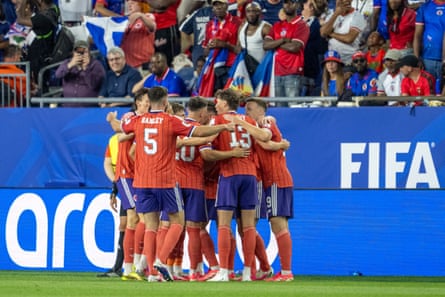
Jude Bellingham has revealed things were not right off the pitch in England’s camp at Euro 2024. Despite reaching the final, where they were beaten by Spain , Sir Gareth Southgate’s side were far from convincing during their run in Germany.

Thomas Tuchel has spoken of creating a “brotherhood” in his squad as he tries to win the World Cup this summer and Bellingham, speaking from inside England’s camp in Kansas City, said that was not the case at the European Championship two years ago.

“At the Euros I think we got a few things wrong off the pitch, I don’t feel the group connected as well as it could have for a number of reasons,” he told the Lion’s Den. “When it came to the tournament, we were seen as one of two or three teams that could win it. We weren’t playing well, which doesn’t help, so even when we were winning, we didn’t get the feeling that we were as happy as we should be.”

England needed Bellingham’s last-minute overhead kick to force extra time against Slovakia in the last 16, penalties to beat Switzerland in the quarter-finals and a last-minute goal to get past the Netherlands in the semi-finals.

Bellingham’s intervention against Slovakia was one of England’s most memorable moments in tournament football, but he says the shine is taken off it by the circumstances of the goal. The Real Madrid midfielder said: “I still remember how I was feeling at the time. It always makes me feel a bit uncomfortable because it was such a bad situation.

“We weren’t playing well. I remember as a kid watching World Cups and Euros where we crashed out against teams we shouldn’t have gone out to and I remember thinking: ‘Wow, I’m about to be a part of one of those moments.’ It shakes up the whole of English football.”

Bellingham faces a fight for a starting role in England’s World Cup opener against Croatia on Wednesday because Tuchel appears to have pitted him against Morgan Rogers in a straight shootout for the No 10 position. The pair have a close relationship, having grown up in the same area in the West Midlands and played junior football together.

Bellingham, who advanced his case for winning the shirt with his display in Wednesday’s final warm-up win against Costa Rica, said there were no problems between the pair.

“He is a top guy, he can get along with anyone, can have conversations with anyone,” Bellingham said. “He can be a bit loud. We have debates that turn into arguments a lot. But we get on like brothers, to be fair.

“The manager has made it very clear in a lot of the times where he has spoken that we are playing for the same position. I know that has eased up a bit more now that he sees me playing more positions and Morgs playing more positions, but I honestly have no ill feelings when he is playing and I’m not playing.”

Chess: Carlsen heads for Hong Kong while Russia unveils the next Botvinnik | Magnus Carlsen | The Guardian

Keyword – Sport
Trefwoorden – Magnus Carlsen, Chess, Sport
Title – Chess: Carlsen heads for Hong Kong while Russia unveils the next Botvinnik | Magnus Carlsen | The Guardian
Author – https://www.theguardian.com/profile/leonardbarden
Link – Chess: Carlsen heads for Hong Kong while Russia unveils the next Botvinnik | Magnus Carlsen | The Guardian
Publish date – 2026-06-12T07:00:38.000Z
Category – Sport
URL – https://www.theguardian.com/sport/2026/jun/12/chess-carlsen-heads-for-hong-kong-while-russia-unveils-the-next-botvinnik

Magnus Carlsen, the world No 1, had his worst tournament result since 2015 last week when the 35-year-old ended up fourth of six in the $178,000 (£133,000) Norway Chess event at Oslo, losing four games out of 10.

There were reasons for his disappointing showing. Previous editions of the event were in distant Stavanger, far from the hometown pressures of Oslo, while Carlsen is the father of a baby son and he arrived at several games seemingly unprepared.

He often took too long over his opening moves. The fast time control was 40 moves in the first two hours, followed by a mere 10 seconds per move increment from move 41 until the end of the classical game.

Drawn games were replayed under Armageddon rules, where White had 10 minutes on the clock and Black seven minutes, but a draw on the board counted as a win for Black. Norway’s scoring system was 3 points for a classical win, 1 for a classical draw, 0 for a classical loss, 0.5 for an Armageddon win and 0 for an Armageddon loss.

Carlsen several times entered the confession booth where players could voice their thoughts to the audience. During one game, which he later lost, he summarised his day so far as: 1 Woke up. 2 Had breakfast. 3 Had a nap. 4 Felt really old.

He made a special effort against Gukesh Dommaraju, the Indian 20-year-old who now holds Carlsen’s abdicated position as world champion but has failed to make an impact. Gukesh finished sixth and last in Oslo, and there was no repeat of 2025 when Carlsen lost to the Chennai player then thumped the table in frustration.

Their final round game was vintage Carlsen, despite mishandling his clock time and playing a long ending on increment. It was a textbook demonstration of how to win with bishop v knight and an outside passed pawn. In the final position the end would be 65…Ng7 66 Kf6 Ne8+ 67 Ke7 Ng7 68 Bg4! and Black’s knight is trapped.

Gukesh’s compatriot Praggnanandhaa Rameshbabu, who was in last place after six rounds, enjoyed a purple patch of four straight wins which, with the aid of the scoring system, took him all the way to first.

Praggnanandhaa’s overall form is strange, though. His stellar 2025 made him one of the favourites for the 2026 Candidates, but he was never in contention there. His Oslo success only takes him to No 11 in the live ratings , with Gukesh a dismal 25th. In contrast, Carlsen has been an unchallenged No 1 for 15 years.

Carlsen’s next event will be the Fide World Team Rapid and Blitz championships, starting on 17 June in Hong Kong. The event was played in central London last year, when the blitz was won by the top-seeded WR team founded by the German chess sponsor Wadim Rosenstein.

Teams of six have mandatory women, junior, and amateur boards. WR are again the top seeds, and include the No 1 ranked woman, Hou Yifan, as well as Carlsen. Teams for the €500,000 (£430,000) event also feature three young stars who could all be the frontrunners for chess in the 2030s: Turkey’s Yagiz Kaan Erdogmus, 15, Argentina’s Faustino Oro, 12, and Russia’s Roman Shogdzhiev, 11.

Erdogmus and Oro have already qualified as grandmasters, while Shogdzhiev broke an age record which has stood for 18 years last week when he scored his first of three required GM norms in the Asian Championship at Ulaanbaatar, Mongolia. The Russian had already narrowly missed his first norm a few months ago at Tashkent and made no mistake in Mongolia, where he was unbeaten against the six GMs he played and drew confidently against India’s experienced Krishnan Sasikiran in the final round.

Shogdzhiev now has the world GM age record of the USA’s Abhimanyu Mishra, 12 years and four months, firmly in his sights. The Russian still has about 12 months to score two more GM norms and reach an overall 2500 rating. That achievement, if it happens, will be sweeter because Oro failed to achieve his own final norm early this year and break the record in Aeroflot Moscow. Oro had to wait until his next event in Sardinia last month before qualifying for the GM title.

Shogdzhiev was born in Elista, Kalmykia, the land of Fide’s former president Kirsan Ilyumzhinov. He was taught chess by his father at four, his mother gave up work to home-school him, and the family moved to Moscow to help him. This column mentioned Shogdzhiev several times in 2023-24 when he was still comparatively unknown, but was receiving special treatment, including a series of all-play-all blitz tournaments where the boy could hone his skills against established masters.

Long ago in the early 1930s, the Soviets identified Mikhail Botvinnik, then 21, as a potential world champion. He got special help, including rare trips to the West and a personal trainer. In the late 1960s, the same path was followed for Anatoly Karpov when he emerged on the world scene.

Now it seems that Russia, which currently has no players in the world top 10, plans to restore its former No 1 chess status, with Shogdzhiev as the spearhead. The 11-year-old has seven grandmaster coaches, one for every day of the week, led by the two-time Russian champion Evgeny Tomashevsky, who says of his pupil: “If you play like Roman at 11, it’s very close to a unique case.”

Next week in Hong Kong, Shogdhziev and Oro will play on the two junior boards for Chess United, the No 8 seeds, who are led by the former world champion Vishy Anand.

Shogdzhiev says of being compared to Oro: “I’m very relaxed about it. But, of course, I want to catch up and surpass … We’re not friends, we don’t see each other often. The language barrier is also a hindrance.”

Shogdzhiev says that his ultimate goal is to become world champion: “I just want to. That would be awesome!”

The three super-talents Erdogmus, Oro and Shogdzhiev are all home schooled. This is a stark contrast with Germany’s world No 6, Vincent Keymer, who had to complete his final state exams a few days before a world championship qualifier.

England’s rising talent Supratit Banerjee, 12, has to prioritise his Sutton grammar homework before spending a couple of hours on chess, while Bodhana Sivanandan, England’s top-ranked woman at 11, has achieved all her successes while a pupil at a state primary school in Harrow.

GM Danny Gormally, 50, won the silver medal on his first appearance in the European over-50 senior championship at Acqui Terme, Italy. Gormally scored 6.5/9, with his only defeat being against France’s top-seeded GM Jean-Marc Degraeve, who totalled an unbeaten 7/9. This is a fine result for Gormally, whose streams on chess are increasingly popular and who is one of England’s few full-time professional players. He had declared beforehand that his target was a place in the top three so as to qualify for free entry and expenses for the next championship in 2027.

In the European over-65 championship, which had more well-known players than the over-50, Georgia’s GM Zurab Sturua won with an unbeaten 7.5/9. GM Keith Arkell finished ninth with 6.5/9, FM Terry Chapman 14th with 6/9, and Scotland’s IM Craig Pritchett, who was second in the unofficial over-75 standings, 20th with 6/9.

Chess has almost always decided its world champion by individual matches rather than tournaments of leading contenders, and the historical record supports this. Periods with a single dominant player (Wilhelm Steinitz, Emanuel Lasker, José Capablanca, Alexander Alekhine, Mikhail Botvinnik, Bobby Fischer, Anatoly Karpov, Garry Kasparov and Carlsen) have been more frequent than instances where the No 1 was only primus inter pares .

When, as now, the official world champion seems inadequate for his role, criticisms of the system quickly multiply. It remains to be seen whether Sindarov, who will challenge Gukesh later this year, can be as impressive in the forthcoming title match as he was in the recent Candidates.

4028 : 1 Rb7! Rxb7 2 Nc6+ Ke8 3 Rxd8 mate. If 1…Rxd4 2 Rxd4+ or 2 Rdc1 should win on material – although in the actual game White missed numerous chances before drawing with K+R v Kv N in 108 moves.

‘A big pouffy dress is not really me’: the brides who got wed in a suit – long before Dua Lipa | Weddings | The Guardian

Keyword – Life and style
Trefwoorden – Weddings, Women’s suits, Wedding dresses, Fashion, Life and style, Dresses for weddings, Skirts
Title – ‘A big pouffy dress is not really me’: the brides who got wed in a suit – long before Dua Lipa | Weddings | The Guardian
Author – https://www.theguardian.com/profile/ellie-violet-bramley
Link – ‘A big pouffy dress is not really me’: the brides who got wed in a suit – long before Dua Lipa | Weddings | The Guardian
Publish date – 2026-06-10T11:00:18.000Z
Category – Lifestyle
URL – https://www.theguardian.com/lifeandstyle/2026/jun/10/a-big-pouffy-dress-is-not-really-me-the-brides-who-got-wed-in-a-suit-long-before-dua-lipa

For some people, wearing a big white dress on their wedding day feels as key as the rings. For others, less so.

When Dua Lipa wore a Schiaparelli couture white skirt suit as she wed the actor Callum Turner in London last month, she joined a long line of women who have opted for a suit. Not least Bianca Jagger, whom Lipa was speculated to be emulating – the model and activist caused a stir when she got hitched to Mick Jagger in 1971, wearing a Yves Saint Laurent Le Smoking jacket and bias-cut skirt.

In a way it’s strange that it’s still considered unusual, but the concept of the traditional wedding, dress and all, still holds immense sway. So who else has chosen a suit over a dress? And were they inspired by Jagger or simply cutting their own cloth? We asked readers for stories of their wedding-day suits.

Tilly Burn, 31, works in local government , Moreton-in-Marsh

I had been toying with the idea of wearing a suit for a while – the reusability really appealed to me, and I realised that if I had a wedding dress it would hang forgotten in my wardrobe. I wanted something comfortable and, rather than just looking beautiful on my wedding day, I wanted to feel cool.

Then I saw the iconic photo of Bianca Jagger and I just thought she looked so cool; effortlessly chic and sexy. A woman wearing a suit looks so powerful! So she became my inspiration.

I tried on lots of different suits, from really expensive Vivienne Westwood ones to mid-range to much cheaper. My suit was by a brand called Me+Em, and I got the trousers tailored perfectly by a local suit-maker, Anwen Greenaway. I felt incredible.

I was married nearly three years ago at the Manor House hotel, Moreton-in-Marsh, and have worn the suit at least 15 times since. On one memorable occasion I did a great John Lennon costume with it.

Judith Winters, 55, archaeological editor, North Yorkshire

We got married in 1997 at Sheffield register office. We were indie postgraduate students and had decided on a humanist wedding – it was definitely our statement of: “We’re going to do this our way.”

I had never dreamed of the white-dress wedding but I did want to dress up for a change. So we took a trip to the fairly new Harvey Nichols store in Leeds. I chose a pale blue Nicole Farhi trouser suit that matched the occasion perfectly.

I felt amazing in it. The trousers were really comfortable and it meant I could boogie on the dance floor and pick up the small children who were at the wedding.

I have worn the suit several times since. It’s still hanging in my wardrobe, looking for that niece to pass it on to.

Justine Knowles, 57, osteopath, Birmingham

I married my husband in 2003 at the register office in Birmingham. We had already been living together for five years. We had no desire to have a traditional wedding and wanted to be quite unconventional about it.

We started with a list of things we could do without and a big, expensive white dress was top of it. I’ve never been a girly-girl and a big white pouffy dress is just not really “me”. So I thought: “Why don’t I just buy a white trouser suit like Bianca Jagger?” I said: “We could go a bit more rock’n’roll with it.” My husband played in bands and he wore a royal blue and red pinstripe Ozwald Boateng suit.

I also didn’t want to end up with something in my wardrobe that I’d never wear again. My mum had put a token effort into getting me into a “nice dress” from the high street but even she admitted I looked better in the white tuxedo trouser suit I had picked out from Principles. It fitted perfectly and was only just over £100.

I have worn it on other occasions since. It probably needs a good old dry clean.

Sarah Morley, 59, graphic designer, near Bath

I was 44 when I married my husband, Chris, at the Roman baths in Bath in September 2011. I’ve never really been a “dress” person, and I’ve always admired women like Diane Keaton, Bianca Jagger and Katharine Hepburn, who showed how stylish a suit can be. Plus, I thought a suit would reflect that I was independent, strong and stylish. But the women’s suits that I’d been looking at didn’t have that edge.

I was at a loss until the day my husband-to-be had a fitting for his suit (he’d always wanted a Savile Row suit and had thought if not now then when). While standing there as the tailor, Richard Anderson, measured him, I thought: “Damn, of course this is the answer.”

A man’s suit, fitted to me, just had that frisson – there were no alterations to make it more feminine, and underneath I wore it with a traditional men’s formal backless evening waistcoat … but with no shirt. It felt fantastic.

Judith Mendes, 61, marine biologist, Jamaica

The decision to wear a suit was a practical one resulting from a sentimental choice to get married where we met, at the coastguard base in Port Royal, Jamaica.

At the time I was a graduate student studying coral reefs and doing my fieldwork right next door to the base. One Christmas, students were invited to a party and I met my now ex-husband there.

So we decided, when we got married in 1992, that it would be nice to get married back there on a coastguard vessel. This required walking up and down a narrow gangway as well as over obstacles on the deck. Obviously a big pouffy dress was just not going to work.

I got that suit off the rack. The shawl collar was made of lace and it had sequins and beading that sparkled in the sunlight. I really felt very beautiful in it.

Helga Saint Pierre, 71, retired teacher, Halifax, Canada

We were students with little money when we got married in the 70s. We planned a simple secular celebration in Canada with university friends, a homemade meal and cake. The only splurge was champagne.

I wore a dove-grey suit that I’d bought off the rack and a small lily of the valley antique brooch that had been my first Christmas present from my soon-to-be husband. All in all, there was no spectacle and very little cost: $100 in 1976.

Maxine O’Neill, 61, location coordinator, Harrow

It was 1993. My husband and I both worked in the record industry and were not the kind of people who would wear traditional suits or meringue-style wedding dresses; it just wasn’t really “us”.

So my lovely mother-in-law, Belle, who was a dressmaker, made me a suit in cream silk, and I made a hat out of a feather boa. We got married in Newry, northern Ireland, where my husband is from.

I don’t have the suit any more because I left it at my parents for safekeeping and they moved and sent it to charity by accident. But I’ve still got the hat.

Do you have an opinion on the issues raised in this article? If you would like to submit a response of up to 300 words by email to be considered for publication in our letters section, please click here.

How do I know when I’ve hit perimenopause? | Well actually | The Guardian

Keyword – Wellness
Trefwoorden – Well actually, Life and style, Menopause, US news, Women, Women’s health
Title – How do I know when I’ve hit perimenopause? | Well actually | The Guardian
Author – https://www.theguardian.com/profile/keren-landman
Link – How do I know when I’ve hit perimenopause? | Well actually | The Guardian
Publish date – 2026-06-07T16:00:02.000Z
Category – Lifestyle
URL – https://www.theguardian.com/global/2026/jun/07/perimenopause-diagnose-how-to

There’s a special frisson to period changes in your mid-forties. Every deviation from your usual pattern can feel like a harbinger of the menopause transition, also known as perimenopause.

One might spend years staring at their underwear, wondering: am I or aren’t I?

Unfortunately, early perimenopause is characterized by uncertainty. That’s because the transition happens in fits and starts, not all at once.

In comparison, menopause itself is just a moment – specifically, the moment 12 months after a person’s last period. It’s only diagnosed retrospectively, long after their ovaries have stopped making estrogen, which drives the menstrual cycle.

It can be really helpful to know whether you’ve started perimenopause. If your symptoms are derailing work or relationships, a diagnosis opens the door to getting treatment. Here’s what you need to know.

What does perimenopause look like?

On average, perimenopause starts around age 47. A changing menstrual cycle usually heralds its arrival, “and the biggest change women will notice is they skip a cycle”, says Nanette Santoro, a professor of obstetrics and gynecology and menopause treatment researcher at the University of Colorado Anschutz School of Medicine.

The first symptoms start an average of four years before the last period, but it’s different for each individual; your periods may start changing months before menopause, or a decade before.

During early perimenopause, periods aren’t as regular, and are often late or early by at least a week. Period flow might be lighter or heavier, and about 40% of women have hot flashes.

Later in perimenopause, periods are even less frequent – sometimes as much as two months apart. Hot flashes peak at this stage, showing up in about 80% of women. Additional symptoms often enter the picture, including depression, sleep disturbances, and genital and bladder symptoms like vaginal dryness and vulvar burning or itching.

Waning estrogen levels are the root cause of these symptoms. In midlife, after decades of releasing estrogen into the bloodstream on a more-or-less regular schedule, the ovaries start to slow down. That translates to less estrogen in the body at less predictable intervals.

Less estrogen means less period flow, because it plays a major role in regular menstruation by growing the uterine lining that gets sloughed off during periods. Estrogen also helps regulate the parts of the nervous system that control temperature and sleep, so dwindling levels lead to hot flashes and sleep problems. It also controls the cells that maintain elasticity and blood flow in the genitals, leading to reduced resilience, lubrication and sensation.

If your periods have stopped due to removal or medical alteration of the uterus, chemotherapy, use of a hormonal IUD or other progesterone-only contraceptives, or other conditions that disrupt regular cycles, you won’t detect flow changes. But other changes will be noticeable. (A blood test can be useful in these situations; more on that below.)

How do I know if I’m in perimenopause?

If your symptoms are pretty typical and you’re over 45, that’s usually enough data for a clinician to make a diagnosis.

“If you’re 49 and you’re telling me you’ve got hot flashes or you’re having these certain changes, I don’t need a blood test to tell you that this is perimenopause,” Santoro says.

Estrogen tests exist, but an abnormal result isn’t that informative, says Lauren Streicher, a professor of obstetrics and gynecology, and menopause researcher, at Northwestern University’s Feinberg School of Medicine. The tests are accurate, but estrogen levels fluctuate wildly during perimenopause. If the level is normal, you might just be catching an upswing or the beginning of a crash – and a low level could also be normal at various times in a person’s life.

Blood tests can be helpful if your symptoms aren’t typical, or if you’re experiencing them earlier than expected. Thyroid problems and diabetes can also begin at midlife and can lead to cycle irregularity, hot flashes and mood swings, so it’s worth ascertaining the true cause.

For particularly confusing scenarios – for example, if you have an IUD and ambiguous symptoms – the blood test for anti-Mullerian hormone (which tells you approximately how many eggs you have left) can help determine whether you are near menopause, but it isn’t useful for every age group and situation.

Several companies sell direct-to-consumer test kits that enable people to check hormone levels at home, but both Streicher and Santoro say they are not good enough predictors of menopause to be particularly useful.

I think I’m in perimenopause – do I need to do anything?

If you have any of the core menopause symptoms, see a menopause specialist about treatment. Hormonal and non-hormonal therapies are available for managing most menopause symptoms, but they’re underprescribed. An OB-GYN with menopause expertise or a primary care clinician with training in treating menopause symptoms can help determine what could work best for you.

While not directly related to menopause, lifestyle basics become particularly important in midlife; Santoro recommends getting good sleep, quitting smoking, exercising regularly and eating healthy, high-fiber foods.

Additionally, get checked regularly for common midlife medical conditions, like high cholesterol, high blood pressure and diabetes. “If you’ve got hypertension in your family and you inherited those genes, they’re coming after you at this time of life,” says Santoro.

Keren Landman MD is an independent health reporter who is also trained as an infectious disease physician and epidemiologist, with experience serving as a disease detective at the CDC and conducting HIV and malaria research in resource-poor countries. Her public health newsletter is called Landmansplained