Keyword – None
Trefwoorden – None
Title – David Squires on … a thirst for adverts and other notes from the World Cup so far | World Cup 2026 | The Guardian
Author – David Squires
Link – David Squires on … a thirst for adverts and other notes from the World Cup so far | World Cup 2026 | The Guardian
Publish date – Tue 16 Jun 2026 12.07 CESTLast modified on Tue 16 Jun 2026 13.36 CEST
Category – Sport
URL – https://www.theguardian.com/football/picture/2026/jun/16/david-squires-thirst-for-adverts-other-notes-world-cup-2026
Russell Crowe says Gladiator II failed because ‘it didn’t have a moral core’ | Film | The Guardian
Keyword – Film
Trefwoorden – Film, Russell Crowe, Culture, Gladiator, Gladiator II, Ridley Scott
Title – Russell Crowe says Gladiator II failed because ‘it didn’t have a moral core’ | Film | The Guardian
Author – https://www.theguardian.com/profile/andrewpulver
Link – Russell Crowe says Gladiator II failed because ‘it didn’t have a moral core’ | Film | The Guardian
Publish date – 2026-06-16T11:01:52.000Z
Category – Culture
URL – https://www.theguardian.com/film/2026/jun/16/russell-crowe-says-gladiator-ii-failed-because-it-didnt-have-a-moral-core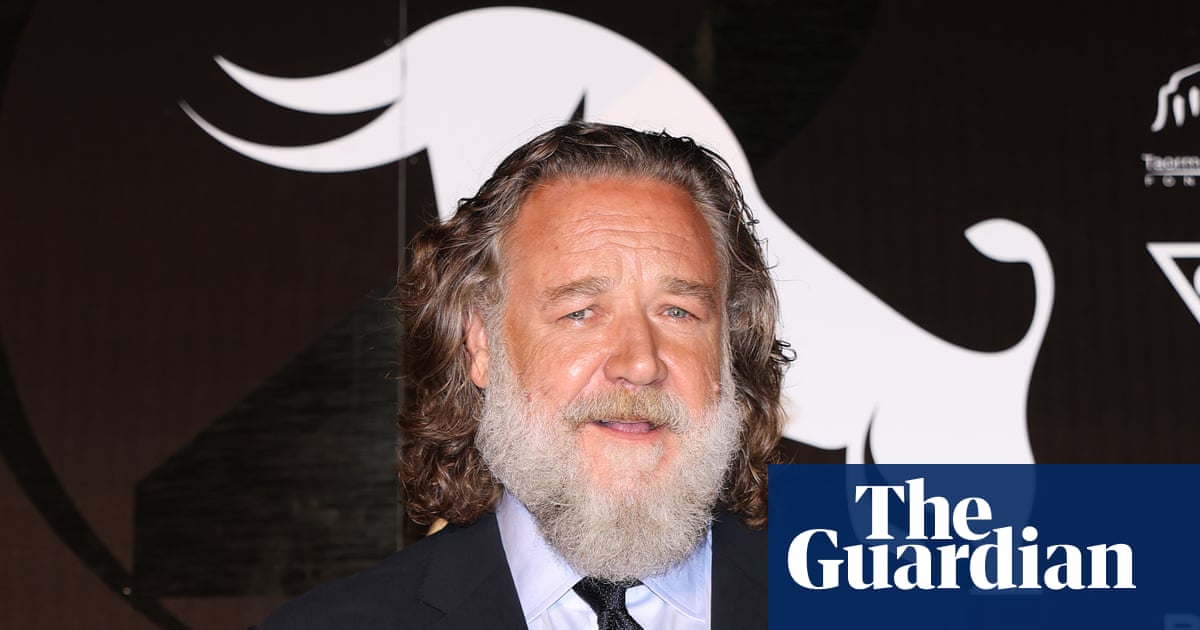
Russell Crowe has said that the Gladiator sequel was a failure because it lacked a “moral core” and that studio behind it “didn’t understand why [the original movie] was successful”.
Crowe was speaking at the Taormina film festival, and in remarks reported by Variety he outlined why the thought the first Gladiator, released to considerable acclaim and box office success in 2000, was a success, and where its sequel, released in 2024, struggled.
Crowe said that his refusal to shoot a sex scene with Connie Nielsen, who played his former lover Lucilla, gave the first Gladiator its “emotional core”. “When we were shooting that film, there was a lot of pressure. The studio, the producers [thought] there should be sex between Maximus and the female characters. I kept pushing back. This is the story of a man avenging the death of his wife and his child. There cannot be a moment in that journey where he stops and has sex with somebody. It doesn’t make any sense because that destroys the journey.”
Crowe added that Ridley Scott , who directed both films, gave way. “Luckily for me, Ridley, even though he’d love a sex scene between me and Connie Nielsen, agreed with me back then that that was the emotional core of the film.”
Gladiator II, in Crowe’s view, failed to heed the lessons of the first film’s success, saying that women appreciated the original Gladiator and were a key element of its audience. “[The studio] failed because they didn’t understand why [the original movie] was successful – it had a moral core.
“That’s the thing a lot of people don’t realise: from the second week of release globally, there were always more women in the theatres than men. You think that on the surface Gladiator is a movie for men, but if it was a movie for men, it would be about revenge, but it’s not about revenge. It is a movie for women because it is about vengeance.”
Houseplant hacks: does fish tank water work as fertiliser? | Houseplants | The Guardian
Keyword – Life and style
Trefwoorden – Houseplants, Gardening advice, Life and style, Gardens
Title – Houseplant hacks: does fish tank water work as fertiliser? | Houseplants | The Guardian
Author – https://www.theguardian.com/profile/gynelle-leon
Link – Houseplant hacks: does fish tank water work as fertiliser? | Houseplants | The Guardian
Publish date – 2026-06-16T09:00:18.000Z
Category – Lifestyle
URL – https://www.theguardian.com/lifeandstyle/2026/jun/16/houseplant-hacks-does-fish-tank-water-work-as-fertiliser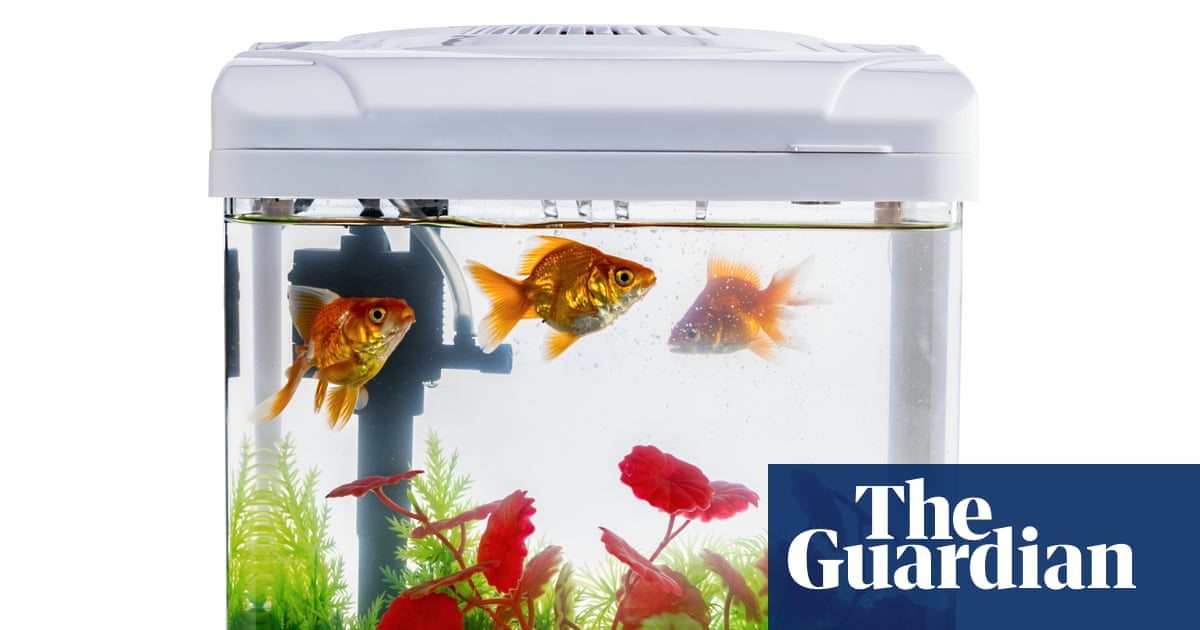
The problem Houseplants need liquid fertiliser, but this can be expensive. Fish tank owners, meanwhile, produce litres of nutrient-rich water during water changes, which then gets poured away. Could it feed houseplants instead?
The hack Water from a freshwater aquarium contains nitrogen, phosphorus and beneficial bacteria. Rather than discarding it during routine water changes, use it to water your houseplants, giving them a free feed.
The method Only use water from a freshwater tank that is changed often. Collect the water during a partial water change. Allow it to reach room temperature before using it on your plants, then apply as you would any water with liquid feed.
The test I used aquarium water on a monstera and a peace lily for a month. Both plants showed healthy growth, and the peace lily pushed out a new leaf. The water did have an odour, but it faded quickly.
The verdict Aquarium water is a useful resource. It will not entirely replace a balanced fertiliser, as the nutrient ratios will vary depending on the tank, the fish and how recently they were fed. But as a supplement between proper feeds, it is considerably less wasteful than watching it disappear down the plughole.
Cape Verde’s Vozinha in tears as cost of visa stopped mother being at Spain draw | World Cup 2026 | The Guardian
Keyword – Football
Trefwoorden – World Cup 2026, Cape Verde, Spain, World Cup, Football, Sport, Africa
Title – Cape Verde’s Vozinha in tears as cost of visa stopped mother being at Spain draw | World Cup 2026 | The Guardian
Author – https://www.theguardian.com/profile/sidlowe
Link – Cape Verde’s Vozinha in tears as cost of visa stopped mother being at Spain draw | World Cup 2026 | The Guardian
Publish date – 2026-06-15T21:19:13.000Z
Category – Sport
URL – https://www.theguardian.com/football/2026/jun/15/cape-verde-hero-vozinha-in-tears-after-spain-draw-as-cost-of-visa-stopped-his-mother-being-at-game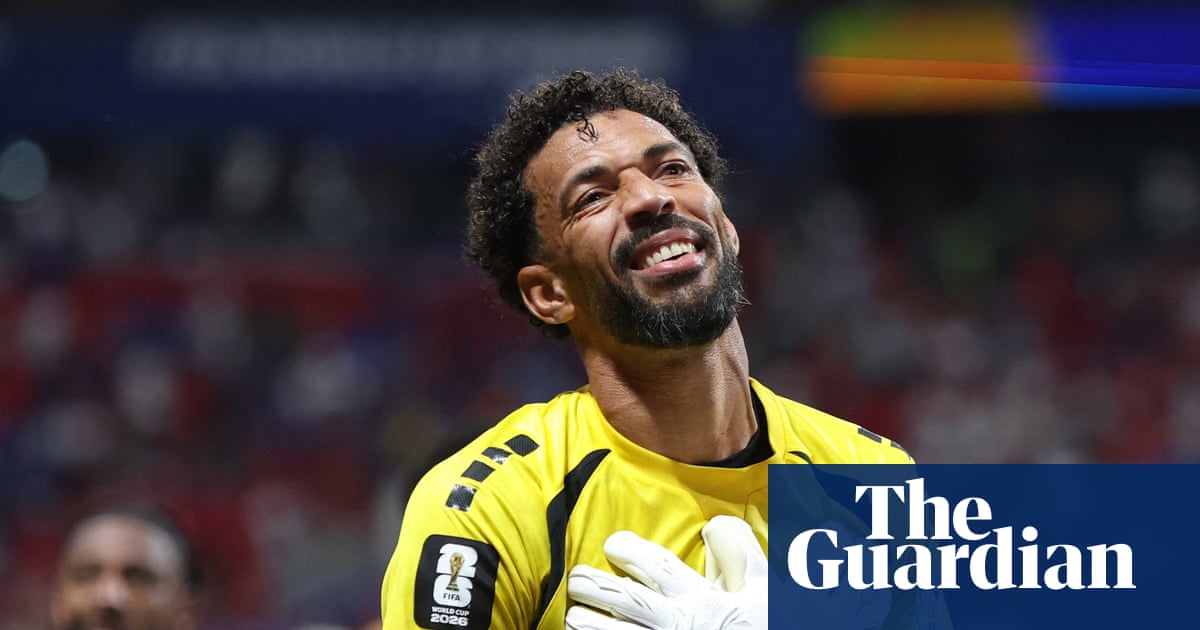
Vozinha, the 40-year-old goalkeeper who was named player of the match after making seven saves in his side’s 0-0 draw against Spain, was in tears at full time. The mother of Cape Verde’s World Cup hero was not there to see history made because she could not afford the visa to the US.
The goalkeeper described the game as the moment he had been working towards his “entire life” and said he wished he could have shared the moment with his late grandparents and his mother.
In January the US government added Cape Verde to the list of countries whose citizens have to post a returnable bond of up to $15,000 (£11,200) before travelling to the US, on top of the visa fee. As a result, Vozinha’s mother was unable to complete her application. Vozinha has been Cape Verde’s No 1 for 13 years.
“I cried because I grew up with my grandparents and unfortunately they were not here; they died a few years ago,” he said. “They were everything for me, for my life. I also cried because my mum didn’t manage to be here because of the visa. Because of the money we had to pay for the visa, we didn’t manage to [get it done] on time. I would like her to be here, but I’m also very happy.
“I have worked my whole life for this moment. I’m 40 years old. I started playing football professionally when I was 25, in 2012. I thought about leaving but I continued because of this dream. This is for everyone. I was named man of the match but this is for all of my teammates because without them nothing would be possible. I will continue to work for Cape Verde and for the people.
Spain, unsurprisingly, had the majority of possession but struggled to break down a well organised Cape Verde defence. Ferran Torres hit the bar in the European champions’ best chance. Everything else that was on target Vozinha stopped.
“Our best weapon is our unity. The way we treat our family is our best strength. Everyone thought we came here just to enjoy the World Cup , but we know we have a team that deserves respect. It’s our first time, but we are here to compete and to fight for our country. We will play all the games with our strategy and our coach’s tactics. We will try to do better than today’s game. I hope we can win some games and, who knows, maybe go through to the next round. I am very happy and proud of all our players.”
The Cape Verde head coach, Bubista, said: “Vozinha is overwhelmed by the emotion. He has made a huge effort to be here, and those were tears of resilience. I don’t like to talk about individuals, but he played so well. The team was calm and that helped to keep him calm.
“This means everything for the country. We’ve always said that we want the whole world to see how our team plays. We showed courage, playing in a way that is a metaphor for our country: with resilience and overcoming obstacles.”
Zelenskyy thanks G7 leaders for ‘strong ideas on how to force Russia into peace’ – as it happened | G7 | The Guardian
Keyword – World news
Trefwoorden – G7, Europe, Ukraine, Russia, France, Donald Trump, Germany, Italy, Japan, Canada, US-Israel war on Iran, Iran, Emmanuel Macron, Volodymyr Zelenskyy
Title – Zelenskyy thanks G7 leaders for ‘strong ideas on how to force Russia into peace’ – Europe live | G7 | The Guardian
Author – https://www.theguardian.com/profile/jakub-krupa,https://www.theguardian.com/profile/alexandratopping
Link – Zelenskyy thanks G7 leaders for ‘strong ideas on how to force Russia into peace’ – Europe live | G7 | The Guardian
Publish date – 2026-06-16T12:54:43.000Z
Category – News
URL – https://www.theguardian.com/world/live/2026/jun/16/g7-world-leaders-ukraine-russia-war-iran-trump-zelenskyy-putin-eu-france-eu-europe-latest-news-updates
Zelenskyy thanks G7 leaders for ‘strong ideas on how to force Russia into peace’
Back to G7, Ukraine’s Volodymyr Zelenskyy has taken to social media to hail a good G7-Ukraine discussion in France , thanking fellow leaders for their time this morning and “for the strong ideas on how to force Russia into peace.”
“Priorities are clear: more air defense missiles along with licences to produce them, winter support package, and cranking up pressure on Russia. Importantly, the US is ready to provide backstop across these lines of effort.
It is key that everything discussed be implemented. Russia must come to learn that its war will never be normalized. I thank everyone who’s helping.
US ‘soon will be able’ to potentially reimpose sanctions on Russian oil, Trump suggests
But Trump did appear to suggest he could reimpose some sanctions on Russian oil, though.
Asked about the possibility of tightening sanctions on Russia, he said:
“Well, soon we’ll be able to do that because the oil is now flowing. So we put, we took sanctions off, because obviously we’re not looking to impede the oil, so we’re in a position to do that soon … at some point.”
Trump gets asked about his decision to stay a bit longer for a formal dinner hosted by the French president, Emmanuel Macron , at the Palace of Versailles on Wednesday night.
The dinner will celebrate the 250th anniversary of the US independence.
Trump says:
“ I’m a fan of beautiful places, and… the French president, who happens to be a very nice man, invited me to dinner at Versailles … and Versailles is not a gold leaf, Versailles is the real deal.
And I said I’d like to do it, I mean, you know, all it means is that I get home later in the evening, meaning early in the morning, and I’m not a big sleeper anyway.”
We don’t get more on Ukraine , though.
Meanwhile, Trump is speaking to reporters again, after his meeting with the president of the UAE.
He is currently talking about the Middle East and Iran – we cover all of that on the Middle East blog – but I will pick up any lines on Ukraine and Europe.
Ukraine peace talks could start before summer, German foreign minister suggests
Meanwhile, the German foreign minister, Johann Wadephul, suggested that some talks on ending the Russian invasion of Ukraine could begin before summer.
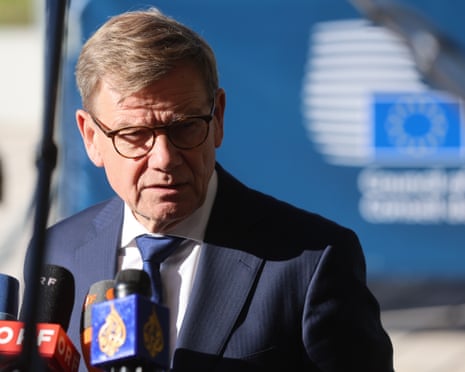
Talking to RTL/NTV broadcasters, Wadephul said neither party appeared to have an upper hand on the battlefield, with the war effectively stuck.
“There is now a chance, I think, to begin talks this summer,” Wadephul was quoted as saying by Reuters.
Referring to Putin, he added: “He may now be at a stage where he is seriously considering it.”
Zelenskyy also briefly talks about business and Ukraine’s postwar reconstruction, stressing the importance of international security guarantees to underpin that process.
Zelenskyy gets asked about China and if he would be prepared to speak to Xi to end the war with Russia .
He effectively says that yes and that he is ready to talk to whoever can help with ending the war.
Russia will find way to block EU accession if we don’t proceed swiftly, Zelenskyy says
Zelenskyy also gets asked about his talks with the German chancellor, Friedrich Merz, and his idea of an associate membership of the EU.
He praises Merz and says he is clearly on Ukraine’s side and stresses that he knows that Ukraine is hopeful on getting some sort of fast track to the EU membership.
He says if that does not happen, Russia “will find a way to block Ukraine’s way to EU.” “They don’t want to see us successful,” he says.
He says Ukraine wants the same membership as other countries, “not better, but not worse.”
Separately, he posted on social media that the pair also discussed “defence support for Ukraine,” including on air defence.
Zelenskyy gets asked about Trump’s infamous comment from last year that Ukraine does not hold any cards.
He says that the situation on the battlefield is changing , with Russia increasingly struggling on the battlefield.
Despite the Kremlin’s denials ( 12:04 ), he repeats his claim that he had suggested inviting Putin to join the talks.
He calls for talks with Putin before this winter and says they should take place in a third country , like Switzerland, Turkey, the US, or one of the Middle East countries.
“ It was terrible winter for us, and but … we don’t want to go through the same winter of course … and Russia has to know that we had terrible winter and they will have also not [a] simple [one]” this year, he says.
He confirms he discussed his proposals with Russian oligarch Roman Abramovich recently.
Trump ‘very positive they can help us with missiles,’ Zelenskyy says
Zelenskyy says that he needs the US president, Donald Trump , to put more pressure on Russia, as he says “Trump can do it, or only maybe only him.”
He says Trump was also “very positive that they can help us with missiles,” as Zelenskyy keeps pushing for a licence to Ukraine to produce Patriot missiles locally.
He says he “hopes it [will be] a yes.”
Zelenskyy also says he wants the EU to build a “European anti-ballistic system,” because “otherwise we will [all] not have enough.”
G7 leaders discussed further sanctions against Russia, Zelenskyy says
Zelenskyy also says he discussed with the G7 leaders some proposals for more sanctions on Russia , including on its shadow fleet.
“We see the [oil] prices are falling down and … it’s good, as Russia will not get additional benefits,” he says.
He also mentions the Russian banking and military sectors.
G7 leaders agree that Russia is not winning, he says
Ukraine’s Zelenskyy is also speaking now at the Reuters Next summit, via a video link.
Asked about his talks with the US president, Donald Trump, he smiles he told him “everything.”
He says the leaders had a “very positive” summit with a wide-ranging discussion on how to press Russia into negotiations.
He says the leaders unanimously agreed that “Russia is not winning and losing a lot of people, and they have to make a deal as quick as possible.”
He adds a growing number of Russians understand they are not winning and should end the war. “Better late than never,” he says.
He confirms he “had some talks” with Trump and is hoping to have more later, with plans to also meet with Germany’s Merz, and the EU’s von der Leyen and Costa.
He says all leaders recognise that Russia keeps attacking civilian targets and does not seem to want to end the war.
Zelenskyy thanks G7 leaders for ‘strong ideas on how to force Russia into peace’
Back to G7, Ukraine’s Volodymyr Zelenskyy has taken to social media to hail a good G7-Ukraine discussion in France , thanking fellow leaders for their time this morning and “for the strong ideas on how to force Russia into peace.”
“Priorities are clear: more air defense missiles along with licences to produce them, winter support package, and cranking up pressure on Russia. Importantly, the US is ready to provide backstop across these lines of effort.
It is key that everything discussed be implemented. Russia must come to learn that its war will never be normalized. I thank everyone who’s helping.
Lithuania gets new prime ministrer after coalition reshuffle
Elsewhere, Lithuania’s governing coalition named a new prime minister after a coalition reshuffle that expelled a populist junior partner, Reuters reported.
The appointment of Mindaugas Sinkevičius – the head of the Social Democratic party who briefly served as economy minister – was confirmed by Lithuanian president Gitanas Nausėda .
Sinkevicius will replace current prime minister Inga Ruginienė , also a Social Democrat.
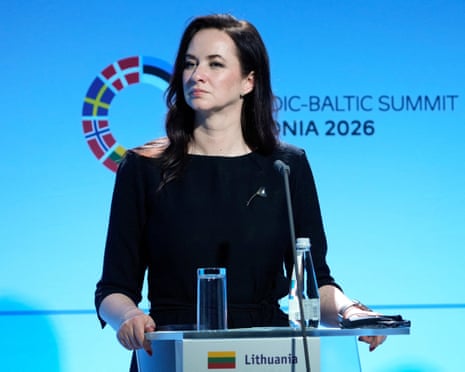
The Social Democrats – who lead the governing coalition – had announced in early June that they would be ousting populist party Nemunas Dawn, criticising its leader Remigijus Žemaitaitis for “inflammatory statements”.
EU lawmakers approve legislation on trade deal with US
Meanwhile, over in Strasbourg, the European Parliament has voted to approve legislation to implement the EU-US trade deal, after months of delays and uncertainty caused by numerous tariff threats from the US president, Donald Trump .
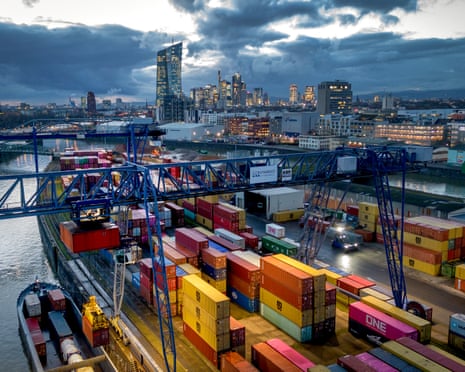
The vote was a formality after a political decision between the EU’s decision-makers was reached last month.
Starmer vows new sanctions on Russia and nuclear energy support for Ukraine
in Évian-les-Bains
Keir Starmer has vowed to “choke off” Russian revenue with further sanctions and to provide hundreds of millions of pounds worth of energy support for Ukraine , as he met world leaders in France for the G7.
After a torrid political week at home , the British prime minister sought to put himself on the front foot on the international stage at the meeting of the group of seven, which kicked off on Monday in the French spa town of Évian-les-Bains, on the shore of Lake Geneva.
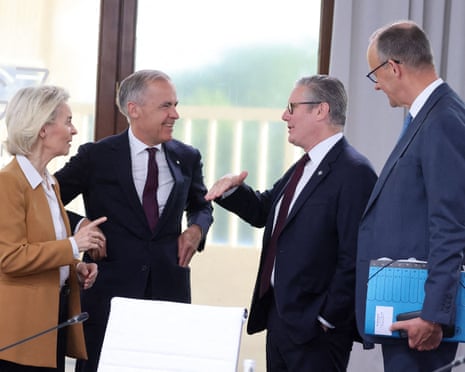
Starmer is expected to meet the Ukrainian president, Volodymyr Zelenskyy, and the prime minister of India, Narendra Modi , on Tuesday, the first full day of the summit.
He will announce sanctions against Russia , days after British troops seized a Russian shadow fleet oil tanker in the Channel.
He is also set to use the meeting to reassure Donald Trump he is willing to raise defence spending , after the resignation of his defence secretary, John Healey , last week and ongoing delays to his defence investment plan – but is not expected to have a bilateral meeting with the US president.
Kremlin says there was no invitation for Putin to attend G7 for talks with Zelenskyy
Meanwhile we also heard from the Kremlin, with Putin’s spokesperson, Dmitry Peskov, responding to Volodymyr Zelenskyy’s comments saying he had offered to meet Putin on the sidelines of the G7 summit in France ( Europe Live Monday ).
Peskov said there are currently no channels open between Kyiv and Moscow, and stressing there was no formal invitation to Putin to attend.
‘Russia should make a deal,’ Trump says as he confirms he held ‘very good meeting’ with Zelenskyy, will meet again later today
Oh, Trump is now speaking with reporters, sitting next to the Emir of Qatar.
He says he had a “very good” meeting with Zelenskyy this morning and will meet with him again later today.
“Look, Russia should make a deal. Russia’s lost tremendous amounts of people, and so has Ukraine. Last month, they lost 35,000 soldiers between the two; it’s on a monthly basis. They averaged 25,000 people, mostly soldiers, young, beautiful people, and it’s crazy what’s going on there.
But we had a meeting, and we’ll see… I spoke with President Putin on Sunday.”
He says there is “a lot of dislike between the two leaders,” and he will meet with Zelenskyy again later today.
There will be more new faces joining later this afternoon, with India’s Narendra Modi among them, too.
The Indian prime minister has just landed in France , coming from Slovakia, where he met with the country’s prime minister, Robert Fico , yesterday.
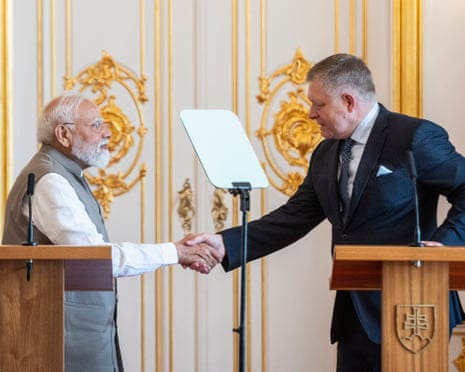
The two leaders – and their senior ministers – signed several deals on defence, digital (including AI), higher education, and labour mobility, according to reports in the Slovak media.
Fico stressed the benefits of the EU-India free trade deal, saying Bratislava would push for a swift implementation of the agreement as he invited Indian companies to invest in the central European country.
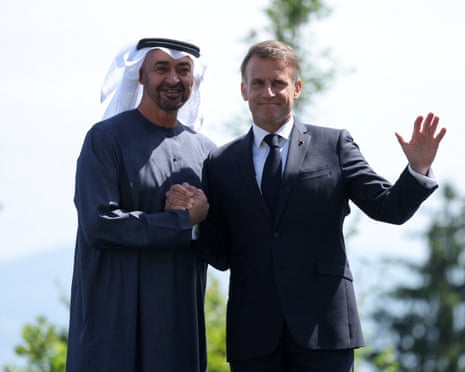
France’s Macron is now out of the meeting room again, welcoming the leaders of Egypt, UAE and Qatar to the G7 Summit, as they are expected to join the midday-ish session on the Middle East.
US justice department charges five men over alleged plot to attack White House UFC event | US crime | The Guardian
Keyword – US news
Trefwoorden – US crime, UFC, Donald Trump, FBI, Washington DC, US news, Sport, MMA, US sports
Title – Five people detained for alleged ‘planned attacks’ on White House UFC cage fighting show | US crime | The Guardian
Author – Associated Press
Link – Five people detained for alleged ‘planned attacks’ on White House UFC cage fighting show | US crime | The Guardian
Publish date – 2026-06-16T12:38:11.000Z
Category – News
URL – https://www.theguardian.com/us-news/2026/jun/16/white-house-ufc-fight-planned-attacks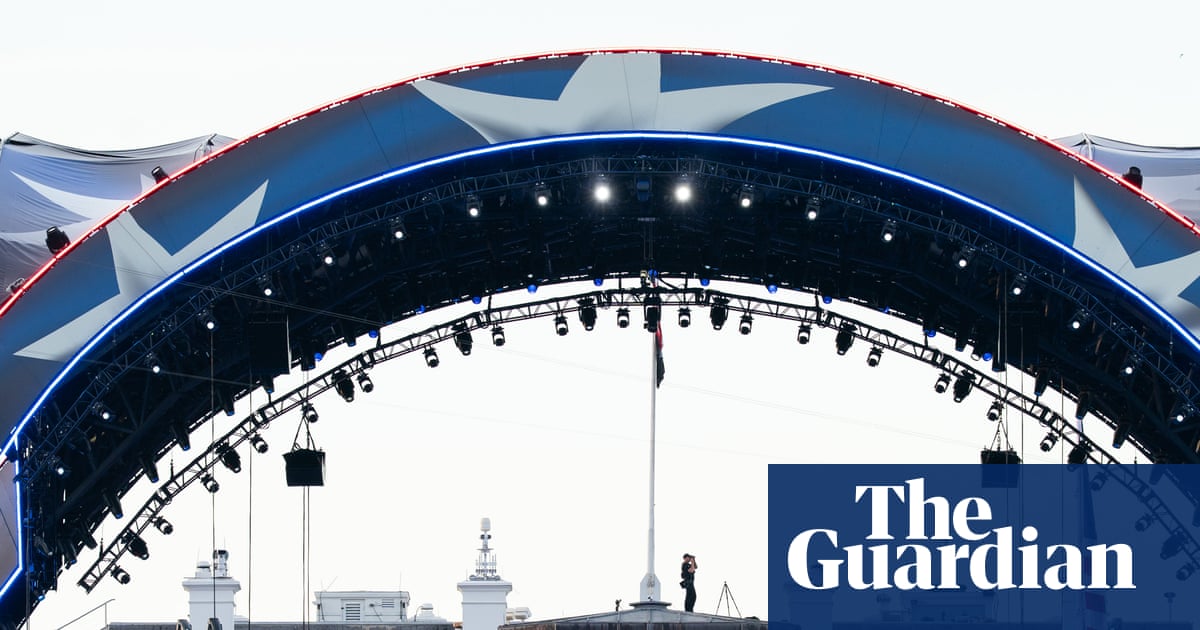
Law enforcement officials disrupted “planned attacks” meant to target the UFC cage fighting show staged at the White House this past weekend, and multiple people were in custody, said Kash Patel, the FBI director.
The nature of the potential threat was not immediately disclosed, with additional details expected to be released once charges are unsealed later Tuesday.
Five people were arrested from states including Ohio, Missouri and California, said a law enforcement official familiar with the matter. The official spoke to The Associated Press on the condition of anonymity to discuss information that was not yet public.
The FBI learned about the possible threat on 10 June, four days before the mixed-martial arts extravaganza on the White House’s South Lawn, “and thanks to the rapid action of the FBI, our partners, and the Department of Justice in a multi-state operation, multiple individuals are now in custody and allegedly planned attacks were stopped cold”, Patel said in a post on X on Tuesday morning.
Donald Trump, who celebrated his 80th birthday at the UFC event on Sunday, sought to tie the fights to larger celebrations of the 250th anniversary of the signing of the Declaration of Independence.
Fox News reported that five people had been arrested and were in custody and that investigators had identified 23 people potentially involved in a plot to attack the event. Officials told the network that the alleged plan involved using explosive‑laden drones and snipers and even possibly storming the White House gate.
There was no indication of how realistic or advanced the plot had become. Patel tweeted out a link to the Fox story which said the plot had come to the FBI’s attention on 10 June, triggering the first arrest in Cincinnati, Ohio.
Fox quoted a statement from the Secret Service.
“In the days leading up to this weekend, our special agents, mission support personnel, and technical security teams worked around the clock to identify those responsible and hold them accountable,” said Sean Curran, the Secret Service director. “Equally important to our protective mission is ensuring accountability through the justice system. To that end, our formal comments regarding the specifics of this case will be made through court filings.”
The Associated Press contributed to this report.
‘Then the firing started’: the Soweto uprising remembered 50 years on | South Africa | The Guardian
Keyword – World news
Trefwoorden – South Africa, Africa, Race, World news
Title – ‘Then the firing started’: the Soweto uprising remembered 50 years on | South Africa | The Guardian
Author – https://www.theguardian.com/profile/rachel-savage
Link – ‘Then the firing started’: the Soweto uprising remembered 50 years on | South Africa | The Guardian
Publish date – 2026-06-16T02:00:41.000Z
Category – News
URL – https://www.theguardian.com/world/2026/jun/16/soweto-uprising-johannesburg-remembered-50-years-on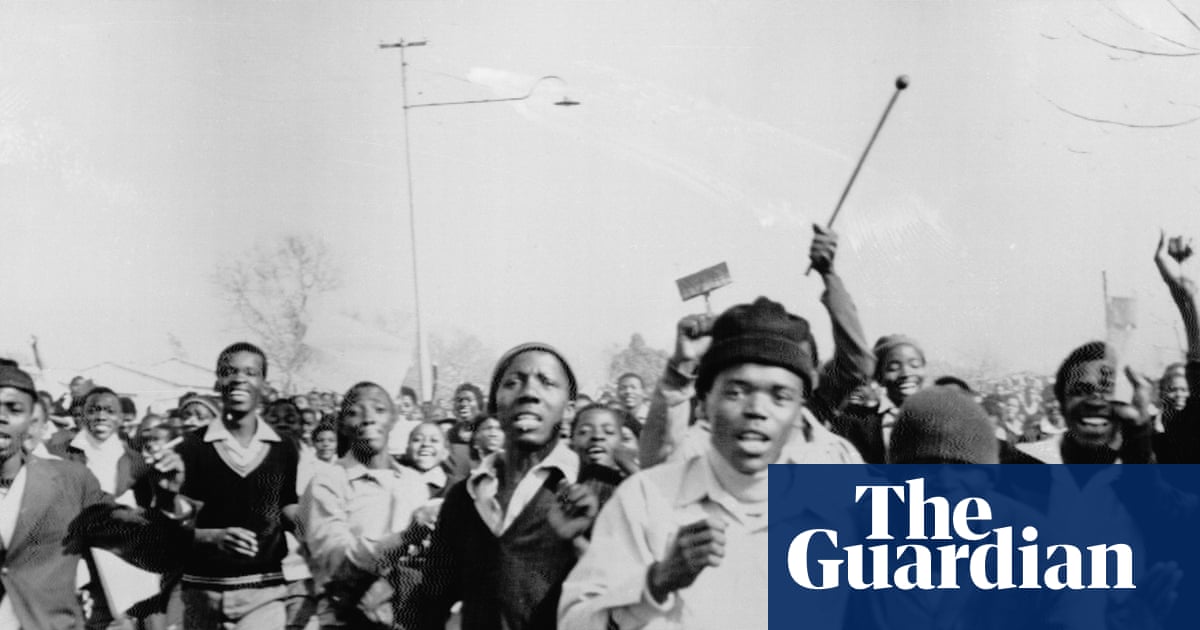
T he day of 16 June 1976 began peacefully in Soweto. Student leaders at high schools across the sprawling Johannesburg township, to which the apartheid regime had exiled hundreds of thousands of black South Africans, took charge of the morning assemblies. They led their fellow students into the streets and began to march toward Orlando stadium.
The students were protesting against the government’s imposition of Afrikaans as a medium of instruction. Their teachers barely spoke the white minority language and the students did not want to learn the oppressor’s language. They were tired of the intentionally substandard Bantu education, tired of being second-class citizens.
By the end of the day, dozens would be dead.
The mood of the young protesters started off joyous, people who marched that winter day remembered. They sang struggle anthems, including Senzeni Na? , which asks in Xhosa: “What have we done [to deserve this]?”
“Our worst-case scenario, of course, was that they were going to throw cans and cans of teargas at us,” said Sibongile Mkhabela, then an 18-year-old pupil at Naledi high school and one of the march organisers.
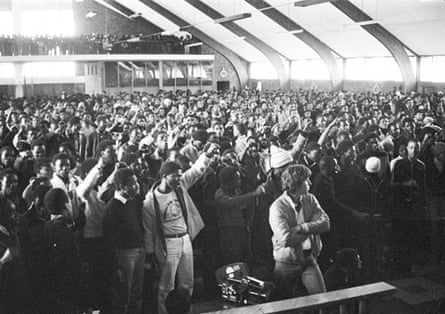
As the children moved east, more schools joined. By the time the first group reached Orlando West, where Nelson Mandela had lived before he was imprisoned on Robben Island, the students numbered in their thousands.
They faced a wall of police. The police had a loudhailer, said Oupa Moloto, then a 19-year-old pupil at Morris Isaacson high school. But none of the students could hear what was being said.
Accounts of what happened next differ. Some say a white police officer threw a teargas canister into the crowd. Moloto remembered police dogs being released to attack marchers. “Now, women students were panicking and then we took stones to retaliate,” he said. “And then the firing started.”
Moloto thought it was fireworks at first. Then he saw that a boy next to him had been shot: “I was surprised when I saw this bleeding, that these guys are really shooting.”
He did not know what happened to the boy in the pandemonium that followed. “Helicopters were hovering over, shooting teargas from up in the sky. Students were panicking, running in different directions,” Moloto said.
Among the first to die were 15-year-old Hastings Ndlovu and 12-year-old Hector Pieterson. The photograph taken by the local journalist Sam Nzima of Mbuyisa Makhubo carrying Hector’s limp, bloodied body, Hector’s sister Antoinette running beside them, face twisted in anguish, became the day’s defining image .
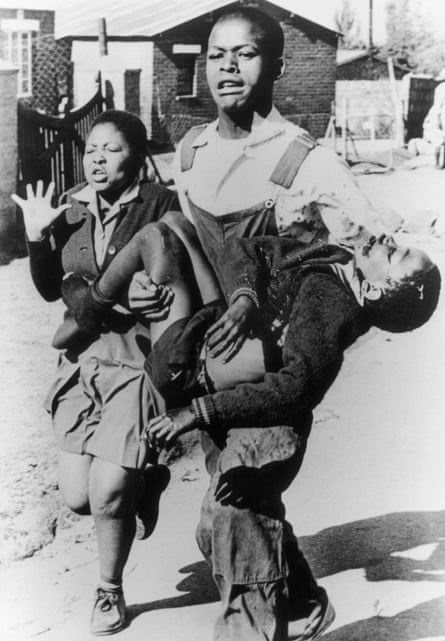
The number of people killed that day, which became known as the Soweto uprising, has never been definitively confirmed. The official figure was 23, but some estimates put the death toll at more than 200, according to South African History Online , a respected resource.
The unrest spread to other townships. Government institutions were looted and burned. The police continued to fire. A regime report in 1980 concluded that 575 people died in the months after the start of the uprising. “By the end of 1976, the entire apartheid system was on trial,” said Mkhabela, who now runs an NGO.
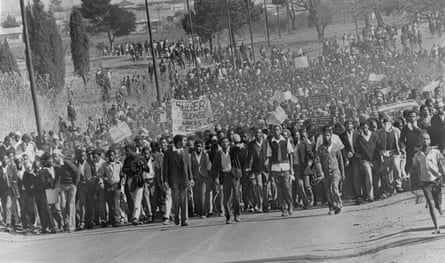
The uprising created a new generation of anti-apartheid activists, reviving a struggle that had faltered after Mandela and other African National Congress leaders were given life sentences in 1964. Thousands of students fled South Africa to join uMkhonto we Sizwe (MK), the armed wing of the ANC in exile.
I nitially, Kingsley Mamabolo planned to stay in Soweto and fight. “People would accuse us of being communist, but you didn’t need people to show you what was happening on the ground,” said Mamabolo, then a 20-year-old final-year student at Naledi high school. In early August, police broke up a demonstration in central Johannesburg and several of his friends were arrested. Some got word out of prison that police were hunting him too and he decided he had to flee.
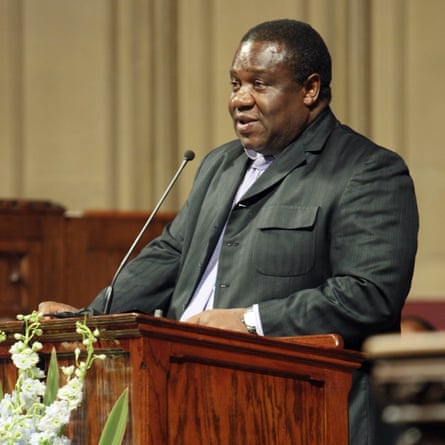
“I thought I was brave, but the coward in me said: ‘I don’t want to be dying in prison’ … There were lots of rumours and stories going about, of people who didn’t make it after they had been tortured in prison,” said Mamabolo.
So began 18 years in exile, in which he represented the ANC in Cuba, Mozambique, Tanzania and Zimbabwe. While Mamabolo was motivated by the cause, it was also the life of a refugee. He was not paid a salary, surviving on food rations from the party and donated secondhand clothes.
Mamabolo, now South Africa’s high commissioner to the UK, said he still felt guilty about not giving his three children born in exile a stable upbringing. “I’m constantly apologising for the life I gave them,” he said. “It wasn’t of my making or their making. I think they understand.”
Mkhabela was arrested at the August 1976 demonstration and put in solitary confinement for four months. Her cell was cavernous and freezing and the Afrikaner guards would beat her at any time of night. “When they hit you, you felt like a rag doll, when you are thrown from one corner of the room to the next,” she said.
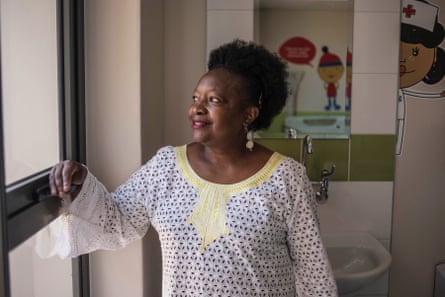
Mkhabela continued her activism on her release and was arrested again nine months later. She spent a year in prison waiting for her 11-month trial, the only woman alongside 10 men. She was one of five convicted and spent another two years behind bars, much of it in isolation.
Decades later, Mkhabela’s experiences were turned into a play by her daughter Ntsako. It helped Mkhabela to realise that her poor memory was probably a result of what she went through. “One of the things that hurt me most in prison was remembering … I had to train myself to forget what it feels like to love and be loved … but in the process the mind forgets a lot of other things that you shouldn’t forget,” she said.
Moloto did not make it out of South Africa. About a year after the uprising, he was caught trying to cross into Eswatini and spent more than three years in prison, much of it in solitary confinement. Guards would force him to stay awake for up to 10 days and mock him when he became disoriented.
“The way those guys were so brutal, at one stage it clicked in my mind … how did it come that God should create people like this?” Moloto said, sitting with his daughter Mpho in an office at the June 16 Memorial Acre in Soweto.
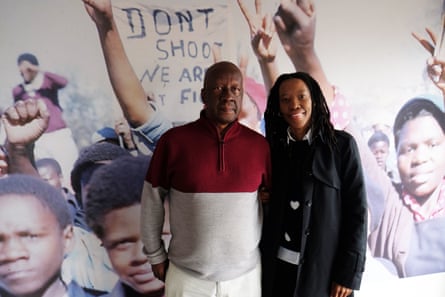
After being released, he was kidnapped and tortured by security forces, who accused him of arms dealing. “I had to withdraw from being active … Even when you sit with your old comrades, you become paranoid, you are afraid,” he said.
Moloto excused himself from the interview. “He’s always seeing danger,” his daughter said. “The paranoia, the nightmares, the physical remnants of what happened to him. He has severe asthma now. You know, I think that’s why he wanted to go out.”
Mpho, 45, is now the primary carer for her father, after his wife of 43 years, Susan Jenny Moloto, died last year. “When Mama was there, she would wake him up and calm him down and ground him and bring him back to reality,” she said. “I’ve now had to step into that role.”
Moloto’s post-traumatic stress disorder means that 16 June 1976 is ever-present for the family, even 50 years later. “It’s not just a chapter in the history books,” Mpho said. “In our lives … for me, it’s still a living, a breathing reality.”
Lukaku makes instant impact to force own goal and rescue draw for Belgium against Egypt | World Cup 2026 | The Guardian
Keyword – Football
Trefwoorden – World Cup 2026, Belgium, Egypt football team, World Cup, Football, Sport
Title – Lukaku makes instant impact to force own goal and rescue draw for Belgium against Egypt | World Cup 2026 | The Guardian
Author – https://www.theguardian.com/profile/jeff-rueter
Link – Lukaku makes instant impact to force own goal and rescue draw for Belgium against Egypt | World Cup 2026 | The Guardian
Publish date – 2026-06-15T21:08:34.000Z
Category – Sport
URL – https://www.theguardian.com/football/2026/jun/15/belgium-egypt-world-cup-2026-group-g-match-report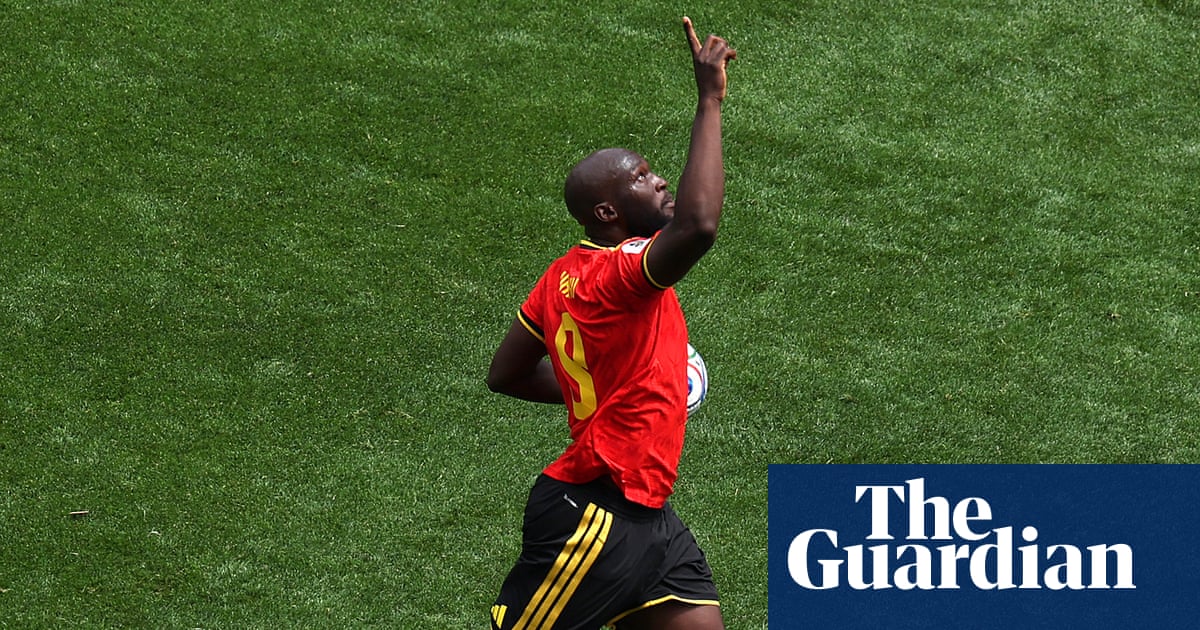
For just over half of Egypt’s opening match against Belgium, it looked as though the Pharaohs had done enough for a famous first World Cup win. And then Rudi Garcia went to his bench and brought on the player Belgium have long relied on in thorny situations.
“Frankly, when you are the opponent and you see Romelu Lukaku entering the field, your confidence goes down and your anxiety increases,” Garcia said after the draw. While Lukaku himself did not score, his threat drew two defenders on to his first run into the box, which resulted in an equalising own goal to salvage a point from a closely fought contest.
Group G hotted up in earnest with presumptive frontrunners Belgium and Egypt opening their World Cup campaigns with a credible draw. A crowd of 66,775 watched on under the intense sun of the early North American summer, in a contest which warranted the contentious cooling breaks that have been universally adopted for this tournament.
The group’s headline clash was slated as a noon affair under a heat advisory in Seattle, with on-field temperatures of 30C (86F) and high, hazy clouds at kick-off. There was scarcely an empty seat to be found, forming a sea of red and white owing to the teams’ similar colours.
Both sides tested the tolerance of the referee, Ramon Abatti, for contact and exchanged a pair of early yellow cards. As the match entered the 19th minute, Egypt found a breakthrough. A quick restart caught Belgium backpedalling into position as Egypt approached the final third. Some nifty right-sided buildup found Mohamed Salah, where he turned to his left and assessed.
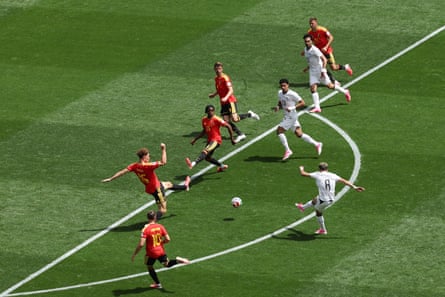
Playing on his 34th birthday, Salah fizzed a pass to his left where Emam Ashour collected and cut toward the top of the D. The midfielder fired a shot underneath Thomas Meunier’s dangling leg and beyond a diving Thibaut Courtois, who had overcommitted to his left and was unable to stretch far enough to his right. It was a timely first international goal for the Al-Ahly midfielder on his 30th appearance.
The stands at Seattle Stadium physically rocked during the raucous celebration, a hallmark of the venue when it hosts American and association football alike (as well as Taylor Swift concerts ).
Belgium struggled to maximise their width for large portions of the first half. Egypt were proactive when closing down Jérémy Doku, often doubling up on the winger whenever the ball went in his direction. On the opposite flank, Leandro Trossard often seemed in two minds about what to do in possession, having the ball taken off of him three times in the opening half-hour.
After Ashour’s opener, Doku switched to the right where Egypt had fewer numbers. As first-half stoppage time loomed, passes and shots increased in desperation. A long-range effort from Kevin De Bruyne failed to enter the box, instead smacking the striker Charles De Ketelaere on the backside.
Doku tried a volley but shanked it well above the bar. Egypt nearly found a second with the half’s final action, but the last in a series of corners drifted above the scrum and tamely into open terrain.
As Belgium shot more speculatively, Egypt comported themselves with greater aspiration than sitting in a bunker. The Pharaohs broke on the counter when able but otherwise were content to have possession in midfield with their defence well stationed behind.
At last, in the 66th minute, Garcia put his team’s fate at Lukaku’s feet. It proved savvy, as a quick break by Meunier into the box for a close-range cross found Lukaku sliding between a pair of defenders in close proximity to the goalkeeper, Mostafa Shobeir.
The ball went beyond Lukaku’s leg but caught the inside of Mohamed Hany’s boot and rolled into Egypt’s net, levelling the game just before the second-half drinks break.
The 33-year-old Lukaku only logged 40 minutes in Serie A for Napoli this season, raising concerns that Belgium’s record scorer would not be ready for this World Cup. Instead, it has perhaps made a role off the bench more palatable for the veteran striker.
“We’re going far [this summer] with Romelu, so we have to go easy on him,” Garcia said. “The goal is to get as far as possible in this World Cup with a Romelu who doesn’t get hurt. I think that’s the first objective. And then if he plays this role of super sub and that every time he hits a goal, frankly, it’s going to be great.”
Togetherness by Rowan Hooper review – a stunning portrait of cooperation in nature | Science and nature books | The Guardian
Keyword – Books
Trefwoorden – Science and nature books, Books, Culture
Title – Togetherness by Rowan Hooper review – a stunning portrait of cooperation in nature | Science and nature books | The Guardian
Author – https://www.theguardian.com/profile/philip-ball
Link – Togetherness by Rowan Hooper review – a stunning portrait of cooperation in nature | Science and nature books | The Guardian
Publish date – 2026-06-15T06:00:04.000Z
Category – Culture
URL – https://www.theguardian.com/books/2026/jun/15/togetherness-by-rowan-hooper-review-a-stunning-portrait-of-cooperation-in-nature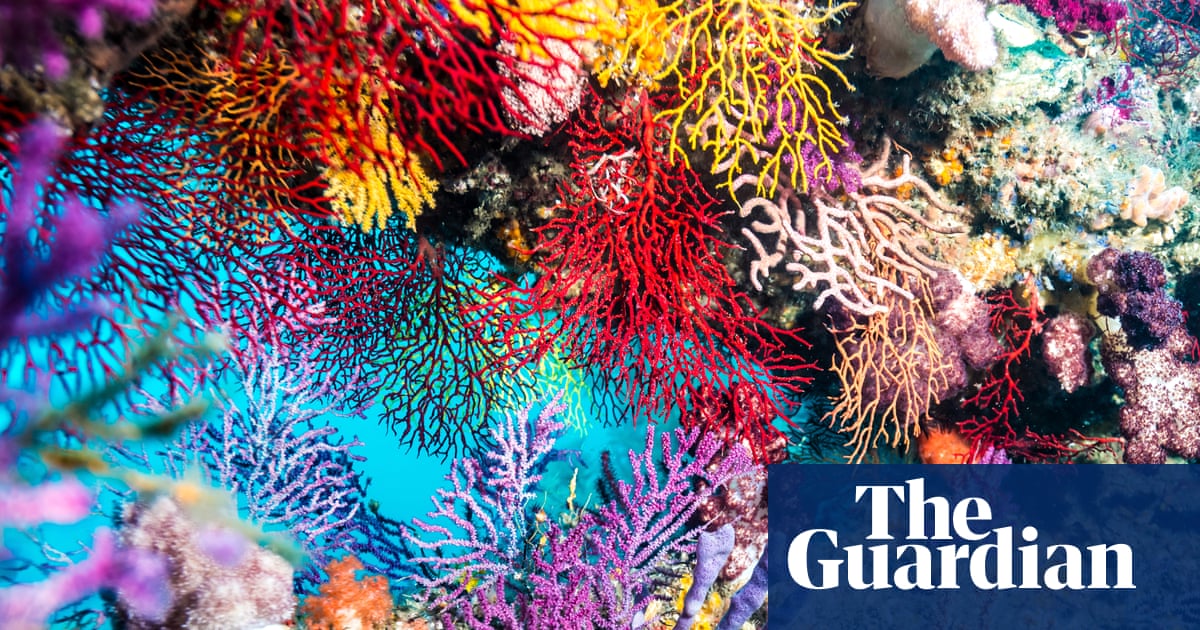
W hen Charles Darwin published On the Origin of Species in 1859, the Industrial Revolution and British colonialism were in the ascendant. Charles Dickens had published Hard Times five years earlier; Queen Victoria nominally ruled a fifth of the world’s population. Darwin, writes science writer Rowan Hooper, crafted his evolutionary theory to deliver what he figured his audience wanted to hear: “an account of nature as a competitive struggle”. Natural selection was launched into a world that was “colonial, capitalist, patriarchal and ruled by the upper class” – and Darwin’s central message, crudely paraphrased by the philosopher Herbert Spencer as “survival of the fittest”, chimed with the times.
Hooper adores Darwin – his account of visiting Darwin’s Kent residence Down House radiates reverence (“it’s a pseudo-religious experience”). But he feels that Darwinism and its union with genetics in the so-called “modern synthesis” has placed undue emphasis on competition in the natural world and underplayed the roles of cooperation and collaboration. In redressing that imbalance, Togetherness is not an attempt to make evolution cuddlier and more palatable; rather, it is a corrective deeply informed by what we have learned since Darwin about how nature works. Written with immense charm and passion, and packed with eye-popping facts, it is also a paean to the wonders of nature and the value and urgency of preserving them.
It’s easy enough to see the competitive side of nature: the lion stalking a gazelle, the bird of prey swooping for the kill. But the photogenic animal world is not necessarily the most representative resource for the natural historian. Hooper shows that we often find a very different story among the soft, slimy and squishy stuff: moulds, microbes, mushrooms. And lichens, which look superficially plant-like but are in fact a partnership between fungi and algae. Each supplies something the other needs: algae can photosynthesise, producing carbohydrates on which fungi feed, while the fungi shelter and spread the light-gathering algae. The relationship is symbiotic: each organism is dependent on the other and they grow and evolve together. Sometimes the lichen collective is joined by other partners: cyanobacteria (photosynthetic bacteria) or yeast. It’s a fantastically productive partnership, enabling lichens to flourish almost anywhere, from rainforests to tundra and deserts.
Or take corals. These colourful, branched marine organisms invite classification as plants but are in fact collaborations of animals (cnidarians, from the same family as sea anemones and jellyfish) and algae that live in their stomachs. The algae photosynthesise using sunlight while the host animal delivers nutrients and carbon dioxide to their guests. (Some deep-sea corals, growing in the dark, host bacteria instead.) Darwin published a book on coral reefs in 1842 after seeing them on the voyage of the Beagle, explaining how their limestone shells created entire island atolls. But he had no idea they were symbionts.
Most land plants depend on symbiotic fungi, especially the root fungi called mycorrhizae that deliver vital nutrient elements such as nitrogen and phosphorus. Without these associations there would be no forests and prairies covering the land, but just mats and crusts of microbial colonies. Orchids are the archetypal plant symbiont – individual plants are interlinked via an underground fungal network along which they can send sugar to their seedlings.
These are not, as was first imagined, oddities: symbiosis is the natural state of most organisms. Beetles and termites cultivate nutritious fungal gardens in their nests. And the importance of the bacteria hosted in and on our bodies – our microbiome – has become increasingly apparent. Antibiotics that deplete them leave us with digestive disorders, while some recurrent bacterial infections and even depression can be treated with faecal transplants, which sound gross but are nothing more nor less than a restocking of our microbial collaborators.
Symbiosis has driven evolution since its earliest days. The chloroplasts responsible for photosynthesis in plant cells were once free-living cyanobacteria. So were the mitochondria that produce energy in our own cells. Such permanent symbiotic merging (endosymbiosis) of single-celled organisms was first proposed in the 1960s by biologist Lynn Margulis, who asserted that the “red in tooth and claw” Darwinian view of evolution was “naive”. “Now we see ourselves as products of cellular interaction,” she wrote in 1987. Such mergers, she said, could allow evolution to advance not in small steps but in great leaps.
Margulis’s endosymbiosis hypothesis is now accepted, but initially met scepticism and even ridicule. Sexism surely played a part in that, but there’s a thesis to be written on the resistance of academic biology to notions of cooperation and collaboration in evolution – or the determination to recast them as mere expediency by “selfish genes”. Margulis made the rather gender-essentialist claim that scepticism about symbiosis was a rejection of the “feminine”, but one can’t help noticing that an emphasis on interconnection in the natural world often came from women, whether it was Rachel Carson’s Silent Spring or the “wood wide web” of forestry scientist Suzanne Simard, the inspiration for a character in Richard Power’s 2018 eco-fable The Overstory.
These interdependencies are vital to the health of the biosphere. The catastrophic “bleaching” of coral reefs caused by warming of the oceans, for example, happens because the symbiotic algae can’t stand the warmer water. Without them, corals are doomed, and reefs have already declined by half since the mid-20th century. But, as Hooper explains, symbiosis is itself a delicate balance and apt to tip into parasitism if one partner reneges on the arrangement. He warns, however, that ultimately the language of competition and collaboration is anthropomorphic and tends to impose moral judgment on the workings of nature.
My review copy of Togetherness is now peppered with marginal annotations of “Wow!” I never knew that the feelgood neurotransmitter serotonin is mostly made by our gut bacteria. Some ants produce antibiotics that they apply to nestmates’ wounds. The bacterial symbionts of cockroaches give them their infernal (to our view) ability to live almost anywhere and eat almost anything. Hooper’s background in conservation biology and his wide travels (I guess being an editor at New Scientist has its perks) bring vividness to his accounts. While he mistakenly asserts that living organisms reduce entropy, seems sometimes to conflate symbiosis and interdependence (predators still need their prey), and somewhat exaggerates the “outrage and panic” that Darwin’s Origin produced among “religious authorities”, these are minor quibbles.
Darwin himself was too astute a naturalist to ignore the interdependencies of nature. He didn’t know the symbiotic secrets of corals or lichens, but he was fascinated by orchids, and an ecological sensibility, as we’d now see it, pervades his writings. The famous final passage of Origin (“endless forms most beautiful”) stresses not the ruthless individualism of nature but its webs of coexistence. “It is interesting,” Darwin wrote, “to contemplate an entangled bank, clothed with many plants of many kinds … these elaborately constructed forms, so different from each other, and dependent upon each other in so complex a manner.”
This is the Darwinian message we need most to hear today. “The crisis of nature we are engulfed in has been caused by a failure to see in ecological terms, a failure set up by our philosophical and economic systems,” writes Hooper. “We are symbiotic creatures at the deepest level of our cells.” A feeling of oneness with nature, he says, is not woolly green fantasy or pre-scientific mysticism. It reflects our best understanding of life and should be heeded.
Togetherness by Rowan Hooper is published by Fern Press. (£25). To support the Guardian, order your copy at guardianbookshop.com . Delivery charges may apply.
‘A huge spectrum of people coming together’: how parkrun made it to its millionth event | Running | The Guardian
Keyword – Life and style
Trefwoorden – Running, UK news, Health, Life and style, Society, London, Kelly Holmes
Title – ‘A huge spectrum of people coming together’: how parkrun made it to its millionth event | Running | The Guardian
Author – https://www.theguardian.com/profile/aneesa-ahmed,https://www.theguardian.com/profile/sundus-abdi
Link – ‘A huge spectrum of people coming together’: how parkrun made it to its millionth event | Running | The Guardian
Publish date – 2026-06-14T08:00:37.000Z
Category – Lifestyle
URL – https://www.theguardian.com/lifeandstyle/2026/jun/14/a-huge-spectrum-of-people-coming-together-how-parkrun-made-it-to-its-millionth-event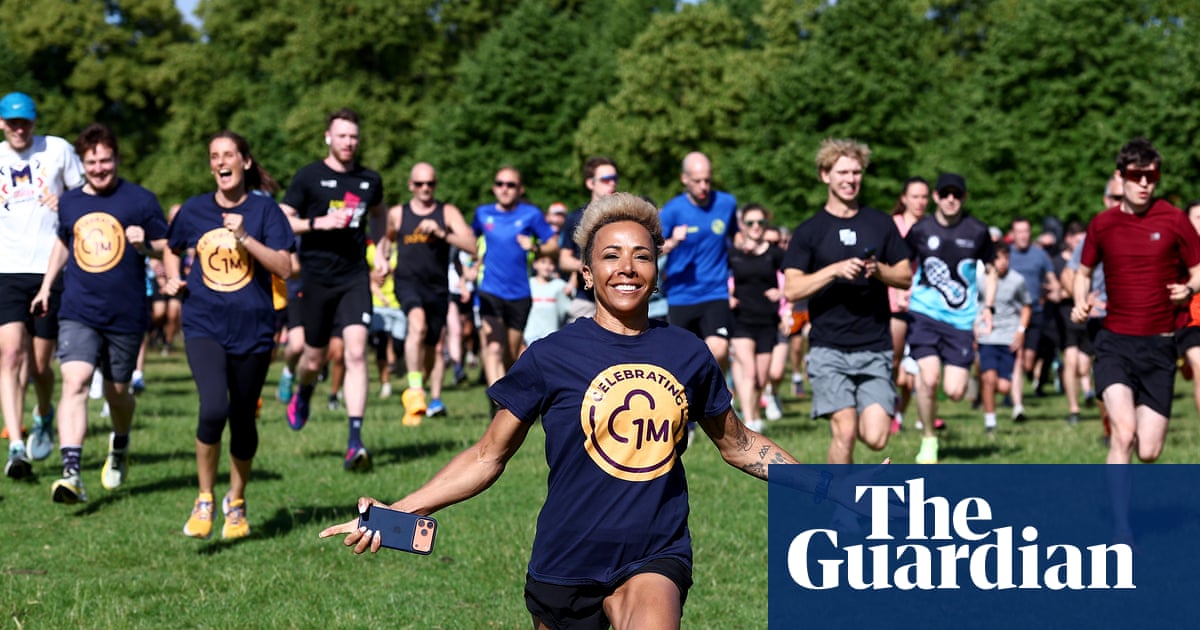
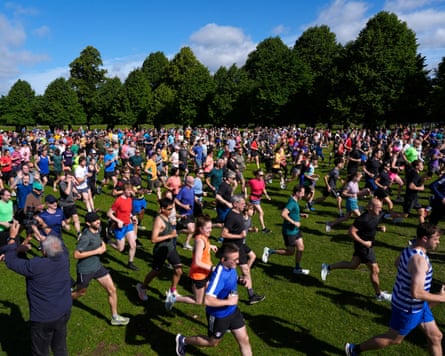
A n event to mark the millionth parkrun took place in west London on Saturday, acting as a celebration of the community cohesion and public health benefit that the charity has been aiming to achieve across the past two decades.
The former Olympic champion Dame Kelly Holmes joined thousands of locals and parkrun fanatics to mark the milestone in a west London park – the venue for the very first parkrun in 2004.
“Parkrun is one of those rare successful social movements that have happened organically,” said parkrun’s global chief executive, Elizabeth Duggan. “It’s not that we’ve had to pay vast amounts of money to grow the brand and ethos, it just happened from one person to another.”
The free weekly 5km event, founded by Paul-Sinton Hewitt, began in Bushy Park, Teddington, with five volunteers and a small group of 13 runners. It has since grown into a global fixture of weekend life, taking place in parks, fields, seafronts and even prisons.
Initially a single timed run, the event now operates at 2,800 locations worldwide, with more than 12 million people registered to take part.
Every Saturday morning, tens of thousands of runners and walkers turn up to jog, push prams or simply complete the course at their own pace.
These events, which are entirely volunteer-run at a local level, have seen bridal showers in matching headdresses, milestone birthday parties, and even engagements at the finish line.
But beyond giving people the opportunity to run and have a controlled space to move their bodies in for free, Duggan argues that one of the greatest successes of parkrun has been its ability to bring people together from across neighbourhoods – and into a shared green space.
“There’s a huge spectrum of people coming together at the parkruns, and there’s something so lovely about young and old, fast and slow, children and octogenarians all doing something together,” she said.
Whether volunteering or running, she has seen many cases of the local parkrun giving people a sense of purpose. People, she says, are always looking to be a part of something bigger than themselves – and the charity is proud to continue to provide the space.
“It is like a spiritual home for some people, some have likened it to a church,” she says. “It’s somewhere that you go, you know people, it calms and connects. It plays a role in community, and people are keen to support and protect it.”
The appeal lies less in competition than routine. Finish times vary widely, and organisers say the average is now the slowest in parkrun’s history, which may reflect a growing number of beginners and walkers taking part for health, rather than speed.
That shift is echoed in the people it attracts. About one in five participants describe themselves as inactive when they first sign up, while almost a third come from lower socioeconomic groups, suggesting the weekly run is reaching people who might not otherwise engage in organised sport.
However, there is still space for performance. The fastest recorded times stand at 13 minutes 44 seconds for men and 15 minutes 13 seconds for women, both set in Belfast. But for most participants, the focus is simply on finishing.
The movement has also become part of public health policy. More than 2,100 GP surgeries in the UK now “prescribe” parkrun to patients as part of social prescribing schemes, encouraging activity to support physical and mental health.
Sport England research has linked participation to reductions in conditions such as depression and diabetes, as well as fewer GP and hospital visits.
At a community-level, parkruns have given groups the space to share their history and cultures with other people in their areas – for example when Burgess Park parkrun hosted a celebration of Ugandan independence day in 2022.
It also connects people with their natural environment, something that has double the benefit to exercising indoors, Duggan says.
Its reach extends far beyond parks – about 25 prisons and young offender institutions now host parkruns, involving more than 12,000 people in custody, in programmes designed to support rehabilitation.
Duggan describes a case of a grandmother who was incarcerated, who would run the parkrun in the prison while her grandson would run it in his local park. When they would phone during the week, the pair would discuss their parkruns and compare stories from the weekend. “It was something that united them even if they couldn’t be together,” she said.
The charity is positive that they will be able to grow and reach even more people. Over the years it has drawn in everyone from Olympic champions to politicians, including Alistair Brownlee, Ed Miliband, and the late Keith Flint of the Prodigy, alongside thousands of first-timers.
“Parkrun is a piece of me,” says Holmes, who took part in the millionth parkrun on Saturday.
“I love the social interaction of it. I’ve spoken to so many people at parkrun over the years and so many people have told me how parkrun has saved their life.
“That’s everyone, from people who have come back from surgery … [and] women who have given birth and are getting back into activity. It’s for everyone really.”
Moving forward, parkrun is hoping to get even more people from a diverse range of communities participating in physical exercise, especially those from a lower socioeconomic background.
“Lower socioeconomic groups and ethnic minorities are statistically more likely to be inactive,” Duggan says.
“So by expressly targeting them we know that we’ll be having a bigger impact on the health of everyone in the nation.”
This article was amended on 16 June 2026. The event in Bushy park was organised to mark the millionth parkrun held globally, but was not itself the millionth parkrun as an earlier version said.