An Air France flight headed to Detroit, Michigan, was redirected to Canada on Wednesday after it was determined that a passenger from the Democratic Republic of the Congo (DRC) had boarded “in error” amid new Ebola -related travel restrictions, officials with the US Customs and Border Protection agency (CBP) said.
“Due to entry restrictions put in place to reduce the risk of the Ebola virus, the passenger should not have boarded the plane,” a CBP spokesperson said in a statement.
“CBP took decisive action and prohibited the flight carrying that traveler from landing at Detroit Metropolitan Wayne county airport, and instead, diverted to Montreal, Canada.”
The spokesperson added that CBP, in coordination with the US Centers for Disease Control and Prevention (CDC), “is taking the necessary measures to protect public health and reduce the risk of Ebola disease introduction into the United States”.
On Monday, the CDC and the Department of Homeland Security (DHS) implemented temporary measures aimed at preventing the Ebola disease from entering the US amid ongoing outbreaks in east and central Africa. The measures include enhanced travel screening, entry restrictions and additional public health protocols.
Among the new rules are entry restrictions for non-US passport holders who have been in “Uganda, DRC or South Sudan in the previous 21 days”. The order is in effect for 30 days, according to the announcement.
The DHS will implement further entry restrictions beginning on Thursday for foreign travellers arriving to the US from countries at the center of the outbreak. In a DHS notice submitted to the Federal Register, expected to be published on Thursday, the department states all US-bound flights carrying foreign travelers who have been in Congo, Uganda or South Sudan in the last 21 days must land at Washington-Dulles international airport in Virginia, “where the US government is focusing public health resources to implement enhanced public health measures”.
On Wednesday, the director-general of the World Health Organization said that so far, there had been almost 600 suspected cases of Ebola and 139 suspected deaths, warning that the numbers were expected to rise. The director-general said that 51 cases had been confirmed in the DRC, “although we know the scale of the epidemic in DRC is much larger”. Uganda has also confirmed two cases, he said.
During his remarks, the director-general also said that an American citizen who was working in the DRC had also been confirmed positive and had been transferred to Germany.
The US is imposing strict restrictions on American travelers who have been exposed in dual Ebola and hantavirus outbreaks in ways that experts say could run counter to their legal rights and affect who will volunteer in future public health crises globally.
The latest restrictions highlight officials’ previous rhetoric on public health measures and their attempts to contain outbreaks now, including reported opposition from the White House to Americans returning home.
The US is not bringing home an American doctor sickened by Ebola and six other people with exposure to the virus. Instead, the patients and others are being moved to Germany and the Czech Republic, officials said on Wednesday.
It is “unlikely” that there will not be more cases of US citizens and residents wishing to return from Ebola-affected regions, and “it would be very concerning if Americans weren’t able to”, said Alexandra Phelan, an associate professor at Johns Hopkins Bloomberg School of Public Health. The unofficial policy could substantially dampen the response from volunteers to the region providing critical assistance, she said.
“There is a very real likelihood that this outbreak may get much more serious, and the need for international support is going to be quite significant,” Phelan said.
The move follows mandatory quarantine measures in Nebraska for passengers from the MV Hondius who were exposed to Andes virus, a type of hantavirus, despite requests from some of the passengers to quarantine at home.
The American Ebola patient is now hospitalized in Germany in stable condition, while the other US citizens were on their way to Germany or Czechia, Satish Pillai, the Ebola response lead at the US Centers for Disease Control and Prevention (CDC), told journalists on Wednesday. “These people, who remain asymptomatic, are being moved to ensure that they have access to the specialized care if needed,” he said.
When asked why these locations were chosen, instead of evacuating the Americans home as in previous outbreaks, Pillai said they were the “most expeditious” options in a fast-changing situation with “the need to move quickly”, adding that “these locations were chosen based on the needs that were present at that time.” Czechia in particular is not known for its experience in treating viral hemorrhagic fevers, but Pillai said it had an existing relationship with the US state department and the Administration for Strategic Preparedness and Response.
During the 2014-15 outbreak, Trump was outspoken about Ebola, posting frequent calls on social media for Americans who had Ebola or were exposed to the virus to be turned away . People who volunteer to help in Ebola outbreaks “must suffer the consequences”, he said in August 2014.
In this outbreak, the White House opposed bringing at-risk Americans home, according to reporting by the Washington Post. Pillai would not confirm in the press conference on Wednesday that the White House made this decision, instead pointing to “the conditions on the ground” and “the need to rapidly mobilize”.
But the law on being able to return home is “really simple”, Phelan said. US citizens and green card holders have a legal right to return to the United States. The order on travel restrictions issued on Monday is clear that it doesn’t apply to US citizens. And the US has some of the best biocontainment facilities, medical care and treatment options in the world, Phelan added. “Millions of dollars have been poured into these facilities for exactly this situation.”
Doubt about whether health workers and other outbreak responders may return to the US could mean fewer Americans volunteer to help stop the outbreak, Phelan said.
“Any other indications that Americans are being prevented from returning home in some way, shape, or form, would serve as disincentives to support that may be absolutely vital to the international response to this growing crisis.” Phelan addded.
Craig Spencer, a doctor who developed Ebola after volunteering in Guinea in 2014 and who was attacked online by Trump, said in an interview four years later that it was already difficult to find nurses and doctors who could take the time to volunteer – and the possibility of not returning home would mean fewer people would be able to help, the epidemic would continue, and the risks to everyone would increase with a less-controlled outbreak: “a pure disaster”, Spencer said.
When asked if this policy would deter volunteers, Pillai pointed to existing organizations in the Democratic Republic of the Congo and Uganda that “have been integral in providing healthcare support” already.
When passengers on the hantavirus-stricken cruise ship were flown back to the US, officials first ruled out the idea of mandating quarantine.
But now, they are requiring certain passengers to remain in the Nebraska biocontainment facility until the end of the month – even though some passengers have attempted to leave and quarantine at home.
“The decision was made across the leadership in the US government to have the passengers stay in Nebraska until 31 May, which marks the 21st day of their monitoring period,” David Fitter, the CDC’s hantavirus lead, told journalists on Tuesday. “We’re constantly regarding the situation and evaluating where things are.”
The decision reportedly came from Jay Bhattacharya, who is performing some of the duties of CDC director until the nominee is confirmed by the Senate. Angela Perryman, a 47-year-old woman who had conversations with a passenger who later died from the Andes virus, told the New York Times that she had tested negative and had no symptoms, and would like to quarantine in an AirBnb in south Florida. Another passenger, a 30-year-old man, said he would like to quarantine in New York state.
Bhattacharya rose to prominence by pushing back against public health measures, which he loosely terms “lockdowns”, in the Covid pandemic. In 2023, he criticized the US Air Force Academy for quarantining cadets; two students later killed themselves. Bhattacharya highlighted the “harms of social isolation” and said the situation was “tragic”.
“Any public health measure that is imposed has to be based on reasonable scientific evidence or principles, and has to be proportionate and necessary to achieve the public health outcome,” Phelan said.
The guiding concept in global health law is implementing “the least restrictive measure necessary to achieve the public health outcome”, she added. If a measure is more restrictive than necessary, then it is infringing on personal rights.
Most people want to follow quarantine directions, but they may be more comfortable in their own home, where the long quarantine time may be more bearable. In public health, “the preference is to use voluntary home quarantine as the least restrictive option available,” Phelan said.
In the case of passengers testing negative with no symptoms and a safe way to return home, “I could see a reasonable judge making that conclusion,” she said.
There is a previous case for comparison, and it goes back to the Ebola outbreak of 2014. When Kaci Hickox, a nurse who treated patients in west Africa, returned to the United States, the CDC did not require her to quarantine in a facility. But Chris Christie, the then-governor of New Jersey, attempted to mandate quarantine – a move that eventually the courts rejected.
Late-night hosts discussed the end of the Late Show and Stephen Colbert’s tenure as well as the latest product from Donald Trump.
Jimmy Kimmel
On Jimmy Kimmel Live!, the host told viewers that the show would not be airing on Thursday “out of respect” to Colbert whose final Late Show is on that night.
“I hope the people who did the pushing feel ashamed of themselves,” he said in reference to the swirl of controversy surrounding its cancellation.
Kimmel said that the situation is “nothing like the old days of late night”, where hosts would compete with one another, as there is now a more supportive atmosphere.
“I hope he comes to visit as many times as possible,” he said before telling his audience that after the final Late Show airs on CBS, “don’t ever watch it again”.
Kimmel spoke again about Trump filing a $10bn lawsuit against his government and winning a fund of $1.76bn, “an astonishingly brazen act” that he “will never understand”.
The tax records that were leaked showed that the president paid just $750 for the whole of 2016, “just about enough to fill your tank to Vegas and back”, he said.
He moved on to the Iran war, which Trump’s sons are “profiting from bigly” and how this week the president has been looking for more conflict with former Cuban president Raúl Castro, who was indicted in connection with a 1996 incident in which four men were killed by the Cuban military when their planes were shot.
This week also saw the House voting to advance a resolution to limit Trump’s powers in Iran. “He’ll ignore it like he avoids the weight limit on a golf cart,” Kimmel said.
Trump has also been waging war against the fellow Republicans who “dared to disagree with him”, such as Kentucky representative Thomas Massie who was defeated this week in the state’s Republican House primary after “pushing for the full release of the Trump-Epstein files”.
But Kimmel said he now has “seven months left in office and nothing to lose”.
Trump has also weighed in on the Los Angeles mayoral race, giving support to Spencer Pratt, another former reality TV candidate. In a bizarre interview, Trump said that the vote was rigged and it would need Jesus to come down and count votes. “If Jesus came down, why would he come down to count votes?” Kimmel asked.
This week has also seen the launch of Trump coins joining the many other products being pushed by the president. “This economy is so bad even he needs a part-time job,” he said.
Stephen Colbert
For his penultimate monologue, the Late Show’s Stephen Colbert spoke about the much-ridiculed Trump gold cellphone that’s now available after a nine-month delay.
The host said it was that the “only Trump item more disappointing after a nine-month wait was Eric”.
Despite claims that the phones would be made in the US, Colbert said “brace yourself”, but instead they are simply “designed with American values in mind”. He joked that the new Arby’s slogan should be: “We have the meats … in mind.”
Trump also “took a break from profiting off a presidency” to give his wife a shoutout in a strange speech where he lied about the success of her documentary and added that there is only room for one star in the family so he “better get rid of that”, which Colbert said is “a pretty weird thing to say to your wife”.
This week also saw the Transportation Security Administration (TSA) announce that passengers can now take an unlimited number of rotisserie chickens onboard a plane.
“Thank God!” he said. “I was getting tired of having to chug my chicken in line.”
Y ears ago, my son and I took a pottery class one Saturday afternoon. I agreed to take him – he wanted to try the wheel but was too young to go alone. I had no real expectations of the class, but as soon as I gripped the lump of clay and tried to centre it on to the plate, I was hooked. There was something primal about having my hands and clothes covered in smears of white. It brought me back to making mud pies as a child.
My son seemed to understand the properties of working with clay in a way that I didn’t but I still managed to cobble together some small pieces and left them to be fired, my name carved in the bottom. When I collected the glazed pieces , I laughed with the studio technician at how neat my son’s bowls were compared with my wonky ones. She suggested enrolling in a longer course but regular classes weren’t possible at that point in my life, so I shoved my indelicate pots to the back of my cupboard and forgot about pottery for a while.
With my youngest child now in his last year of school, I have more time for committing to something weekly. Feeling the dance of age, I’m keen to learn new things. As soon as I can afford a six-week beginner’s pottery class, I book it in with a friend.
We turn up to an old warehouse studio for the first class, nervously clutching our op-shop aprons and ratty towels. Before we receive our bags of clay we go around the room and introduce ourselves, explaining why we have enrolled. I’ve always found this daunting, and can feel my heart racing as I think of something to say. I explain that I am there to create intuitively; to stop overthinking and just play. Others talk about being burnt out or close to it. They are mostly nurses, emergency doctors, social workers, occupational therapists and mental health practitioners, and have signed up hoping pottery will help to calm their nervous systems, reduce stress and allow them to be in their bodies.
Our teacher begins to introduce us to the basics: how to centre, how to drop in, to widen, to pull up the walls. We watch her demonstrate and my adrenaline is pumping. I cannot wait to start. Finally, with our knees jammed tight around our wheels, our arms locked in position, we lean close and try to make something intentional. I discover quickly just how hard that is. Walls sag, lumps break off, pots collapse. The studio is filled with nervous laughter, appreciation for a neighbour’s efforts, and a general amusement at how difficult it all is. I soon burn through six balls of clay, making one uneven bowl after another. At the end of the two and a half hours, we clean our wheels – and ourselves.
We keep nothing from that first week. There is no urgency to make something quickly as there was in the taster class I did with my son. This course is about learning, about getting a feel for it. For me, it is about letting go of expectations. I know that it takes thousands of hours to master a new skill and yet I am frustrated at how clumsy I am, at how my hands won’t work as I want them to.
It isn’t until I let go of any expectation that everything I make will be worth glazing, that I truly begin to learn. And then it becomes less about the finished product and more about the process itself. Each class, I concentrate so hard that I bite the inside of my mouth and leave with a stiff neck and aching elbows. The next morning, I can feel the pull of new muscles. As we slowly start to improve my friend and I walk home at the end of each class, covered in a splatter of crusted white dust and grinning at each other.
By week three, I manage to make something resembling a pot. By week four, I make a sort of coffee cup with thick squat walls. My plaster board is now populated with small pots I intend to turn in week five, when we learn to cut away the dried clay and shape our pieces. In week six, we learn how to glaze and how to dip our pots into vats of thick colours that will change in the heat of the second firing. I have seven pieces to glaze.
They aren’t perfectly symmetrical, the walls are too thick, but they will each find a function in my house. As I keep learning pottery, they are a reminder of where I started.
Nova Weetman is an award-winning author of books for children and young adults
It began as a satirical online project after a high court judge compared unemployed young people to cockroaches. Now millions of young Indians are flocking to it as an outlet for their frustration.
A parody political party with the insect as its symbol has exploded across India’s social media by turning absurdist humour into protest. Memes and short videos mocking corruption, joblessness and political dysfunction have flooded social media sites, where millions of users are embracing the cockroach – an insect known for its ability to survive harsh conditions – as a tongue-in-cheek symbol of endurance.
The online movement’s rise has been unusually rapid. The Cockroach Janta (people’s) party, or CJP, set up its website and social media accounts on Saturday. By Thursday, its Instagram page had amassed more than 15 million followers, far surpassing the 8.8 million of Narendra Modi’s governing Bharatiya Janata party (BJP) on the platform.
“Nothing of this was intentional,” said the CJP founder, Abhijeet Dipke, a political communications strategist and student at Boston University in the US.
The movement’s rise reflected mounting frustration among young Indians, he said. “It is the younger people who were actually very frustrated. They didn’t have any outlet. They were really angry at the government.”
The CJP emerged online after remarks by the supreme court chief justice, Surya Kant, triggered a backlash among young Indians angered by unemployment, rising living costs and recent government exam paper leaks that have disrupted job recruitment drives.
During a hearing last week, Kant criticised what he described as “parasites” attacking institutions and compared some unemployed young people and activists to cockroaches.
“There are youngsters like cockroaches, who don’t get any employment or have any place in a profession,” Kant said. He said that some turned to social media activism, journalism or public interest campaigns and “start attacking everyone”.
The comments quickly spread online, where many saw them as dismissive. Kant later clarified that his remarks referred to people obtaining fraudulent degrees, and said he did not intend to insult India’s youth.
But the controversy soon led to the creation of the CJP account on Instagram, which adopted the cockroach as its political symbol and began posting memes, mock campaign slogans and satirical commentary targeting Modi’s government. Within days, it drew tens of thousands of online volunteers through a Google form submission, alongside endorsements from some opposition leaders.
“We have to understand that five years ago nobody was ready to speak up against Modi or the government. The times are changing,” said Dipke, who has previously worked with the Aam Aadmi party (AAP), which emerged from India’s anti-corruption movement in 2012.
Dipke said the CJP was not affiliated with any real political organisation. But its rise echoes a broader trend across South Asia, where youths have played a central role in anti-government movements in recent years, including uprisings in Sri Lanka and Bangladesh and unrest in Nepal.
“The youth are really frustrated and the government is not acknowledging their concerns,” Dipke said.
The pressures are especially acute in India, where young people make up more than a quarter of the population, yet many face scarce job opportunities and persistent unemployment. Many young voters are also angry with Modi’s ruling Hindu nationalist party over issues including rising religious polarisation, widening inequality and economic pressures.
The CJP leans heavily into self-mockery. Its tongue-in-cheek membership criteria include being unemployed, lazy, chronically online, and capable of ranting professionally. Its manifesto uses satire to address several contentious issues in Indian politics, including opposition allegations of voter manipulation, criticism of the relationship between corporate media and the government, and the appointment of retired judges to official posts.
Some opponents, many of them Modi supporters, have dismissed it as an online political gimmick aligned with the opposition, citing Dipke’s past association with the AAP. They also say the surge in popularity is likely to fade as quickly as it emerged, arguing that it is a digital campaign rather than a grassroots movement.
But Dipke said what began online was unlikely to remain confined to social media. “This is the movement that has arrived in India … it will change the political discourse,” he said. “It will continue online, and if required it will also come on the ground.”
The movement has already begun to slowly spill offline, with some young volunteers appearing at protests dressed as cockroaches. So has the apparent pushback.
On Thursday, Dipke wrote on X that the CJP’s account on the platform, which had about 200,000 followers, had been withheld in India – marking one of the first visible restrictions on the movement. The reason was not immediately clear.
Minutes later, he announced a new account for the group, alongside a post reading: “Cockroach is back.” It added: “You thought you can get rid of us? Lol.”
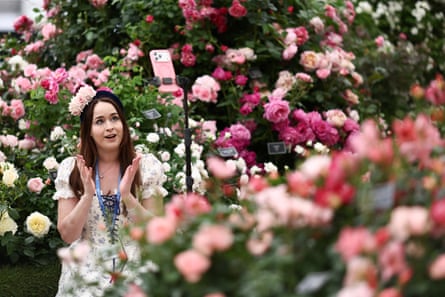
T here was King Charles and David Beckham as well as a nocturnal garden to support bats and a Viking-themed allotment full of edible plants in pots. The Royal Horticultural Society’s Chelsea flower show , which ends on Saturday, was as lovely and celebrity-glittered as ever, most agreed.
But dig a little deeper, say critics on the conservative wing of the RHS – including one spectacularly outspoken former contributor – and not everything is necessarily smelling of roses.
There has been a cashflow problem and, depending on whom you speak to, the root cause might be global events, financial losses due to A3/M25 roadworks blocking visits to RHS Garden Wisley or, in the mind of some, “wokery” and a lack of adherence to the traditional ways of doing things.
The RHS’s latest accounts filed with the Charity Commission reveal it recorded a net loss of £8.1m in the year ending January 2025 – double its losses of the previous year – raising concerns that financial pressures might grow like Japanese knotweed.
The RHS said unpublished financial accounts for the last financial year were much healthier. “With the well-documented impact of the M25/A3 behind us, last year the RHS grew its income by 7% and achieved a cash profit of £4.8m, whilst still investing £83m in our charitable work, and this April we enjoyed record garden visits and membership sign-ups,” it said.
But those concerned about the RHS’s future have been pointing to the need for the Chelsea flower show to find new charity sponsors after a mystery philanthropic couple, who have spent more than £23m on the show, ended their support this year. Meanwhile, the Newt, the luxury hotel in Somerset which was previously a longstanding sponsor, launched its own garden show this year, with the offer of free-entry to under 16s (there is no discounted ticket for children at Chelsea).
It is against this backdrop that the RHS has faced a conservative backlash, with critics pointing to comments from its treasurer, who had noted that the financial difficulties might be exacerbated by a transition to ensuring its shops are peat-free, a move made this January in recognition of the huge environmental damage caused by peat extraction.
Among those who believe the RHS has wandered up the wrong garden path is Tim Penrose, an award-winning RHS exhibitor whose Dorset firm, Bowden Hostas, once held a royal warrant with the then Prince Charles.
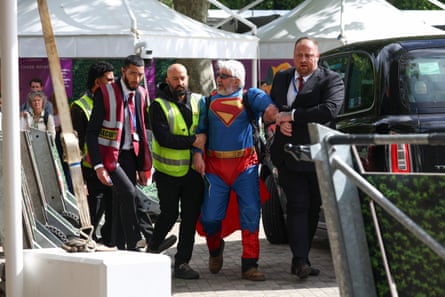
Penrose was blocked from exhibiting this year, he said, because he had failed to attend “anti-peat” seminars. He turned up anyway in a Superman suit claiming that only the fictional superhero could save the RHS now. Penrose said he had since been give a lifetime ban for his protest.
“In my application I agreed to adhere to their rules,” he said. “So I was very upset and astonished when they turned me down on the anti-peat issue, writing to me saying they would not be able to ‘give me space’ because I was not ‘committed’ to anti-peat policy and that I hadn’t attended any of their anti-peat seminars.
“They just don’t like me speaking out. There are others who agree with me about the way things are going, but everyone is too scared for fear of being excluded … There is unbelievable snootiness from staff who behave like school teachers … The thing is, you go too woke, you could go broke.”
The RHS declined to comment on Penrose’s statements but in recent years it has also been criticised for its lack of urgency in banning the use of peat.
Among those who have long championed the peat prohibition is the TV gardener Monty Don who has described gardeners who use the product in their garden as “lazy and irresponsible”. The extraction of the partially decayed organic matter is said to destroy unique ecosystems and accelerate climate change. The government had pledged to ban its sale but has yet to enact the legislation.
Such a ban involves extra costs for some nurseries and the sentiments voiced by Penrose have been echoed on the RHS’s social media channels, where there was further upset voiced about a garden that featured a parked Range Rover. The car manufacturer was a new sponsor this year.
One wrote: “Nurseries who have supported the RHS for years are being forced out because their plants cannot be grown in peat-free compost, especially carnivorous plants. And the RHS flagship event has a lithium mine on a driveway as a main focus, and AI-designed gardens .”
A second added: “RHS will do anything for a quick buck these days!!!”, while a third posted: “I can’t believe the RHS think this kind of promotion of a brand is a great idea for the future of the flower show … selling your soul to the corporate elite isn’t what horticulture is about.”
An RHS spokesperson said they were confident about the future. “RHS Chelsea is thriving and there is high interest from sponsors to do gardens in 2027,” they said. “The vast majority of nurseries are with us as we transition to peat free for the planet.”
From a compilation released by William Burroughs associate John Giorno – fellow contributors included Patti Smith, Philip Glass and the Fugs – comes the fledgling sound of Laurie Anderson’s breakthrough Big Science: spoken word, electronically manipulated voices, violin. It doesn’t quite work, but it’s worth hearing, not least for the distinctly country-ish slant to her violin playing.
19. It’s Not the Bullet That Kills You, It’s the Hole (1977)
Trawling through Anderson’s pre-Big Science recordings gives you a fascinating glimpse both of New York’s downtown art scene in the late 70s and of Anderson trying on different styles. Here, an appealing, oddly poppy Cajun/reggae/art-rock hybrid with lyrics inspired by controversial performance artist Chris Burden .
18. Talk Normal (1986)
Anderson’s concert movie Home of the Brave moved her closer to conventional 80s art-pop (two tracks were collaborations with Nile Rodgers). But Talk Normal is the pick: squalls of avant guitar courtesy of Adrian Belew, and a great lyric that sees a passerby describe the singer as “another Laurie Anderson clone”.
17. The Lake (2015)
Heart of a Dog is an album perhaps only Anderson would have made: a film soundtrack that meditates on loss – not of her late husband, Lou Reed , but their pet dog Lolabelle – via spoken word and ambient music. The Lake is closer to a conventional song, being sweet, sad, fragile and fraught with terrifying childhood memories (the original version appeared on 2010’s Homeland).
16. Only an Expert (2010)
Reed’s guitar – in coruscating feedback-drenched mode – meets warp-speed, stop-start house music, topped with Anderson’s steely spoken-word observations on how big business dominates our lives by deliberately inventing problems only they can solve. Further embellished with a remarkably catchy chorus, Only an Expert is sharp, funny, smart and wildly enjoyable.
15. Beautiful Red Dress (1989)
Ironically, Anderson’s most approachable album – she even took singing lessons! – was her most divisive. Some fans thought Strange Angels a capitulation, although it’s hard to see how Beautiful Red Dress, a wry exploration of the gender pay gap, would have displaced the likes of Paula Abdul from the top of the charts, hooky chorus or not.
14. Langue d’Amour (1984)
If 1984’s Mister Heartbreak seemed poppier than Anderson’s previous work, such things are relative: she still sounded unlike anyone else. Langue d’Amour is a strange, spare but fabulously atmospheric assemblage of vocodered vocals and drifting synth tones, held together by a bassline faintly reminiscent of Suicide and a minimal rhythm.
13. Everything Is Floating (2018)
Hurricane Sandy and its aftermath haunted the song-cycle Landfall, a collaboration with Kronos Quartet. Everything Is Floating captures the immediate aftermath, the strings – ominous but oddly calm – mirroring Anderson’s thoughts on discovering her archive (“all the things I had carefully saved all my life”) has been destroyed by floodwater: “How beautiful, how magic … how catastrophic.”
12. The Puppet Motel (1994)
It was probably only a matter of time before Anderson collaborated with Brian Eno. The result, Bright Red, was a sharp left turn away from its pop-facing predecessor Strange Angels. The Puppet Motel rides a distinctly funky rhythm, but you wouldn’t necessarily dance to it; it’s too eerie and unsettling.
11. Thinking of You (2010)
The centrepiece of Anderson’s dense, complex Homeland – an exploration of post 9/11 Bush-era America – was the 11-minute monologue Another Day in America, but its most beautiful track is Thinking of You: twilit, understated, her multitracked voice set to strings that alternately drone and evoke chamber music.
10. Flying at Night (2024)
The best moments of Amelia, Anderson’s concept album about pioneering aviator Amelia Earhart, come when the songs delve into her internal world. Flying at Night is a case in point. The lyrics are ambiguous – “top speed into the darkness … I’m flying, I’m free” – and the becalmed but chilling music gets under your skin.
9. Born, Never Asked (1981)
Born, Never Asked has a deeply creepy power all of its own. Addictively melodic and decked out with marimba, there’s nevertheless something profoundly ominous about it, at odds with the ostensibly blithe lyrical conclusion: “You were born, and so you’re free, so happy birthday.” And Spiritualized’s 1995 cover is fantastic, transforming it into frazzled psychedelia.
8. Life on a String (2001)
Her first studio album in seven years, the spare, haunting Life on a String wasn’t without its out-there moments, but it most clearly underlined what a superb songwriter Anderson is. The closing title track is wonderful, a suitably meditative paean to living in the moment.
7. Language Is a Virus from Outer Space (1984)
Anderson’s live album United States is a mammoth undertaking – it’s nearly four-and-half hours long – but entirely worth it. If you want an obvious highlight, here it is. Warped synth pop meets Steve Reich’s Clapping Music, reworked in more streamlined style on Home of the Brave, but more fun here.
6. Poison (1994)
“The moon had gone out and the air was thin, it was the kind of night the cat would drag in … ” Poison is the dark heart of the Bright Red album, which twists Eno’s ambient synths into a chilly background fog, and romantic despair spills into something far more troubling, like a film noir rendered into sound.
5. Big Science (1981)
The coolly nonchalant tone of Anderson’s vocals on Big Science’s title track only serve to amplify its sense of dread regarding the future: “Every man for himself,” it keeps repeating. It sounds even more pertinent 45 years on, a song that might have been written to soundtrack the age of AI.
4. Excellent Birds (1984)
A song later reworked by collaborator Peter Gabriel as This Is the Picture (Excellent Birds) on his album So. Both versions are great and Gabriel’s is by far the better known, but the original edges it, creating a strange musical space that’s simultaneously humid and unsettling, and too wilfully disjointed to count as funky.
3. Slip Away (2001)
Anderson’s musical response to her father’s death is a masterpiece. It’s extraordinarily beautiful – waves of keyboards and violin swelling and washing – unflinching in its description of his final moments, moving in its thoughts on memory and loss and ultimately hopeful: “And after all the shocks the way the heart unlocks and we slip away.”
2. O Superman (For Massenet) (1981)
O Superman’s anomalous chart success in the UK is perhaps down to the longstanding British love of a novelty hit, but equally there’s no denying the weird hypnotic spell it casts over the listener, the extraordinary way something so minimal can shift so much in mood. It is comic, warm, mysterious and chilling.
1. Sharkey’s Day (1984)
If O Superman is the Anderson track everyone knows, Sharkey’s Day is the Anderson track everyone should know. It sounds like a beguiling, sunlit, beautiful pop song shot through a peculiar distorting lens. Hooks fly in all directions, its key changes unexpectedly, its arrangement is a set of curious fragments – ferociously distorted guitar, tablas, sweet back vocals, sampled horns, percussive voices – that keep moving, apparently at random, but somehow still work perfectly together. Curious side note: although Anderson claimed to be unaware of the Velvet Underground when she met Lou Reed, the refrain of “and the little girls sing” suggests she definitely knew Walk on the Wild Side. Laurie Anderson’s European tour begins 26 May at Vatroslav Lisinski, Zagreb, Croatia, and continues until 13 July
Emmanuel Macron is under pressure to open discussions on reparatory justice for France’s role in hundreds of years of enslavement of African people as he makes a key speech on the legacy of slavery.
On Thursday the French president will celebrate the 25th anniversary of France becoming the first country in the world to recognise the slave trade and slavery as crimes against humanity in a 2001 law brought by Christiane Taubira , a leading MP from French Guiana.
Macron’s office said “the memorial work around the question of slavery and the slave trade is a permanent project of recognition for the president”.
As he enters his final months as president, however, demands are growing on Macron to launch a formal discussion process on how to address the legacies of enslavement in French society. France is facing a political row over racism in politics, the media and society, and the far right is polling high in the run-up to the 2027 presidential election.
The sense of urgency comes amid anger in France that its representatives – alongside those of UK and other European nations – abstained in March’s UN vote to describe the transatlantic chattel slave trade as the “gravest crime against humanity” and call for reparations as “a concrete step towards remedying historical wrongs”.
Victorin Lurel, a Guadeloupe senator, wrote in an open letter to Macron that France had committed a “moral, historic, diplomatic and political mistake” in abstaining and had “tarnished” its image internationally.
From the 16th to the 19th centuries, France was the third largest trafficker of enslaved people across the Atlantic and Indian oceans among the European nations, after Portugal and Britain. France was responsible for kidnapping and enslaving about 13% of the estimated 13 to 17 million men, women and children forced from Africa across the Atlantic.
Among those calling for a process of dialogue in France is Dieudonné Boutrin , who heads the International Federation of Descendants of the History of Slavery and is a descendant of enslaved Africans who were trafficked from Benin to the French Caribbean island of Martinique. Boutrin works alongside Pierre Guillon de Princé, a descendant of 18th-century slave-ship owners in Nantes, who last month made a formal apology for his ancestors’ role in transporting about 4,500 enslaved Africans to the Caribbean, at least 200 of whom died at sea.
Boutrin and Guillon de Princé wrote to Macron this month asking him to initiate discussions on reparatory justice. They said this would “restore trust between our communities, acknowledge the reality of history, foster a spirit of brotherhood, and heal the psychological wounds suffered by communities of colour who have been made to feel inferior. Slavery is a wound whose scars are still visible through racism, the spread of which we have so far been unable to halt.”
Aïssata Seck, the director of France’s Foundation for the Remembrance of Slavery, an advisory body to the government partly funded by the state, and its president, the former prime minister Jean-Marc Ayrault, published an open letter to Macron last month asking for France to take the lead in opening up dialogue on how to address and repair the racism and inequality that are legacies of enslavement.
Paris is regarded as crucial to the global discussion on reparations, because several “overseas departments and regions” remain part of France, such as the Caribbean islands of Martinique and Guadeloupe, French Guiana, and the Indian Ocean islands of Réunion and Mayotte. In these places, structural inequalities and disparities on employment, health, the cost of living , pollution and environmental safety are seen by local parliamentarians as a direct legacy of the mechanisms of enslavement and colonialism.
France is also facing demands for potentially billions of dollars in reparations to Haiti, after it imposed a harsh financial penalty on the country in 1825 to compensate owners of enslaved people after the Haitian revolution. That debt, which many Haitians blame for two centuries of turmoil, was only fully repaid to France in 1947. In 2025, Macron announced a joint commission with Haiti to examine the issue, with conclusions due by the end of this year.
France was the only country to bring back slavery, when Napoleon reinstated it in 1802 after a first attempt to ban it in 1794. Slavery was finally abolished in 1848, with compensation awarded to the owners of enslaved people.
I’m 21, and all my life I’ve been anxious about the future. It’s not getting better. There are a lot of things that worry me – no job prospects even with a degree under my belt; I won’t be able to find a partner who will respect me; I’ll never own a house. And outside these, of course, I’m worried about climate change and global politics.
The advice I have been offered is to “not think about it” or “focus on what I personally can control”. But I have dreams and aspirations; I want to be a writer and an artist and I am working harder than ever to make those things happen, even if AI might make those fields even more competitive. So my question is: How do I balance my dreams and aspirations practically, and take care of myself, without living in a bubble?
Eleanor says: There’s a widespread idea that taking care of ourselves means retreating from these problems, and the task is to work out how much retreat is too much. I think this is a lie sold by people who want us to consider epsom salts a form of resistance. I think a lot of us could afford to stop looking for ways to feel better and start looking for ways to fight, in part because fighting can be the best way to feel better. The struggle is the route to the comfort.
Think about a similar phenomenon, when facing a massive to-do list. It’s so overwhelming that I feel bad; I feel so bad I can’t start; I need to do something comforting now so I can feel OK enough to start later. As you’ll know, though, there is no analgesic like actually facing the problem. Any form of relief that involves turning away is so brittle by comparison. Your body knows it’s only hiding.
It’s the same for the things that worry you. You’re right to feel worried about the climate, what AI might do to creative and intellectual industries, your job prospects and economic future, why romantic respect feels so rare. I feel the exact same way. So many young people like you do. Some centre of gravity has been kicked out. But the primary problem is not feeling anxious , any more than the primary problem after losing your keys is that you feel stressed . The primary problem is that they’re gone. Our primary problem is that this really is happening.
And just like with the to-do list, there is no truer way of feeling better than to turn around and face it.
Why can’t you afford a house? Why is work so insecure? Who else is stuck in this with you? Are you meeting and thinking with other people who are also mad that they likely won’t own property? Are you friends with other people attending to the environmental future?
I promise you – I promise you – there is a really special kind of relief available when you find other people to fight and think about these things with. Your writing and your art will be better for it too.
Maybe you won’t own a house, but you’ll feel awake . Maybe you won’t find a partner who respects you, but you’ll feel seen by people who know you should not have to choose between companionship and esteem. In the same way you feel better once you start the to-do list, you’ll feel braver and stronger and truer the more you engage with the problems.
“Don’t think about it” and “focus on what you can control”? Tell that person to kick rocks. Think about it more . Try to expand what you can control. The US philosopher John Dewey said the cure for democracy is more democracy. I think the cure for struggle is more struggle.
There’s a despair tax on seriously engaging with this stuff and I wish you didn’t have to pay it so young. And there is not a linear relationship between how much you fight and how good you feel. But living in a bubble is not caring for yourself, so you do not have to choose. The genuine relief comes from turning, facing and fighting.
When the UN general assembly voted overwhelmingly in favour of a landmark climate crisis ruling on Wednesday, the Pacific island of Vanuatu’s prime minister hailed the result as the start of “a new chapter” in climate action.
“The task before all of us now is to translate legal clarity into meaningful action, stronger cooperation, and greater protection for present and future generations,” said Jotham Napat.
The recognition by states that they have a legal responsibility to address climate breakdown by cutting their greenhouse gas emissions, including tackling fossil fuels, could prove a boost for climate diplomacy and litigation, according to experts.
While the international court of justice’s (ICJ) 2025 advisory opinion was at the time hailed as a “historic win” for small island states particularly vulnerable to the effects of the climate crisis, it has so far proved weak as a diplomatic lever .
To try to help it make a difference on the ground, Vanuatu led negotiations on a new UN resolution, a lengthy process that required numerous compromises .
The final version , co-sponsored by 90 countries, urges states to transition away from fossil fuels in a “just, orderly and equitable manner” to reach net zero by 2050, and to phase out “inefficient fossil fuel subsidies that do not address energy poverty or just transitions as soon as possible”.
But the resolution explicitly does not attribute responsibility to any particular state.
Although the final resolution did not achieve the unanimity Vanuatu had sought, 141 countries voted in favour, with 28 abstentions. Eight states voted against it, including some of the world’s biggest producers of oil and gas: the US, Saudi Arabia, Russia, Belarus, Iran, Israel, Yemen and Liberia.
The advisory opinion has so far had more impact domestically than diplomatically. Harj Narulla, a barrister at Doughty Street Chambers in London who was counsel for Solomon Islands during the ICJ proceedings, said it had already proved transformative for domestic litigation . “This resolution won’t change that, but it does add great political weight behind the opinion which judges take notice of, even if they won’t say it publicly.”
It may also support domestic lawmakers trying to introduce new legislation and setting climate goals.
Joie Chowdhury, the climate justice and accountability manager at the Center for International Environmental Law, said: “One of the important spaces where we have already seen uptake of the ICJ’s legal conclusions is in nationally determined contributions . The resolution can further encourage national climate plans to integrate the advisory opinion’s findings.”
But Narulla said the new resolution was likely to have the greatest influence on climate diplomacy. “The international community is showing that Cop is not the only forum that matters and, if progress stalls there , then climate action will be pursued through the general assembly and in other multilateral spaces.”
Rebecca Newsom, the global political lead at Greenpeace International, said the timing of the vote, after the inaugural fossil fuel phaseout conference in Santa Marta , Colombia, last month and the impact of the energy crisis on the fossil fuel industry, showed “political momentum is clearly growing”.
“Governments must now translate this resolution into tangible roadmaps to equitably phase out fossil fuel exploitation, production and consumption,” said Newsom.
Tuvalu is due to host a meeting of world leaders in October, before the Cop31 global climate talks in Turkey the following month. It has also agreed to co-host the second fossil fuel phaseout conference early next year.
Meanwhile the world’s biggest oil and gas producers remain opposed to any suggestion that they have legal obligations to mitigate their greenhouse gas emissions. The US, for example, reportedly lobbied to drop the UN resolution altogether . Before the vote, the US ambassador Tammy Bruce criticised the text for singling out “certain groups for preferential treatment” and making “alarmist political statements, such as the idea that climate change is an unprecedented challenge of civilisational proportions”.
Narulla said these votes against did not meaningfully weaken the resolution. “At this point, we expect large fossil fuel producers like the US and Saudi Arabia to oppose any meaningful diplomatic progress on climate change. What’s impressive is that beyond this small group, such an overwhelming majority was secured – including many states wholly dependent on fossil fuels.”
It is worth noting that few states have yet announced specific policies as a result of the advisory opinion, and even some of those voting in favour of the resolution sought to qualify their approval. Australia’s ambassador to the UN, James Larsen, said “states continue to hold differing views on the scope and content of some of those obligations”.
Some aspects of the resolution were less controversial, including a recognition that nations should maintain their statehood and maritime boundaries even if their land disappears underwater.