Keyword – Sport
Trefwoorden – US Open, PGA Tour, European Tour, Golf, Sport, US sports
Title – Wyndham Clark wins US Open with nerves of steel amid fierce challenge from Burns | US Open | The Guardian
Author – https://www.theguardian.com/profile/bryan-armen-graham
Link – Wyndham Clark wins US Open with nerves of steel amid fierce challenge from Burns | US Open | The Guardian
Publish date – 2026-06-21T23:07:30.000Z
Category – Sport
URL – https://www.theguardian.com/sport/2026/jun/22/wyndham-clark-wins-us-open-with-nerves-of-steel-amid-fierce-challenge-from-burns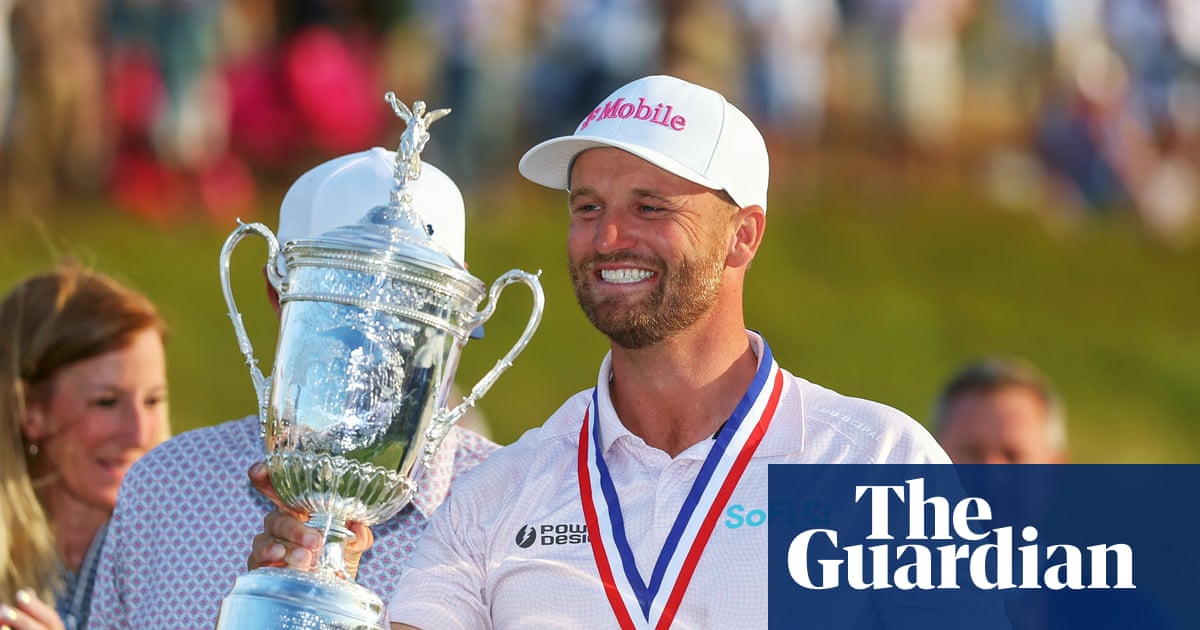
Wyndham Clark arrived at the 1st tee for the final round of the US Open on Sunday afternoon with six shots in hand and two wildly divergent outcomes before him. He could complete a wire-to-wire victory and capture America’s national title for a second time. Or he could equal the largest final-round collapse in major championship history.
The 32-year-old American ultimately responded with a masterclass in patience, restraint and nerve, overcoming a furious challenge from Sam Burns and increasingly hostile galleries at Shinnecock to capture his second US Open title in four years with a score of four under par, finishing one shot clear.
In the end, Clark did not merely survive what is billed as golf’s toughest test. He conquered a field of 155 world-class players, the suffocating pressure of a major championship, a stingy layout purpose-built to expose every flaw and crowds that seemed to cheer almost every mistake – even as a contest that had felt like a formality hours before came down to the 72nd hole.
“It was tough, but I’m proud of the way I handled it,” said Clark, who earned a record $4.5m (£3.4m) winner’s share from the tournament’s $22.5m (£17m) purse. “Things really could have gotten away from me. I stood tough.”
For the first time all week, Shinnecock appeared willing to loosen its grip. Winds that had battered the Long Island track through the opening three rounds eased significantly on Sunday, lifting hopes that someone from the distant chasing pack might mount a charge at Clark’s six-shot advantage. The rugged, treeless 7,440-yard course less than a mile from the Atlantic Ocean, hosting the US Open for a sixth time, had played firm but fair throughout the championship, much to the United States Golf Association’s credit. The more forgiving conditions felt like an invitation for Clark’s pursuers to make one final run.
The 29-year-old Burns, who held the 54-hole lead at Oakmont a year ago before closing with a 78, seized the opportunity. Three groups ahead of Clark, the American pieced together a three-under outward nine of 32 and steadily ratcheted up the pressure, while the Scottie Scheffler struggled to generate momentum alongside Clark in the final pairing.
As Clark and Scheffler emerged beneath a molten afternoon sun, the gallery made its allegiances clear. Thousands of spectators packed shoulder-to-shoulder around the 1st tee serenaded Scheffler with an a cappella rendition of Happy Birthday as the world No 1 sought to complete the career grand slam on his 30th birthday. The reception for Clark ranged from coolly indifferent to openly hostile, with scattered boos greeting his introduction and cries of “Get in the bunker!” after his opening tee shot despite it finding the fairway.
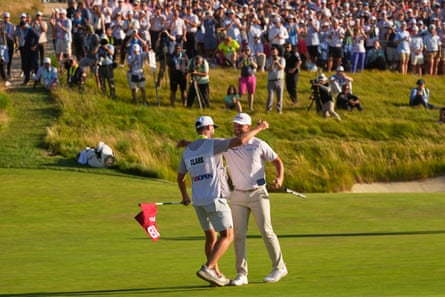
It was no surprise that Scheffler, golf’s dominant player, would command the Long Island crowd’s support. The rancor of the anti-Clark sentiment was more unexpected. Several spectators were eventually removed from the course by local police after repeatedly heckling the 2023 champion, whose reputation took a major hit after last year’s locker-room smashup following a missed cut at Oakmont, an incident that later resulted in the club banning him from its property unless he fulfilled a series of conditions that included completing counseling or anger-management sessions.
“The crowd was tough today,” Scheffler said. “I think sometimes it can get a little too much when balls are kind of going off greens and you start hearing cheers. That felt a bit much to me.”
He added: “It shows a lot about Wyndham, how he handled not only this golf course but I think the crowd today as well and is a well-deserving champion.”
The mood only intensified as Clark’s cushion began to shrink. They cheered when his tee shot at the 2nd found the heavy rough and again when his approach came up short and rolled off the green. By then his lead was down to four. Clark was standing over his fairway shot at the 3rd when Burns, not Scheffler, cut the deficit to three.
Burns was capitalizing. Three birdies in his opening five holes had already narrowed the gap and another at the 8th reduced the margin to two. Moments later Clark missed a three-foot par putt at the 7th, prompting one of the loudest cheers of the week and leaving his lead at a single shot.
Clark was now facing far more jeopardy than anyone could have imagined when the day began. Trying to avoid matching the largest blown 54-hole lead in US Open history – a dubious distinction set by Mike Brady (five) in 1919 – he covered the opening nine in three-over 38 while Burns surged into contention.
Yet for all the noise surrounding him, Clark refused to unravel. A nerveless up-and-down at the 9th allowed him to reach the turn one shot clear. The most important shots of his championship were still to come. Clark fired his approach at the 10th to four feet and converted the birdie putt to restore a two-shot cushion, then came a birdie putt from 24ft off the back of the 16th green that got it back to two after Burns had closed once more. Soon after Burns signed for a final-round 67, a score that could have been even lower had his 17-foot birdie attempt for a share of the lead and a potential playoff not shaved the edge and left him collapsed to his knees in anguish on the green.
“I really thought I made that putt,” Burns said. “I hit it exactly how I wanted with the speed I wanted and just didn’t go in, but really proud of the way we played today.”
He added: “Last year at Oakmont I felt more I lost the golf tournament. I certainly don’t feel that way today. I think I did my best, and I did everything I could to have a chance to win.”
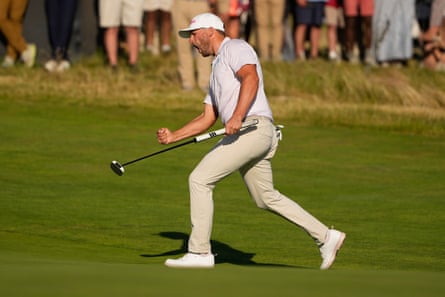
Scheffler, despite the broad support, could never quite generate the charge the crowd desperately wanted. The putting woes that had frustrated him throughout the week resurfaced again and again, costing him repeated opportunities to apply scoreboard pressure.
Clark did make a bogey at 17 and his drive at the 18th missed the fairway. But his shot into the green left him two putts from about 50ft, and he left the first one dead. The title was his.
South Korea’s Tom Kim (70) finished third at one under. JT Poston (67), Keith Mitchell (70) and Scheffler (71) shared fourth place at even par. In five previous US Opens at Shinnecock, only three players in total finished under par.
The Masters champion Rory McIlroy never seriously threatened after mounting a brief challenge with a run of birdies to reach two-under on Saturday’s front nine, closing consecutive rounds of 73 that left him at six-over. “The wheels came off,” he said of Saturday’s finish. “I sort of shot myself out of the tournament then.”
The victory completed a remarkable four-day display of control for Clark. At about 5pm during Thursday’s fog-delayed opening round, the leaderboard resembled a Hamptons weekend traffic jam, a gridlocked mass of more than 40 players within two shots of the lead. Then Clark found the open lane. Taking full advantage of unexpectedly benign conditions during the golden hour, he reeled off birdie, birdie and eagle at the 3rd, 4th and 5th holes to create the sort of separation rarely seen at a US Open.
He first seized the outright lead at 7.09pm on Thursday evening. By the time the delayed opening round finally concluded early Friday morning, his advantage had already been trimmed to two shots. It grew to four by halfway and six entering the final round. That margin proved just enough to avoid a piece of unwanted history: Greg Norman at the 1996 Masters remains the only case of a golfer losing a major after carrying a lead of six shots or more into the final round.
Instead Clark’s second US Open title on his sixth appearance placed him in rare company. Only Brooks Koepka, Lee Trevino, Walter Hagen, Ernie Els and John McDermott have won America’s national championship twice in so few starts.
“The first one was amazing, and this one seems even better,” Clark said. “Especially after the sour taste from last year’s championship, to come back and win this again is almost surreal.”