Net migration to the UK fell by nearly 50% to 171,000 last year, according to official figures released on Thursday, in what will be seen as a boost for Keir Starmer’s government.
Data released by the Office for National Statistics (ONS) showed the difference between the number of people moving to the UK and the number of people leaving was at its lowest level since 2021.
The figure was down 48% year on year from 331,000 in 2024, extending a sharp decline from a record peak of 944,000 in 2023.
The figures will encourage government ministers who have promised to drive down the number of people moving to the UK. Migration has become a key political battleground against the rise of Nigel Farage’s Reform UK.
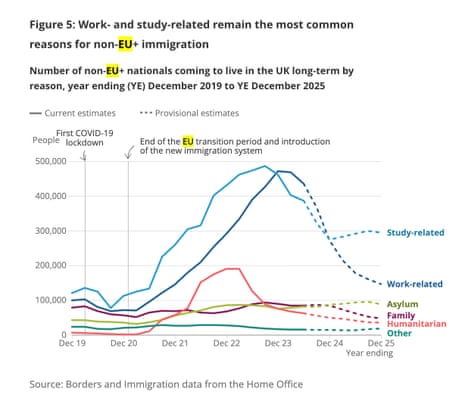
The number of nationals from outside the EU arriving for work-related reasons fell by 47% in 2025, which was the main cause of the continued fall in net migration. Over the same period, overall emigration fell slightly.
An estimated 813,000 people immigrated to the UK while 642,000 emigrated. The continued fall in net migration was being driven by fewer people from outside the EU arriving in the UK for work, the ONS said.
ONS figures cover net migration figures in the 12 months to December 2025.
The Home Office is publishing its own figures on Thursday related to the 12-month period to March 2026.
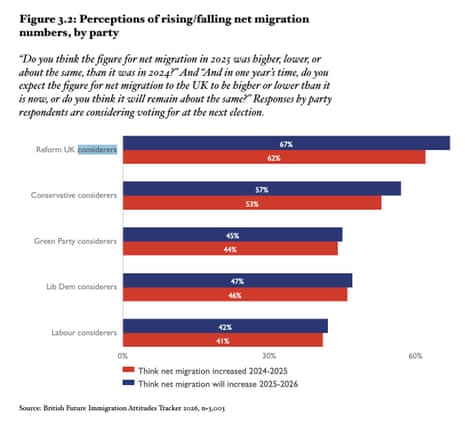
Many people mistakenly believe net migration is rising in Britain despite figures dropping to their lowest level in years, a thinktank has found . Research from British Future, published ahead of latest government figures on migration, revealed a chasm between reality and public perception of net migration, with a substantial portion of the public believing it had increased.
Net immigration into UK fell by almost half in 2025, down to 171,000, ONS says
Net migration to the UK stood at an estimated 171,000 in the year to December 2025, down nearly a half (48%) from 331,000 in the previous 12 months, according to new figures from the Office for National Statistics (ONS). The Press Association says:
It is the lowest figure since early 2021, when the post-Brexit immigration system was introduced and Covid-19 travel restrictions were still in place.
Net migration is the difference between the number of people moving long-term to the UK and the number of people leaving the country.
An estimated 813,000 people immigrated to the UK in the year to June while 642,000 emigrated.
The continued fall in net migration is being driven by fewer people from outside the EU arriving in the UK for work, the ONS said.
Latest figures suggest ‘excessively tough’ policies proposed by Labour for legal migration no longer needed, says thinktank
The IPPR , a left-leaning thinktank, says today’s immigration figures suggest the government does not need to press ahead with plans to toughen the rules governing legal migration.
In a statement, Marley Morris, the IPPR’s associate director for migration, trade and communities, said:
Today’s figures show that migration has fallen sharply, while the asylum system is beginning to function more effectively after a period of strain. The government has made notable progress since the start of the year in closing asylum hotels.
This should prompt a more measured debate. An excessively tough approach now runs the risk of making policy for the pressures of three years ago, rather than the reality of today.
Public concern about migration has been driven by a sense that the system was not under control. The figures suggest that is changing, but there is still work to do.
The focus now should be on the parts of the system that still need fixing: tackling small boat crossings, closing remaining asylum hotels, and speeding up appeals. The priority should be to build a fair, well-managed immigration system that supports the economy and public services, not a race to push numbers ever lower.
Morris was referring to the government’s plans to significantly increase the amount of time migrants have to wait until they can get indefinite leave to remain in the UK.
Number of asylum seekers housed in hotels down 35% in March on previous year, at 20,885, figures show
The Home Office has also published asylum figures this morning. These show that the number of asylum seekers being housed temporarily in hotels stood at 20,885 at the end of March 2026, down 35% year-on-year from 32,326. The Press Association says:
It is the lowest figure since data was first reported in 2022, Home Office figures show.
The total had climbed as high as 56,018 at the end of September 2023.
The Labour government has pledged to end the use of hotels for asylum seekers by the next election.
Tories claim net immigration still ‘far too high’ after ONS figures show it almost halved in 2025
The Conservatives are saying non-EU immigration remains “far too high”. This is what Chris Philp , the shadow home secretary, is saying in his response to the net immigration figures.
Brits are leaving on a massive scale and non-EU immigration remains far too high. Mass immigration undermines our society and low wage immigration is bad for the economy. British families feel it in lower wages, longer waiting lists for public services and housing shortages.
Labour must go further and reform indefinite leave to remain before their hard-left flank forces them to abandon it altogether.
The next Conservative government will introduce a binding annual immigration cap at a very low level, close the loopholes that let temporary visa holders stay indefinitely and tighten and extend the conditions for ILR. We want a small number of highly skilled migrants and no low-skilled migration at all. But sadly, Labour do not have the backbone to do any of it.
Shabana Mahmood , the home secretary, has said the immigration figures shows the government is making “real progress” on border controls. In a statement, she said:
Net migration has fallen by 82% in just three years.
We will always welcome those who contribute to this country and wish to build a better life here. But we must restore order and control to our borders.
As these statistics show, real progress has been made, but there is still work to do. That is why I am introducing a skills-based migration system that rewards contribution and ends Britain’s reliance on cheap overseas workers.
The sharp fall in the net immigration figures is largely a result of tougher rules for work visas and student visas , originally introduced by James Cleverly when he was home secretary in the Conservative government, and then mostly kept in place by Labour.
Here is a chart from the ONS report indicating this.
Reform UK and Tory supporters most likely to wrongly think net immigration has been rising, report says
Net immigration has been falling for at least the past two years. But many people wrongly believe the opposite, according to new research from the British Future thinktank, published before today’s ONS figures came out. (See 9.44am .) Geneva Abdul has the story.
Here is the British Future report .
And this chart from the report shows that it is Reform UK and Conservative party supporters most likely to think, wrongly, that net immigration has been going up.
Net immigration into UK fell by almost half in 2025, down to 171,000, ONS says
Net migration to the UK stood at an estimated 171,000 in the year to December 2025, down nearly a half (48%) from 331,000 in the previous 12 months, according to new figures from the Office for National Statistics (ONS). The Press Association says:
It is the lowest figure since early 2021, when the post-Brexit immigration system was introduced and Covid-19 travel restrictions were still in place.
Net migration is the difference between the number of people moving long-term to the UK and the number of people leaving the country.
An estimated 813,000 people immigrated to the UK in the year to June while 642,000 emigrated.
The continued fall in net migration is being driven by fewer people from outside the EU arriving in the UK for work, the ONS said.
Matthew England from the Hansard Society has a list of all 20 MPs who won the chance to bring in a private member’s bill, listed according to whethere they were for or against assisted dying.
Desmond Swayne tops list of MPs selected to bring in private members’ bills
Here is the list of 20 MPs who won the right to introduce a private member’s bill in the ballot held this morning. The list is in order, with Desmond Swayne in first place. Although 20 MPs can introduce a bill, only the people in the top seven are guaranteed a full day for their second reading debate , which means they are the MPs with the best chance of having a bill that might eventually become law.
The top seven MPs winning the ballot are: Desmond Swayne (Conservative, New Forest West), Lauren Edwards (Labour, Rochester and Strood), Mike Wood (Conservative, Kingswinford and South Staffordshire), Andrew George (Liberal Democrats, St Ives), Luke Evans (Conservative, Hinckley and Bosworth), John Whittingdale (Conservative, Maldon), and Jessica Toale (Labour, Bournemouth West).
The other MPs on the list are: Neil Shastri-Hurst (Conservative, Solihull West and Shirley), Gareth Snell (Labour, Stoke-on-Trent Central), Lincoln Jopp (Conservative, Spelthorne) Patricia Ferguson (Labour, Glasgow West), Robert Jenrick (Reform UK, Newark), Damian Hinds (Conservative, East Hampshire), Alistair Strathern (Labour, Hitchin), Clive Jones (Liberal Democrats, Wokingham), Victoria Atkins (Conservative, Louth and Horncastle), Munira Wilson (Liberal Democrats, Twickenham), Steff Aquarone (Liberal Democrats, North Norfolk), Paul Foster (Labour, South Ribble), and David Pinto-Duschinsky (Labour, Hendon).
This is from my colleague Jessica Elgot .
NEW – Two assisted dying supporters have come second and fourth in the private members bill ballot
– Lauren Edwards
– Andrew George
If they choose to take on the bill, it is possible it could still pass (but it is still very difficult)
Schools are ‘pipeline’ to joblessness for many people, says ex-Labour adviser
Schools have become a “pipeline” to worklessness for a large cohort of young people in the UK, according to an influential former Labour adviser who has called for urgent action to help a “lost generation”. Alexandra Topping and Richard Partington have the story.
Treasury minister Lucy Rigby says rich already being taxed properly, as Wes Streeting calls for ‘wealth tax that works’
Good morning. It’s a big day for Rachel Reeves , the chancellor. In a Commons statement, she is announcing a series of measures to help people with the cost of living. She wants people to enjoy a “Great British summer”, she says. Reeves’s plan for what makes for a good summer is not quite the same as Samantha Niblett’s ; the chancellor is talking about free bus travel for children, as Heather Stewart, Peter Walker and Sarah Butler report in their preview.
Reeves is speaking after 11.30am.
In the meantime, another Labour MP with ambitions to run the economy has been speaking out. Wes Streeting has given an interview to the BBC’s Nick Robinson for his Political Thinking podcast and he had a lot more to say about his policy agenda than he did in his resignation speech in the Commons yesterday. As the BBC reports , Streeting proposed a “wealth tax that works” – by which he means not what most people think of as a wealth tax (the Green party version – a tax on assets above a certain amount ), but instead aligning capital gains tax rates with income tax rates. Streeting said this proposal – which is broadly the same as one of the main proposals in the Labour Growth Group ’s report last week – could raise up to £12bn a year.
Lucy Rigby , the new chief secretary to the Treasury, was giving interviews this morning. Asked about Streeting’s proposal, she said she had not heard his interview, but she suggested Reeves was already taxing wealth. She told the Today programme:
We already tax wealth in this country. The chancellor introduced a host of measures in her first budget, and then further measures in the last budget as well, that try and make sure that tax is as progressive and fair as possible.
Here is the agenda for the day.
9am: Nusrat Ghani, a Commons deputy speaker, selects from a ballot the 20 MPs who will get a slot to bring forward a private member’s bill.
9.30am: The Office for National Statistics publishes figures for long-term migration into the UK. Separately, the Home Office publishes its quarterly asylum figures.
9.30am: Peter Kyle, the businesss secretary, takes questions in the Commons.
10.30am: Steve Reed, the communities secretary, gives a speech on “neighbourhood standards”. He is expected to suggest profits made by private providers of social care could be capped.
11.30am: Downing Street holds a lobby briefing.
After 11.30am: Rachel Reeves, the chancellor, makes a statement to MPs about measures to help people with the cost of living.
There are also 14 written statements coming today, of which at least two look particularly interesting. The government will publish information about the appointment of Andrew Mountbatten-Windsor as a trade envoy, in compliance with a Commons humble address. And Bridget Phillipson, the equalities minister, is publishing the long-awaited guidance on single sex spaces updated in the light of last year’s supreme court judgment on the meaning of the Equality Act.
If you want to contact me, please post a message below the line when comments are open (between 10am and 3pm), or message me on social media. I can’t read all the messages BTL, but if you put “Andrew” in a message aimed at me, I am more likely to see it because I search for posts containing that word.
If you want to flag something up urgently, it is best to use social media. You can reach me on Bluesky at @andrewsparrowgdn.bsky.social. The Guardian has given up posting from its official accounts on X , but individual Guardian journalists are there, I still have my account, and if you message me there at @AndrewSparrow, I will see it and respond if necessary.
I find it very helpful when readers point out mistakes, even minor typos. No error is too small to correct. And I find your questions very interesting too. I can’t promise to reply to them all, but I will try to reply to as many as I can, either BTL or sometimes in the blog.
For Aston Villa, the Europa League must only be the beginning, Unai Emery insisted after winning the trophy for a fifth time. Beating Freiburg 3-0 on Wednesday evening brought Villa’s first major piece silverware since the League Cup in 1996, but Emery is determined this should not be the summit of their achievements. He again rejected the tag of “king of the Europa League”, preferring to focus on “now” and, by implication, the future.
“Next year we will play in Champions League and this is the challenge,” the Aston Villa manager said. “The best teams in the world are there and it will challenge us a lot. The Premier League is the most difficult league in the world. To be fighting top seven, top five, top four is something very difficult. Hopefully we can be close with teams like City and Arsenal.
“It’s a huge challenge we have in Premier League. Why? In the beginning we are not contenders for top seven. There are top seven teams. Top six, and Newcastle is the seventh. And we are trying to get there. To try to be consistent there. We are achieving it.”
Winning the Europa League is part of the process. “Play for Europe, play for trophies,” Emery said, explaining the stages of fulfilling the dream he outlined in his introductory press conference as Villa manager. “This is the first one and we are achieving and the experiences we are having is every important in how we can get better.Trophies make sense of what we are doing. We are not going to stop.”
A key part of that process has been the set-piece coach, Austin MacPhee, as exemplified by the move that led to Youri Tielemans finding space to put Villa ahead with a ferocious volley. John McGinn, the Villa captain, said: “I’m biased, but we have a great set piece coach in Austin MacPhee. We tried to deceive a bit with the set piece. We did it against Liverpool at the weekend. Youri has great quality to find the goal. It’d have been over the bar if it were me!”
Emery called MacPhee “a really fantastic creator. We must be so, so demanding in our details. Austin is fantastic. Everything we are working on makes sense. The hours in each training session each day to try to get as best as possible our challenges in set pieces. When we are scoring like that of course we are proud of what we’re doing.”
The Villa keeper, Emiliano Martínez, required treatment for a hand injury before the game, and revealed after the match that he played with a fracture. “Today I broke my finger during the warm-up and for me, every bad thing brings something good. I’ve done this my whole life and I’ll keep doing it,” the Argentinian said. “Should I be worried? Well, I’ve never had a broken finger before,. Every time I caught the ball, it went the other way. But these are things you have to go through, and I’m proud to defend Aston Villa.”
H irokazu Kore-eda’s new film is a bafflingly unsatisfying and unconvincing muddle of ideas and moods; it is a futurist fable of AI-humanoid robot children, unpersuasively performed in a returning keynote of bland serenity. It is perhaps comparable to Kore-eda’s 2009 film Air Doll , a more adult story of man whose sex doll secretly comes to life.
Otone (Haruka Ayasi) – an architect who appears to work from home, with no office scenes or colleagues visible – is an educated woman married to down-to-earth Kensuke (Daigo Yamamoto), a carpenter who likes beer and playing baseball. Two years previously, their seven-year-old son, Kakeru (Rimu Kuwaki), was killed by a hit-and-run driver who has never been caught. They are approached by a company called REbirth, whose offices are huge and white with creepy logos and designs, like all sinister corporations in the movies, although the question of whether REbirth is supposed to be sinister is one of the film’s many unanswered questions.
REbirth offer a promotional free offer: an ultra-hi-tech humanoid robot replica (or replicant) of Kakeru, whose physical form, speech patterns and memories they can fabricate using videos, photos and other research materials provided by the stricken parents. The new Kakeru can stay with them for however long it takes to get through the grieving process. And when this stunningly convincing Kakeru 2.0 is delivered at the couple’s home, the audience will surely be expecting some emotional fireworks or, if those fireworks are absent, then a surely a very significantly numbed lack of emotion. But we get neither: Otone and Kensuke are bizarrely matter-of-fact; they behave as if some very sophisticated iPhone has been delivered. Otone’s mother faints when she sees the robot – but recovers quickly.
Otone wants to make a success of their new arrival, while Kensuke is grumpily unsure about the whole idea. He harshly tells “Kakeru” not to call him daddy – an instruction which has its ironic backlash when the police suspect him and “Kakeru” on the street of being a paedophile and victim. It’s a subplot punchline of sorts, not quite funny, not successfully serious. The tonal oddity of the film continues, trying to be a sci-fi dystopia and yet also a relatable heartbreaker about parental grief; these two modes simply undermine each other. Nor does the film attempt comedy, as in Spike Jonze’s Her – the intention is always seraphically serious.
Kensuke at one stage brings this “Kakeru” to the scene of the hit-and-run crime that killed their son, to see if the robot will remember or recover details of the culprit’s identity; this is a rather clever Hollywood-ish idea, one of many the film doesn’t pursue. He also uses “Kakeru” as a kind of confessor to whom he can admit his own guilt about the boy’s death; this idea is also left undeveloped.
Yet it is not enough for the film to ponder the existence of just this uncanny-valley robot child. It turns out that other abandoned or otherwise feral robot children have made contact with “Kakeru”, effectively planning a kind of replicant revolt, representing a yearning for freedom which the film finally appears to endorse. (As with other films about rebellious AI robots, you have to wonder about battery life.)
And so the film finally comes to its end, unsatisfying and baffling to the last, accompanied by its dreamy-sweet music. There’s nothing wrong with film-makers leaving their comfort zone and going for a big swing but this just doesn’t work; it isn’t as interesting as films on similar themes including Kogonada’s After Yang and Benjamin Cleary’s Swan Song . The story is misconceived and Kore-eda’s quietist, un-emphasised style doesn’t suit it.
Sheep in the Box screened at the Cannes film festival
The Unite the Kingdom march attracted tens of thousands of people to the capital on Saturday. While some insist it was a display of national pride, others see the Tommy Robinson rally as a hostile display of anti-migrant sentiment. US vice president JD Vance appeared to align himself with those who attended the march at a White House press briefing on Tuesday.
We would like to hear from people who have emigrated – or are considering doing so – because of anti-migration sentiment or government policy. Since the UK is just one country where anti-migration sentiment has flared, we’re keen to hear from people globally who have made life decisions because of the current climate.
If you’re having trouble using the form click here . Read terms of service here and privacy policy here .
For all their outward differences, there always seemed to be things that linked Mahmoud Ahmadinejad and Donald Trump.
A visit to the then Iranian president’s rather humble Tehran neighbourhood nearly 20 years ago highlighted cost of living problems that prefigured those facing Trump now.
Amid soaring prices, the grocer at the end of Ahmadinejad’s street in the Narmak district was no longer stocking tomatoes, saying customers could not afford them and voicing a wish to close down. Shoppers at a nearby fruit and vegetable market complained at the cost of potatoes, onions and fish.
It seemed to represent a failure on the kitchen table issues that the populist leader had pledged to tackle. Trump critics will surely hear an echo.
Two decades later, that reporting trip has uncanny resonance amid reports that Israeli strikes on a security post were designed to free Ahmadinejad from house arrest and lead to his installation as Iran’s new leader.
The New York Times, citing official sources, reported that the US and Israel had identified the anti-western and anti-Zionist former president as the person they wanted to lead Iran after the regime’s presumed collapse in the face of their military onslaught.
The plan went awry almost immediately. The strikes, on the first day of the war on 28 February, killed the guards and injured Ahmadinejad, who was initially reported by Iranian media to have died. The former president, it is said, went to ground afterwards, having become “disillusioned” with the US-Israeli scheme. His whereabouts is not known.
There are several other mysteries as to how such a divisive figure became the poster boy for regime change in what has long been the west’s leading adversary in the Middle East.
On one level, a mutual attraction between Trump and Ahmadinejad is not so far-fetched. The pair share a populist, headline-grabbing communication style ; similarities in their autocratic governing style have also been noted.
Cynics may add that the two have a common taste for overturning democratic election results. Compare Ahmadinejad’s hugely controversial 2009 election win – widely assumed to have been stolen – with Trump’s efforts to overturn Joe Biden’s victory in 2020.
But the real headspinner is Israel’s apparent choice of Ahmadinejad as a man it could do business with.
Styling himself as an Islamist populist, the former provincial mayor was arguably the key figure who set Iran and Israel on a long path to war after he was elected in 2005. Within weeks of taking office, he set the tone at a “World Without Zionism” conference in Tehran with remarks that were roughly translated as calling for Israel to be “wiped off the map” .
Ahmadinejad revelled in the backlash and his baiting of Israel became relentless. His government organised exhibitions and conferences satirising and challenging the veracity of the Holocaust. Amid it all, Ahmadinejad loudly championed the resumption of Iran’s nuclear programme, which had been stalled to allow negotiations and to build trust with the west.
It was a recipe for fear, hostility and mounting tensions – a toxic mix that has led to open warfare. And the man chosen to clear the air is the same one who did so much to pollute the atmosphere in the first place. How did it happen?
Washington policy insiders point to “a transformation” Ahmadinejad underwent after leaving office in 2013. He became increasingly disenchanted with the Iranian regime and fell out with the supreme leader, Ali Khamenei, his one-time mentor who was killed on the opening day of the war.
In a measure of his alienation from the regime, he was rejected three times by a candidate vetting body when he tried to regain the presidency in 2017, 2021 and 2024.
A former White House adviser on Iran said: “He is a true populist and even when he was president, he would be focused much more on the nationalistic sides of Iran, the history and the Persian heritage stuff that the Islamic republic had mostly been dismissing. He was pretty public about his dissatisfaction with the trajectory of the Islamic republic and developed this really brilliant social media campaign.”
Regime-imposed restrictions on Ahmadinejad’s movements – which were not widely known about – may have been triggered by contacts with Israel, which some speculate could have occurred when he travelled to Hungary in 2024 and 2025 to speak at a university associated with the far-right government of Viktor Orbán.
“My understanding is that he showed some level of recognition that his antics [on Israel] were not helpful, and that he was willing to do things differently,” the former US official said.
It is not clear how Ahmadinejad would have taken over after the regime’s expected collapse – and whether he would have been accepted by a public that protested against him after the disputed 2009 election .
Alex Vatanka, head of the Iran programme at the Washington-based Middle East Institute, said: “If this was a genuine effort to go regime change, in many ways it is not a bad idea. Ahmadinejad certainly did start speaking as a very different man than he was first in 2005 when he became associated with his Holocaust denial rhetoric. [But] I do question whether he had the level of popularity to pull it off.”
More intriguing, said Vatanka, was why Ahmadinejad’s role as an agent of change was emerging now when hopes of toppling the regime appeared all but lost.
He added: “My first question is who leaked it and why? Are they trying to make the regime panic about the level of infiltration. Is this going to create a sense of anxiety and paranoia inside the regime in transition?
“This is a regime that has been badly infiltrated across the board for years. It was focused in the past on nuclear and military officials. Now a relative political heavyweight has been implicated. If you can tap into Ahmadinejad, who else can you tap into?”
Ecuador’s Jhonatan Narváez edged out the Spaniard Enric Mas at the end of Wednesday’s stage 11 to win his third stage of this year’s Giro d’Italia as Afonso Eulálio retained the leader’s pink jersey.
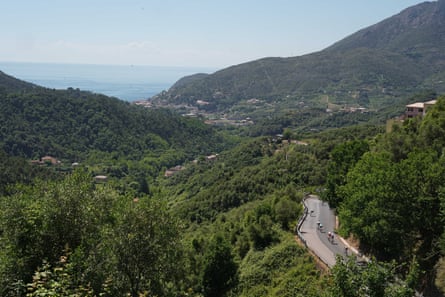
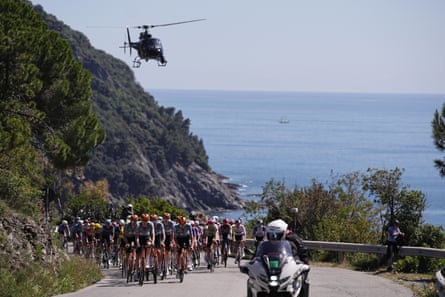
Narváez (UAE Team Emirates XRG) and Mas (Movistar) were left to battle for the win after leaving the breakaway group on the final climb and Mas made the first move, only for the Ecuadorian to overtake him before the line. The Italian Diego Ulissi (XDS Astana) won the race for third place at the end of the entertaining 195km ride from Porcari to Chiavari.
“Mas was the strongest in the climb and I knew I had to play my game, I just tried to defend myself on the uphill,” said Narváez. “I was scared because when he did the sprint he almost closed me on the barriers and I was on the limit, but it was full gas racing all day, because we don’t race just in the uphills, we race on the downhills also.”
There was no change at the top of the general classification, with Portugal’s Eulálio maintaining his 27-second lead over the race favourite Jonas Vingegaard.
The first half of the stage provided plenty of opportunities for breakaways from the peloton before the riders reached the first of three categorised climbs. Early attacks were reeled in and the group that managed to get away grew in size as others left the bunch to go in chase, before the race settled down on the second climb with a 12-man group over three minutes ahead of the peloton.
A crash on the descent brought down three of the leaders, and the breakaway began to split. On the uncategorised climb before the finish, Mas attacked and Narváez followed. And with Mas unable to shake off the Ecuadorian before the descent, Narváez was always going to be the favourite in a sprint finish.
Mas, a three-time runner-up in the Vuelta a España, is out of contention for the overall win but was desperate for a stage victory on his Giro debut. It was Narváez, though, who claimed the fifth Giro stage win of his career.
The peloton, containing all the GC contenders, trailed in more than three minutes behind the winner, and Eulálio (Bahrain Victorious) will wear the pink in Thursday’s stage 12, a flat 175km ride from Imperia to Novi Ligure.
Schools have become a “pipeline” to worklessness for a large cohort of young people in the UK, according to an influential former Labour adviser who has called for urgent action to help a “lost generation”.
Peter Hyman, a former adviser to Tony Blair and Keir Starmer, told the Guardian the government should ban social media and enact radical education reform to tackle the “national scandal” of young people who are not in education, employment or training (Neet).
Launching a major new report which is expected to influence government policy on Neets in the UK, Hyman called on ministers to overhaul a system that trapped the young in a “rejection economy” where they were being failed by the education system, employers and social media companies.
The former headteacher said he was shocked at the sadness and despair experienced by school leavers who felt abandoned, ill-equipped and unable to enter an increasingly competitive jobs market. He added that close to one million were being wrongly classed as “snowflakes”, when in fact they were being “failed by government and the state”.
The UK has the third-highest rate of young people who are Neet among Europe’s richest countries , after a sharp rise to almost one million – the highest level in more than a decade.
Fuelling a growing sense of alarm in government, it comes as the former Blair-era cabinet minister Alan Milburn prepares to publish a highly anticipated report into the crisis in youth jobs next week.
Milburn told MPs on Wednesday that Britain risked facing a “generational problem” that was worse than the damage inflicted on young people by the 2008 financial crisis.
The rate of 16- to 24-year-olds who were Neet peaked at 16.8% in 2012 amid soaring unemployment after the banking crash. The rate fell back, although has since increased sharply to 12.8% amid a difficult jobs market and growing problems with mental ill-health.
“On the face of it we’ve got a smaller problem. But what I want to say to you is – you’ve got a bigger problem. Because the nature of the problem is more entrenched,” Milburn said.
“It’s a labour market problem, it’s a jobs crisis – but it’s being fuelled by a health crisis. And so these two things are self reinforcing: you have a vortex; a spiral. And it has enormous consequences.”
The report, Inside the Mind of a Young Neet, argues the UK must stop blaming young people for a system that has let them down. Co-authored by researcher Shuab Gamote and the former headteacher, it draws on conversations with more than 400 young people across the UK.
The report states that Britain’s workless youth faces “a unique combination of challenges including: poverty, Covid, loneliness, social media addiction, and economic shock”.
It adds: “We have created circumstances – run the economy into the ground, locked children away during lockdown, regimented them in schools, turned a blind eye to bullying, given them the social media tools of destruction – and then let them drift.”
A joyless education system that focused too heavily on passing exams and too often failed to address bullying and mental health problems left too many young people without qualifications or any sense of potential pathways to training or work, Hyman said. “I was shocked by the level of vitriol and hatred these young people used when talking about school,” he added.
The report also talked to multiple young people who had spent years “doing nothing”, with this “bedroom generation” victims of “a taught and learned helplessness that our system encourages”. They often felt unable to gain experience required for even entry-level jobs and wanted vocational options signposted, more work experience and more flexibility from employers, it said.
Asked if the government, which is carrying out a consultation into a ban on social media for children , should enact a ban, Hyman said: “From our conversations with young people it’s clear the government needs to ban social media for the under-16s.”
But it also needed to provide youth hubs and opportunities for young people to connect in real life and learn new skills, he said.
“The young people we’ve spoken to crave more social connection and places to go,” he said. “It’s no good saying ‘get off your phone and do something’ if they don’t have anything to do nearby.”
I ’m sure this isn’t the intended takeaway from The Boroughs, a supernatural murder-mystery set in a New Mexico retirement community, but I am transfixed by what is on offer to the ageing demographic across the pond. It’s like watching an episode of The White Lotus and vowing in your next life to come back as an affluent white American, but more realistic. God willing, we’ll all get old – and with a bit of careful planning, maybe we could stretch to a berth in one of the villages that a country with the space to house them provides for a reasonable sum?
Protagonist Sam Cooper (Alfred Molina) doesn’t know how lucky he is, any viewer native to these cramped isles might think, as his daughter and son-in-law drop him off at his new home in The Boroughs. There he will find like-aged neighbours, multiple shops, sports and exercise classes, a community centre and numerous other facilities, including a lavishly appointed care home (The Manor) for if and when the time comes. A skittering monster extracting a modicum of body fluids from you every now and again seems a small price to pay. But we’ll get to that.
The Boroughs takes its time to crank up the plot. It moves, you might say, at the pace of its inhabitants. Which is only to the good. It means there is time to build their world. Sam, whose wife Lily (Jane Kaczmarek) died suddenly and more or less in his arms five months ago, is mired in grief. It was Lily’s dream to retire here and Sam is furious with the owner of the village, Blaine Shaw (Seth Numrich), for not letting him break the contract. His neighbour Jack (Bill Pullman) is a cheery sort, not least because single men like him are a rare local commodity (though he has recently met “someone special”), whose bonhomie gradually improves Sam’s own mood. Wally “I have stage-four prostate cancer” Baker (Denis O’Hare) – most Boroughlingians open with their health status; it saves time – is one of the 100 residents recently banned from the community centre “after the orgy”, and rounding out what will soon become the Scooby gang are Geena Davis as Renee, a former band manager whose ex-husband is still giving her financial pain, and married couple Art (Clarke Peters), a weed-smoking hippy and Judy Daniels (Alfre Woodard), a retired journalist.
It is, obviously, a fine cast and any fears (deriving from the presence of the Duffer brothers, famed for Stranger Things, as producers) that some of the best actors in the business are about to be wasted on hokum are soon laid aside by an intelligent, witty script and a plot that nods to all the most entertaining monster tropes without being slavishly devoted to them. There’s also an unexpected tenderness and wisdom underlying the whole, that befits the stage of life its characters are at. Creators Jeffrey Addiss and Will Matthews are relative newcomers as writers (they have The Dark Crystal: Age of Resistance TV series and Lord of the Rings: The War of the Rohirrim under their belts). They channel the spirit of Spielberg as the Duffers did, though they manage to emulate not just his unerring instinct for storytelling but his emphasis on emotional truth.
But hokum is fun too! And there is plenty of that as Sam begins to suspect that the distressed ramblings of Edward (Ed Begley Jr), the previous occupant of Sam’s house who is now confined to The Manor, about a creature in the walls of his home may have some truth in them. We get glimpses of a horrible thing (“It had too many legs”) creeping out of the oven at night and leaving shiny blue blood droplets when shot and injured, mysterious thefts of anything containing quartz round the village, mass bird deaths, underground shenanigans, a tree bearing glittering orange fruit and much, much more! Including a menacing security guy, old photographs that appear to show people from long ago looking exactly the same as they do now, and – could that be a veiled threat that Blaine, with a face as smooth as his manners, has just issued to Sam?
Like the best hokum, The Boroughs speaks, via monsters and electroplasm, to eternal human fears. Death is one, but The Boroughs parses it further – the fear of dying alone and friendless, after all one’s loved ones have gone, or after years of living in a terrifying, memory-less present – and then gives us comfort, that together most monsters can be defeated.
‘I remember growing up and smelling lanolin everywhere and the wisps of wool just floating around,” debut novelist Marcia Hutchinson has said of her home city of Bradford, then a traditional Yorkshire mill town, where she was born to Jamaican parents in late 1962. From 1948, Bradford became a destination for several thousand Windrush migrants from the Caribbean, encouraged to come to the UK as part of postwar reconstruction. What they found was frequent racism and hostility as well as cold, damp weather and inadequate housing. Hutchinson has been open about using her own difficult childhood as the inspiration for The Mercy Step, a novel that does not stint on accounts of poverty, systemic abuse and violence, yet is pungent with wit and colour. For sheer vivacity and determination, it deserves its place on the shortlist of this year’s Women’s prize for fiction .
Hutchinson’s alter ego, Mercy Hanson, makes her stubborn, lively presence known “during the coldest winter of the 20th century”, speaking to us directly from her mother’s womb. “Mummy” is a God-fearing and often terrifyingly God-invoking character, “five foot nothing” with a tiny waist despite her many pregnancies. Four older children have been left “Back Home”, some adopted by white families. Mercy is the third girl to be born to Mummy and Daddy in England; another daughter and a longed for, spoiled only son soon follow.
Mercy is born prematurely, at home; Mummy cuts the umbilical cord herself. The light of that first winter is “cold and anaemic”, the paraffin heater disperses fumes; before long Mercy is admitted to hospital with pneumonia, referred to as “New Monya”. Hutchinson blends beautifully a mix of Jamaican patois and Yorkshire dialect throughout, as well as the “Speaky-Spokey” RP that her mother adopts when talking to the “Hinglish”.
Mercy spends her first year away from the family in hospital, and ever after feels apart from her siblings, a separateness emphasised by her habit of sitting on the hall stairs observing daily goings-on from her “Mercy Step”. She is mischievous and bold, jealous of her mother’s time and attention. Daddy is “tall, very tall, a proper giant” puffing on Capstan Full Strength, watching horse racing on the “Tee Vee”, rarely without a hat: “the Trilby makes him go on for ever”. The red glow of his cigarettes increasingly seem to Mercy a sign of “the Devil” and he is a threat to her from the off, even knocking the tiny baby about in her crib. “This isn’t right,” the infant consciousness informs us. Beatings are dispensed casually on the children by both parents, but the domestic abuse and coercive control wielded by Daddy over Mummy is complete.
Hutchinson depicts Mercy’s reaction to sustained abuse as akin to entering a dissociative fugue state; but despite the home horrors the novel is by no means depressing. For every dodgy pastor or unsympathetic teacher there is encouragement – from a kindly librarian or from Mona, Mercy’s big sister, an afro-sporting free spirit.
The novel ends with Mercy’s acceptance to grammar school aged 11. Though it drifts dangerously into vignette in places and there are some odd similes – a family dog is compared to both a cat and a rabbit, for instance – keeping to a tight timeframe smooths out some rookie errors of composition. It is through reading and sport that Mercy strives to get on and out. There is a wonderful moment of early political consciousness when she and her classmates inform their PE teacher that they are not “coloured” but “Black”, inspired by the recent 1968 Olympics black power salute undertaken on the podium by three athletes. As it concludes, The Mercy Step echoes and amplifies that moment of empowerment.
The Mercy Step by Marcia Hutchinson is published by Cassava Republic (£10.99). To support the Guardian, order your copy at guardianbookshop.com . Delivery charges may apply.