Keyword – Environment
Trefwoorden – Electric, hybrid and low-emission cars, Automotive industry, Automotive emissions, Business, Greenhouse gas emissions, Environment, Motoring, Technology, Travel and transport, Renault, Citroën, Renewable energy, Transport, Manufacturing sector, Europe
Title – How Europe’s EV makers shrank their product to challenge the bloated SUVs | Electric, hybrid and low-emission cars | The Guardian
Author – https://www.theguardian.com/profile/jasper-jolly
Link – How Europe’s EV makers shrank their product to challenge the bloated SUVs | Electric, hybrid and low-emission cars | The Guardian
Publish date – 2026-06-21T04:00:20.000Z
Category – News
URL – https://www.theguardian.com/environment/2026/jun/21/europe-ev-shrank-challenge-suv-smaller-china
T he winding backstreets of London, Paris and Rome are a large part of their charm. But they are also a problem for electric carmakers. For a long time, squeezing big batteries into smaller, cheaper cars to fit European streets was too much of a problem, so manufacturers focused on bloated SUVs instead.
But that is finally changing. Battery technology has improved and Europe’s carmakers havecut manufacturing costs enough that they can now sell cars that might have a chance of fitting down a medieval lane or two.
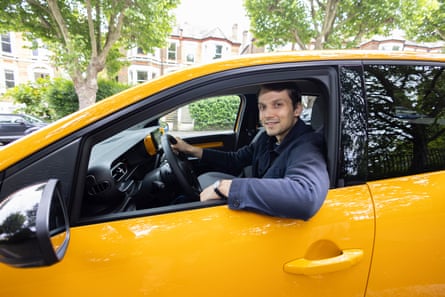
The new Renault Twingo E-Tech is a case in point. Driving the city car through London attracts quizzical looks. Its bulbous headlights live up to the older petrol version’s “frog” nickname, and this particular model has a “mango yellow” paint job.
But small, European electric cars like this will be notable for more than their looks if they can slow the trend towards ever-bigger lumps of metal – and help fend off the challenge from Chinese rivals.
“The world is not going to be saved by big SUVs that are electric,” says Renault’s chief design officer, Laurens van den Acker, who led development on the Twingo. “The world is going to be saved by small electric cars. We need more of them and not less. We need them to become as popular as other cars.”
Car companies are probably not the obvious candidates for saving the world, but they do have a part to play in making vehicles that don’t pump several tonnes of planet-heating carbon dioxide into the atmosphere each year. Road transport currently accounts for about a fifth of EU emissions.
Switching from a small petrol hatchback to an electric SUV represents two steps forward and one step back in environmental terms. The larger car will not produce emissions directly, but more bulk and bigger batteries mean higher emissions associated with manufacturing and more energy needed to move compared to a smaller vehicle – not to mention clogging up streets.
Renault’s Twingo (priced from €19,490 in France and probably selling for about £18,000 when it launches in the UK next year) will go up against an increasing number of rivals in the city car and small car segments of the automotive market. Citroën has the ë-C3 and is planning to revive the venerable 2CV name for a forthcoming small electric model. Peugeot, Citroën’s sister company in the Stellantis group, has the E-208.
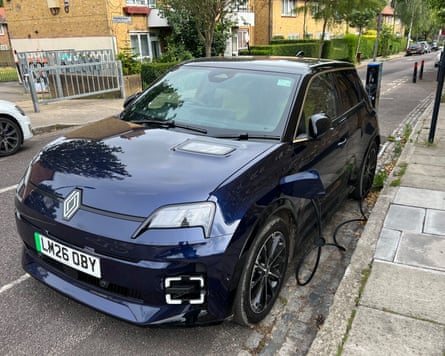
Renault and van den Acker have already had a hit with the slightly larger Renault 5 E-Tech, the 2025 winner of Europe’s venerable Car of the Year award . The Mini Cooper Electric and the Fiat 500e have also been on sale for several years, and more are on the way, notably the Volkswagen ID. Polo. There is also the very fun niche of even smaller “ quadricycles” such as the Citroën Ami and the Micro Microlino .
Reversing the trend
The blossoming of smaller cars comes after decades of vehicles getting bigger. At 4.41 metres (14ft 5in) on average, cars manufactured in 2024 were 5% longer than in 2016, according to Dutch government statisticians. They were also nearly 4% wider at 1.82 metres (5ft 10in) – a particular problem for anyone trying to navigate the canal-side streets of Amsterdam.
Smaller cars had started to disappear because it became harder for manufacturers to make money on them. Safety regulations meant extra kit, which was tricky to package into smaller spaces. And when the shift to electric came, batteries were initially too expensive for cars that had traditionally been the most affordable.
If any brands can claim to be synonymous with small cars, they are Mini and Smart – the latter particularly for its two-seater model, the Fortwo . Smart became a joint venture between Germany’s Mercedes-Benz and China’s Geely in 2019, when it turned its attention to larger electric models, and it is now planning an electric version of the Fortwo, called the #2 (pronounced, awkwardly, as “hashtag two”).
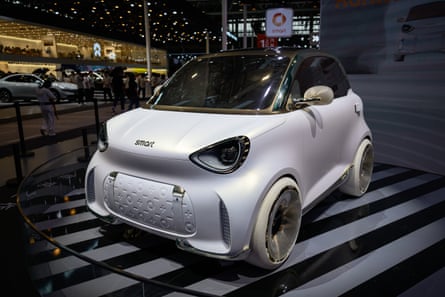
Smart Europe’s boss, Wolfgang Üfer, told an industry conference last month that the #2 was the model everyone, including his own mother, had been asking for. But it has taken longer to develop because of the design challenges of packaging everything into a footprint less than three metres long.
“Making a big car is easy,” says Xuan-Zheng Goh, Smart Europe’s director for product, marketing and communication. “Making a small car is a real big challenge. You need to make some careful decisions.”
Demand for smaller cars has always been there in Europe, he says, but the key to making them financially viable was the falling cost of batteries.
To clamp down further on costs, Renault pushed to design the Twingo in two years rather than four, and did some of the engineering work in China. It also cut the number of parts from between 1,500 and 2,000 found in other cars to only 750.
Within those constraints, van den Acker says, the company sought to make “EVs that you could actually fall in love with”. On the Twingo, that translates to quirky touches such as the headlights and bright colours, a profile in which the windscreen and bonnet form a single line, and sliding back seats to allow for more legroom or boot space.
It is also “French and good taste”, van den Acker adds. ”What you guys in England love.” The trade-off, though, is range: the Twingo has a 27.5kWh battery that gives it a range of 163 miles – easily enough for the school run, but meaning this reporter had to stop to charge for 20 minutes on a weekend return trip from London to Oxford.
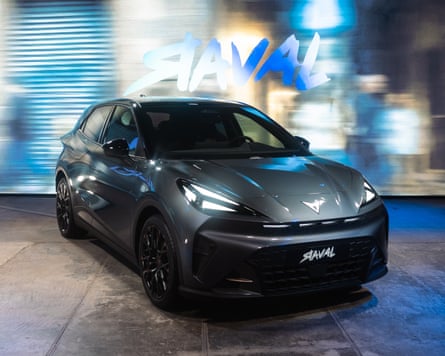
Cupra, owned by Volkswagen, is another manufacturer shrinking its product with the launch of its electric Raval. Starting at £23,785, the car is “a gamechanger” for the company, according to Markus Haupt, the chief executive of Cupra and its Spanish sister brand, Seat.
“We said, OK, now is the moment to bring these cars,” Haupt says, pointing to increased demand for electric vehicles in the UK and Europe. “With this car we have the perfect package to convince [customers] that electro mobility is not the future, it’s the present.”
Getting the cost of production down was a crucial first step, Haupt adds. That required billions of euros of spending across the Volkswagen group to produce a new platform – a shared manufacturing blueprint used as the basis for several cars across different brands. Production costs should be about level with petrol cars “by end of this or beginning of next decade”, says Haupt.
Carmakers have another big reason to try to switch to electric for the millions of small cars in Europe: they need to hit emissions targets in order to avoid fines. That will be impossible without making EVs their top sellers.
However, governments setting the rules – including in the UK – have come under a lot of pressure from the industry to slow the pace of change . Carmakers may be able to sell more hybrids to meet their legal obligations – an option for some small cars such as the Toyota Aygo and the Fiat 500 – albeit at the cost of much higher carbon emissions.
Chinese rivals
But, as ever in the European car industry, there is an elephant in the room: Chinese rivals . China’s relatively new cities and wide roads do not necessarily need smaller cars, but the country’s carmakers know there is a market for them in Europe.
BYD, the world’s largest electric carmaker , has the Dolphin Surf city car, while Stellantis is helping to distribute the Chinese manufacturer Leapmotor’s T03. Smart’s cars, meanwhile, are designed in Europe but engineered and made in China.
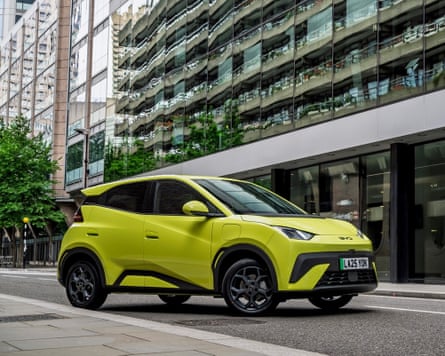
Haupt said European manufacturers welcomed the competition, but that China’s manufacturers should be pushed to source components and produce cars in Europe, given the huge government subsidies across Chinese industry that last year prompted the EU to impose tariffs on Chinese cars.
The EU’s new “Made in Europe” rules are expected to go further still, giving a strong incentive to manufacturers to build within the bloc (with the UK at risk of being shut out). That may well mean European buyers will always pay more for small cars, but the upside might be more Chinese carmakers setting up factories there.
“I think for Europe, looking where we are standing now on our industrial basis, it will be super-attractive,” says Haupt. ”This would create employment. This would attract investment to Europe.”