The Danish director Nicolas Winding Refn , best known for films such as the Pusher trilogy and Drive, has emotionally spoken about his near-death experience and heart surgery three years ago.
The director, whose first film in 10 years, Her Private Hell , premiered on Monday evening, told gathered journalists that he had “died for 25 minutes” in 2023.
His “leaking heart” was “discovered by accident”, Refn continued. “My lungs were filling up with blood. Suddenly, I was told that I would probably not live, but if I did they didn’t know what would happen. So, two weeks later I was operated on.”
He added, tongue-in-cheek: “Thank God the surgeon was Tom Cruise and he could fix me with his hands, and then he brought me back to life with electricity.”
Through tears, Refn explained that the experience had changed his approach to his career and personal life.
“Before I died,” he said, “I had come to the end of my career because I didn’t have anything left in me. So, there was nothing for me to do.
“I realised before I died that I’d been given a gift, I could start over again. Like how many people get a second chance? And I got a second chance from God. And I could use that for good,” he concluded.
His words echo those given in an interview with Screen International on Sunday, when he told Wendy Mitchell, “I was dead for half an hour, and I was brought back to life with electricity, like Frankenstein,” he reveals. “I suddenly realised I could start over again. I had this desire to go back and make movies again like I’ve never made movies before.”
Refn’s 2011 film, Drive, was a major hit on the Croisette in 2013; he returned to the festival in 2013 with Only God Forgives and 2016 with The Neon Demon.
Her Private Hell is a horror-thriller about a tortured film star, played by Sophie Thatcher, whose best friend marries her father. Meanwhile, a mysterious figure played by Charles Melton and known as Leather Man seeks to avenge the kidnapping of his daughter.
Tuesday also saw the first screening of another film by a director who has come back to Cannes after battling considerable health challenges. The dark drama Minotaur is the first film in almost 10 years from the Russian director Andreï Zvyagintsev, who was hospitalised for 11 months with Covid in 2021.
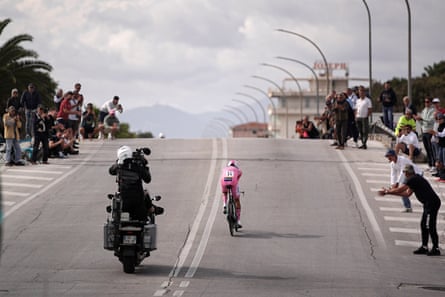
Filippo Ganna sailed to an easy victory in stage 10’s individual time trial at the Giro d’Italia on Tuesday,. The pre-race favourite, Jonas Vingegaard, failed in his bid to take the overall lead as Afonso Eulálio battled hard to keep the pink jersey.
No one could come close to Ganna, a time trial specialist who completed the flat, 42km (26-mile) route along the Tuscan coast from Viareggio to Massa in 45min 53sec. Ganna had little to worry about while waiting for confirmation of his eighth Giro stage win – seven of those have come in time trials.
Ganna’s Netcompany-Ineos teammate Thymen Arensman finished second, 1min 54sec behind. The Dutchman had five seconds to spare over the Frenchman Rémi Cavagna (Groupama-FDJ United) who finished third. Vingegaard (Visma–Lease a Bike) was three minutes down on Ganna in 13th place.
“We have done an amazing job last winter to prepare for time trials,” Ganna said afterwards. “And it can be seen also with the GC riders of the team, look at Thymen in second place.”
Portugal’s Eulálio took the pink jersey after stage five and began the day 2min and 24sec ahead of Vingegaard. The Bahrain-Victorious rider dug deep to limit the damage and still holds a 27sec overall lead.
In the only time trial of this year’s race, Vingegaard was expected to seize control. While he is now within touching distance of Eulálio, the Portuguese rider defied the odds and his own pre-stage predictions.
“I’m not expecting a good time trial,” Eulálio had said. “It’s the worst possible type of stage for a lightweight climber like me. It’s going to be suffering.” Suffer he did, but with the finish in sight, Eulálio found an extra gear to power to the line. “The pink jersey is giving me strength,” he said after Tuesday’s stage.
Arensman was the big mover in the general classification, up from sixth spot to third overall, and is one-and-a-half minutes behind Vingegaard, while Felix Gall (Decathlon CMA CGM) slipped from 35 seconds off the Dane to almost two minutes adrift.
Gall had been Vingegaard’s main rival on the recent summit finishes, where the favourite won two stages, and the Austrian will now need to push hard once more to recoup his losses.
Wednesday’s stage 11 is a 195km ride from Porcari to Chiavari, lacking any categorised climbs but with a number of hills to negotiate close to the finish line.
I n the age of online hookups, signals of attraction – once felt in a significant look or a brush of the hand – are now transmitted by way of screens. Laying bare the gamification of dating, Tadeo Pestaña Caro’s probing debut follows 20-year-old slacker Santiago (Max Suen), lost in a cycle of thwarted desire in Buenos Aires. Whether at his dead-end job at a call centre or lying awake in bed, he is glued to his phone, hungrily swiping through various dating app profiles. A sea of naked torsos and bulging crotches surge across his screen, each promising a passionate encounter and perhaps something more.
Caro’s film captures this obsession with striking psychological precision. There’s a paradox to Santiago’s compulsive behaviour, which is at once all-consuming and distracting. Faced with the illusion of choice, he can’t help swiping even when he’s on a night out with his coworker Karen (Jazmín Carballo), who plays a big-sister role to the restless young man. Santiago’s real-life conversations are punctuated with the constant pings of new messages, offering dopamine rushes that leave him wanting more.
Peppered with witty dialogue, these moments of disconnect bristle with ironic humour and palpable melancholy. It is unclear, however, what Santiago is actually after. When his sexually charged online conversations translate into in-person meetups, he seems to desire genuine intimacy as much as a hookup. He is drawn to a glamorous gay club with a secret back room, but then panics when the fantasy of anonymous sex turns into actual flesh. The script, though, offers little insight into his personal life beyond his screen addiction, so Santiago’s contradictory acts of self-sabotage lack much emotional heft. But despite its weaknesses as a character piece, the film manages to impress with its account of the queer scene in Buenos Aires, packed with vivid visual details.
A Few Feet Away is on digital platforms from 25 May.
The flightless moa, an extinct bird of New Zealand, stood more than 3 metres tall, weighed over 200kg and had eggs larger than those of any bird now living. Now the de-extinction company Colossal Biosciences says it is a step closer to resurrecting the moa after creating an artificial eggshell.
Colossal hopes the artificial incubation system, which it successfully used to hatch chickens, could be scaled up to create a bird as big as the moa in future. “We’ve created a novel shell-less culture system that is fully scalable and biologically accurate,” said Prof Andrew Pask, the chief biology officer at Colossal.
The company previously provoked controversy with claims to have de-extincted the dire wolf and its ambition to bring back the woolly mammoth . The latest advance has been met with scepticism by scientists who say its scope is impossible to judge given that the company made the announcement through a press release with scarce scientific detail or data.
It is already possible to hatch chicks from artificial eggshells but the survival rate is limited because chicks may not get enough oxygen. Colossal suggests its new platform, a silicone membrane, is better than existing “ex-ovo” approaches because it allows oxygen through at the same rate as a chicken eggshell.
“It sounds impressive but then it would, because it’s a press release,” said Dr Louise Johnson, an evolutionary geneticist at the University of Reading. “I look forward to reading more details when they’re published, but until there’s a peer-reviewed paper I might as well give expert commentary on a YouTube ad.”
Moa eggs are estimated to have been approximately 80 times the volume of a chicken egg and roughly eight times the volume of an emu egg, placing them beyond the capacity of any available avian surrogate.
Even if the artificial eggshell is effective and can be scaled up, Colossal will still face significant scientific challenges in its attempt to bring back the moa. The species went extinct about 600 years ago, and since DNA fragments over time it will not be possible to reproduce a complete copy of the genome.
Colossal’s approach with the dire wolf was to tweak 20 genes in the grey wolf aimed at making them closer in appearance to a dire wolf – but far from a complete genetic replication.
Others raise broader ethical questions about the company’s ultimate objectives. “It is legitimate to ask whether it makes ecological sense to genetically redesign some modern birds to superficially resemble moas, and what fate would await such animals,” said Carles Lalueza-Fox, the director of the Museum of Natural Sciences of Barcelona and a specialist in DNA recovery.
“Would we release them on New Zealand’s South Island? As with other examples publicised by the same company – one need only recall the mammoth or the giant wolf – there is a rather surprising mix of scientific advances and publicity that could be described as misleading, which transcends the scientific sphere and must always be interpreted in the context of a private company’s business interests.”
When I cook pasta with a hollow (eg, orecchiette), how do I stop it sticking together? The water is always boiling and salted, sometimes with oil, but last week my granddaughter and I spent half an hour going through the damn stuff. David, Manchester “Pasta is an engaged activity, so it’s really important that you don’t just drop it [in boiling water] and walk away,” says Dara Klein, of Tiella in east London. “Like a dear friend, pay it some attention.” David mentions orecchiette, which is a particularly vulnerable shape, says the Guardian’s Italian correspondent, Rachel Roddy : “They have a habit of falling into each other,” she sympathises, and in such times it’s best to check your basic principles. “It’s always the same rules,” Roddy says. “The water should be fast boiling, add salt, then stir, so you’ve got that double movement.” She isn’t one for adding olive oil, mind. Neither is Klein: “It’s just not necessary. And even if you’ve added a healthy glug of oil to the water, you’re still going to get clumping if you don’t stir.”
This may seem obvious, but make sure your pasta hasn’t intertwined in the bag before shaking it into the rolling water, and don’t be daft and dump the lot in all at once. “As soon as the pasta is in the water, give it a stir with a wooden spoon,” says Klein, who then stirs every minute to ensure those pasta shapes float free.
Once cooked, it’s a good idea to scoop out the pasta with a slotted spoon or sieve (“a spider or a regular one,” Roddy says) and put it in a big bowl. “You want to be doing this in batches, rather than pouring the lot into a colander – that’s just another opportunity for the pasta to clag because the water goes down the sink, the steam comes up and you glue the pasta together in the colander.” If you really must drain, meanwhile, Roddy would go for the double – ie, two colanders. “If you do all of these things – make sure the water is moving, you rain in the pasta, you stir regularly and lift out once cooked – then you should have liberated orecchiette.”
Where many people have fallen foul of the clump, however, is in one-pot dishes. Again, success, Roddy says, comes down to adding the pasta gradually and keeping things moving. That said, she would be minded to change tack: “I would be wary of using shapes such as orecchiette in a one-pan dish, because they like to stick more than others.” This inclination, coupled with the starch being released into the water and functioning like glue, can only spell trouble.
When it comes to the likes of pasta salads (ie, in which it’s dressed and served at room temperature), be sure to cook the pasta only to just al dente. “Clumping can happen if you take the pasta right up to the maximum cooking time,” Roddy warns, so keeping it harder will mean it’s less sticky. Again, once it’s ready, get that pasta in a big bowl, Roddy says: “You don’t want it to be in a small, claustrophobic space, because you’re then just letting that bit of residual water and the starch on the pasta stick together.” Just like the rest of us, movement and space are key.
Got a culinary dilemma? Email feast@theguardian.com
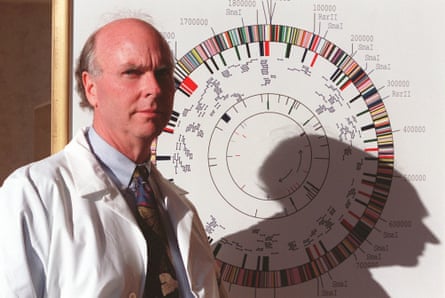
At the international BioVision conference in Lyon in February 2001, the geneticist Craig Venter performed a remarkable piece of scientific barnstorming. Human beings possess far fewer genes than science had ever realised, he announced. We have about 30,000, far lower than previous estimates of 100,000.
Such lack of heritable material showed people are not prisoners of their genes but are shaped primarily by environmental influences, he added. “We simply do not have enough genes for this idea of biological determinism to be right,” said Venter, who has died aged 79. “The wonderful diversity of the human species is not hard-wired in our genetic code. Our environments are critical.”
The timing of Venter’s announcement was dramatic. A few days later, the journals Nature and Science were scheduled to publish details of the first draft of the human genome, and outline our species’ detailed genetic makeup – which would indeed reveal the paucity of our genes. This work had been spearheaded by the US government and the UK Wellcome Trust’s Sanger Centre, in an uneasy partnership with Venter’s own privately funded sequencing company, Celera Genomics.
BioVision 2001 had been set up to orchestrate the publication of the partnership’s results, but at the conference’s closing sessions several days later. Venter had now thrown a spanner into this carefully arranged process. Journalists in the audience, myself included, were startled. Apart from revealing our unexpected low gene count (the figure has since been reduced even further, to about 20,000), Venter had completely undermined the impact his rivals were due to make.
“Did you know these results are embargoed until next week?” I asked Venter. “It might be their embargo but it wasn’t mine,” he replied. His announcement made the front pages of newspapers across the globe including my own at the time, the Observer.
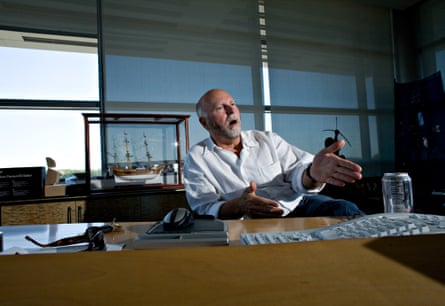
Venter was a brilliant, daring entrepreneur and an unapologetic self-promoter who took pleasure in showing off his achievements as well as his private plane, yacht and flash watches. It was a tendency that made enemies. James Watson , co-discoverer of the double-helix structure of DNA, from which our genes are made, compared him to Hitler for attempting to dominate science by trying to patent human genes. Others nicknamed him “Darth” Venter, after the Star Wars villain.
Other scientists have been more forgiving. The neuroscientist Sir John Hardy of University College London (UCL), who collaborated with Venter on dementia research, acknowledged that the competition between Celera researchers and US and UK government scientists had sometimes been testosterone-driven. “On the other hand, there is no doubt that this competition speeded things up enormously and ended really in a score draw,” Hardy said.
Venter was born in Salt Lake City, Utah, to Elisabeth (nee Wisdom) and John Venter, both parents having served in the US marines during the second world war; by then his father was studying accountancy and his mother sold real estate to help the family finances. Growing up in Millbrae, California, he had a poor academic record at Mills high school. He was offered a swimming scholarship at Arizona State University but turned it down and instead chose the beaches of southern California to follow “pursuits that involved drink, girls and bodysurfing,” he wrote in his autobiography, A Life Decoded, published in 2007. These pleasures were interrupted by the Vietnam war. Venter signed up for the Naval Hospital Corps school and became a senior corpsman in Da Nang in the naval hospital’s intensive care unit, a job he later described as M*A*S*H without the jokes and pretty women.
“I witnessed several hundred soldiers die, more often than not while I was massaging their hearts – at times with my bare hand – or attempting to breathe life into them,” he recalled. “Vietnam would teach me more than I ever wanted to know about the fragility of life.”
The war had one beneficial impact on Venter. It stimulated an interest in life sciences and he applied to study medicine at the University of California, San Diego, where he gained a PhD in physiology and pharmacology in 1975, seven years after his return from Vietnam.
He began research into genome sequencing and in 1992 co-founded the Institute for Genomics Research (later the J Craig Venter Institute) in Gaithersburg, Maryland, with the biologist Claire Fraser, later his second wife. In 1995, their team generated the first genome sequence of a living organism, the bacterium Haemophilus influenzae , using a revolutionary technique he called whole genome shotgun sequencing. Random pieces of DNA are sequenced and then assembled into contiguous genome sequences using powerful computers. In 1998, Venter founded Celera Genomics, to apply this method to the human genome.
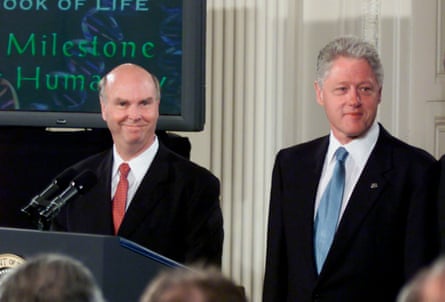
Crucially, Venter’s technique contrasted with that used by publicly funded UK and US scientists who were sequencing the genome in smaller, more organised segments. This relatively cautious approach was denounced by Venter as slow, wasteful and costly. A truce was agreed and celebrated at a White House ceremony in June 2000 before the competing draft sequences were published in February at Lyon.
Venter later revealed that much of the DNA used in Celera’s decoding efforts had come from his own cells, to the annoyance of scientists who felt he had subverted standard processes for selecting DNA donors and had behaved egotistically. “I’ve been accused of that so many times, I’ve got over it,” he responded . In any case, use of his own DNA had revealed he possessed an abnormal fat metabolism and an elevated risk of Alzheimer’s disease, so that he was now taking fat-lowering drugs to reduce its impact, he added.
Later that year, Venter was sacked as head of Celera by Tony White, the president of Applera – which owned the company – and who wanted it to move away from the business of gene sequencing and into the far more lucrative field of drug discovery. Venter was judged to be unsuitable for leading such a goal.
“I sought solace in the one thing I knew could cheer me: I headed for my boat and set sail for the turquoise seas of St Barts … in the Caribbean,” he recalled in Life Decoded. He returned to use his vast payoff to endow the J Craig Venter Institute with $100m. There he could pursue projects that included designing energy-producing microbes and synthesising bacterial genomes. He later set up two other companies, Human Longevity and Diploid Genomics, which aim to combine artificial intelligence with advances in ageing research and gene sequencing to boost human lifespans and diagnose disease.
As to Venter’s claims in Lyon about the overriding power of the environment in determining human behaviour revealed in our low gene count, these have since been questioned rigorously by scientists. Just because humans have a lot of different traits, does not mean we have to possess a lot of genes, they point out.
Nature has simply found a way to make our genes do increasingly sophisticated management work, said Sir John Sulston , one of the leaders of the UK’s public genome effort, in response to Venter’s claims. As we move up the ladder of complexity, we are simply increasing the variety and subtlety of genes, Sulston told the Guardian at the end of the Lyon conference.
Venter was married three times and had a son, Christopher, from his first marriage, to Barbara Rae, in 1968; they divorced in 1980. His marriage to Fraser in 1981 ended in divorce in 2005. Three years later he married Heather Kowalski, who had been his press officer at Celera. She survives him, along with Christopher and three siblings, Keith, Gary and Suzanne.
John Craig Venter, geneticist and business entrepreneur, born 14 October 1946; died 29 April 2026
This article was amended on 15 May 2026 because a picture caption incorrectly referred to the bacterium Haemophilus influenzae as “flu-causing”.
“Did you know that horses’ legs are their fingers?” This is just one question asked in a fun podcast by broadcasting favourites and longtime besties Alice Levine and Greg James. The format is finding its feet, but so far it’s the standard chatty pod fare: no topic is off limits as they invite listeners to share their gripes, crises and any inane thoughts they can’t shake off. And in episode one, Alice reveals her War Horse acting debut … Hollie Richardson Widely available, episodes weekly
Lemme Say This
After a short hiatus, Hunter Harris and Peyton Dix’s culture podcast has been resurrected by the Obamas’ production outfit Higher Ground. For takes that are extremely pertinent and often very funny, the Brooklynites are rarely bested; a recent episode offered insightful chat on Lena Dunham’s memoir and the total nonsense that is Euphoria. Hannah J Davies Widely available, episodes weekly
Uncover: The Expert Witness
If nine episodes feels like a lot for a limited series, this new one from Canada’s CBC has a bit to dig into. Namely, how did a strangely secretive AI policing tool used in Akron, Ohio, turn out to be a total dud? Tech and true crime are expertly fused in a series hosted by Sam Mullins (Sea of Lies). HJD Widely available, episodes weekly
Stories from a Stranger
Nurse turned content creator Hunter Prosper first interviewed strangers in the US during the Covid pandemic, going viral on TikTok. This podcast is a decidedly earnest brand extension, featuring polished chats with unusually candid folk. Despite the schmaltz, it is rather touching: his first episode centres on three love stories, including one from sprightly 96-year-old Sally. HJD Widely available, episodes weekly
A History of the United States in 100 Objects
Roman Mars leads a who’s who of podcasters – from Radiolab’s Latif Nasser to Song Exploder’s Hrishikesh Hirway – in this new take on A History of the World in 100 Objects. In a fascinatingly meta first episode, Pulitzer-winning writer Jill Lepore considers what a time capsule from 1876 teaches us about curation. HJD Widely available, from Tuesday 19 May
T wo police vans waited expectantly near the front entrance. Officers patrolled the pavements while suited security men with ear pieces stood stern-faced, casting suspicious looks at those approaching. The location in east London had not been disclosed until that morning but no chances were being taken.
It was not for a visiting dignitary or even an embassy of a country in conflict that all this was deemed necessary but the Nova exhibition, a commemoration of the 378 people massacred at a music festival on 7 October along with the 44 taken as hostages and the 19 of those who died in Hamas captivity.
When the exhibition had travelled to New York, hundreds of people had turned up in Lower Manhattan to protest against the conduct of Israel since the 7 October attack, some of whom claimed the show was a piece of political propaganda.
Elkana Bohbot, a co-organiser of the 2023 music festival, who spent 738 days as a hostage in Gaza of which 690 were in a tunnel, said he had only one request to those who might turn up to demonstrate in London: “Come in for one minute. Not an hour but just one minute. Come inside. That’s it.”
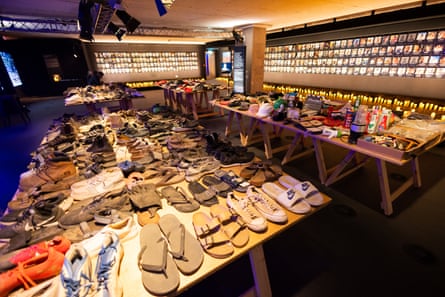
London is the 10th city to host the immersive reminder of this part of the worst atrocity committed against Jews since the Holocaust. There is a room of shoes belonging to those who fled, evoking memories of the spectacles, hair and footwear that helped evidence the crimes of the concentration camps. But the horror at Nova is perhaps among the most documented of our times. The exhibition in Shoreditch, which opens to the public on Wednesday, seeks to use that which was caught in technicolour, via the phones of the victims and body cameras of the protagonists, to challenge “with their own eyes” those who deny its gravity, said Bohbot, 36, whose pallor perhaps offers evidence aplenty of the continued trauma that haunts his nights.
Visitors to the six-week exhibition are first shown a three-minute film of partygoers speaking of the bliss of the event, and the beauty of the sunrise that morning as they continued to dance. That ends with footage capturing the moment that the DJ on the main stage was told that the music had to stop. “Red alert, red alert,” the crowd were told.
The next room in the exhibition – dark, noisy and chaotic – is scattered with the belongings of the participants along with other significant pieces from the crime scene. There are burned-out cars and shot-through toilet cubicles next to the pro-cam footage showing how it came about. There is audio of those who found themselves cowering under bushes or forced into the horribly evocative marches of tens of miles to relative safety. A recording also captures the moment that one of the Hamas attackers boasted to his father that he had killed “10 Jews with my own hands” and was calling from the “phone of a Jew” he had killed along with her husband.
Another exhibit is the CCTV positioned outside one of the bomb shelters near the festival where young men and women hid for their lives. Grenades can be seen thrown in by the terrorist – and chucked out just as quickly by Aner Shapiro, 22, a British-Israeli citizen and off-duty Israeli soldier who had simply come to dance with friends.
His parents Moshe, 55, and Shira, 50, said that they had been able to account for every moment of the last 30 minutes of their son’s life thanks to the first-hand accounts, phone footage and CCTV. There were 27 people in the shelter, designed for eight. “He told them: ‘My name is Aner Shapiro, I’m a soldier. I have to tell you, there’s a war now, a big war. Don’t be afraid. You’ll be OK. I will protect you,’” said Shira, who was born in Oxford. Shapiro is believed to have thrown out as many 11 grenades before an rocket-propelled grenade was used on him followed by more grenades. He died after taking a shot to the head. He had told those behind him to try to follow his lead should he fall. They did until the Hamas attackers stormed in. Five of the 16 inside were taken hostage. One was shot there and then. Three later returned alive from Gaza.
The protest outside the event in New York was a “manifestation of how important it is to do this exhibition over and over and in more and more places,” said Aner’s father. “They don’t want to know. But it’s not that they cannot learn about what happened.”
Lisa and Michael Marlowe, from north London, last spoke to their son, Jake, 26, at 4.30am UK time on 7 October. He was an unarmed security guard at the festival. “Oh he’ll be asking for money again,” said Michael, 64, of his thoughts on receiving the early morning call. “He was just saying: ‘I love you. And I’ll keep in touch. There’s a lot of commotion going on, there are paragliders in the air. I’ll call you back when it’s all calmed down.’” Jake never did call back. “It is important for everyone to see the exhibition,” said Michael, who had to identify his son in a morgue in Israel. “We are not lying.”
Artificial intelligence may have exploded in the public consciousness thanks to a new generation of attention-grabbing chatbots, but AI and machine learning have been with us for several years – and these more established models are already delivering significant returns.
Electricity grids and AI, for instance, are a match made in heaven. Grids are complicated, have vast numbers of inputs and outputs, require constant oversight and create huge quantities of data. Dealing with enormous numbers of variables and complex systems is one of the things AI does best – better, arguably, than pretending to be human.
Iberdrola, Europe’s largest utility company, which owns ScottishPower in the UK, has been using AI for more than 10 years to make predictions, optimise processes and detect patterns, which can be used to improve its operations. One example of this is providing customers with accurate estimates of outage times after incidents, via an app. Another is allowing engineers to plan ahead by telling them which grids or transformation centres will need partial replacements the following year, using myriad variables that predict possible issues based on historical data.
In a slightly more sci-fi vein, Avangrid, Iberdrola’s US subsidiary, announced last year that it had partnered with Levatas and Boston Dynamics to deploy a robot “dog” to improve substation inspections. The dog, nicknamed Spot, has sophisticated imaging and thermal technology and uses AI to detect damaged equipment. Automated inspections will take place more frequently and the result will be greater reliability for customers.
Maximising renewables output
But AI isn’t just about making grids more operationally efficient. It is also helping to make energy more clean. Renewable sources of energy such as wind and solar are by their nature variable, but AI can help operators maximise the electricity they produce, reduce wasted energy and limit the need for fossil fuels as back-up sources. “By predicting when and where energy will be needed, AI can help avoid outages and cut down on wasted power,” says Justin Bates, co-founder of ESGmark, an organisation that promotes and recognises environmental, social and governance standards in business.
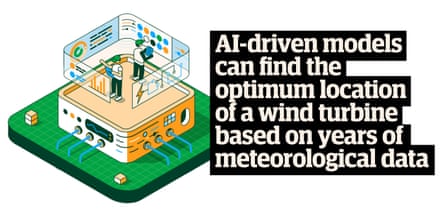
For companies such as Iberdrola, this begins in the design phase. It might start with AI-driven models finding the optimum location of a wind turbine, based on years of meteorological data. It could then go into operations and maintenance. This may include using algorithms to predict maintenance issues before they occur, or anticipating wind or solar production for each hour of the day. Knowing what is being produced and where can help balance the grid, either by shifting energy around, by releasing stored energy (such as pumped hydro) or switching on back-up energy (which may come from fuels such as gas) where needed as a last resort.
Improved energy storage solutions
Back-up fossil fuel capacity should be needed less in the future thanks to more innovative and dependable renewable-energy storage solutions – and, again, AI is playing a crucial role in these. Last year, Iberdrola partnered with Multiverse Computing, a global leader in quantum computing solutions, to deliver a pilot project in northern Spain to optimise the installation of grid-scale batteries. Multiverse’s solution uses quantum and quantum-inspired algorithms to select the optimal number, type and locations of batteries on the network – thereby reducing the costs of adding batteries to the grid and improving network performance.
Similarly, as batteries become an increasingly important part of the grid, AI could help enlist the batteries in electric vehicles. The latter could potentially form a part of the grid’s battery capacity – the UK’s cars famously spend 96% of their time parked . AI could help balance these thousands of connections.
AI can also allow grids to do more with what they already have. “Innovative grid technologies, including those based on AI, allow us to transport more electricity through our existing electricity infrastructure, by improving our understanding of the real-time conditions of our increasingly complex electricity networks,” says Layla Sawyer, secretary general of CurrENT, which represents grid technology providers in Europe. “This includes the effect of weather conditions, dynamic energy production and consumption, and many other factors that impact grid operators.”
Keeping customers informed
At the other end of the energy supply network, AI can improve the way energy companies interact with their customers. This entails sharing information on topics ranging from outages to expected bills, but also helping customers to conserve energy. “AI can help energy companies to connect with customers in a more meaningful way, encouraging smarter energy use that benefits everyone and supports ESG principles by creating a fairer, cleaner energy system we can trust,” says Bates.
Finally, AI can even help wildlife. In the future, AI modelling will be able to analyse bird flight paths and recommend renewable sites that reduce ecological concerns, while Iberdrola’s existing AI power systems can detect birds and stop specific turbines if required.
It’s modelling like this that really encapsulates the benefits of AI to the grid. While the technology has already been used for a number of years to improve existing systems, in future, it will increasingly be embedded in the planning stage of large-scale infrastructure projects and integral to their operation. As Bates points out: “AI is helping to transform our energy grids, making them smarter, more reliable, and ready to handle cleaner energy.”
In the 20th century, the UK’s electricity grid was shaped by coal-fired power stations, clustered in the industrial heartlands. The once world-leading system was designed for a one-way energy flow from power plants to consumers – whose use of electricity was modest and predictable.
The shift to cleaner energy and growing electrification of all aspects of life means the grid of 70 years ago is no longer fit for purpose. With power generated from a wider and more disparate range of sources, significant investment and pioneering technology are required to deliver a grid that can match supply with ever-increasing demand.
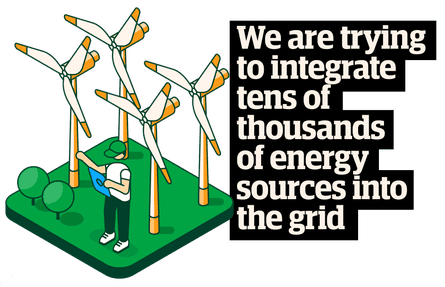
“It’s way more complicated than energy in equals energy out,” says Robert Friel, member of the Institution of Engineering and Technology’s Sustainability and Net Zero Policy Centre. “We are trying to integrate tens of thousands of energy sources into a grid that was designed to take coal energy mostly from the Midlands and move it around the country. This is a complete transformation. We’ve got to build for the future.”
Increasing demand
For instance, most of the UK’s wind power is generated off Scotland and in the North Sea, where a single turn of a turbine at Dogger Bank wind farm generates enough electricity to power a home for two days . But transporting that electricity to London and the south-east, where demand is higher, requires an overhaul of national transmission and distribution networks to overcome bottlenecks after decades of little expansion.
By 2035, Ofgem forecasts that the UK’s renewable generation capacity will grow from 120GW in 2024 to 300GW, resulting from ambitious targets for wind and solar power, which should largely free the UK from volatile prices of imported fossil fuels.
But the new grid isn’t just about integrating more clean power; it is also about helping the system cope with huge increases in demand.
UK consumers will be using twice as much electricity by 2050, the Climate Change Committee predicts [pdf], as petrol cars and gas-powered heating systems are displaced by electric vehicles (EVs) and heat pumps. As well as transport and heating, households are using electricity more than ever for entertainment, communication and home working, with on average 13 electrical devices per household – although more efficient appliances help keep energy use lower. As reliance upon cloud-based services and artificial intelligence (AI) grows, datacentre usage is expected to more than double by 2030.
To help meet this soaring demand, record levels of investment in the UK’s transmission network were recently announced by Ofgem , the UK’s energy regulator, as part of its framework for ensuring the companies operating the UK’s energy networks have sufficient revenue to invest in and run them. Nicola Connelly, CEO of SP Energy Networks, which plans to invest almost £12bn to 2031 in delivering critical energy infrastructure, noted: “If the UK wants to deliver on its ambition to be a clean energy superpower and capitalise on its natural resources, then it needs the electricity grid to match demand. We are committed to delivering that at pace, combining unprecedented levels of investment with a focus on ensuring fair returns for consumers and investors.”
Changing consumer habits
There’s a cultural change afoot too, as customers move from being passive consumers of energy to generating their own and, in some cases, selling it back to the grid. Faced with the upfront costs of installing EV chargers and solar panels, many hope to reap the benefits.
Aggregators – companies that bring together smaller energy producers – will play an increasing role from a consumer perspective in selling and buying electricity at the best price.
Consumers are also getting smarter at using power when it’s cheaper, aided by growing levels of automation, which will affect demand, habits and usage down the line.
Technological innovation
To cope with increasing demand, technologies are being introduced to increase the capacity of existing infrastructure and reduce the amount of new power lines that are inevitably needed to transmit twice the electricity we use today.
Much of the new infrastructure planned will be offshore and under the sea – which wasn’t an engineering option back in the 1950s when the supergrid’s overhead transmission lines were conceived and built.
However, the infrastructure being built and upgraded needs to be smarter, flexible and more responsive to the flow of energy moving in different directions across the network, and increasingly automated. The continued use of AI will help improve management of supply and demand in real time.
“It’s possible that AI tools could see problems emerging in a system with thousands of generators in a way that a few control engineers just couldn’t,” says Friel.
Friel says there’s also scope to understand far more about household consumption and generation at a granular level and “how potentially thousands of domestic batteries and millions of electric cars will come together. Smart meters are part of [supplying this data] but we need more information to enable a digital system to emerge.”
As well as providing vital data, smart technology is helping give customers more flexibility, says Rozlyn Brennan, smart solutions director at ScottishPower. “Households are now often producers of energy as well as consumers, and smart technology is allowing people to choose when they use their energy, whether it’s smart EV charging, or saving money by using appliances out of peak times.”
Innovations are creeping in. SP Energy Networks, for example, has created a detailed “digital twin” of Britain’s electricity network. Using AI, it allows the modelling and testing of digital solutions to manage increased electricity demand on its real-life counterpart, helping to prevent outages and identify the most efficient way to operate the network.
Other emerging uses of AI include using it to enable individual PV panels on solar farms to dynamically adjust to different lighting conditions and accurately find the optimal operating point.
But to get the benefits of emerging technologies and modernise the grid, the UK needs to get going, says Friel – and this requires vision and commitment of the kind that inspired the first supergrid.
Its successor must be built to meet the needs of a cleaner, more digital and decentralised world. This isn’t just an engineering challenge but a social one, demanding collaboration between grid operators, policymakers and consumers to create a system that’s resilient, efficient and fit for the future. “We’ve come further than we might have imagined in the last 10 years, but we’ve still got a long way to go,” adds Friel. “Transforming the grid [will require] billions of pounds, but the danger is we don’t think big enough.”