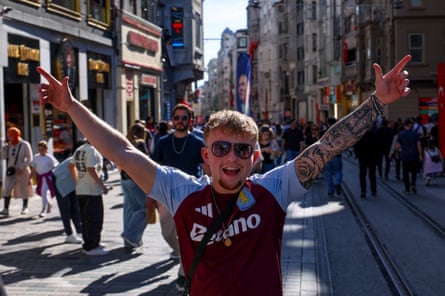
A s Aston Villa arrived at Besiktas Park on the banks of the Bosphorus, for one last training session before the real thing, it was impossible not to consider the journey to the Europa League final. John McGinn, who will lead Villa out as captain in Istanbul, was in the side promoted from the Championship via the playoff final seven years ago. Tyrone Mings also started that day at Wembley and across the course of the following 12 months Villa built a spine that will be central to their hopes of winning their first major European trophy since 1982.
It is why McGinn’s mind goes back to a 3-0 league defeat at Wigan and a midweek trip to Rotherham in the season they clinched promotion, averting a likely financial disaster. Tammy Abraham, then on loan from Chelsea, also began the playoff final victory over Derby. “If we lose that match, are Aston Villa here at the minute?” McGinn says. “Probably not. For us, tomorrow night, it will be nice to see the supporters who were there at Rotherham away, Wigan away, nights like that on a Tuesday evening when it’s very easy to stay at home. They deserve it just as much as the players do and hopefully we can give them something to remember.”
Ezri Konsa, a beacon of consistency who could be forgiven for living off being labelled a Rolls-Royce by Prince William, who is expected to attend the final as an avid Villa supporter, joined in the months after they returned to the Premier League. Emiliano Martínez, Ollie Watkins and Matty Cash arrived the following summer. Together the core of this Villa side have reached the Europa Conference League semi-finals, the Champions League quarter-finals and a FA Cup semi-final. On Wednesday they will, as Emery says, be the focus of the footballing world.
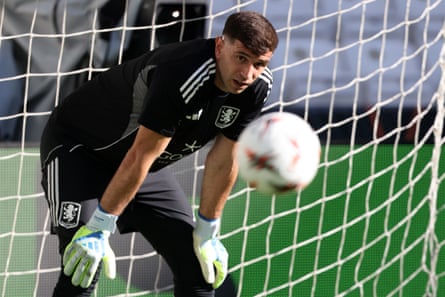
McGinn has spoken about shedding the tag of “nearly men” and Martínez acknowledges it would be “massive” to get over the line against Freiburg. “We’ve been together for so many years, played so many games together, going from mid-table to the European places, semi-finals and now we’re in the final. I think we deserve it. I think the fans deserve it. And obviously the manager has had five finals and you wouldn’t want anyone else on the bench leading us in a European final.”
Martínez likens trying to feed Villa’s hunger for a first trophy since the League Cup in 1996 to his first Copa América with Argentina in 2021. “I went into my first Copa América without seeing Argentina win a trophy,” says the World Cup winner. “I was 27, 28 years old and this is the same. In Birmingham the Villa fans always say: ‘I’ve never seen Villa in a European final, I’ve never seen Villa lifting a trophy.’ So it’s that same mindset as I went into my first Copa América, with that anger, belief and confidence I can do it. I believe in my team and myself.”
Martínez was speaking publicly for the first time since attempting to leave the club last summer. It was this time last season he cried as he left Villa Park, presuming it would be for the last time. “We are in a European final, in the Champions League again with all the circumstances and the ups and downs, and with the budget we had this year, we were among the lowest spenders in the Premier League,” says Martínez. “Sometimes football can change … when we stick together and fight together we can beat anybody. I am really proud to stay – I made the right choice.”
Villa yearn for a trophy and, as Martínez says, the consensus is that in Emery they have something of a superpower. Thomas Tuchel’s comments in the buildup to Chelsea’s Super Cup victory over Emery’s Villarreal in 2021 spring to mind. “They can call the [Europa League] trophy the Unai Emery trophy soon,” said the now England manager. Emery, however, is reluctant to lean into that characterisation.
“I am not a king in this competition,” says the Basque. “I am now here with Aston Villa in a new chapter. And everything I did is done – of course it’s there in that moment but with it I am not winning tomorrow. I need to win with the players we have now, with Villa now. It’s a new way, a new moment and, hopefully, a new era.”
Villa, who could welcome back Amadou Onana from a calf injury after he trained with his teammates on Tuesday, are heavy favourites to beat a Freiburg side that finished seventh in the Bundesliga . McGinn and Emery recognise as much, both reading from the same hymn sheet. McGinn talks of treating Freiburg with the respect they deserve, Emery of a tricky task. “We have a huge challenge,” Villa’s manager says. “Are we thinking about the next party on Friday? No, no, no.”
Some of the biggest West End shows could be forced to temporarily close during a “summer of turbulence” in London after union members voted to move towards strike action over a dispute about pay and conditions.
An indicative ballot held by the performing arts union, Equity, was overwhelmingly backed by its membership: 98% voted yes to potential strikes. The result means the union now has the right to have a statutory ballot on taking industrial action.
A recent report on British theatre found that demand for live performance had never been higher . Last year, 37 million people attended shows around the UK and more than 17 million did so in the West End.
Despite the record audiences, theatre producers are facing financial challenges after the costs of production doubled in a decade . Ticket prices in London remain much lower than on Broadway .
The general secretary of Equity, Paul W Fleming, said: “The West End has had a very successful three years. Our members want to share in that success and they’re tired of antiquated working conditions. They really have snapped.”
Equity and the Society of London Theatre (Solt) have been negotiating their multiyear agreement since December 2025, but have come to an impasse over pay, holidays and how injuries caused while performing are handled.
The union has proposed a 7% pay increase for its members every year for the next three. It is also pushing for better holiday and incapacity pay if a worker is injured on a production.
Fleming said he was hopeful industrial action could be avoided, as it was in 2023 , but if it did happen it wouldn’t mean that the whole of the West End would “go dark”; instead the big weekend shows that were economic drivers for producers would be targeted.
Equity has about 1,000 members, including performers and stage managers in the West End working on 44 shows, including hits for producers such as Cameron Mackintosh and Sonia Friedman.
If an agreement is not reached when the two sides meet on 10 June, then the union could ballot its membership on whether they would be prepared to take part in a strike, which would affect matinees and evening shows on Saturdays.
Fleming said: “If Solt doesn’t come back with a proposal that implements the proposal we’ve just balloted our members on, then we will be balloting for industrial action.”
A spokesperson for Solt said: “Constructive, good faith discussions are ongoing, and we have already made meaningful progress together in a number of areas.
“We look forward to our upcoming meeting with the Equity team and remain committed to the jointly agreed process, and to continued productive discussions to reach a fair, sustainable minimum terms agreement as soon as possible.”
I t is difficult to see through the dust inside the cramped, low-roofed tent on the eastern edge of Khan Younis. Ibrahim al-Aloul works alongside four others, with a piece of fabric tied over his mouth and nose as his only shield against the toxic grey powder as he sifts and grinds.
Outside, a skinny donkey waits with a cart to carry the finished product to the next tent along, where it will be mixed with gypsum, calcium and binding agents before being bagged in flour sacks and sold.
This is Gaza’s cement industry, improvised out of desperation and for now the only construction operating in the besieged Palestinian coastal strip. The health risks of these compounds are severe , but in Gaza, where the death toll of the past two years of Israeli bombardments has reached more than 71,000 and a steady toll of killings continues despite the eight-month ceasefire, options are limited.
“We work long hours and the dust is suffocating,” Aloul says, stepping outside into the street of tents to breathe – endless rows that have become the only homes Palestinians can find. “But there is no other work, and no other cement. We have no choice.”
Israel has barred cement and all building materials from entering Gaza since October 2023, deepening a blockade on construction imports in place since 2007 . By October 2025, Unosat satellite imagery found approximately 81% of all structures in the Gaza Strip had been damaged, with more than 123,000 destroyed outright. The UN estimates the destruction generated 61m tonnes of rubble , and a joint EU, UN, and World Bank assessment puts the cost of recovery at $71.4bn (£52bn) over the next decade.
Against that backdrop, a small, scattered network of entrepreneurs, labourers and engineers has begun turning the ruins into raw material.
The idea came to Saadi al-Sha’er – Aloul’s employer – when he noticed clay fused with cement dust accumulating around Gaza’s bombed factories and warehouses. Before the war, he had made fibreglass products. When that work disappeared, he began experimenting.
“At the ruins of a brick and marble factory in al-Qarara, north of Khan Younis, I found large amounts of the material,” he says, cement dust coating his clothes, eyelashes and hair. Workers break the hardened deposits down by hand with heavy concrete blocks, then sieve the result through progressively finer meshes until only powder remains – sourced from bombed-out factories, marble-cutting plants and crushed concrete debris.
The final mixture is roughly 60% cement dust, 15% lime, 10% gypsum, 10% calcium and a bonding agent. When the bonding agent runs out, wood glue is substituted. Sha’er also processes a second product: prewar cement that hardened in storage, broken down and reformulated with gypsum and bonding agents to perform slightly better.
“When ingredients run short, I improvise,” he says. His operation produces between half a tonne and two tonnes a day, employing about 30 people.
He sells for 12 to 18 shekels (£3-£4.60) a kilogram at source. By the time it passes through traders, the price has multiplied. A single bag now costs 2,000 shekels (£506). Before the war, a standard bag of conventional cement cost 40.
For a population largely destitute, these sums are mostly beyond reach. But for those who can find the money, the substitute is the only path to something sturdier than a tent.
Mahmoud al-Astal, 38, a farmer in al-Mawasi, has been in a shelter with his extended family for more than two years. He looked into buying poles and nylon sheeting to build a greenhouse-like structure, but the cost and short lifespan put him off.
“I found it more logical to construct something more solid to shield us from the elements and last longer, since there is no end in sight to this displacement situation,” he says. “And since we’re not after a high-rise, this cement should do fine.”
Othman al-Awda, a builder who is constructing Astal’s small two-room house using the substitute cement, adjusts his mix ratios to compensate for its reduced strength and keeps his ambitions strictly within the material’s limits. “It is clearly limited in strength,” he says. “But it works for brickwork. I would never use it for columns.”
The October 2025 ceasefire agreement explicitly required the immediate resumption of humanitarian aid and the entry of reconstruction materials. But OCHA , the UN’s humanitarian arm, reports that reconstruction efforts are being severely delayed by continued bans or tight controls on “dual-use” items such as steel, cement and heavy equipment, which, according to Israel, could also serve a military purpose .
Mahmoud Ubeid, a civil engineer specialising in construction management, oversees renovation works at several sites, including, most recently, al-Wafa hospital. Confirming that the substitute cement is now the primary material available for finishing work such as plastering, tiling and basic wall repair, he says his firm offers a 12-month warranty on work done with it, but no more.
“It performs its purpose during the current phase, but it cannot be relied upon long-term,” Ubeid says. “It fails under testing and cannot be permitted for structural use. But for temporary finishing – to preserve lives and property – it is what we have.”
He knows the quantities are nowhere near sufficient. Ubeid estimates that what is now being produced amounts to less than 1,000th of Gaza’s temporary finishing needs alone. Priority goes to hospitals and public infrastructure.
Sha’er, who has worked in construction since 2008, does not describe what he is doing as a solution. Living in a building that once served as Asda’a prison and displaced from Rafah along with dozens of other families, he crosses the rubble to his tent every morning, ties the cloth across his face and starts sifting.
“What we are doing to build is unimaginable, against all odds,” he says. “But I won’t give up.”
I met Dat in San Francisco in 2015. I had left a tourism consulting role in China and moved to the US to start my own Mongolian vodka product. Dat was a specialised nurse. He loved being a nurse.
They say opposites attract and I think that rings true for us. He had this way of calming a room. Dat would arrive at a party and somehow the volume in the room would come down a little bit. He did the same with me. It was a very busy time trying to build my business but he was always there – very supportive and curious about what I was doing. We moved quite quickly into the relationship and spent a lot of time together.
In 2018, we made a decision to leave the US. When Trump got elected, America started changing quickly and it made it harder to commit to my business. We said: let’s try Australia. I’m originally from Perth but Dat was born in Vietnam and had never been to Australia before. We just got on a plane and left.
In Australia, we ended up taking over the Broadwater resort in Busselton. When Covid hit, we worked and lived together 24/7. A lot of relationships probably wouldn’t survive that. I don’t really know how to explain it, it just worked.
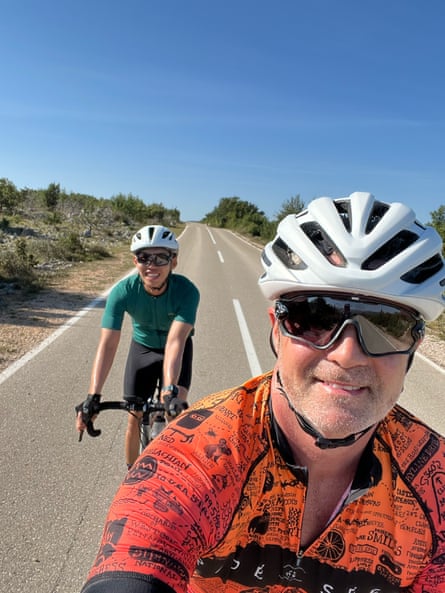
In 2023, after five intense years at the resort, we decided we needed a proper break. I wanted to buy a catamaran and sail around the world but Dat couldn’t swim, so we landed on another challenge: a cycling tour from Venice to Athens. We didn’t really know what we were getting ourselves into.
When we started training, Dat didn’t know how to ride. On our first proper outing he rode through gravel on an angle and fell off within minutes. I thought: “Oh, that’s it. It’s never going to happen.” Instead, he blamed me for not telling him that would happen, cheekily asked for $5 to get back on, then finished the ride – a good 40km or so.
We did the Venice-to-Athens ride as part of a small tour. It was amazing but extremely challenging. One day in Albania it was 37C, we had about 130km to ride and the wind was in our faces. We were hot, dirty and running out of water but Dat didn’t complain. We were some of the only riders who finished that day. That’s one of Dat’s strengths: once he’s made up his mind, he’s going to do something, no matter how hard it is.
After our ride, we stopped in Hokkaido, Japan, on the way home. It was intentionally the opposite of our bike ride: we moved very, very slowly – just wandering, checking out onsens and restaurants. One afternoon in Sapporo, we ended up at Whisky Bar Tasokare, a tiny, dimly lit six-seat bar. We were the only customers.
Over a Kanosuke single malt and a whisky cocktail, we started talking about the trip, replaying everything we’d been through – we rode over 2,500km. It was a real test but we got through it without arguments. If we wanted to swear, we swore at the hills, not each other!
Somewhere, during those drinks, it clicked that after riding thousands of kilometres, navigating foreign countries and spending basically every waking hour together, marriage probably wouldn’t be the hardest thing we’d do.
There wasn’t a big proposal, just a decision we made. I think we were both relieved it was so easy, and delighted to have found the next thing to do together. We embraced and told Ms Maki (the bar owner), who was thrilled.
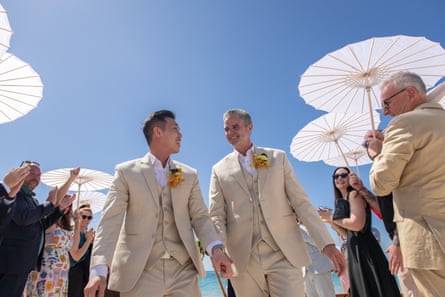
We got married in 2024 at the Broadwater down by the beach, with family and friends who flew in from all over the world. My son, Travis, was our celebrant. Then, during the ceremony, Dat surprised me: he said he was taking my surname, so he could share a name with Travis. I thought that was beautiful. There were lots of tears and a big party with a drag queen.
Being married feels more grounded and real, like we’re even more of a team. We stepped away from the day-to-day at the Broadwater about a year ago and now live in Cottesloe with our rescue dog, Harvey. Cycling is still a really big part of our lives. We’ve done rides in Norway, France and Australia. Through it all, we’ve always had each other’s backs.
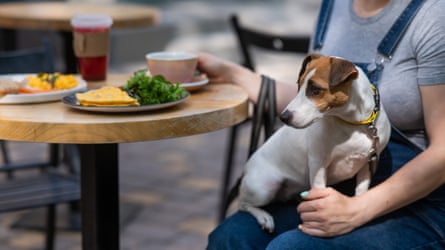
O ut for dinner in London with her husband and two-month-old son, Gizzelle Cade noticed another woman coming into the restaurant with a pram. “It had all these little trinkets and toys,” says Cade. “I was like, wow, she put some cute little decor there.” The woman reached into the pram to get, Cade assumed, her baby – instead she pulled out a dog. Then she put an absorbent pad, the kind you use for puppy training, on the floor and placed the dachshund on it.
“I was completely taken aback,” says Cade. “To see pretty much an open bathroom where I was dining with my newborn – it was insulting.”
Cade can’t confirm whether the dog actually used it, and a spokesperson for the restaurant, Gordon Ramsay’s Street Pizza, has said it reviewed CCTV footage and found no evidence the dog urinated or defecated in the restaurant. At the time, Cade says she complained to two waiters and the manager, who didn’t do anything. Then she confronted the woman. “The owner started to compare her dog to my son. She said: ‘Well, your baby shits and pisses. My dog needs to shit and piss too.’ She kept on comparing her dog to my newborn baby.”
It escalated. Cade, an influencer from the US who is now living in the UK, posted a video on TikTok, outside the restaurant. Naturally, it went viral (it has since had more than 20m views).
Cade, who is Black, says she started receiving horrendous abuse online, much of it obscenely racist. “But the overall opinion and the feedback that I have received has been positive,” she says. “It resonated with people. People were already thinking about this privately, about dogs and public spaces and boundaries and hygiene.”
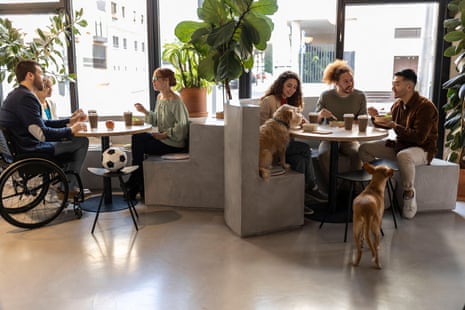
If you live in the UK, it probably hasn’t escaped your notice that dogs are everywhere. There are more dogs around now – about 13m by some estimates, up from around 9m before the pandemic. They’re on the bus, and at the cafe. If a petition to parliament proves successful you might find yourself sitting next to one on a flight back to the UK. You may have seen one riding in a supermarket trolley. If they’re not yet in your office, they’re definitely at every co-working space across the country. There may be one by your feet right now as you read this. Maybe you noticed the mess?
The organisation Keep Britain Tidy estimates half a million dog owners leave their pooch’s poo where it lands, an estimated 35 tonnes of faeces. One study found high levels of pesticides, banned for agricultural use but used in flea and tick treatment for dogs, in ponds in London’s Hampstead Heath. Dogs swimming in the ponds (there are designated canine swim areas) can contaminate the water as the chemicals, which are harmful to invertebrate wildlife, wash off their fur.
I have a dog in this fight. My golden retriever Roo, who turned two last week, is with me most of the time. She’s my work pal (she encourages me to get up from my desk to get us both regular snacks), and my walking buddy. She has been on boats, trains and buses; in shops, cafes and restaurants. But do dogs even enjoy all of this?
“I would say more yes than no,” says Clive Wynne, director of the Canine Science Collaboratory at Arizona State University. “I think going out and about and seeing things and smelling things is very positive for dogs, and they enjoy being out in the world.”
But dogs are individuals and highly variable, says Wynne, so it’s up to owners to ensure their pets aren’t overwhelmed. “The main thing that people easily forget is that dogs need to sleep a lot more than humans do. Again, it varies greatly by individual and breed and so on, but we think dogs need to sleep about 14 hours a day. So if they’re being taken out all day with no opportunity to rest, that would become stressful.”
Obviously I know Roo is the best dog in the world, but I also don’t expect you to agree, or necessarily want to be around her when you’re eating – I don’t always either (I know where she’s been). This is the dog who, I’m sure, still dreams fondly about the day she wrestled the corpse of a fetid fermenting badger and it exploded all over her. She is well trained, having passed her gold Kennel Club good citizenship award, but on the day of writing, she slipped her lead and ran through my son’s primary school. Not every child will have been thrilled.
The world is going to the dogs, according to some people. Others think this is a great thing. “If I can, I’m taking her absolutely everywhere,” says Nikki Beatnik, a DJ and record producer who has Minnie, a miniature pinscher cross. Her previous dog, Purdy, went everywhere with her, too. Both were rescues. “My dogs have been street dogs and they’ve had really hard lives, so I feel an extra responsibility to make their lives amazing,” says Beatnik.
With that aim, she likes to take Minnie into central London, into shops and on public transport. She feels there are more dog-friendly places now. “It feels like it’s getting more like LA, where you can take your dog everywhere.”
So far, she hasn’t had any confrontations with people who don’t want her dog around. “In fact, I find more people talk to you when you’ve got a dog – people from all walks of life will come up. There are people with their kids who will keep them away from the dog. I try to be as patient as possible, because not everyone is a dog person. I’m quite understanding of it.”
Owen Sharp, CEO of the Dogs Trust, has had dogs for the last couple of decades and has seen the change in the UK. The organisation is running a survey on the nation’s canines. “Not that long ago, you had to plan quite carefully where you were going with your dog, whereas these days, you can pretty much assume that you will find places.” A few weeks ago, he was in Ireland, he says, “and they are not as far along that journey, and actually it’s quite hard to go to [dog-friendly] places. It suddenly seemed unusual.”
Things were changing before 2020, but Sharp thinks Covid was an accelerant. There was a boom in pandemic puppies and the shift toward flexible working means “people are spending more time with their dogs, and there is that kind of hybrid existence, where the lines between the workplace and home have blurred.” According to Sharp, businesses such as cafes, hotels and restaurants, as well as offices, changed to accommodate all the new dog owners. “If you want to bring customers back, we need to make it a dog-friendly environment.”
For some people, that now means human-unfriendly. Cade says she has received hundreds of messages from people who are tired of dogs being everywhere, including those with allergies. Cade stresses that she loves dogs – she used to have her own, a shih-tzu. “But I do value hygiene, and every place is not a place that is or should be dog-friendly. I’ve gone to cafes and watched baristas pet dogs and then continue making coffee. People have allergies. Some people just don’t like dogs. I think what has happened is there’s been this overtaking, where there’s no respect for hygiene, no respect for people’s personal boundaries.” (Cade stresses she does not mean assistance dogs.)
There may also be a growing impact on trained service dogs and the people who rely on them, such as to alert them to an oncoming medical event or as a visual or hearing aid. “Other people who are allowing their dogs to freely approach or misbehave around them – they’re going to distract that dog,” says Vicky Worthington, executive director of Assistance Dogs UK. “It’s not going to be able to do its job properly. I think that there’s an element of making sure that we have more responsible dog ownership in general, because that helps everybody, but it also certainly helps assistance dogs being able to do their job uninterrupted.”
People seem to be increasingly misrepresenting their pet as an assistance dog, most commonly as an “emotional support animal” – which is, says, Worthington, “really a pet dog that brings comfort by being present. An assistance dog has been trained to mitigate a disability. Someone might well have a psychiatric assistance dog; that’s a different thing to emotional support dogs. Emotional support dogs aren’t referenced in legislation, but trained assistance dogs are.” Assistance Dogs UK is exploring options to have genuine assistance dogs recognised, and clearer legal definitions.
We may think dogs are everywhere, but this is not a new thing, says Wynne, whose book on the history of the dog-human relationship is coming out next year. In medieval England, he says, an edict was issued to monasteries and nunneries banning them from having any more pets, especially dogs, “because they were overrunning the place. In Shakespeare’s works, a couple of hundred years later, the dogs are almost always a nuisance. Presumably because if you lived in London in those days, there were dogs everywhere, barking at everything and biting people.”
A visitor from centuries ago, he says, would come to our modern cities, look at the dogs and wonder: where are the children? In previous generations, larger families were the norm. That people are increasingly choosing not to have children, or to have just one or two, “is unprecedented. That surely has made a difference.”
It’s not just that dogs have become a replacement for children – undoubtedly true for some, known as dinkwads , or dual income, no kids, with a dog – but that in a society where there are fewer children around, people seem to be more accommodating of dogs. “Dogs are a risk to small children, so when there were more kids everywhere, parents were more concerned about there being dogs everywhere,” says Wynne. Earlier this year, research by the Times found 34% of postcode areas in England had more dogs than children. “You get competition in city councils between people who want to see areas of a park made into a kids’ playground, compared with people who want to see it made into a dog area.”
Letting our dogs live inside our houses, sleep on our beds and cuddle on the sofa is all quite modern, he says. “If you were to wind back the clock one century, most people would find that very strange. But there would be a subset of society who would be totally with you on that: the upper classes. They have always allowed themselves to be very indulgent with dogs.”
Wynne has devoted his career to studying dogs – and has had dogs himself – but even he is annoyed by the trend of taking them everywhere. He has seen people at the supermarket “with their dogs sticking their noses into foodstuffs that are close enough to the ground”.
Dogs are, he says, “by and large tremendously wonderful, gentle beings. But not always.” Especially, he says, in situations where there are children “who may behave unpredictably”.
According to police, there were more than 32,500 recorded dog attacks in the UK in 2024, (most of these happen at home). Might we be coming to a point where there is enough pushback from people who are tired of dogs in public? “I think it would only take one horrific news story of a child being harmed by a dog that’s somewhere it wasn’t supposed to be, like in a supermarket or inside a restaurant, for the pendulum to somewhat swing back.”
We may come to a point where we need measures to ensure the dog people and their pets can coexist peacefully with those who would rather avoid them. Councils regularly review their public space protection orders, which, among other things, specify where dogs can and can’t be. Others have called for a reinstatement of the dog licence, which could go towards the public cost of cleaning up canine mess. Many people, including those of us who have dogs and regularly witness appalling behaviour from other dogs and their humans, would like to see less entitlement and more education and training.
“My belief and my experience is that the vast majority of dog owners want to do the right thing,” says Sharp. He does have sympathy for people who don’t want to be around dogs. “I think it’s beholden on all of us who are dog owners to be mindful of that, knowing how to make sure your dog is safe and people are safe around dogs.”
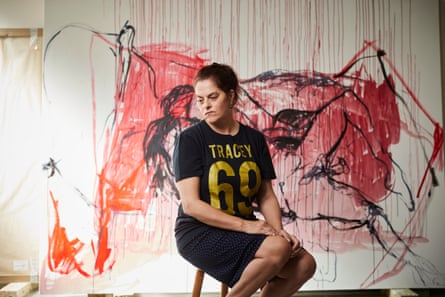
I n a photographic self-portrait taken not long after she was diagnosed with squamous cell bladder cancer in 2020, Tracey Emin’s iPhone shrouds her right breast as our line of vision descends from her catheter to her urostomy bag to her disposable knickers. Her body is fragile here in this hospital mirror, yet her gaze is anything but. It looks us dead in the eye as if to say: I matter, this matters – a sureness that challenges the notion of subjugation in times of ill-health.
Even now, six years after her life-saving surgery, Emin refuses to conform to what may, or may not, make us feel comfortable when it comes to her post-operative body. As well as losing her bladder, Emin also lost her uterus, ovaries, lymph nodes, part of her colon, her urethra and part of her vagina. And yet she has found a striking autonomy in documenting the changes in her body. “This is mine, I own it,” she affirmed in an interview not long after her surgery.
It’s a phrase that I recited, like a mantra, in my own hospital bed after my colectomy in 2023 . And it was in tribute to Emin that I took self-portraits of my body when I was recovering at home. In one photograph, taken two weeks after my surgery, my right hand lifts up my jumper to reveal the bloated and bruised belly beneath it – knickers folded down to expose its bloody surgical wounds. In another, my camera homes in on the purply-grey comet tail of an IV drip bruise that streaks across my left wrist.
Would I have taken these photographs if it wasn’t for Emin? Probably not. In the weeks that led up to my own life-saving surgery, I became increasingly fixated on the ways in which her no-holds-barred Polaroids, like the squares of her autobiographical blankets, were urging us to look at her in ways that perhaps we’d rather not. Twenty-seven years after her sculptural work My Bed catapulted her to tabloid fame in the late 1990s, Emin is still challenging us to acknowledge the things we tend to pull away from. Only these days her bleeding nudes are centred squarely on the presence of non-visible disability and what Harry Weller, creative director of Emin’s studio, calls “her wild scramble for existence”.
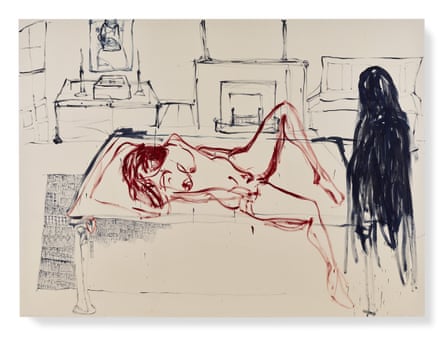
“Back in the 90s, people used to say it was confessional art,” Emin recently mused to Maria Balshaw, director of the Tate. Only it wasn’t. “I wasn’t confessing anything at all to anybody,” she corrected her past critics – and maybe even her present fans. I thought of Emin’s vital reframe only a few weeks ago when I visited her landmark show at Tate Modern and contemplated her 2023 painting, I watched Myself die and come alive. In it, her red-swabbed body is splayed out on a table, she is watched over by the black cloak of death, and her mother’s ashes are resting in a casket behind her bloody hair. Like most of Emin’s artworks, this painting isn’t asking for a certain kind of gaze from us – it exists for itself alone, and that’s what makes it so corporeally present. The same can be said for her 2024 painting Barbed Wire Stitches in which her white thighs part like two craggy cliffs to reveal the scratchy black sutures between them.
Call it visceral, call it personal. But, like Emin, I too struggle with the word “confessional” in relation to women’s expression of their experiences. The implication being that there is something guilt-inducing and therefore even shameful about a woman drawing attention to herself both in her life and art. As if by doing so, she needs to beg pardon for it. Only Emin has never subscribed to this falsehood. Come to think of it, neither did Frida Kahlo over the course of her all-too-short life (Kahlo died when she was only 47) – another autobiographical artist whose retrospective is set to appear at Tate Modern next month.
Mexico’s ever-proliferating export, Kahlo, whose magical realist visions began in the paralysing months after a tram crashed into her bus in 1925; a metal rail skewering her abdomen and exiting her vagina, breaking her spinal column, collarbone and pelvis in the process, and irreparably damaging her reproductive organs. Over the months that followed, her parents fixed a mirror to the canopy of her bed so that she could see herself and, in turn, be seen with the help of her palette. It was an act of emancipation that one can see in her 1932 painting My Birth – a surrealist depiction of Kahlo’s birth and her miscarriage entwined – in which the act of childbirth becomes a Kafkaesque scene by way of the mother’s covered head and her baby’s lifeless body stuck between splayed limbs and blood stains. Yes, it is gruesome, but – like Emin’s selfie almost 90 years later – it is real. How we choose to engage with both tells us much about how far we’re willing to acknowledge their bodily reality – and on what terms.
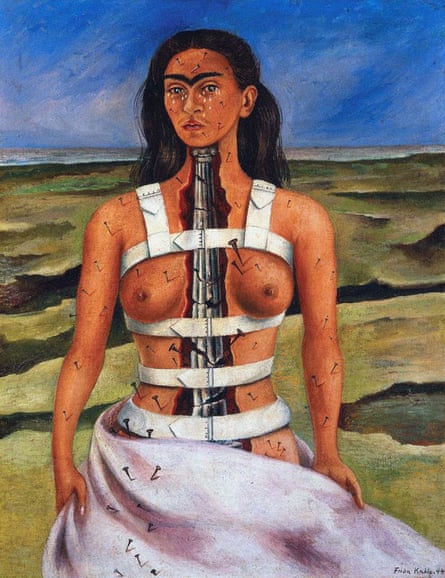
As Kahlo’s biographer Hayden Herrera remarked in 1983, Kahlo’s art has a particular intensity and strength “that can hold the viewer in an uncomfortably tight grip”. We can see this for ourselves in her 1944 artwork, The Broken Column: a valiant self-portrait of chronic pain that evokes the Saint Sebastian paintings of the Christian faith. Only in Kahlo’s martyrdom, her nail-pricked torso, like the fissured desert behind her, has been cut and cranked open to show us the blood red flesh of her internal reality, a cracked classical column lodging itself against her chin so as to make her as rigid as stone.
With an anatomical eye on her wounds, Kahlo would redraw what she called her “body’s landscape” on her own terms, making her disabilities into something transcendental, a devotional act that helped her transform the mundanity of her day-to-day experience of chronic pain into something extraordinary. And I think the same could be said of Emin.
“What would she have done if she had had any children?” Emin wrote of Kahlo in 2005 . “Also, what if she hadn’t had one misfortune after another?” Questions we know still haunt Emin’s work as much as they did Kahlo’s. For both of these artistically divergent artists, it is their highly personal experiences – of illness, of disability, of miscarriage and abortion – which have always counted on the canvas. And it’s what has drawn me closer to them as I’ve navigated my way through my own health complications of late – several surgeries and with more to come in the future.
Twenty years after my thyroid cancer diagnosis, and three years after my bowel cancer scare, it is to these artists that I return to more than any other to foster a sense of autonomy in myself, and to strengthen my understanding of what it means to carry the light and dark in my own bodily narrative. I see the defiance and aliveness in Emin’s bleeding stoma selfies. I see the pink flesh of the melon in Kahlo’s 1953 painting Fruta de la Vida and how it conjures the crimson innards of the artist’s wounds. And I see how art can be a response to pain – a way of making sense of the body when it turns against itself.
T he title’s first word should probably be “His”. Nicolas Winding Refn has returned to Cannes with a bizarre new fantasia moodscape, a midnight movie of fear and dreamy disquiet, meaning … what, exactly? The setting of the film – a twist on the 60s pulp shocker of the same title by Norman J Warren – morphs and shapeshifts from place to place, with the antilogical procedure of a dream, from a supposedly real outer world to the inner space of hallucination and memory. It starts in a giant, empty hotel (whose colossal Stygian corridors are not unlike those in Refn’s Only God Forgives ) in the middle of a digitally rendered dystopian city, wreathed in the kind of mist that tends to conceal a serial killer, and people here are frightened of someone called the “Leather Man”.
We move to the fictional action of a movie the hotel’s inhabitants are (possibly) planning to make, or perhaps to the world of their fears and imaginings, their ideas occasioned by this ostensible realist premise. And then we move to a situation from the past in US-occupied postwar Japan, where a haunted GI is looking for his daughter. This is a story populated by quasi-Lynchian characters and gargoyles with strange nicknames – the whole imagined landscape, lit by Refn’s throbbingly neon purples, reds and blues, looks like a nightclub in hell. And yet it is less violent and explicit than his earlier adventures. The pace is doomy, sepulchral and slow; like Refn’s TV series Too Old to Die Young , it moves at the pace of a zombie which has been shot but still keeps on shuffling forward. Or perhaps it is more like that of a sleepwalker who walks and talks slowly, but has a clearer idea of what is happening than those who are, in a more banal sense, awake.
Sophie Thatcher plays Elle, a young woman who shows up at this hotel, resenting the supercilious presence there of another woman called Hunter (Kristine Froseth). Elle has a tense encounter with her stepmother, Dominique (Havana Rose Liu), who is having an affair with clubowner Nico (Diego Calva); she also has an upsetting conversation with her father or father-figure named Johnny Thunders, played by a dissolute-looking Dougray Scott, positively gurning with sensual pleasure. And Charles Melton, his face a mask of grimness, plays the American soldier searching for his missing daughter, a historical set piece emerging from the mist.
All of this is not, in fact, leading to the shocking bloodbath that those who have followed Refn’s movies may come to expect. The tide of sexualised violence and pornified fear has receded, leaving behind what I think is a terrible, unspoken sadness; that is what remains once the debt to pleasure or addiction has been paid. Her Private Hell resists interpretation, like so many of Refn’s recent films, but executes a slow dervish swirl of hypnotic strangeness.
Her Private Hell screened at the Cannes film festival .
It is one of the unwritten laws of the annual celebration of silliness and tight trousers that is Eurovision: neighbouring countries, and blocs with strong cultural and political ties – think the Nordics, Greece and Cyprus, the former Soviet states – tend to mark each other high.
The song contest’s “neighbourhood voting” has even been the subject of learned studies . But its role has rarely been as explicitly acknowledged as this year, when the head of Moldova’s public broadcaster felt he had to resign because his country’s jury gave only three points to next-door Romania.
The same jury gave nul points to Moldova’s other neighbour, Ukraine , while awarding a maximum 12 points to Poland and 10 to Israel. The Moldovan public, by contrast, whose votes also count in the contest’s final result, gave the full 12 points to Romania and 10 to Ukraine.
After hundreds of fans took to social media in protest, Vlad Țurcan, the director of Teleradio-Moldova, resigned on Monday, describing the jury’s failure to recognise “sensitivities” between neighbours as “extraordinary” and “serious”.
Țurcanu added: “Our stance toward Ukraine is not one of zero points, and our feelings toward Romania can only be ones of love. We have distanced ourselves from the jury’s voting, but this is still … my responsibility, as head of this institution.”
Much of present-day Moldova was part of Romania in the early 20th century, and the two countries share deep linguistic and cultural ties. Since gaining independence in 1991, more than 850,000 Moldovan citizens have acquired Romanian citizenship.
Moldova’s president, Maia Sandu, even said earlier this year that she would vote for unification with Romania if a referendum were held, framing the idea partly as a way to protect Moldova’s democracy, which has come under intense Russian pressure .
Margarita Druță, who announced the Eurovision results live on air, said in a video posted online that she had nearly refused to read them out. The former Moldovan defence minister Anatol Șalaru said only the public’s vote – “a vote among brothers” – mattered.
Alex Cozer, a political commentator, accused Teleradio-Moldova of causing “a scandal with Romania”, while Moldova’s culture minister, Cristian Jardan, called over the weekend for explanations for the way the seven-person jury decided to vote.
Victoria Cușnir, a member of Moldova’s jury, said she regretted having accepted the invitation to be in the jury, evoking “a public lynching experience” over the vote, which she said she did not see as “an expression of anti-Romanian sentiment”.
The question of neighbourhood voting “should be discussed from the outset, if it is the most important criterion imposed on the jury”, she said on social media.
Sandu downplayed the row on Tuesday, saying that “we should not allow anything or anyone to damage the relationship between our countries”. The most important part of the vote was the public’s decision to give Romania its highest score, she said.
Romania’s Alexandra Căpitănescu and her rock song Choke Me finished third in Saturday’s contest, helped overwhelmingly by the public vote. The winner was Bulgaria’s Dara with Bangaranga , followed by Israel in second place.
Căpitănescu, 22, said she had no hard feelings and thanked Moldovans who had voted for her. “We aren’t upset with the Moldovan jury, which scored the entries as it saw fit,” she posted on social media.
“It’s not right for an entire nation to be held accountable for the decision of just seven people,” Căpitănescu added. Moldova’s contestant, Satoshi, who came eighth, called on fans not to “fuel hatred”.
“Our countries have been and will remain friends,” he added.
Țurcanu, who was appointed director general of Teleradio-Moldova in 2021 for a seven-year term, is expected to remain in his post until a successor is chosen.
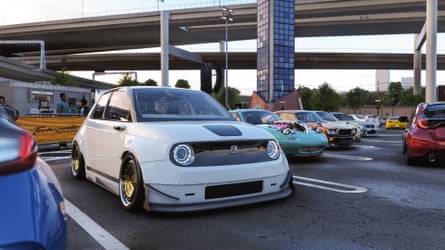
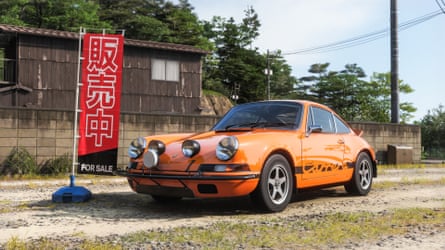
T he Forza Horizon games have always been about drama. Not just the tension and excitement of racing, but also the sensory impact of the natural environment – the sun rising over a dense city, rain clouds hovering above a valley floor. There are moments in this game – perhaps after emerging from a dense forest, or coming up from an underpass – where Mount Fuji briefly appears in the distance, hazy yet majestic, the Platonic ideal of a volcano – and it almost takes your breath away. Fans of this series have been waiting years for Japan and now here it is, the whole country, reduced, remixed and repackaged as a driving paradise.
In many ways, Forza Horizon 6 is a continuation of what this series has always been about. You enter a festival-style driving competition then drive around a vast map splattered with various races and challenges, earning reputation by competing well and buying new vehicles for your extensive garage. There are slight changes this time – you start as a rookie not an established legend, so you have to qualify to enter the festival, and Playground has re-introduced the need to unlock successive levels of competition bringing back the sense of progression from the earliest titles in the series. You start out clattering about in slower C-class vehicles on easier circuits and have to work hard to start lining up against super cars such as the Ferrari J50 or Lamborghini Huracán.
Progress is through winning races of course, but also through carrying out challenges such as speed traps and jumps, or simply pulling cool drifts and other stylish driving manoeuvres as you explore. And you’re not just unlocking festival events, there’s a whole strand of the game named Discover Japan, where you take part in driving tours of beautiful areas, your guide pointing out places of interest while you zoom past at 150mph. There’s even a Crazy Taxi-style delivery side hustle, where you fulfil takeaway orders in a cute little truck to unlock better jobs and more cash.
Money is spent on cars, naturally, and after 20 hours I have the sort of collection that billionaires would lay off 85% of their staff to own. An Aston Martin Vulcan, a Jaguar XJ220 S in sky blue, a classic 1986 Audi Quattro. It goes without saying that these things are beautifully modelled, and as ever, you can re-paint them and cover them in decals, or simply search the user-generated market for cool custom designs. My GMC Jimmy SUV is painted in sugary pink and festooned with manga art. Aside from cars, you can also buy a variety of houses dotted around the map, and then customise and upgrade your garage so other players are able to pop in and admire your vehicles, like a testosterone-fuelled version of Animal Crossing.
None of this would mean anything if the handling wasn’t fun, but oh goodness, it really is. Race events take in streets, muddy fields, gruelling slopes and winding mountain tracks, and the cars all react exactly how they should. The Jeep Trailcat grips mud like a magnetic clamp, the Honda NSX-R GT corners faster than a runaway roller coaster. On tarmac, there’s always enough give in the tyres to allow spectacular drifts (this is Japan after all, the home of drift racing), but you can usually pull it back without spinning into the bushes. Braking discipline is the number one skill to learn in the urban races or the mountain-based touge runs where corners are tight and unforgiving. While racing through fields, however, there’s room to slip and slide with thrilling abandon.
And you’re never really playing alone. Sure, you can treat the game as a vast solo campaign, but if you’re online, there are always other participants on your roads. You can choose to race against other people on the campaign races instead of AI drivers, or select Horizon Play! and take part in crazed championship competitions against a dozen strangers. In our test, the servers held up well, with almost no glitches and very little waiting time between races. If you want to meet up with friends and bomb it along the Hakone Nanamagari route, tripping speed cameras for kicks, you can.
If I have a complaint about this game it’s that its version of Tokyo city doesn’t feel quite Tokyo enough. All the familiar sites are intricately replicated and instantly recognisable (the radio tower, Akihabara, the Shibuya crossing), but bereft of the thronging masses of pedestrians, the sounds, the fashions, the clamour of this super-high-tempo city, it all feels weirdly sterile, even post-apocalyptic. Almost the best way to experience the city is from a distance, cruising the coastline of the game’s Ito region, seeing the skyscrapers glisten in the sun. It was perhaps unrealistic to expect in a racing game something as bustling and enthralling as the Tokyo of the Yakuza series.
But mostly, it’s business as usual at the Forza Horizon festival: an expansive map filled with scenic and seasonal variety (plus hidden cars!), an intuitive yet still challenging handling model and hundreds of challenges to take part in. Forza Horizon 6 adds to the size and visual splendour of the environment, brings in better progression and provides an impressive array of accessibility options for players with different abilities, including full auto drive, limitless fast travel and high contrast mode. It does not revolutionise what this series has always done, there is nothing radical here to attract a whole new base of players. But that’s fine. There is no other way most of us will ever get to sit in a Porsche 911 GT3 and cruise into the Daikoku parking area with Yellow Magic Orchestra playing on the radio. For that experience, and so many others, the designers of this beautiful game should be thanked and applauded.